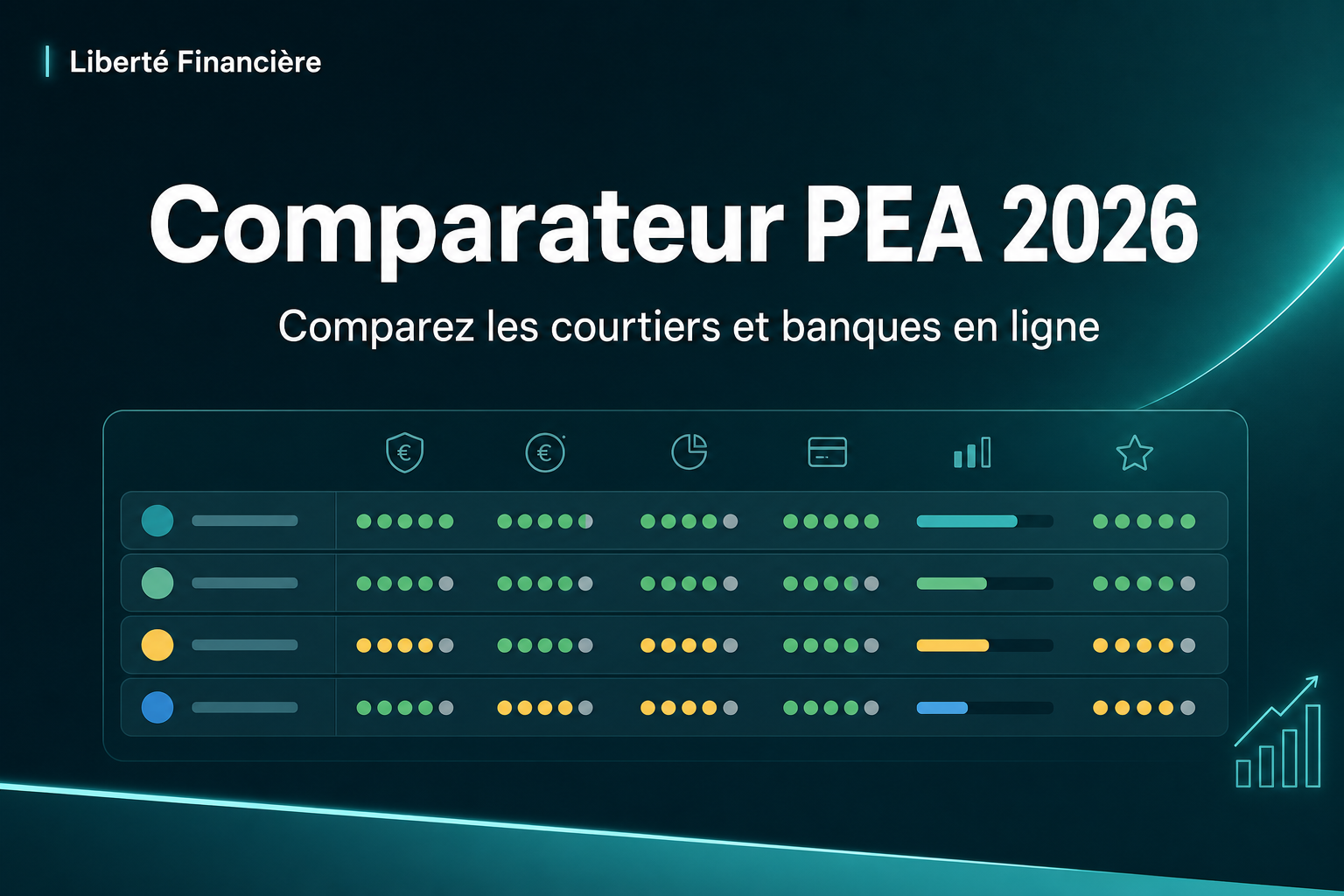
How to use this PEA comparison tool
This PEA comparison reviews the online PEA accounts of the main brokers and banks: Trade Republic, Fortuneo, BoursoBank, Saxo Bank, Interactive Brokers, XTB, Bourse Direct, Shares, Mexem and N26, as well as the PEAs of traditional French banks (Crédit Agricole, Hello bank, EasyBourse, Monabanq) and managed PEAs (Ramify, Yomoni). The PEA (Plan d'Épargne en Actions) is the French tax-advantaged stock savings account. Each broker is rated on around sixty criteria taken from their price lists and official documents, then grouped into sections.
- Top rated: the overall ranking, all sections combined.
- Cheapest: brokerage fees simulated on orders of €10, €100, €500, €2,000 and €10,000, plus €0 offers on selected ETFs.
- Extra fees: account opening, custody, inactivity, withdrawal and closing fees, minimum deposit.
- Most secure: country and parent company, regulator, segregated accounts, custodian bank, cash protection.
- Best service: app, customer service, incoming transfers, refund of transfer fees, French tax form (IFU) provided.
- Compare 2-3 brokers of your choice: put two or three PEAs side by side, criterion by criterion.
There is no single best PEA for everyone: the right broker depends on the size of your orders, how often you invest and what you want to buy. The filters are there to help you find the PEA that fits your profile.
What is the best PEA in 2026 for your profile?
You are starting with a small budget or invest every month
If you invest a few tens or hundreds of euros a month, fees on small orders are what matter. Trade Republic (€1 per order, €0 with a savings plan), XTB (€0 brokerage fees) and Fortuneo (one free order per month up to €500) are unbeatable here. Shares also lets you buy fractions of shares and ETFs, handy when a single unit costs several hundred euros. For automatic, regular investing, look at the savings plan row: Trade Republic, BoursoBank and Bourse Direct offer one.
You place large orders
Above €2,000 per order, the percentage-based fees of banks become expensive. On a €10,000 order, expect €5 at Interactive Brokers, €6 at Mexem, €8 at Saxo Bank and €9 at Bourse Direct, compared with €35 at Fortuneo, €45 at EasyBourse and up to €50 at BoursoBank. Trade Republic and XTB stay at €0 or close to it whatever the amount.
You want a full-featured PEA with a French bank
BoursoBank and Fortuneo bring together PEA, PEA-PME, managed portfolios and a bank account in one place, with customer service based in France. BoursoBank also offers Boursomarkets: €0 fees on 75 ETFs from €100 per order. Fortuneo waives its fees on 120 Amundi ETFs for orders of at least €500, Saxo Bank on 150 Amundi ETFs.
You don't want to manage it yourself
A managed PEA (Ramify, Yomoni, or the managed options of Fortuneo, BoursoBank and Crédit Agricole) leaves the choice of ETFs to a manager based on your risk profile. That comfort comes at a price: 1% to 1.6% a year on your assets, and sometimes a high minimum investment. Over 20 or 30 years, that gap weighs heavily against a self-managed PEA invested in one or two ETFs.
In this video (in French), I compare the PEAs of the main brokers and give you my ranking by profile:
PEA fees: what you really need to compare
Brokerage fees are the first thing to compare, but not the only one. Here is what a buy order for shares or ETFs costs depending on its size, based on the price lists used in the comparison tool:
| Broker | €500 order | €2,000 order | €10,000 order |
|---|---|---|---|
| Trade Republic | €0 * | €0 * | €0 * |
| XTB | €0 | €0 | €0 |
| Fortuneo | €0 | €7 | €35 |
| Interactive Brokers | €1.25 | €1.25 | €5 |
| Mexem | €1 | €1.20 | €6 |
| Saxo Bank | €2 | €2 | €8 |
| Bourse Direct | €0.99 | €2.90 | €9 |
| Shares | €1 | €4 | €20 |
| Crédit Agricole | €1 | €5 | €15 |
| BoursoBank | €1.99 | €10 | €50 |
| Hello bank | €1.75 | €8 | €48 |
* Trade Republic: €0 with a savings plan, €1 per one-off order.
Since 1 July 2020, French law has capped PEA fees: transaction fees may not exceed 0.5% of the order amount for orders placed online, and transfer fees are capped at €15 per listed security, up to €150 per account. Custody fees are capped as well, but some banks still charge them: at the online brokers in this comparison, they are free.
Also check the often-forgotten extra fees: inactivity fees (up to €120 a year at Crédit Agricole without 12 orders in the year, €3 a month at EasyBourse without an order), custody fees of €6 a month at Monabanq without a monthly order, €6 withdrawal fees at Bourse Direct, €85 closing fees at Fortuneo, minimum opening deposit (€100 at Fortuneo, €200 at EasyBourse). A PEA that looks cheap on paper can cost more than another if you place few orders.
PEA at a traditional bank or with an online broker?
Opening your PEA at your usual bank is the easy option, but rarely the cheapest: higher percentage-based brokerage fees, custody or inactivity fees, a less complete app. Online brokers and online banks have driven fees down without sacrificing security: your shares and ETFs remain your property, held in segregated accounts, separate from the broker's own funds.
On security, the tool shows for each PEA the country of the parent company, the regulator (ACPR and AMF in France, BaFin in Germany, the Danish FSA, the Central Bank of Ireland…) and the cash protection: €100,000 through the deposit guarantee scheme for most of them, €20,000 at Interactive Brokers and Mexem. With a foreign broker, also check whether it provides the IFU (the French annual tax statement that pre-fills your tax return) and whether the account has to be reported on form 3916: both rows are in the « Best service » section.
Reminder: how does a PEA work?
The PEA (Plan d'Épargne en Actions) is a French tax wrapper created to channel savings into European companies. Its key rules:
- One PEA per person, so two per couple, open to any adult French tax resident.
- Contribution cap: €150,000 on a standard PEA, €225,000 combining PEA and PEA-PME. Gains are not capped: your PEA can be worth far more than €150,000.
- Eligible securities: shares of companies headquartered in the European Union or the European Economic Area, and PEA-eligible ETFs and funds, including ETFs that track the S&P 500, the Nasdaq or the MSCI World through synthetic replication.
- No tax as long as you don't withdraw: dividends and capital gains are reinvested inside the plan without being taxed.
PEA taxation in 2026
Everything depends on the opening date of the plan, which starts the 5-year clock. Opening a PEA early, even with a few euros, lets you « lock in » that date.
- After 5 years: gains withdrawn are exempt from income tax. Only social contributions remain due, at 18.6% since 1 January 2026 (previously 17.2%). You can make partial withdrawals without closing your plan and keep paying in.
- Before 5 years: a withdrawal closes the PEA, and gains are taxed at the 31.4% flat tax (12.8% income tax and 18.6% social contributions). Exceptions: withdrawal to start or take over a business, redundancy, disability or early retirement.
Compared with an ordinary securities account (CTO), where every dividend and capital gain is taxed at 31.4% from the first year, the tax saving over 20 years runs into thousands of euros.
PEA-PME, PEA Jeune and managed PEA
The PEA-PME
The PEA-PME works like the PEA, with the same taxation, but it is reserved for shares of small and medium-sized companies and mid-caps, as well as certain funds and crowdfunding securities. It comes on top of the standard PEA (combined cap of €225,000) and can be opened with a different provider. In the comparison tool, the PEA-PME is offered by Saxo Bank, Fortuneo, BoursoBank, Bourse Direct, Crédit Agricole, EasyBourse and Hello bank. I actually transferred mine to hold crowdfunding investments: in this video (in French), I explain where to open one.
The PEA Jeune
The PEA Jeune is for 18 to 25 year-olds who are still attached to their parents' tax household, with a contribution cap of €20,000. It becomes a standard PEA when that attachment ends and keeps its tax seniority: the best way to start the 5-year clock very early. It is available at Trade Republic, BoursoBank, Bourse Direct, Crédit Agricole, EasyBourse and Yomoni.
The managed PEA
You choose your risk profile, the manager builds and rebalances an ETF portfolio. Convenient if you don't want to deal with it, but annual fees reduce your return every year: compare them with the custody fee row of the tool.
What should you put in your PEA?
For most investors, a PEA filled with ETFs (index trackers) is enough: a PEA-eligible MSCI World or S&P 500 ETF lets you invest in hundreds of global companies with very low annual fees, while enjoying the plan's tax treatment. European shares held directly, dividend ETFs or small caps (in the PEA-PME) can then complete the portfolio.
The choice of broker matters here too: some waive fees on a selection of ETFs (Amundi at Saxo Bank, Fortuneo and Bourse Direct, Boursomarkets at BoursoBank). If your favourite ETF is on the list, your regular investments cost you nothing. My selection of ETFs for a simple PEA portfolio (video in French):
PEA or ordinary securities account (CTO)?
The ordinary securities account (CTO, compte-titres ordinaire) has no cap and no geographical restriction: US shares, bonds, ETFs from any country. But it offers no tax advantage. The PEA is limited to European securities and eligible ETFs, with much lighter taxation after 5 years.
The most common strategy: fill your PEA first, then open a CTO for what the PEA does not allow (US shares held directly, bonds, non-eligible ETFs). Nothing stops you from having your PEA with one broker and your CTO with another. I compare both accounts in detail here (in French):
Transferring your PEA to another broker
Opened your PEA at your bank and paying too much in fees? A PEA transfer lets you switch provider while keeping your plan's tax seniority: the original opening date still counts for the 5 years. The steps:
- Open a PEA with the new broker (check the transfer row in the « Best service » section: not all accept incoming transfers, XTB and N26 for example).
- Fill in the transfer request with the new provider, with the PEA account details of the old one.
- The new broker handles the rest. It usually takes two to six weeks.
Transfer fees, charged by the provider you leave, are capped at €15 per security and €150 in total. Good news: Saxo Bank, Fortuneo, BoursoBank, Bourse Direct, Mexem, EasyBourse, Hello bank and Ramify refund them, fully or partly. I transferred my own PEA, here is why and how (video in French):
How to open a PEA online
- Choose your broker in the comparison tool above based on your criteria, then click « Discover ».
- Create your account online: identity, address, tax situation and investor questionnaire.
- Upload your documents (ID, proof of address): verification takes from a few minutes to a few days.
- Make your first deposit by bank transfer from an account in your name: this deposit often sets the tax opening date of the PEA.
- Place your first order or set up a savings plan.
Several brokers offer a welcome bonus when you open an account (brokerage fees refunded, free shares): find them on the bonus codes and referral offers page and in the BoursoBank, Saxo Bank and Interactive Brokers pages. For Trade Republic, my Trade Republic FAQ answers the most common questions.
Frequently asked questions (FAQ) about the PEA
What is the best PEA in 2026?
There isn't just one: for small regular orders, Trade Republic, XTB and Fortuneo are the cheapest; for large orders, Interactive Brokers, Saxo Bank and Bourse Direct; to keep everything with a French bank, BoursoBank and Fortuneo. The « Top rated » filter of the tool gives the overall ranking.
What is the cheapest PEA?
On brokerage fees, Trade Republic and XTB charge €0 or close to it whatever the order size. But a cheap PEA also means no extra fees: custody, inactivity, withdrawal or closing fees. The « Cheapest » filter combines these criteria.
Can you have several PEAs?
No, one PEA per person (two per married or PACS couple). You can, however, hold a PEA and a PEA-PME, with two different providers if you wish.
What is the PEA contribution cap?
€150,000 of contributions on a standard PEA, €225,000 in total with a PEA-PME, €20,000 for a PEA Jeune. Only contributions count: gains made inside the plan are not capped.
How is a PEA taxed in 2026?
After 5 years, gains withdrawn are exempt from income tax and only subject to 18.6% social contributions. Before 5 years, a withdrawal closes the plan and gains are taxed at 31.4%, with exceptions (starting a business, redundancy, disability, early retirement).
What happens if I withdraw money from my PEA before 5 years?
The PEA is closed and gains are taxed at the flat tax. After 5 years, on the other hand, you can withdraw part of your savings without closing the plan and keep making contributions.
Can you buy US shares in a PEA?
Not directly: the PEA is reserved for European companies. You can, however, invest in US or global markets through PEA-eligible ETFs (S&P 500, Nasdaq, MSCI World) that use synthetic replication.
How much does a PEA transfer cost?
At most €15 per listed security and €150 in total, charged by the provider you leave. Several brokers refund these fees when you arrive: the « Best service » section of the tool shows which ones.
Is my money safe in an online PEA?
Your shares and ETFs belong to you and are held in segregated accounts: if the broker goes bankrupt, they are not part of its assets. Uninvested cash is protected by a deposit guarantee, €100,000 at most brokers and €20,000 at Interactive Brokers and Mexem. The PEA does not, however, protect you against market falls: any stock market investment carries a risk of capital loss.
Should you choose a self-managed or a managed PEA?
Self-managed is much cheaper if you are ready to pick one or two ETFs yourself and invest regularly. A managed PEA suits you if you prefer to delegate everything, accepting 1% to 1.6% in fees per year.
Is this PEA comparison up to date?
Yes. Price lists, ETF offers and security criteria are taken from the brokers' official documents and updated with every price change. If you spot a mistake, write to us via the contact page.