
In this article for beginner and intermediate investors, you will discover the main terms specific to crowdfunding and crowdlending. This glossary will help you better understand this world and provide a solid foundation for getting started with your investments.
General definitions
Crowdfunding

Crowdfunding refers to a method of collective financing where individuals or investors fund a project via an online platform.
Crowd = crowd
Funding = financing
To go further, you can read the Mazars Report on Crowdfunding in France
Crowdfunding categories
There are mainly four forms of crowdfunding:
Donation: a contribution with no financial consideration, sometimes with a symbolic reward.
Lending (crowdlending): financing in the form of a loan, with repayment of the capital and interest according to a contract.
Equity investment (CrowdEquity): taking an equity stake in a company in exchange for shares.
Bond / debt: financing through the purchase of bond securities, remunerated by interest until they are repaid.
Crowdlending
Crowdlending is a subcategory of crowdfunding, corresponding to crowdfunding through lending. It is also known as P2P Lending (Peer-to-Peer Lending). This market is particularly developed and widespread in Germany, whereas it is still not widely adopted by investors in France.
Crowd = crowd
Lending = lending
Type of loans/projects/borrowers
The loan is intended either for an individual or for a legal entity (company)
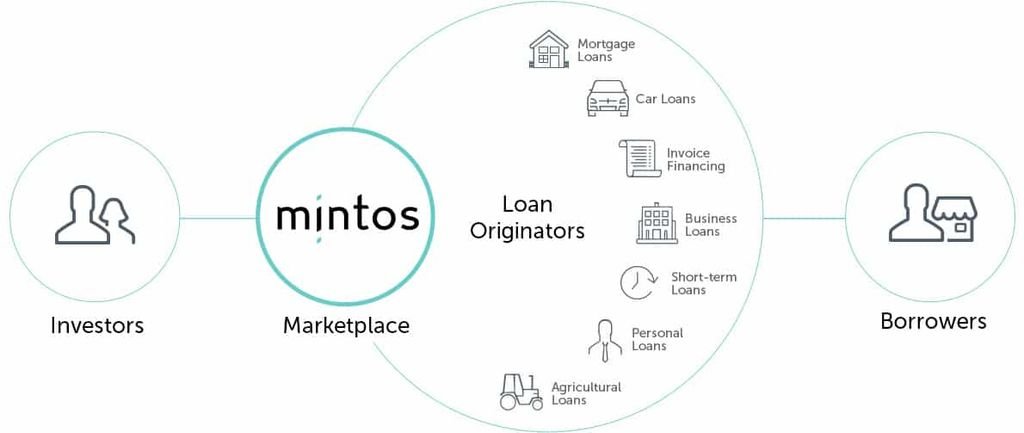
Here are the main types of loans:
Real estate (CI) – Property development or property trading or refinancing
Renewable energy (ENR)
Agricultural
Factoring
Automotive
Business (companies)
Short term
Personal (individual / consumer)
I diversify my investments across all these loan categories and share my results every month in my monthly video review on YouTube.
Platform
A website that acts as an intermediary between borrowers and investors.
Find here the list of all the platforms I have invested on.
AMF

Financial Markets Authority. French organisation responsible for supervising financial markets
ACPR

Prudential Supervision and Resolution Authority: French organisation attached to the Banque de France, responsible for supervising banks and insurance companies.
PSFP
PSFP stands for Crowdfunding Service Provider.
A European status regulating crowdfunding platforms since 2021, allowing them to offer crowdfunding (loans, bonds, shares) in the EU under a regulated framework.
ESCP
ECSP stands for European Crowdfunding Service Provider
A European status authorising a platform to offer crowdfunding services (loans, shares, bonds) in the EU under a single framework.
Lending company
A crowdlending lending company acts as an intermediary between investors and borrowers.
It is often called a Loan Originator (LO).
Group of lending companies (financial group/holding company)
A set of companies specialised in granting financing, managed by a parent company in order to centralise strategy, resources and risk management.
A group may own several lending companies and a platform.
Balance sheet

Accounting document that shows, at a given date, what a company owns (assets) and how it is financed (liabilities), in order to assess its financial strength.
Risk

There are many risks in crowdfunding and crowdlending. In general, the higher the rate, the higher the risk as well. I have identified 7 main risks:
Risk of capital loss / default
Risk of delay
Liquidity/illiquidity risk
Project risk (execution / operational)
Legal and regulatory risk
Platform / lending company / group risk
Geopolitical risk
Entry ticket
Minimum amount required to invest in a project or loan. It can range from €1 on some platforms (e.g.: La Première Brique) to several thousand euros elsewhere.
Interest

Interest is the remuneration paid to investors in exchange for the money lent; it constitutes the financial gain obtained for the capital tied up during the term of the loan. There are several payment methods:
Monthly without amortization
Monthly with capital amortisation
Bullet repayment
Annual or quarterly
Compound interest
Interest rate
Percentage used to calculate the remuneration paid to the investor in exchange for the money lent, determining the gain generated over the investment period.
IRR (Internal Rate of Return)
Indicator that measures the annual profitability of an investment by taking into account all cash flows (inflows and outflows) and their timing, in order to obtain a real return.
Coupon
Interest paid to the investor for holding a bond.
Cashback
Commercial benefit consisting of returning to the investor part of their investment or fees, in the form of a discount, bonus or credit after investment.
Repayment
Return of the borrowed capital, generally accompanied by interest. It may be made at regular intervals (monthly, quarterly, annually) or in a single payment at the end of the contract. In real estate, it may also be partial, for example when the units of a project are sold progressively.
Projects/Loans

Due diligence
Set of in-depth checks carried out by the platform before validating a project, in order to assess its reliability, its risks, the strength of the project owner and legal compliance.
Fundraising
Period during which a project is published online to raise, from investors, the target financing amount before it closes or reaches its target.
Security

Legal or financial commitment intended to secure the investment: in the event of borrower default, it helps protect all or part of the sums invested through an asset, a commitment or a mechanism planned from the outset.
Real securities
Mortgage: security registered over a real estate asset (1st rank, 2nd rank, 3rd rank, shifted, etc.). In the event of default, recovery goes through legal proceedings.
Promise to grant a mortgage: a simple promise of a mortgage, not very secure because it only binds the promisor.
Fiducie: temporary transfer of assets to a trustee as security for the loan. Considered the strongest security (over the asset or the company carrying the project).
Other securities
GAPD (First Demand Guarantee): the guarantor must pay immediately as soon as they are called upon.
Pledge: pledging of an asset (company shares, life insurance, securities account, business assets, etc.).
Personal guarantee: the borrower commits their personal assets.
Delegation of payment: the borrower’s end customer pays the funds directly to the platform.
Buyback guarantee: guarantee to repurchase the receivable after a default (e.g.: 30 or 60 days, depending on the platforms).
Collateral coverage
Refers to all the assets provided as security to secure financing. The coverage may consist, for example, of a real estate asset (mortgage) or assets transferred to a trustee (security trust).
Primary and secondary market

Primary market: this is the market where you invest directly in a new project published online by the platform to finance the borrower.
Secondary market: this is the resale market, where investors can sell or buy back shares of projects already funded from other investors.
Terms specific to crowdlending
APR
Annual Percentage Rate / Global Effective Annual Rate
APY – Annual Percentage Yield (annualised compounded return)
Auto-invest

Feature that allows you to invest automatically in new projects according to criteria you have predefined (amount, rate, duration, rating, etc.).
Casdrag (CD)
Cashdrag refers to the period during which your capital remains uninvested on a platform, which reduces your potential return.
KYC

Know Your Customer (identity verification)
Loan
English-language term meaning a loan.
Loan Originator (LO)
Lending company that issues the loans offered to investors.
Note
Regulated financial product grouping together several loans from the same credit company.
LT/ST
Long Term / Short Term: indicates the duration of the loans (long term / short term).
XIRR
Metric used to calculate the annualised rate of return by taking into account the actual timing of cash flows. If no repayment has taken place, the XIRR remains at 0%.
Terms specific to real estate
Preliminary sale agreement

Pre-contract by which the seller and the buyer undertake to conclude the sale of a real estate asset. It sets the terms of the transaction (price, deadlines, conditions precedent) before the final deed of sale is signed.
Conditions precedent
Clauses inserted into the preliminary contract (e.g.: preliminary sale agreement) that suspend the performance of the contract until a future and uncertain event occurs. The most common relate to obtaining financing or obtaining a building permit.
Disbursement
Payment of the funds raised to the project owner, generally carried out after the planned conditions have been validated (signature, securities, documents).
Partial disbursement
Payment of funds in several stages. A first tranche is released (e.g.: purchase of the land), then the following ones as the project progresses, upon presentation of supporting documents (e.g.: works invoices).
Pre-marketing
Phase prior to the launch of a project during which the platform assesses investor interest and prepares the necessary elements before the official opening of the fundraising.
Financial ratios
LTA – Loan To Acquisition
Ratio between the loan amount and the value of the land at purchase. The higher the LTA, the more the loan represents a significant share of the acquisition, and therefore the higher the risk.
I consider that an LTA below 100% starts to be interesting.
LTC – Loan To Cost
Ratio between the loan amount and the total cost of the project (purchase + works + fees). It is used to check the project owner’s contribution. A low LTC indicates a better level of security.
I consider that an LTC below 75–80% starts to be interesting, as this shows that the developer is financing at least 20–25% of the project from its own funds.
LTS/LTV – Loan To Sale / Loan To Value
Ratio between the loan amount and the estimated sale price of the property (or its value). It measures your ability to recover your capital in the event of default. The lower the LTV, the better the protection.
I consider that an LTV below 60–65% starts to be interesting.
And as always, don’t give up on ANYTHING!
Image source: Magnific