
I have been investing with Interactive Brokers (IBKR) since August 2023. Today, my securities account is worth about €84,500, mostly in dividend stocks and dividend ETFs. It is the oldest broker in my portfolio, the one with the most markets and features, but also the one that takes the most time to get used to.
In this review, I cover everything: the European entity that holds your account, the real protection of your securities and cash if the broker goes bankrupt, the fees (with worked examples and the trap of the fixed pricing offered by default), currency conversion, the PEA (the French tax-advantaged equity savings plan) launched at the end of 2024, interest on cash, the platforms, opening an account, French taxes step by step, transfers and my figures after more than three years. I finish with a comparison with Saxo Bank, Trade Republic, BoursoBank and Fortuneo.
This article is not sponsored by Interactive Brokers. Some links are affiliate links: if you open your account with my link, you can receive up to $1,000 in IBKR shares.
Interactive Brokers at a glance
Criterion | Interactive Brokers |
|---|---|
Founded | 1978 (US group listed on the Nasdaq, ticker IBKR) |
Entity for French clients | 🇮🇪 Dublin (Ireland): Interactive Brokers Ireland Limited |
Regulator | Central Bank of Ireland |
Accounts | Securities account, PEA, joint account, company account |
Markets | About 150 stock exchanges in some forty countries |
Fees on Paris stocks | 0.05% of the order, minimum €1.25 (tiered pricing) |
Fees on US stocks | $0.0035 per share, minimum $0.35 (tiered pricing) |
Currency conversion | 0.002% of the amount, minimum $2 |
Custody and inactivity fees | None |
Cash protection | Irish scheme: 90% of the loss, up to €20,000 |
IFU (French annual tax summary) | Provided for the PEA, not for the securities account |
Bonus |
Interactive Brokers does not play in the same league as mainstream brokers: it is aimed at investors who want to buy anywhere in the world, in several currencies, with some of the lowest fees on the market as soon as orders exceed a few hundred euros. In return, the interface is dense and some screens are still in English only. To see how its PEA compares with other French offers, my PEA comparison tool puts it side by side with 16 other brokers.
Discover Interactive Brokers More than 150 stock exchanges, currency conversion at 0.002% and up to $1,000 in IBKR shares when you open an account. |
My video: 7 Interactive Brokers features worth knowing
If you prefer video, here is my feedback on the features I actually use: multi-currency, performance compared with an index, statements, automatic data export, choice of pricing plan, fractional shares and the AI connection.
What is Interactive Brokers?
Interactive Brokers was born at the end of the 1970s around Thomas Peterffy, a Hungarian-born engineer who was one of the first to automate market making on options. The brokerage business for clients started in the early 1990s, then the group went public on the Nasdaq in 2007 and joined the S&P 500 index in 2025.
The model has not changed since: in-house, highly automated technology that makes it possible to charge little per order. The group reports more than $21 billion in equity and an "A-" rating from Standard & Poor's. For a broker, these two figures matter: they measure its ability to absorb a market crisis without putting its clients in trouble.
Leadership team
 Thomas Peterffy, born in Budapest and arrived in the United States at the end of the 1960s, is the founder of the group. A programmer by training, he was one of the first to hand over options pricing to computers. He still chairs the board of directors and remains the main shareholder, which explains the continuity of the strategy: in-house technology, low fees, no race for marketing campaigns.
 Milan Galik joined the group at the end of the 1990s as a developer, before leading the software teams. He has been its chief executive officer (CEO) since 2019. This stability at the top, with a founder still on board and a CEO who came up through the company, is quite rare in online brokerage.
Key dates
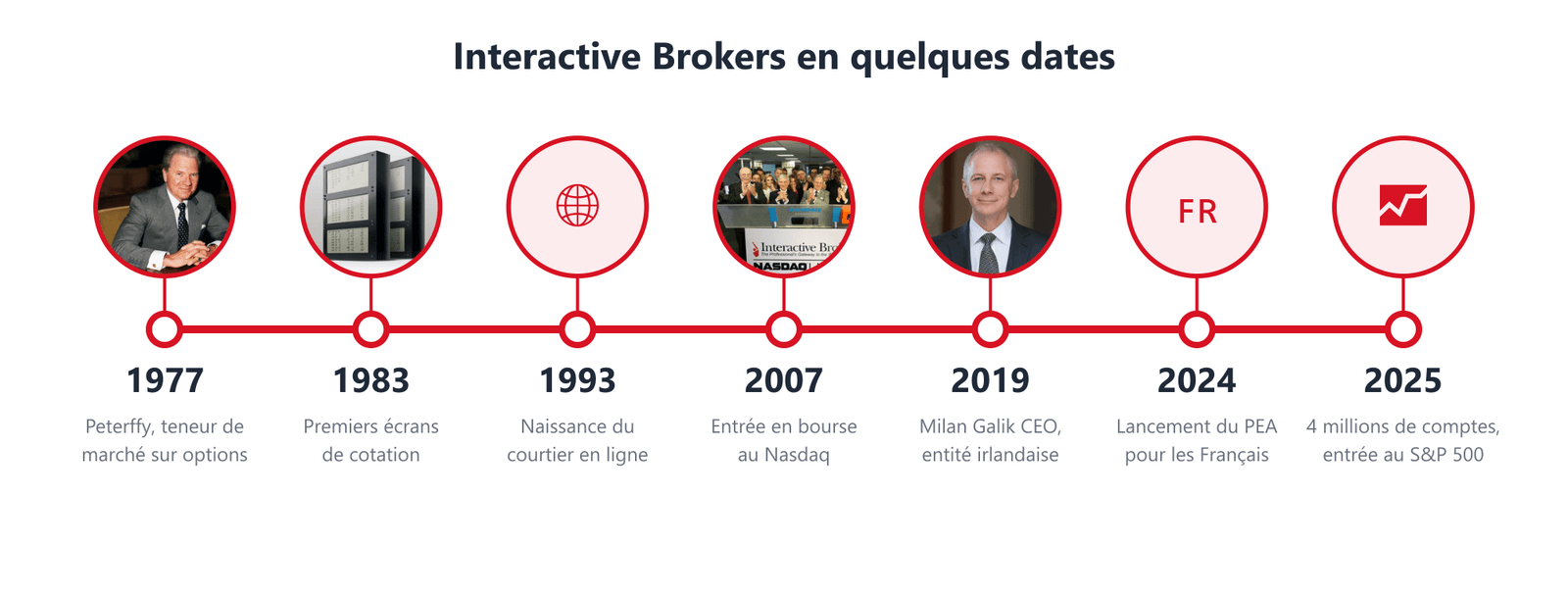
1977: Thomas Peterffy buys a seat on the American Stock Exchange and starts out as an individual market maker on options.
1980s: his company, Timber Hill, is one of the first to have prices quoted by computers rather than by floor traders. After the 1987 crash, it helps set up cross-margining between clearing houses.
1993: Interactive Brokers is born, opening up to the public the order routing technology developed for Timber Hill.
Late 1990s: Timber Hill handles nearly 5% of the world's volume of exchange-listed derivatives.
2007: IPO on the Nasdaq.
2019: Milan Galik becomes CEO, Thomas Peterffy remains chairman of the board. The Irish entity is created for European Union clients after Brexit.
2023: more than 2.5 million client accounts.
2024: launch of the PEA for French tax residents.
2025: more than 4 million accounts and entry into the S&P 500 index.
2026: the group starts its 49th year in business, with more than 3,000 employees in around fifteen countries.
This longevity matters for a broker: Interactive Brokers has come through the 1987 crash, the bursting of the dot-com bubble, the 2008 crisis and the Covid shock without any incident for its clients. Its accounts are published every quarter, like those of any company listed in the United States.
What has changed recently
Many reviews online still describe the Interactive Brokers of five years ago: a minimum deposit of several thousand euros, inactivity fees, no PEA, a single austere platform. All of that is gone. Here is what has really changed over the last two years, and what makes the broker more attractive for a French investor:
The PEA is open to all French tax residents, with an IFU and the option to transfer an existing PEA into it.
IBKR Desktop is gradually replacing the old Trader Workstation for investors: the same power, but a modern and much more readable interface.
GlobalTrader, the simplified app, lets you buy stocks and ETFs in a few clicks, from $1, without having to face the menus of the main app.
Recurring investments and fractional shares have been extended to tens of thousands of securities on the securities account.
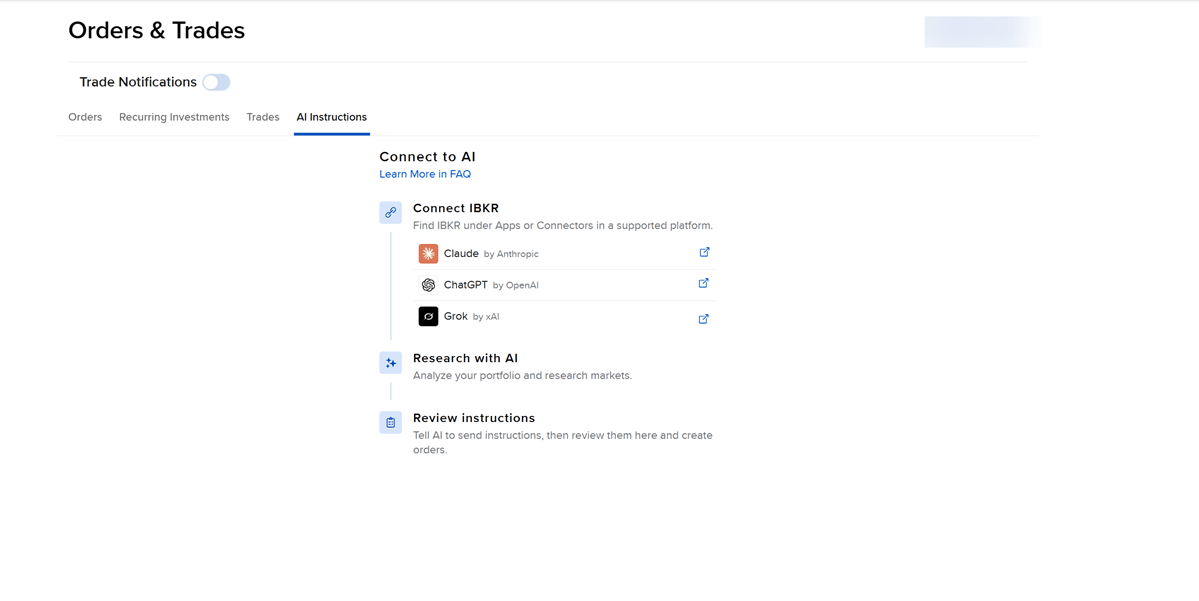
The connection to artificial intelligence assistants (Claude, ChatGPT, Grok and Perplexity) lets you ask questions about your portfolio in plain language (performance, dividends received, taxes paid abroad, unrealized gains), in read-only mode.
Extended trading hours on US stocks let you place orders overnight, which is handy from Europe.
Interest on cash has followed central bank rates: it remains attractive on the dollar, more modest on the euro.
What has not changed: no IFU for the securities account, cash protection limited to €20,000 and a support team that sometimes answers in English. These are the three points to accept before opening an account.
Regulation: which company are you entrusting your money to?

As a French resident, your account is not opened with the US parent company but with Interactive Brokers Ireland Limited, a company incorporated under Irish law and registered with the Irish companies register (CRO) under number 657406, with its registered office at North Dock One, 91/92 North Wall Quay, Dublin 1. It is authorized by the Central Bank of Ireland (reference C423427) and operates in France under the European passport.
There are two practical consequences. First, your account is an account opened abroad: you have to declare it every year (see the tax section). Second, in the event of a dispute, Irish rules and the Irish ombudsman apply, not the AMF (the French financial markets authority). To find out which entity holds your account, look at the header of your activity statement: accounts opened a long time ago may still belong to another subsidiary of the group.
Safety: what happens if Interactive Brokers goes bankrupt?
This is the most frequent question, and many articles get the answer wrong. You need to distinguish between your securities and your cash.
Your stocks and ETFs belong to you. They are kept separate from the broker's own assets (these are called segregated accounts) and cannot be used to pay its creditors. In the event of bankruptcy, they are returned to you, provided you have not borrowed money or securities and do not hold positions in futures contracts.
Your cash and any loss are covered by the Irish investor compensation scheme: 90% of the loss, up to €20,000. That is much less than the €100,000 cash guarantee you get with a French broker or bank.
The US protection ($500,000, topped up by private insurance) that you see quoted everywhere only covers securities held by the group's US subsidiary. It does not automatically add to the Irish protection for a French client: do not count on it.
In practice: keeping securities with Interactive Brokers is not a particular problem, but I never leave a large amount of cash there. If you need to park cash for a long time, a savings account or an interest-bearing account covered up to €100,000 is still a better fit.
The day-to-day security of your account
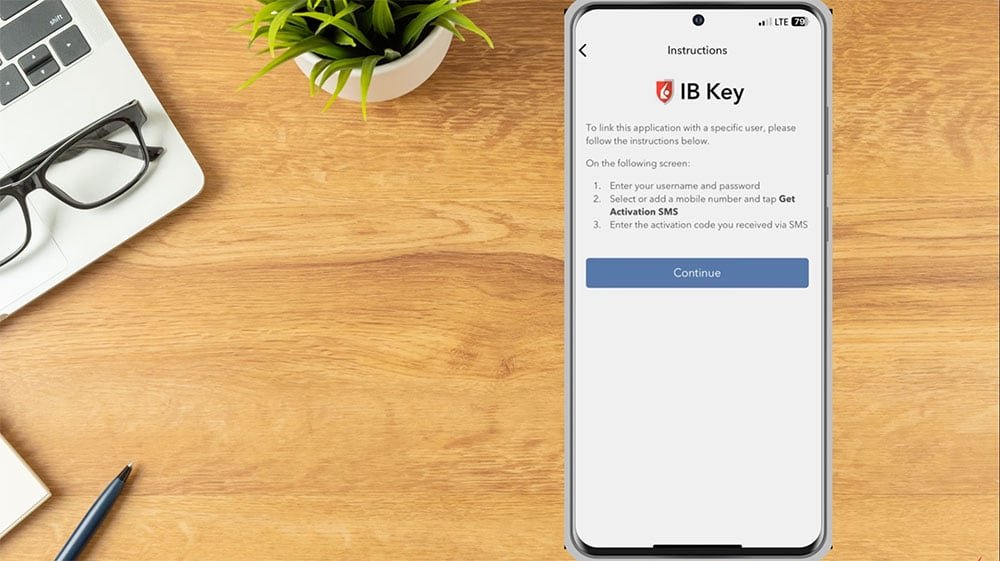
Protection in the event of bankruptcy is not everything: the most common risk for an individual is still having their login hacked. Interactive Brokers requires two-factor authentication at every login, ideally with the security key built into the mobile app. Above all, withdrawals can only go to a bank account in your name that has been registered beforehand: even with your password, a fraudster cannot empty your account into theirs without going through a new verification. You also get an alert at every login and every withdrawal request.
Available accounts: securities account and PEA
The standard securities account (CTO, compte-titres ordinaire) gives access to the broker's whole universe: stocks and ETFs from all over the world, bonds, options, futures, funds. You can open it on your own, as a couple (joint account) or in the name of a company. From your client area, you can add other accounts in a few clicks. On this securities account, you can also schedule recurring investments (daily, weekly, monthly or quarterly), charged like a regular order.
Two situations that other brokers handle badly: moving abroad and companies. If you move to another country, your account follows you: you just ask support to change the entity, without selling your securities. And you can open an account in the name of your company or your personal holding company to invest its cash on the stock market, with the same fees as an individual.
The PEA at Interactive Brokers
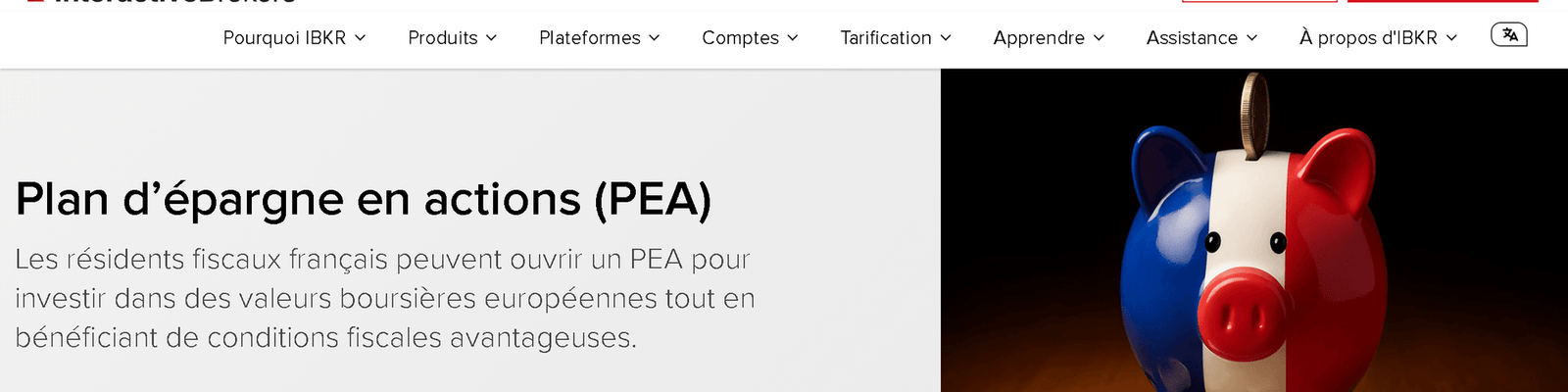
Launched in 2024 and reserved for adult French tax residents, the Interactive Brokers PEA follows the standard rules: one PEA per person, deposits in euros only, a cap of €150,000, eligible European stocks, ETFs and funds. No opening, account maintenance or transfer fees charged by the broker, and an IFU (the annual tax summary) is provided.
What you need to know before choosing this PEA:
Its big strength: all European stock exchanges are at the same price as Euronext Paris. Buying a German, Italian, Dutch or Danish stock costs 0.05% (minimum €1.25 on tiered pricing), whereas many French banks add €15 or more in foreign market fees.
There is no PEA-PME (the small and mid-cap version), no PEA Jeune (the version for young people) and no managed portfolio.
No fractional shares (the law does not allow them in a PEA yet) and no scheduled investing.
A securities account is opened at the same time: deposits go through it before reaching the PEA.
Transfer fees charged by your previous broker are not refunded, unlike what Saxo Bank or BoursoBank do.
Like any account held abroad, this PEA has to be declared on formulaire 3916 (the French form for declaring foreign accounts), even though for tax purposes it is a PEA like any other.
Personally, my main securities account is with Interactive Brokers and my PEA is with Saxo Bank. Saxo offers a simpler interface, Amundi ETFs with no order fees and the PEA-PME; Interactive Brokers goes much further on markets and asset types. That is why I have both in my portfolio. I compared their PEAs in this video:
💶 Fees: what you really pay
Fixed or tiered pricing: the right choice depends on the size of your orders
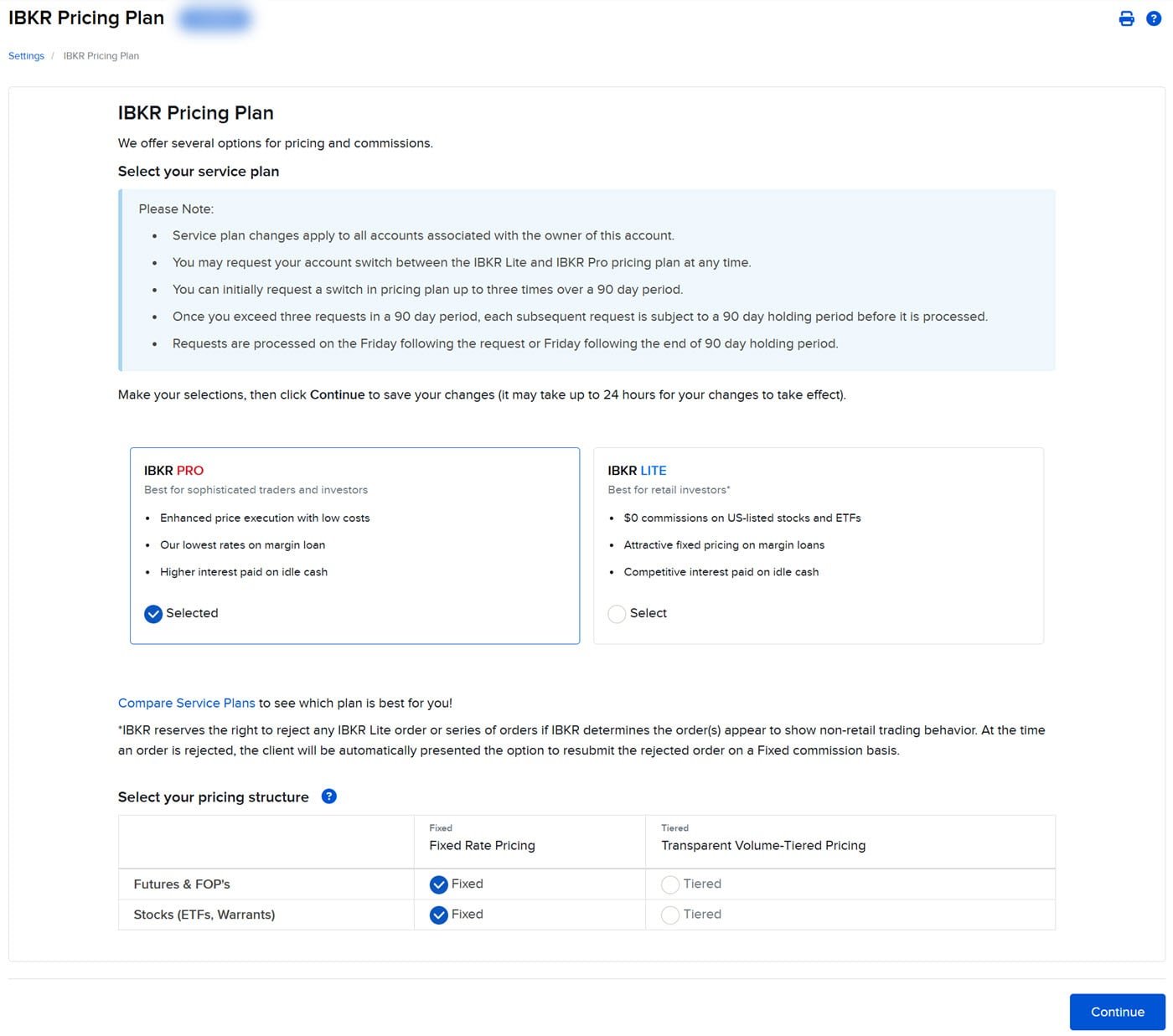
Interactive Brokers offers two pricing plans. The fixed plan is all-inclusive: 0.05% of the order with a minimum of €3. The tiered plan also starts at 0.05%, with a minimum of €1.25 and a cap of €29, but you have to add exchange and clearing house fees. On Euronext Paris, these third-party fees are low for a stock (0.0095% plus €0.13 per order, and €0.04 for clearing) but much heavier for an ETF (0.006% with a minimum of €1.20, and €0.10 for clearing). You can switch plans at any time, from the User menu (icon at the top right) > Settings > Account Configuration > IBKR Pricing Plan, as in the screenshot below from the official guide.
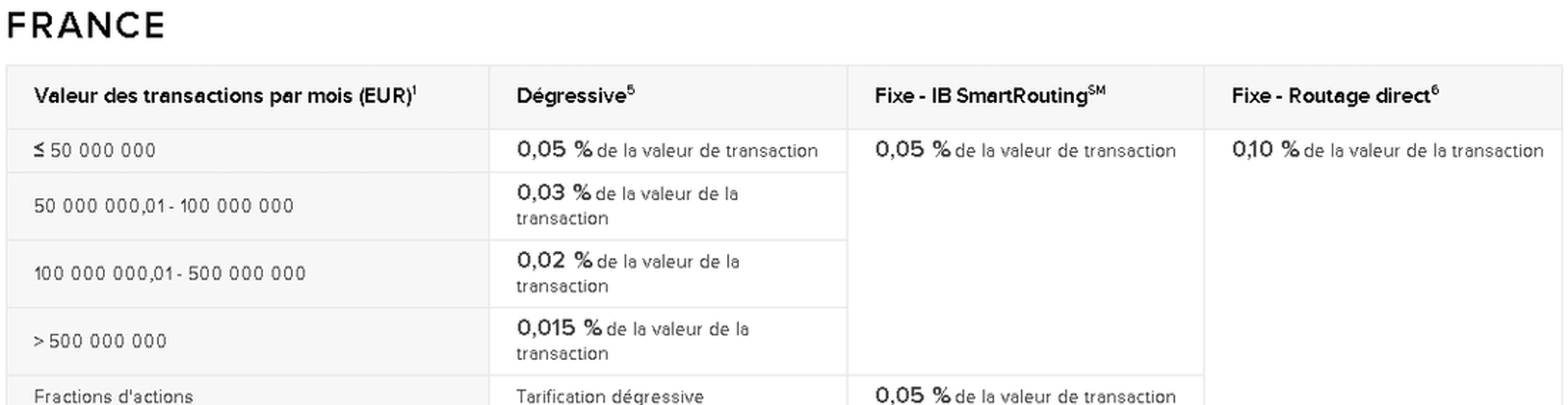
Simulation, exchange fees included, for a purchase on Euronext Paris (excluding the financial transaction tax):
Order amount | ETF on tiered | Stock on tiered | Fixed pricing |
|---|---|---|---|
€500 | €2.55 | €1.47 | €3.00 |
€2,000 | €2.55 | €1.61 | €3.00 |
€10,000 | €6.30 | €6.12 | €5.00 |
€100,000 | €35.10 | €38.67 | €50.00 |
Conclusion: tiered pricing wins for orders up to about €3,400 on an ETF (about €4,750 on a stock) and above about €66,000. In between, fixed pricing is cheaper. If you invest with orders of a few hundred euros, choose tiered; if your orders are around €5,000 to €50,000, stay on fixed.
On US stocks, you pay per share: $0.0035 on tiered (minimum $0.35, plus a few fractions of a cent in exchange fees) versus $0.005 on fixed (minimum $1). Buying 10 shares at $200 therefore costs you about $0.35 on tiered and $1 on fixed, and tiered almost always comes out ahead in the United States. Fractional shares are charged on the same schedule, capped at 1% of the order.
In a PEA, the law caps fees at 0.5% of the order anyway: a €100 purchase costs you €0.50 at most. Finally, as with all brokers, buying shares of French companies with a market capitalization above €1 billion (LVMH, TotalEnergies, Air Liquide…) is subject to the 0.4% financial transaction tax since April 2025. ETFs and sales are not subject to it. In the United Kingdom, it is a 0.5% stamp duty on purchases.
Currency conversion fees
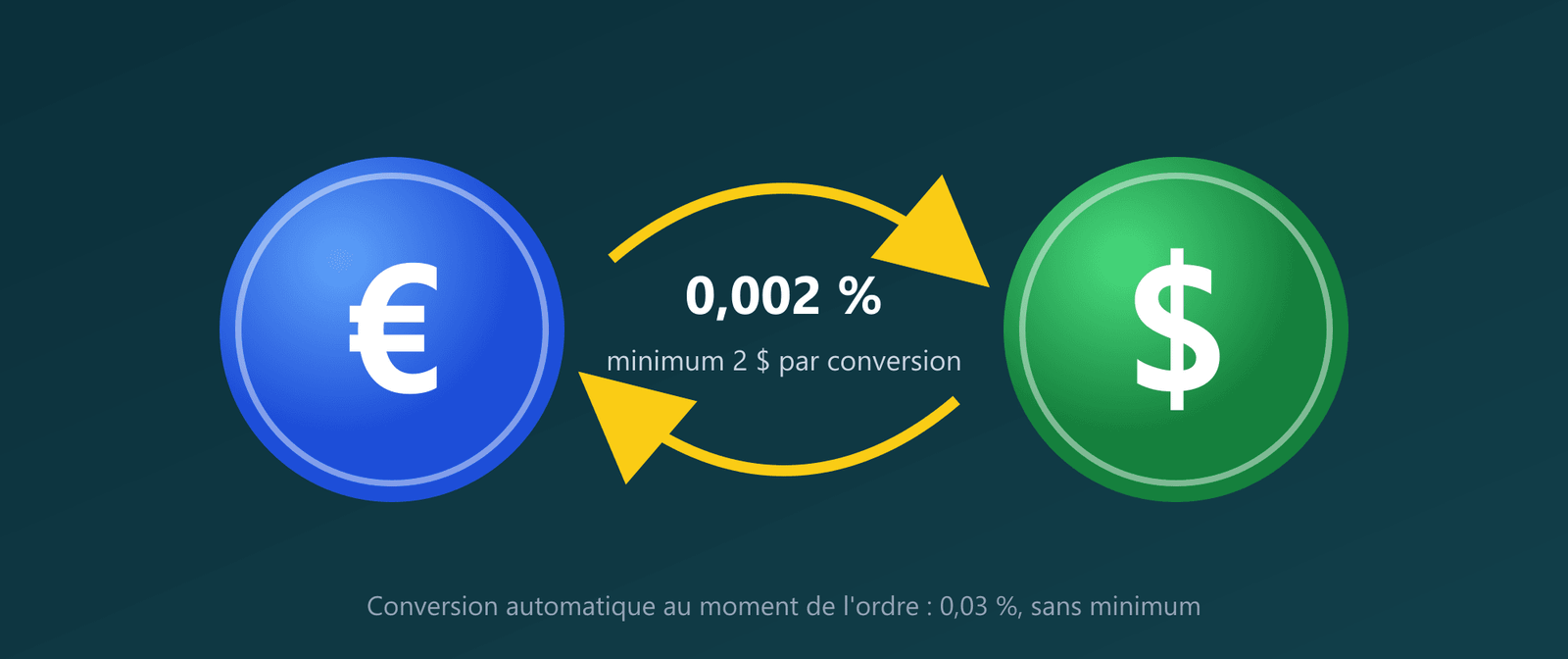
Currency conversion costs 0.002% of the amount, with a minimum of $2 per conversion. Converting €10,000 into dollars therefore costs you about $2, whereas many brokers automatically charge 0.25% to 1%. If you let Interactive Brokers convert at the time of the order, it is 0.03% with no minimum: cheaper for small amounts, more expensive above about $6,700. The cheapest option is therefore to convert round amounts yourself, and keep your dollars in dollars: your US dividends then land directly in the right currency, ready to be reinvested without another conversion.
Other fees
Opening, custody, inactivity, closing: €0. No minimum deposit.
Withdrawals: one free withdrawal per month, then €1 per SEPA transfer in euros.
Deposits: free on the broker's side, by SEPA transfer or by direct link with your bank.
Outgoing securities transfer: not charged by Interactive Brokers (the receiving broker may have its own fees).
Real-time market data: a paid subscription is offered for some exchanges, but it is not needed for long-term investing.
Open an account with no fixed fees No minimum deposit, no custody fees, no inactivity fees. Bonus: up to $1,000 in IBKR shares. |
Over more than three years, my fees break down as follows: about €60 in commissions for around sixty orders, barely €1 per order, and €46 for 26 currency conversions, each charged at the $2 minimum. The financial transaction tax is not included. Looking back, I could have reduced the currency part by grouping my conversions, or by letting the automatic conversion at 0.03% handle small amounts.
Available markets and products
This is the broker's historical strength: about 150 stock exchanges in around forty countries, from a single account and with deposits possible in about twenty currencies. Stocks, ETFs, bonds, funds, options, futures, and even crypto-related products. More than 24,000 stocks and ETFs are available as fractional shares on the securities account, which lets you invest a precise amount rather than a number of shares.
Fees for the other products, on tiered pricing on US markets:
Product | Fees | For whom? |
|---|---|---|
Stocks and ETFs | $0.0005 to $0.0035 per share (minimum $0.35) | Everyone |
Options | $0.15 to $0.65 per contract | Experienced investors |
Futures | $0.25 to $0.85 per contract | Traders |
Bonds | 0.10% of face value | Fixed income, cash management |
Mutual funds | 3% capped at $14.95, $0 on no-transaction-fee funds | Funds not available elsewhere |
Currencies (forex market) | 0.08 to 0.20 basis points of the trade | Conversion, hedging |
For an individual investor, this catalog is mainly useful for two things: finding a stock or ETF that other brokers do not offer (small foreign companies, Nordic or Asian exchanges), and buying bonds directly, which very few online brokers offer to individuals in France.
The execution quality of your orders
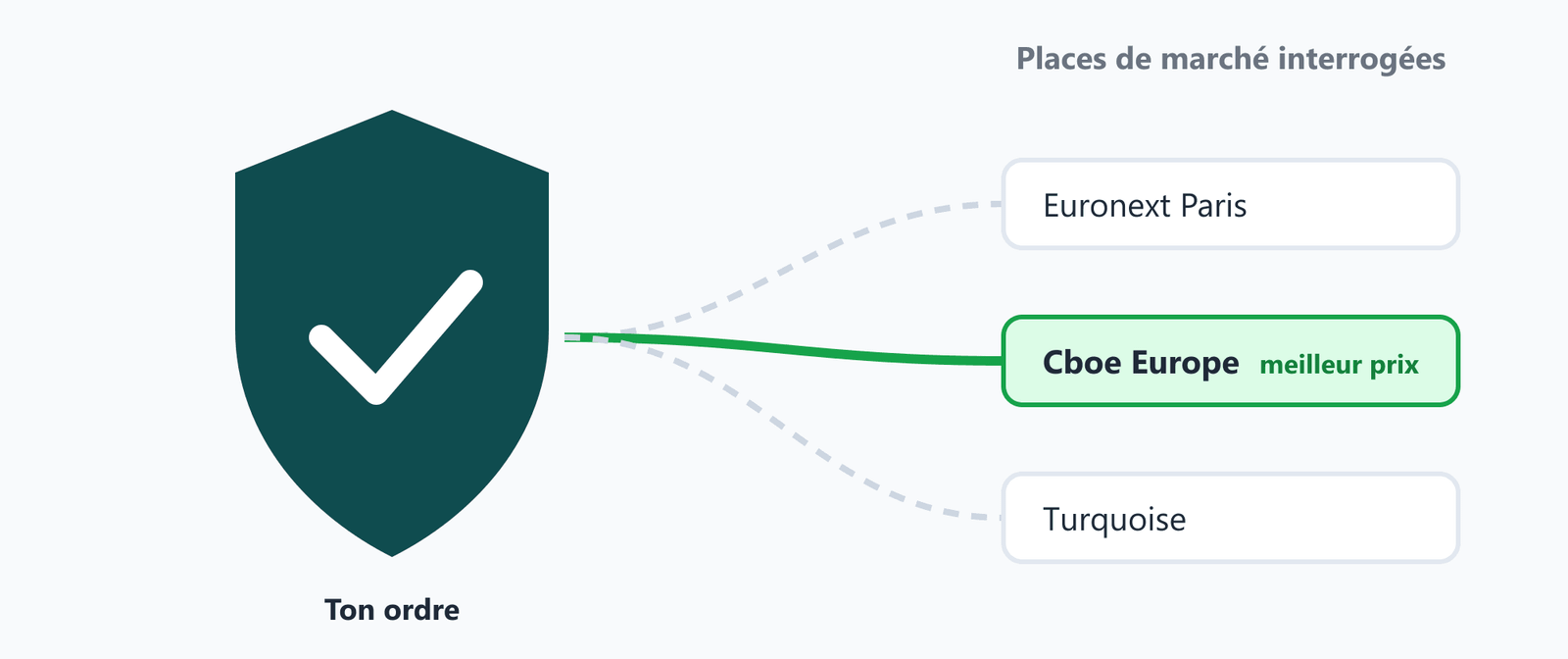
When you place an order, the Interactive Brokers routing system queries the various exchanges and venues where the security trades (for a French stock: Euronext, but also alternative venues such as Cboe Europe or Turquoise) and sends the order where the price is best at that moment. On an order of a few thousand euros, gaining one or two cents per share often pays back the commission.
Another important point: Interactive Brokers has never been paid by market makers to send them your orders (known as "payment for order flow"). Other brokers charging €0 or €1 per order did this for a long time, Trade Republic first among them, executing orders on a single venue in exchange for a kickback from their partner. European regulation has put an end to this model: the revised MiFIR regulation bans the practice throughout the Union since summer 2026, and Trade Republic has given it up. This system was not necessarily unfavorable on large, heavily traded stocks, but it could make you pay a wider spread on less liquid securities.
Why you cannot buy some US ETFs
European regulation prohibits selling an individual a product that does not have a key information document in French (the KID, or DIC in French). Most ETFs listed in the United States do not publish one: they are therefore blocked for purchase. The solution is to take the European version (known as UCITS), often domiciled in Ireland and listed in London, Amsterdam or Frankfurt. That is what I do with the JEPQ ETF: I hold the Irish version listed in dollars in London, which incidentally has no US withholding tax on its distributions.
Interest on cash and securities lending
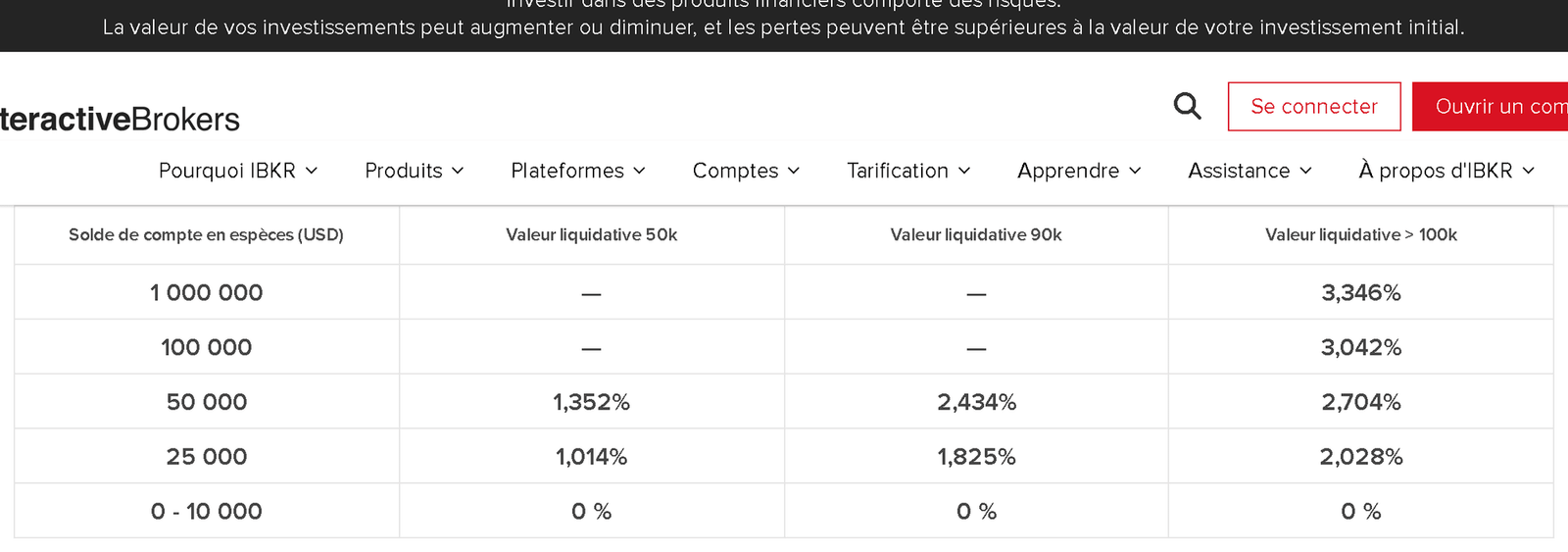
Interactive Brokers pays interest on uninvested cash, but with two conditions. The first 10,000 euros (or dollars) earn nothing, and the full rate is only paid if the total value of the account exceeds $100,000. At the time of writing, this full rate is about 1.97% on the euro and 3.38% on the dollar. Below $100,000, the rate is reduced pro rata. Example: with $25,000 in cash on a $50,000 account, the average rate drops to about 1%.
The securities lending program also lets you lend your shares to short sellers, against cash collateral. The broker pays you half of the interest it receives and you can sell your securities at any time. It is reserved for margin accounts or accounts above $25,000, and this income is taxable. For a portfolio of highly liquid ETFs, the gain remains modest.
Margin account and leverage
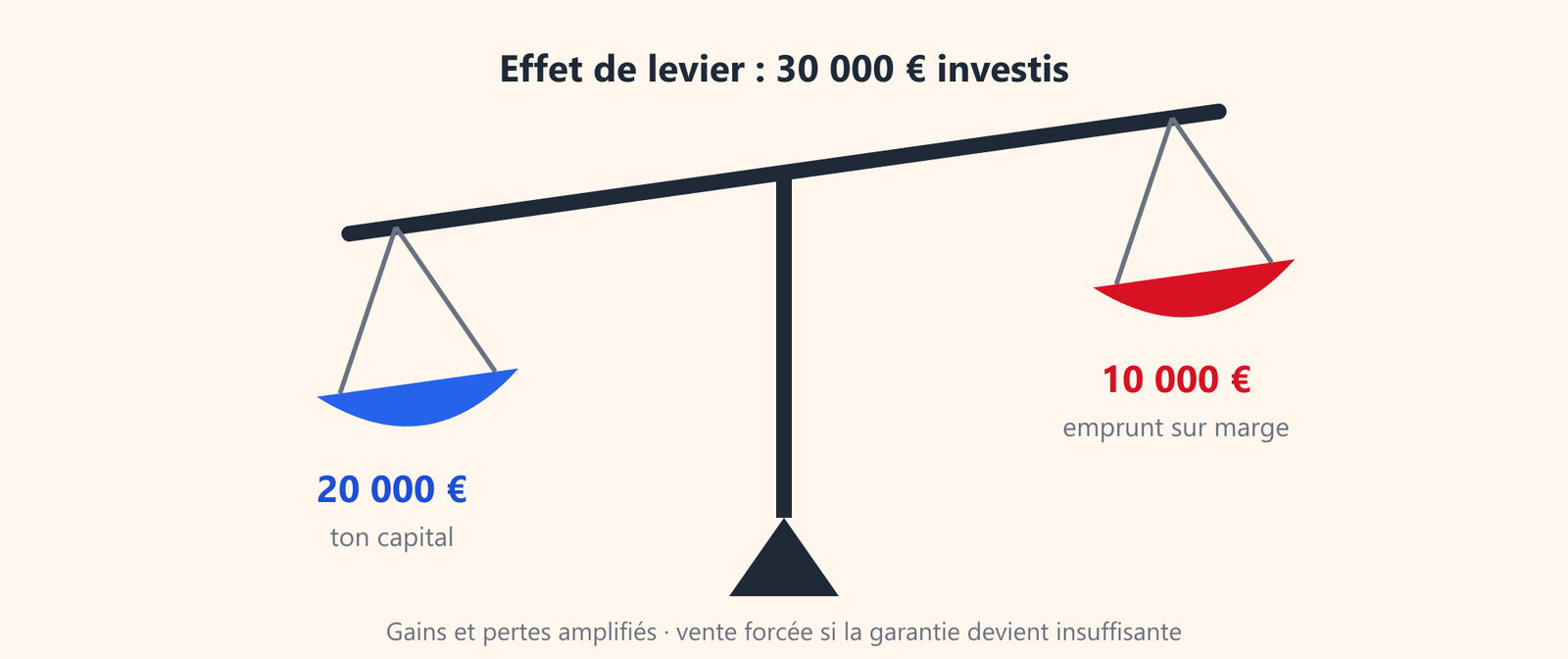
When you open your account, Interactive Brokers offers a cash account (you only invest the money you have deposited) or a margin account, which lets you borrow by pledging your securities as collateral. Rates are among the lowest on the market (from about 4% on the dollar at the time of writing, a little less on the euro), and they go down in steps as the amount borrowed increases.
Example: with €20,000 in ETFs, you can borrow €10,000 to invest €30,000. If the market rises by 10%, your portfolio gains €3,000 for a borrowing cost of about €400 per year. If it falls by 30%, it is only worth €21,000 for €10,000 of debt: your €20,000 stake has dropped to €11,000, a loss of 45% instead of 30%. And if the collateral becomes insufficient, the broker sells your securities itself, automatically and without notice, at the worst possible moment.
The margin account is also used for short selling and trading options. For a long-term investor, my advice is simple: choose the cash account. That way you avoid any unintended borrowing, for example if a purchase exceeds your available cash. This is not possible in a PEA, where leverage is prohibited.
🖥️ Platforms and tools
Client Portal: the web client area. This is where you manage deposits, withdrawals, settings, statements and tax reports.
IBKR Desktop: the recent software, more readable than the historical Trader Workstation (TWS), which I would leave to active traders.
IBKR Mobile: the full app. GlobalTrader: a simplified app for buying stocks in a few clicks.
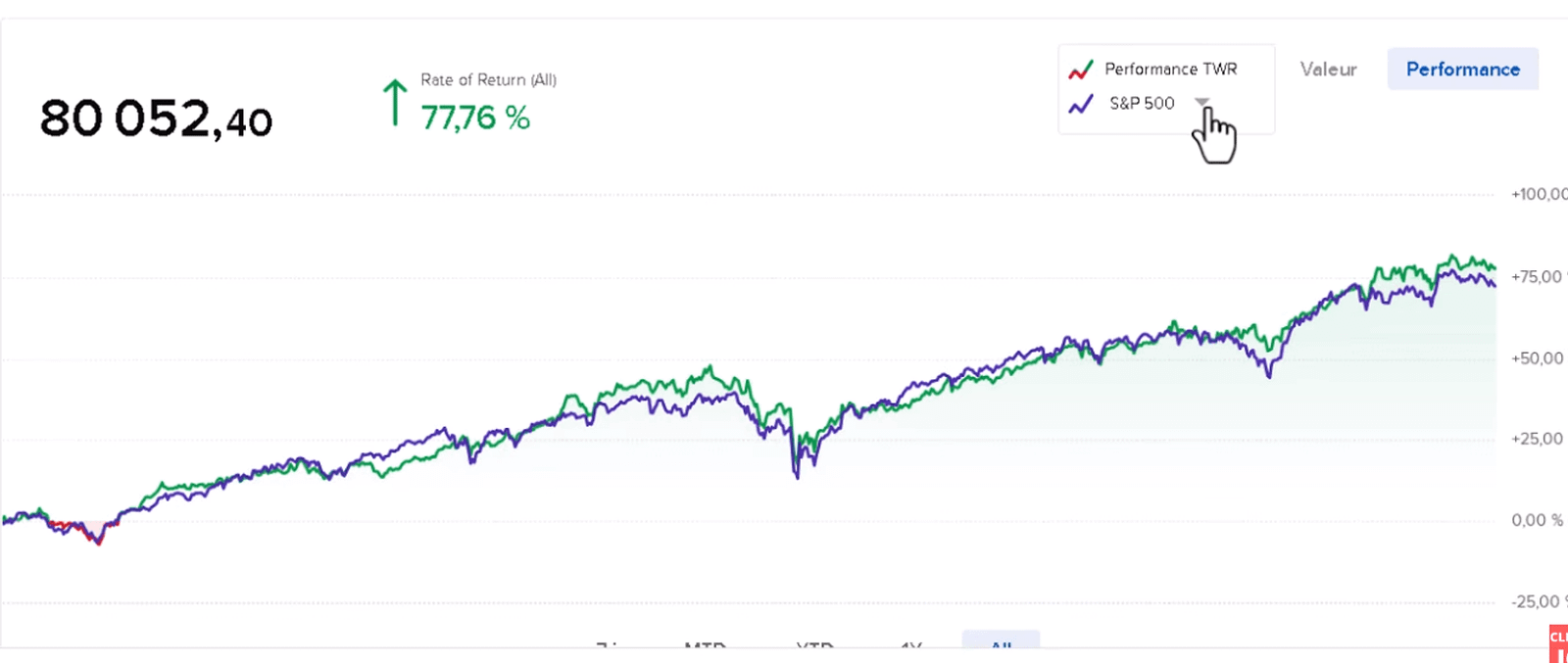
PortfolioAnalyst and the dashboard: time-weighted return (TWR), compared to an index. Since I started, my portfolio is up 77% versus 73% for the S&P 500 and 97% for the Nasdaq 100.
Activity statements, monthly and annual, in PDF, CSV or HTML: dividends, tax withheld, realized gains. Few brokers are as complete on this point.
Flex Query: an automatic export of your data that you can plug into a spreadsheet or your own tool. I use it every day to calculate my internal rate of return (XIRR), which takes the dates of my deposits into account.
AI connectors: since 2026, you can link your account in read-only mode to Claude, ChatGPT, Grok or Perplexity to ask them questions about your portfolio. No order is ever placed without you.
PortfolioAnalyst in detail: this is the tool I recommend even to people who buy nothing but a single ETF. It shows the breakdown of your portfolio by country, sector, currency and asset type, volatility and the main risk ratios, a comparison with several indices, and a dividend forecast for the next twelve months. You can even add your accounts held elsewhere (bank, other brokers) to track all your financial assets in one place, and generate a PDF report on the date of your choice.
Market data: quotes are free but slightly delayed on most exchanges. A real-time subscription costs a few euros per month per exchange; for long-term investing, you do not need it. Trading hours: on US stocks, Interactive Brokers also lets you trade overnight and before or after the regular session.
The downside: there are hundreds of menus, and some screens or notifications are still in English only. I recommend starting with the mobile app and the Client Portal, and ignoring the rest until you need it. To practice risk-free, a demo account with a fictitious portfolio of one million dollars reproduces all the platforms, and the free IBKR Campus training explains how they work.
📝 Opening an account step by step
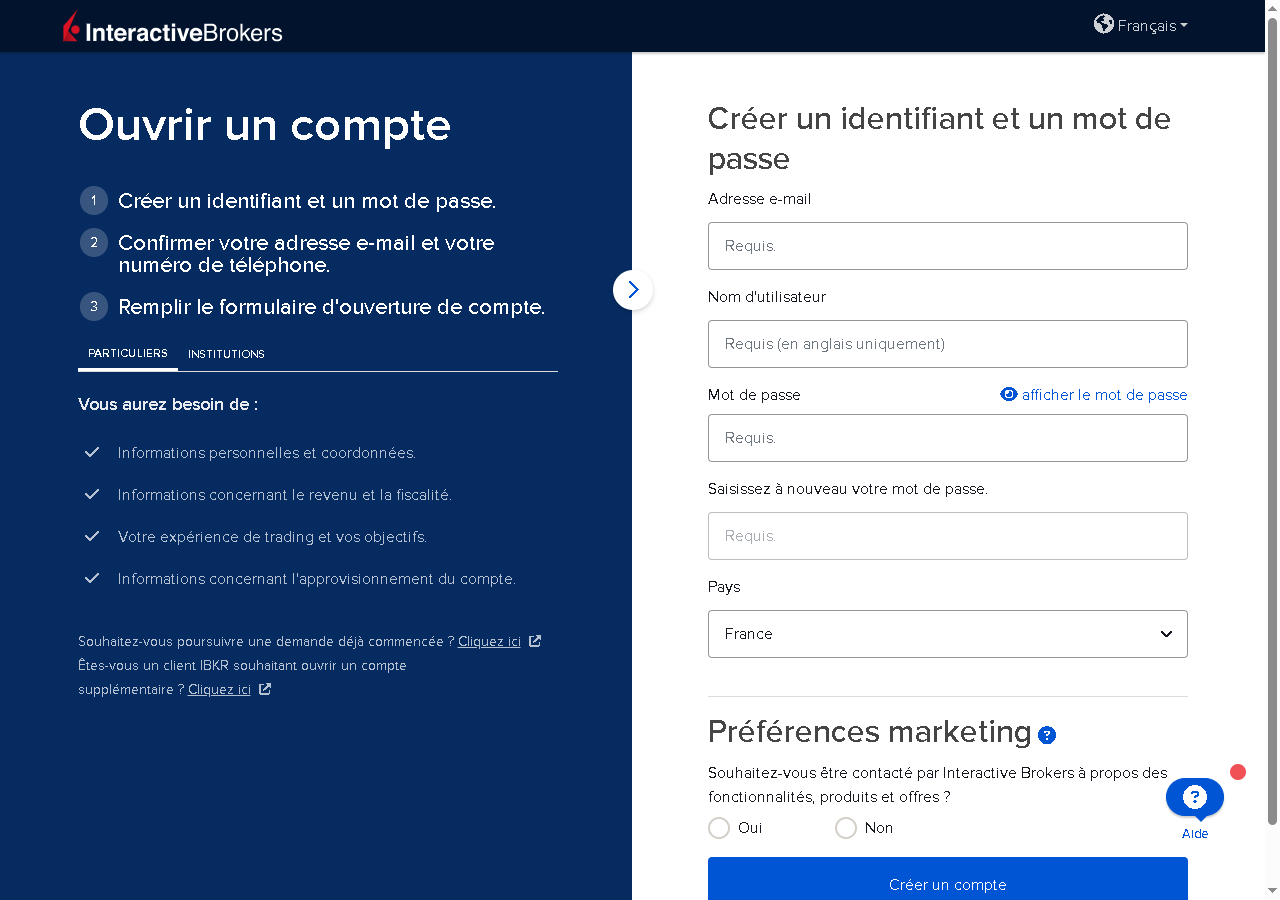
Create your login from this link: email, username, password and country of residence.
Fill in your application: identity, address, employment status, income and net worth, then the questionnaire on your trading experience. Answer honestly: it determines which products you will have access to.
Choose a cash account (no borrowing) if you do not plan to use leverage, and add the PEA if you wish.
Send your documents: ID and proof of address. Approval usually takes one to three business days.
Activate the security key in the IBKR Mobile app rather than SMS codes: it is what you use to approve your logins, and not setting it up is the cause of many locked accounts.
Sign the W-8BEN form offered when you open the account: it reduces the withholding tax on US dividends from 30% to 15%. It is valid for three years, so remember to renew it.
Choose your pricing plan (fixed or tiered) in the settings before your first order, depending on the size of your orders (see the fees section).
Fund your account by SEPA transfer, quoting the reference provided by the broker, then convert your currencies if needed.
How long before you can start investing?
Allow about thirty minutes to fill in the online application, preferably on a computer as there are many questions. Approval then takes one to three business days, sometimes more if a document is rejected or if a compliance question is asked through the message center. The first SEPA transfer arrives in about one business day. In practice, between signing up and your first purchase, plan for less than a week. The PEA can then be added from the client area in a few minutes, with a separate approval.
Interactive Brokers for a dividend investor
This is my profile, so I will go into detail. If you are looking for regular income with dividend stocks and ETFs, Interactive Brokers has several concrete advantages. First, the multi-currency account: US dividends stay in dollars and are reinvested without conversion. Then direct access to companies that pay their dividend every month or every quarter in the United States, such as listed real estate companies (REITs) or business development companies that finance small businesses, which many French brokers do not offer. Finally, the tools: a twelve-month dividend forecast, a history of payments and withholdings per security, and detailed statements for your tax return.
Withholding tax depends on the country and the domicile of the security. It is 15% on a US stock with the W-8BEN form, 25% on a French stock held in the securities account, and zero on the distributions of an ETF domiciled in Ireland, even if it invests in US stocks (the withholding is then paid inside the fund, at a reduced rate). That is why I hold the Irish version of JEPQ rather than the US version, which would be blocked anyway for lack of a key information document.
One last tip: a dividend portfolio produces a lot of lines in your tax return. Keep every annual statement in PDF and CSV; that is what will save you the most time in the spring. Personally, I use and recommend FlashFiscal, which reads these statements directly and prepares formulaires 2047 (foreign income), 2074 (capital gains) and 3916 (foreign accounts). With my link, you get €15 off your first year.
I interviewed its founder, Axel Paris, to understand how the tool handles statements from foreign brokers:
Using Interactive Brokers day to day
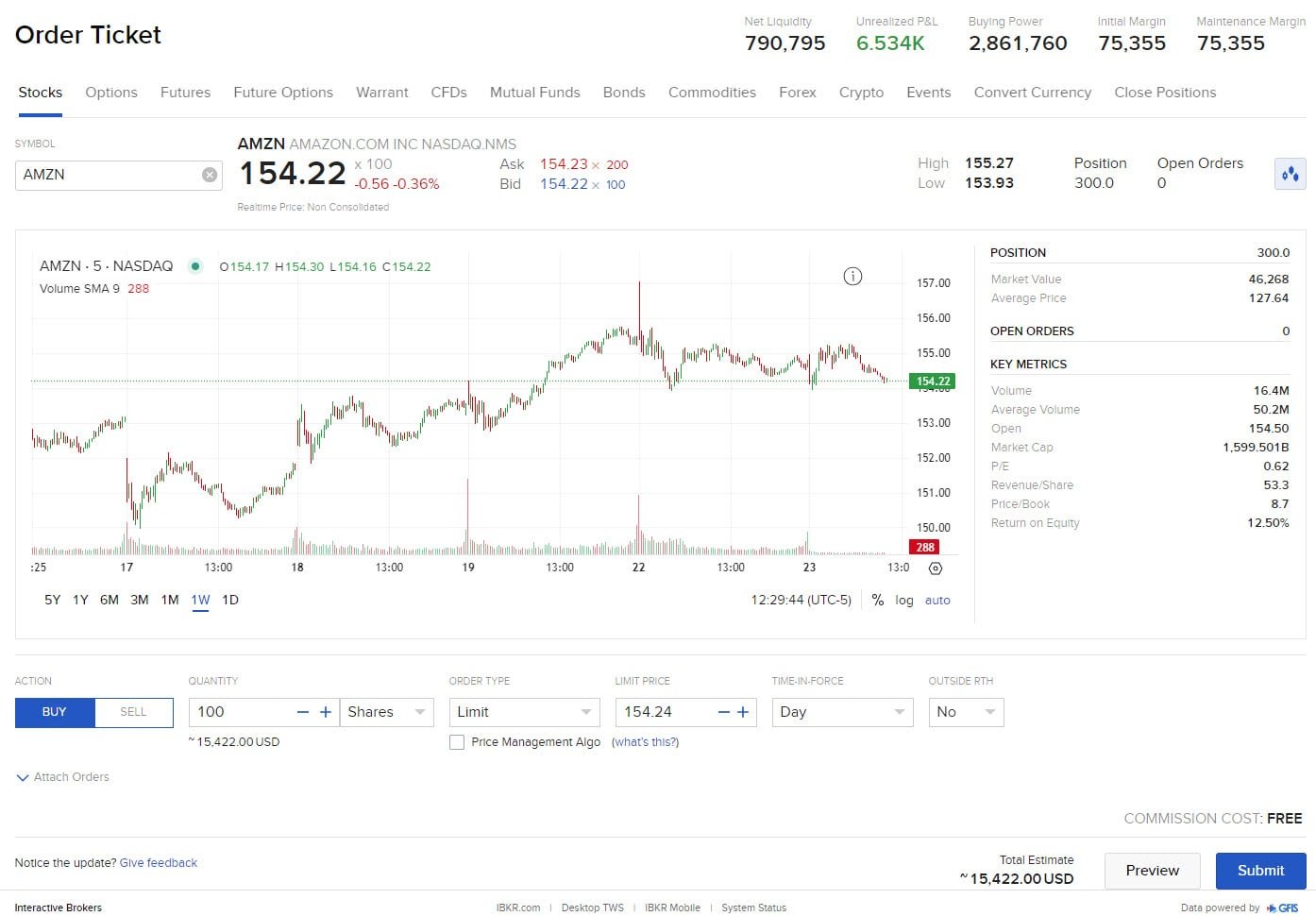
Placing an order step by step
Search for the security by its ticker (for example CW8 for a World ETF or MA for Mastercard) rather than by its name: the search often returns several listings of the same security.
Choose the right listing: exchange and currency. The same ETF can be listed in Paris in euros, in Amsterdam in euros and in London in dollars or pounds. For a PEA, only the eligible European version appears.
Prefer a limit order to a market order: you set the maximum price you are willing to pay, which avoids nasty surprises at the open or on thinly traded securities.
Enter a quantity or an amount: an amount in currency if you buy fractional shares on the securities account, a number of whole shares in the PEA.
Choose the order duration: valid for the day, or until canceled if you are aiming for a price lower than the current price.
Click on the preview before submitting: it shows the estimated commission and the margin used. If a borrowing line appears when you did not want to borrow, cancel.
Converting currencies
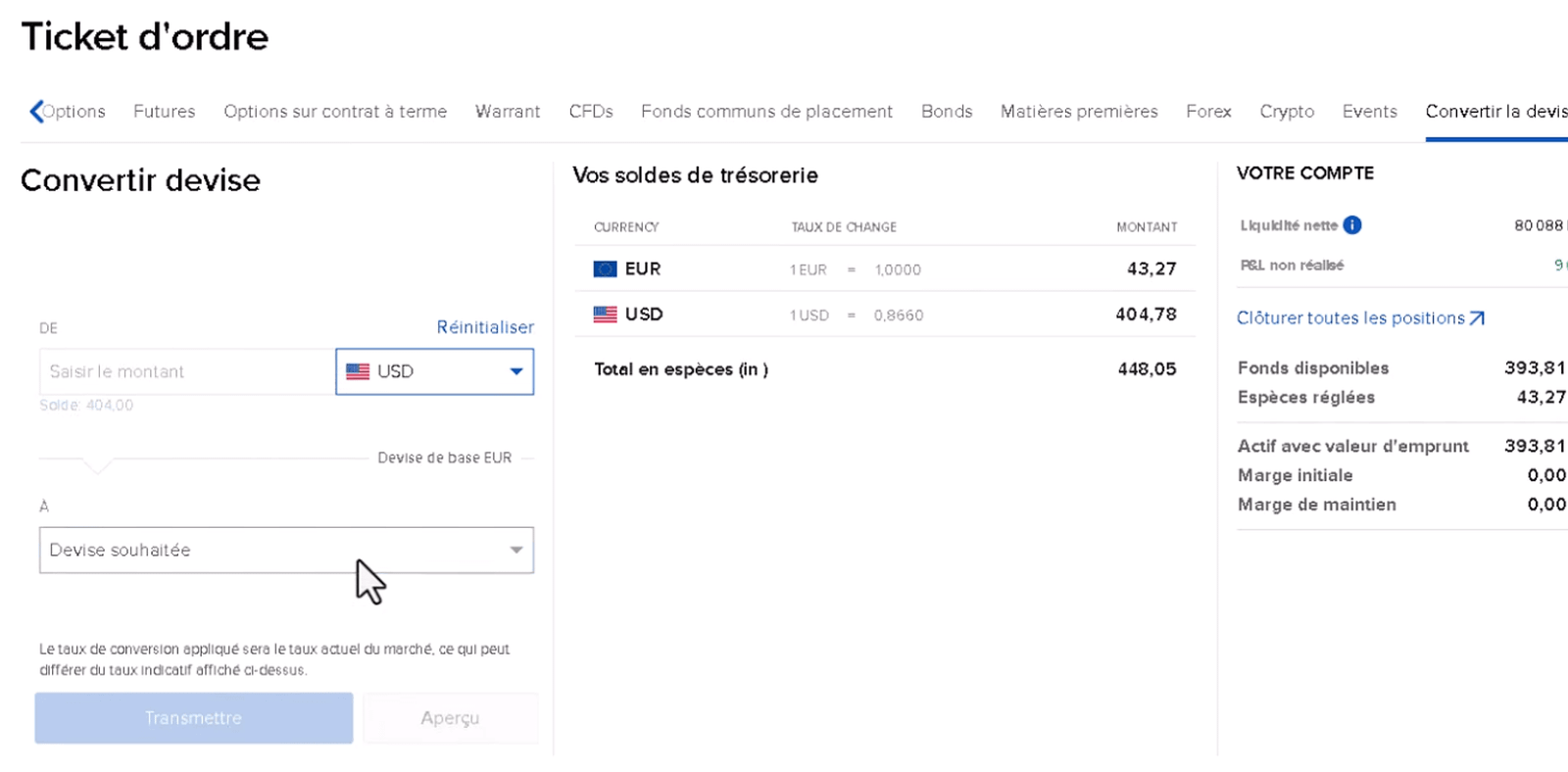
Conversion is done from the transactions menu, in the currency conversion section: you choose the source currency, the target currency and the amount, then you submit it like a stock order. The rate applied is the forex market rate at the moment of execution, with no hidden markup, and the cost is shown before you confirm. I usually convert a round amount once a quarter, then invest it in several installments in the resulting currency.
Dividends and automatic reinvestment
Dividends land in your account in the currency of the security, after deduction of the withholding tax of the country of origin. You can leave them as cash, reinvest them yourself, or activate automatic dividend reinvestment in the settings: the broker then buys back shares of the same security, including fractional shares on the securities account. It is a handy way to put compound interest to work without thinking about it, but be careful: each reinvestment is a purchase that adds to your tax history.
Withdrawing your money and closing your account
You request a withdrawal from the client area to the bank account in your name that you have registered. The first withdrawal of the month is free, the following ones cost €1 by SEPA transfer. The funds usually arrive in one to two business days. Only available cash can be withdrawn: remember to sell or convert beforehand, and to wait until the settlement period for your sales has ended. To close the account, sell or transfer your securities, withdraw the balance, then request the closure from the settings: it is free. Keep your annual statements, you will need them for your tax returns.
And in the event of death?
This is a topic nobody talks about, even though an account abroad is harder for heirs to track down than an account at a French bank. The securities are part of the estate and are transferred to the heirs on presentation of the death certificate and the notary's documents, often with longer delays than in France. My advice: write down the existence of the account, the entity that holds it and how to contact support in your estate documents, and tell your notary about it. The formulaire 3916 filed every year also leaves a record with the tax authorities.
Taxation in France: your tax return step by step
Before going into detail: for the securities account, I use FlashFiscal, a French tool that imports Interactive Brokers statements and generates the tax return forms (2047, 2074, 3916) in a few minutes. The analysis of your statements is free; the annual license, needed to get the forms, starts at €149, and my link gives you €15 off the first year. I show you the whole process in this tutorial:
FlashFiscal: €15 off the first year Free analysis of your Interactive Brokers statements, then formulaires 2047, 2074 and 3916 ready to copy into your return. |
Interactive Brokers withholds nothing for the French tax authorities and does not provide an IFU for the securities account. It is up to you to report your income, using the annual activity statement. Here is what you need to do every spring:
Formulaire 3916: declare each account opened with Interactive Brokers (CTO and PEA). Forgetting it costs a €1,500 fine per account and per year. Once entered the first year, it is carried over from one year to the next.
Dividends and interest: formulaire 2047, then carried over to the 2042 (the main income tax return). For US dividends, the 15% withholding gives you a tax credit of the same amount, which avoids double taxation. For French stocks, it is less favorable: on my LVMH dividends, a 25% withholding tax was deducted at source, instead of the 12.8% advance payment of a French broker. Keep your French stocks in a PEA instead.
Capital gains: formulaire 2074. Be careful, the broker calculates capital gains using the first in, first out rule, whereas the French tax authorities require the weighted average price: you have to recalculate, in euros, at the exchange rate on the day of each transaction. FlashFiscal is in fact switching to the weighted average price calculation, which removes this recalculation.
Capital losses: they are offset against your capital gains for the year, then carried forward for ten years. Remember to declare them even in years without gains.
Other income: interest paid on your cash and from securities lending is declared as foreign investment income.
Rate: by default, the prélèvement forfaitaire unique (flat tax) of 31.4% in 2026 (12.8% income tax and 18.6% social charges), unless you opt for the progressive income tax scale.
The main boxes to fill in for a securities account, based on the annual activity statement converted into euros:
What you declare | Where | Where the figure comes from |
|---|---|---|
Existence of the account abroad | Box 8UU of the 2042 return, then one formulaire 3916 per account | Account number and address of the entity, at the top of the statement |
Gross dividends | Box 2DC (via formulaire 2047) | Dividends section of the annual statement |
Interest (cash, securities lending) | Box 2TR (via formulaire 2047) | Interest section of the annual statement |
Foreign withholding taxes | Box 8VL, up to the amount of French tax | Withholding tax section of the statement |
Net capital gains | Box 3VG (after formulaire 2074) | Sales for the year, recalculated at the weighted average price in euros |
Net capital losses | Box 3VH | Same calculation, when the balance for the year is negative |
Check the instructions for your tax return every year: box numbers can change. And if you have opted for the progressive scale on another part of your investment income, the option applies to all of it: run the simulation before ticking the box.
Example for $1,000 of gross US dividends on the securities account: $150 is withheld in the United States. In France, the 12.8% income tax amounts to $128; the tax credit from the US withholding wipes it out entirely, but the $22 surplus is lost. That leaves the 18.6% social charges, i.e. $186. You therefore receive about $664 net out of $1,000, a total tax rate of about 33.6%, slightly more than the 31.4% on a French dividend received through a French broker.
On the PEA side, the IFU is provided and the taxation is the same as elsewhere: after five years, only social charges (18.6%) apply to the gains withdrawn. To learn more about FlashFiscal, here is my interview with Axel Paris, its founder:
Transferring your securities to or from Interactive Brokers
You can transfer an existing PEA to Interactive Brokers without selling your holdings: the tax seniority of the plan is preserved. The fees charged by your previous broker (capped by law at €15 per holding and €150 in total) remain payable by you. In the other direction, Interactive Brokers does not charge for outgoing transfers. The only precaution: fractional shares cannot be transferred, so you need to round up to a whole share or sell the fraction beforehand.
Transfer your PEA or your securities You request the transfer from the client area, without selling your holdings or losing the seniority of your PEA. |
Customer service and user reviews
You can contact support through the message center in the client area, by chat, or by phone on the free European number 00800 42 276 537. Answers usually come in French, sometimes in English, and a ticket can take a few days. For my part, I have always been able to communicate in French, by phone as well as by message, and my requests were handled well. If English holds you back, note that you can also open an Interactive Brokers account through the ProRealTime software, a partner of the broker, which provides support in French.
On Trustpilot, the rating is 3.0 out of 5 for about 5,500 reviews. Positive reviews praise the fees and the range of markets; negative ones mostly mention lengthy identity checks, accounts temporarily blocked at opening and the interface. This feedback is consistent with what I see: the broker is solid, but it is not designed for beginners.

What other investors say
Opinions are very divided, which is consistent with the broker's profile. On review platforms, about a quarter of the ratings are one star and the majority are four or five stars. On app stores, the mobile app is rated higher than the broker itself, a sign that the tool is well liked once you get the hang of it.
What comes up on the positive side: the fees, currency conversion, the range of markets, execution quality, the strength of the group, and error-free handling of corporate actions (stock splits, dividends, mergers).
What comes up on the negative side: a long and meticulous account opening process, accounts frozen during a verification, logins blocked by two-factor authentication, ticket-based support considered slow, answers sometimes in English, an interface that intimidates beginners.
My takeaway: most problems occur at opening or because security has not been set up. Once the account is open, the security key activated and two or three screens mastered, day-to-day use is very stable.
⚠️ Risks and points to watch
As a reminder: I am not a financial investment advisor. Any investment carries a risk of capital loss, and past performance is no guarantee of future performance.
Market risk remains the main one: your stocks can lose value, whatever the broker.
Cash is poorly protected (€20,000 at 90%), see the safety section.
Leverage is easy to access: a margin account lets you borrow, and therefore lose more than your stake. Choose a cash account if you have no use for it.
Reporting obligations, in particular formulaire 3916, take a bit of time the first year; after that, the return is very easy to redo from one year to the next.
The group has already been sanctioned in the United States, notably in 2020 for failures in its anti-money laundering controls ($38 million in total, shared between the SEC, FINRA and the CFTC, the US regulators). These fines did not affect clients, but they are a reminder that compliance remains an issue at this broker.
Interactive Brokers versus other brokers
Figures from my PEA comparison tool, for a PEA opened with each of them. For Interactive Brokers, these are the brokerage fees on tiered pricing only, excluding exchange fees (see the fees section):
Criterion |
|
|
|
|
|
|---|---|---|---|---|---|
€500 order | €1.25 | €2 | €0 | €1.99 | €0 |
€2,000 order | €1.25 | €2 | €0 | €10 | €7 |
€10,000 order | €5 | €8 | €0 | €50 | €35 |
Specific offer | Capped at €29 | 150 Amundi ETFs at €0 | Savings plan at €0 | 75 ETFs at €0 | 120 Amundi ETFs |
Cash protection | €20,000 | €100,000 | €100,000 | €100,000 | €100,000 |
PEA-PME | ❌ | ✅ | ❌ | ✅ | ✅ |
Scheduled investment plan | ❌ | ❌ | ✅ | ✅ | ❌ |
Transfer fees refunded | ❌ | ✅ | ❌ | ✅ | ✅ |
Formulaire 3916 | Yes | No | No | No | No |
Trustpilot rating | 3.0 | 3.6 | 3.7 | 4.4 | 3.7 |

To go further, my PEA comparison tool details these brokers and a dozen others on around fifty criteria: fees, safety, offer, customer service, taxation, bonus.
Interactive Brokers or Saxo Bank?
These are the two brokers I use. Saxo Bank has a more pleasant interface, an IFU for all its accounts, cash protection of €100,000, the PEA-PME, 150 Amundi ETFs with no order fees in the PEA and refunds of transfer fees. Interactive Brokers is cheaper on orders and above all on currency conversion, gives access to many more markets, pays interest on cash and offers much more advanced tracking tools. For an ETF PEA, I chose Saxo; for US stocks and a multi-currency account, Interactive Brokers.
Interactive Brokers or Trade Republic?
Trade Republic is unbeatable for investing small amounts automatically: free savings plans from €1, fractional shares, a very simple app, an interest-bearing account. On the other hand, execution takes place on a single venue and the choice of securities is more limited. Interactive Brokers takes the lead as soon as the amounts grow, when you want to choose your execution venue, or when you move beyond large European and US stocks. Many investors start with one and end up with the other.
Interactive Brokers or an online bank (BoursoBank, Fortuneo)?
French online banks have three strengths: an IFU provided for all accounts, no foreign account to declare, and ETFs with no order fees under certain conditions (75 at BoursoBank, 120 Amundi ETFs at Fortuneo). However, their fees climb quickly beyond a few hundred euros per order (0.5% at BoursoBank, 0.35% at Fortuneo on the PEA in my comparison tool), they often require a current account, and their fees on foreign exchanges are much higher. For orders of €2,000 or more, or for investing outside Euronext, Interactive Brokers is significantly cheaper.
My advice: if you are a beginner and invest small amounts every month, Trade Republic or Fortuneo are simpler (BoursoBank remains an option). As soon as your orders exceed a few thousand euros or you want to go further, Interactive Brokers and Saxo Bank take over: Saxo for an ETF PEA with a pleasant interface, Interactive Brokers to go beyond Europe, manage several currencies and track your portfolio in detail. The two complement each other very well.
My choice for the international securities account Some of the lowest fees, every stock exchange in the world and a real multi-currency account. |
On a securities account: the difference comes from currency conversion
On a securities account invested in US stocks, currency conversion is what costs the most over time, far more than order fees. Many brokers charge about 0.25% on each conversion, both when buying and when selling. On €50,000 invested in the United States and then brought back, that represents about €250 in conversion costs, versus about $4 at Interactive Brokers if you convert yourself. That is the main reason I keep my US stocks there.
What it really costs: three profiles in figures
To go beyond the fee schedules, here is the real annual cost of three ways of investing, exchange fees included:
Profile | What they do | Cost per year | Good choice? |
|---|---|---|---|
Small investor with a PEA | €300 per month in a World ETF | €18 (fees capped at 0.5% by law, i.e. €1.50 per order) | No: €0 at several competitors |
Regular investor with a PEA | €5,000 per quarter in an ETF | €12 on fixed pricing (€3 per order) | Yes |
US securities account | $2,000 per month in US stocks | About $11 ($0.35 per order and automatic conversion at 0.03%) | Yes, very competitive |
For the third profile, automatic conversion is cheaper than manual conversion, because $2,000 stays below the threshold of about $6,700 above which the $2 minimum becomes worthwhile. Above €25,000 invested per year in orders of several thousand euros, Interactive Brokers becomes one of the cheapest brokers on the market, across all account types.
Who is Interactive Brokers for?

Yes if you invest outside Euronext (United States, United Kingdom, Switzerland, Nordic countries, Asia), if you place orders of more than €500, if you want a multi-currency account, or if you have significant financial assets that you want to track closely.
Yes if you are an expatriate, a cross-border worker or likely to change country: your account follows you.
Yes for a company or holding company investing its cash.
Probably not if you are a beginner and want to invest €50 to €300 per month automatically: an app with a free savings plan will be simpler and cheaper.
Probably not if you want an IFU for everything and no tax paperwork: a French broker will be a better home for your securities account.
❌ Mistakes to avoid
Keeping the default pricing plan without comparing it with the real size of your orders (see the fees section).
Leaving cash idle below €10,000: it earns nothing. Invest it or keep it elsewhere.
Forgetting the W-8BEN form or its renewal every three years: your US dividends would then be taxed at 30% instead of 15%.
Buying French stocks in the securities account: 25% withholding on dividends, whereas a PEA exempts them from income tax after five years.
Forgetting formulaire 3916: a €1,500 fine per undeclared account and per year.
Opening a margin account by default without needing it, and borrowing without realizing it.
Not activating the security key in the mobile app, and finding yourself locked out at login.
Keeping fractional shares if you plan to change broker: they cannot be transferred.
🔎 My experience in figures
I opened my securities account in August 2023. Since then, I have deposited €60,750 and withdrawn about €3,400. Today, the account is worth about €84,500, almost all of it invested. My portfolio is built around income: the JEPQ ETF (Irish version), Mastercard, BlackRock, Main Street Capital and Realty Income.
My internal rate of return (XIRR), which takes into account the date and amount of each of my deposits, breaks down as follows between dividends, capital gains, fees and taxes:
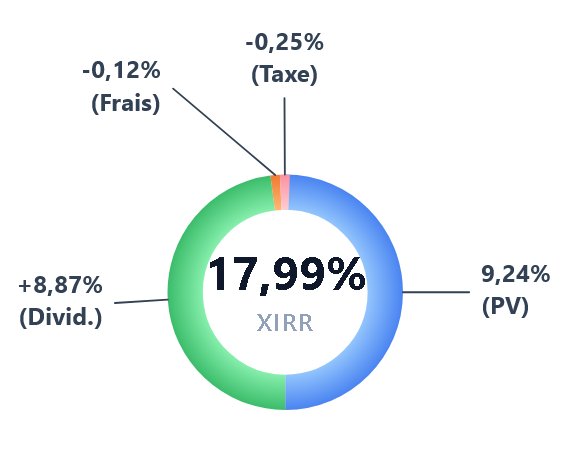
Gross dividends and interest: about $10,700 received since opening.
Withholding taxes: about $250, recovered as a tax credit.
Fees: about €60 in commissions (€1 per order) and €46 in currency conversions.
Performance: +77% TWR since I started, in line with the S&P 500.
My figures across all my platforms can be seen on the My investor portfolio page.
What I have learned in more than three years
My routine: a transfer in euros, a conversion into dollars every quarter, then staggered purchases. At the end of each month, I export the statement to do my review, and my data is automatically pulled every day into my own tracking dashboard.
What I would do again: keep a multi-currency account for dollar securities, and leave dividends in dollars to reinvest them without conversion.
What I would do differently: check from the start which pricing plan suits my orders, and never buy a French stock in the securities account.
Time spent: a few hours to get started at the beginning, then about ten minutes a month, and half a day a year for the tax return.
⚖️ Pros and cons
✅ Pros
Some of the lowest fees from a few hundred euros per order, almost free currency conversion.
Access to almost all the world's markets, multi-currency, fractional shares.
Long-established, very well capitalized group, segregated securities.
Very comprehensive statements, data export and analysis tools.
Interest on cash above €10,000.
Bonus of up to $1,000 in IBKR shares.
⚠️ Cons
Fairly complex and feature-heavy interface, partly in English only.
No IFU for the securities account and formulaire 3916 to fill in.
Cash protection limited to €20,000.
Recent PEA: no PEA-PME, no scheduled investing, transfer fees not refunded.
Fixed pricing often offered by default, more expensive for small orders.
🎁 Bonus and referral
By opening your account with my link, you can receive up to $1,000 in IBKR shares: $1 in shares for every $100 deposited during your first year. These shares are locked for one year. No code to enter. All the conditions are detailed on my Interactive Brokers bonus code page.
Up to $1,000 in IBKR shares $1 in shares for every $100 deposited during your first year, with no code to enter. |
A short glossary to find your way
Fixed / tiered pricing: the two commission schedules. Fixed includes all fees; tiered is cheaper per order but exchange and clearing fees are added on top.
Exchange fees: what the stock exchange and the clearing house charge to execute and settle your order. They are included in fixed pricing and passed on separately in tiered pricing.
Routing: the choice of the exchange or venue where your order is executed. Smart routing looks for the best price; direct routing forces a specific venue, usually at a higher cost.
Limit order: an order that only executes at your price or better. Conversely, a market order executes immediately, at the available price.
Cash / margin account: the first only invests your money; the second lets you borrow by pledging your securities as collateral.
TWR: the time-weighted return, which neutralizes your deposits to compare your portfolio with an index. XIRR: the internal rate of return, which takes into account the date and amount of each deposit, in other words your real return.
W-8BEN: the US form certifying that you are not a US resident, which reduces the withholding on US dividends to 15%.
KID (DIC in French): the key information document required to sell a product to a European individual investor. Without it, a US ETF cannot be bought.
UCITS: the European standard for funds and ETFs, a guarantee of a document in French and of domicile in Europe.
IFU: the imprimé fiscal unique, the annual tax summary that pre-fills your French tax return. Provided for the PEA at Interactive Brokers, not for the securities account.
Flex Query: the automatic, customizable export of your data (positions, transactions, dividends) to a spreadsheet or a personal tool.
FAQ: frequently asked questions about Interactive Brokers
Is Interactive Brokers reliable?
The group has existed since 1978, it is listed on the Nasdaq, has more than $21 billion in equity and its European clients are served by an entity regulated in Ireland. Your securities are kept separate from the broker's assets. See the safety section.
What happens to my shares if the broker goes bankrupt?
They are returned to you, because they belong to you. Cash and any losses are covered at 90%, up to €20,000.
Can you open a PEA with Interactive Brokers?
Yes, since 2024, for any adult French tax resident. No PEA-PME and no fractional shares in this PEA.
Is there a minimum deposit?
No. There is no longer any minimum deposit, inactivity fee or custody fee.
Should you choose fixed or tiered pricing?
Tiered if your orders stay below €3,000 to €4,000, fixed for orders of €5,000 to €50,000 on Euronext. In the United States, tiered is almost always cheaper.
How do you declare an Interactive Brokers account?
Formulaire 3916 for each account, then 2047, 2074 and 2042 for the income from the securities account. The PEA comes with an IFU.
Why can't I buy a US ETF?
Without a key information document, European regulation prohibits individuals from buying it. Take the European version (UCITS) of the same index.
Are the website and support available in French?
The public website and a good part of the client area, yes. Some screens and notifications are still in English; support usually answers in French.
Does my cash earn interest?
Yes, above €10,000 or $10,000, with the full rate if your account exceeds $100,000.
Does Interactive Brokers sell my orders?
No. It does not get paid by market makers to send them your orders: they are routed to the venue offering the best price.
What is IBKR Lite?
A commission-free plan on US stocks, designed for occasional investors and offered depending on the group entity that holds your account. If the option does not appear in your settings, you stay on the IBKR Pro plan, with the choice between fixed and tiered pricing.
Can you open an account in the name of a company?
Yes, for a company or a holding company, with the same fees as an individual account. Have the articles of association, the certificate of incorporation and the identity of the beneficial owners ready.
What happens if I move abroad?
You keep your account and your securities: support attaches it to the group entity responsible for your new country. As for the PEA, moving abroad no longer leads to its closure since the French Pacte law of 2019; check with the broker which conditions apply afterwards.
Can you transfer a securities account to Interactive Brokers?
Yes, without selling your securities. The request is made from the client area; any fees are those of your previous broker.
Can you test it without real money?
Yes, with a demo account that has a fictitious portfolio, available as soon as you sign up.
Is Interactive Brokers suitable for a beginner?
It is usable, but a simpler broker is often more comfortable to get started. Nothing stops you from transferring your securities later.
Conclusion
After more than three years, Interactive Brokers remains my broker for the international securities account: very low fees, every stock exchange in the world, a real multi-currency account and tracking data I cannot find anywhere else. In return, it asks for a bit of personal effort: understanding the interface, choosing tiered pricing, converting your currencies yourself and doing your tax return carefully.
If this profile suits you, you can open your Interactive Brokers account and take advantage of the share bonus. And to compare with other offers, my PEA comparison tool is still the best place to start.
And as always, never give UP!