Investing in crowdlending (or P2P lending) in Europe isn't just about comparing interest rates and any guarantees on the loans. It's also about understanding which legal framework the platform operates under, and what that framework really gives you when something goes wrong. After a lot of analysis work (loan agreements, licences, exchanges with the platforms), here's my overview of P2P crowdlending regulation: MiFID II, ECSP, national licences, risks, the nature of the contracts and how it all ties in with my P2P comparison tool.
 Why regulation matters
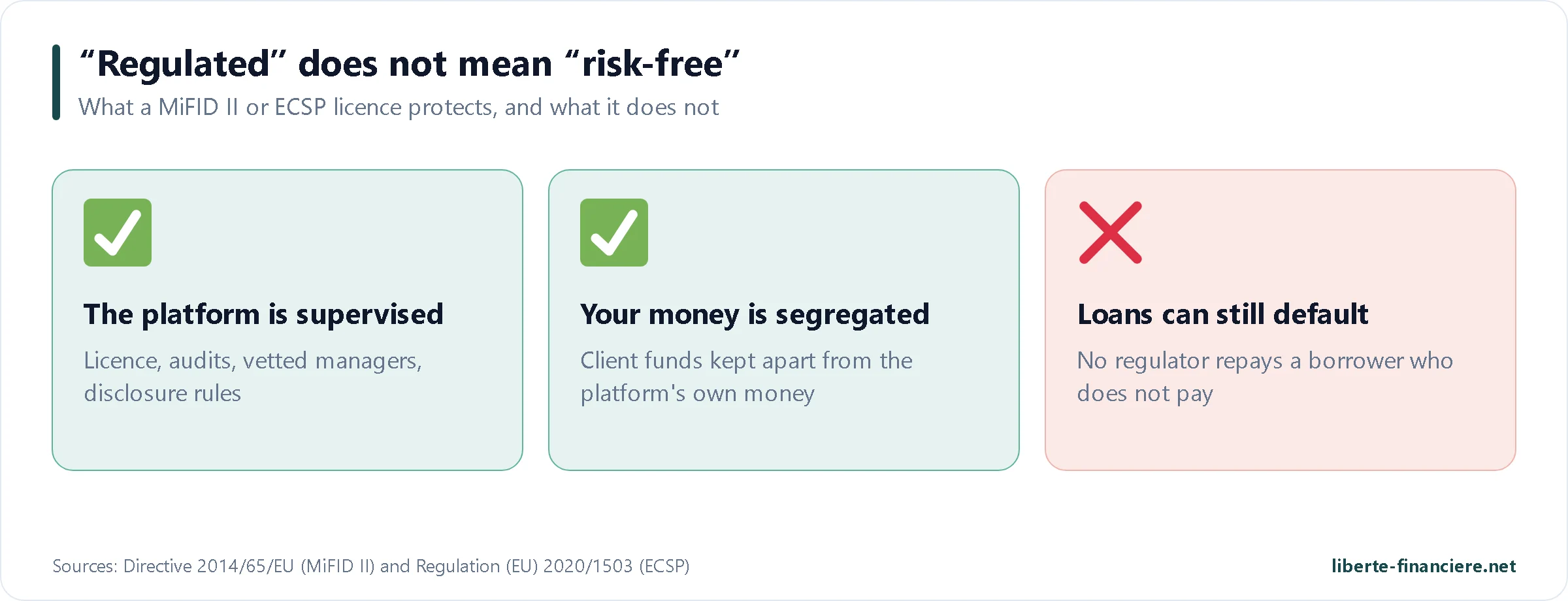
You often read "the platform is regulated" and people assume that means no risk. But "regulated" doesn't always mean the same thing. Some licences obviously protect the investor (information, segregation of accounts, recourse). Others only cover the borrower or the fight against money laundering (checking identity and the origin of funds).
One point not to overlook, which I often repeat on my YouTube channel: a regulated platform can still generate losses. Mintos (MiFID II) and EstateGuru (ECSP) each have, to date, more than 100 million euros of claims in serious difficulty, with little chance of recovery. On the other hand, some players with no investor regulation sometimes show track records without a single loss, but with fewer regulatory protections if the platform goes off the rails.
Finally, regulation (MiFID II or ECSP) on a platform is a big plus to look for whenever possible. It's a major criterion, just like the financial statements of the lending companies.
 The different regulatory frameworks
Here's the hierarchy I use in my P2P comparison tool:
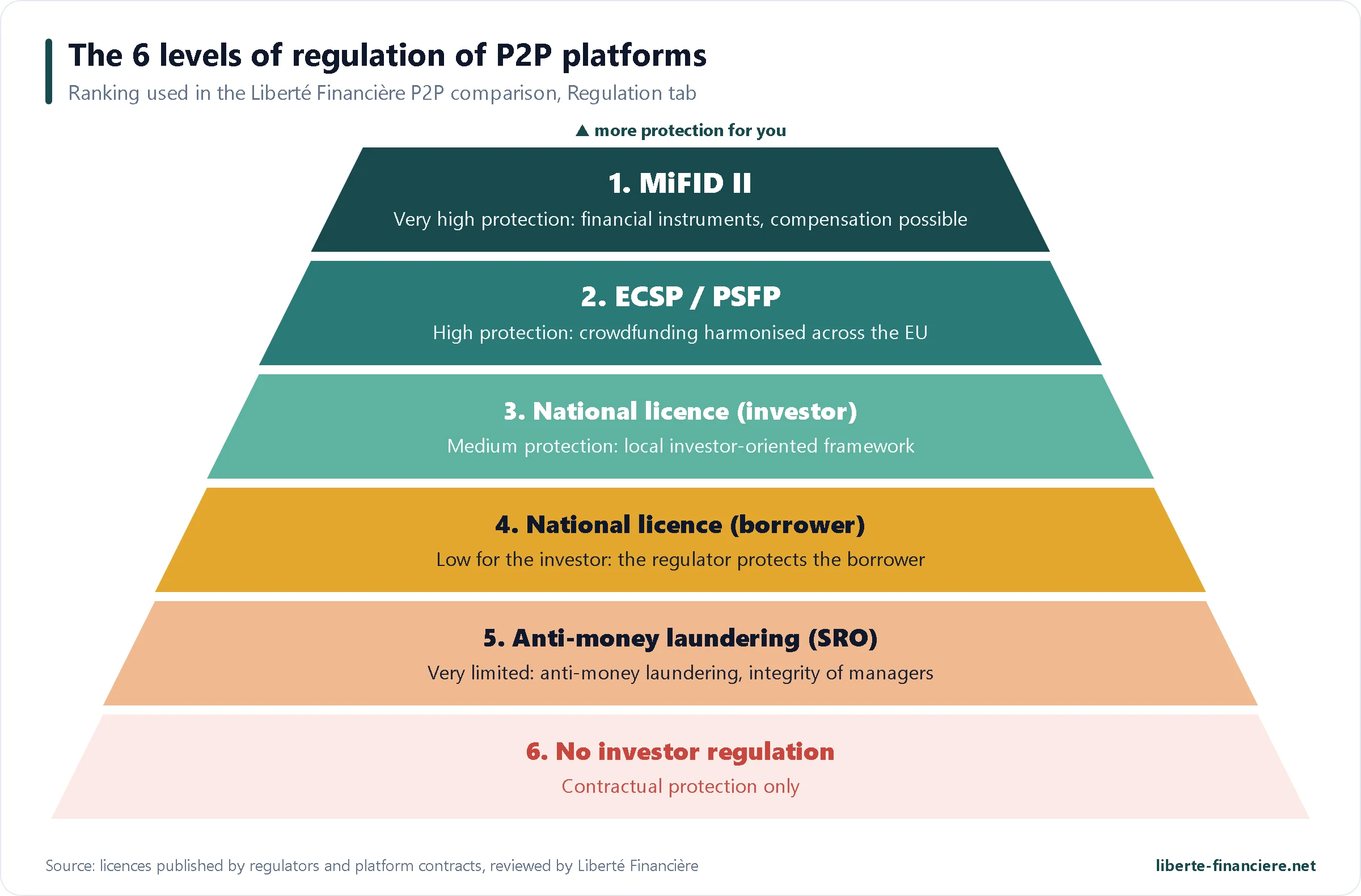
Framework | Example platforms |
|---|---|
1. MiFID II | |
2. ECSP | Afranga, Bienprêter, FinBee, Lendermarket, InRento, EstateGuru… |
3. National licence (investor) | NEO Finance, AxiaFunder |
4. National licence (borrower) | |
5. Anti-money laundering (AML / SRO) | Maclear (Switzerland) |
6. No investor regulation |
This ranking isn't an absolute quality score: ECSP prohibits certain conflicts of interest that MiFID II may allow if they're properly managed. It's one factor among others to take into account before investing.
 My video: regulated crowdlending platforms
If you prefer video, here's my presentation of the different regulatory frameworks (MiFID II, ECSP, national licences) and the platforms that fall under them:
To see more videos like this one, feel free to follow me on my YouTube channel: Liberté Financière on YouTube.
 1. MiFID II: the most demanding framework
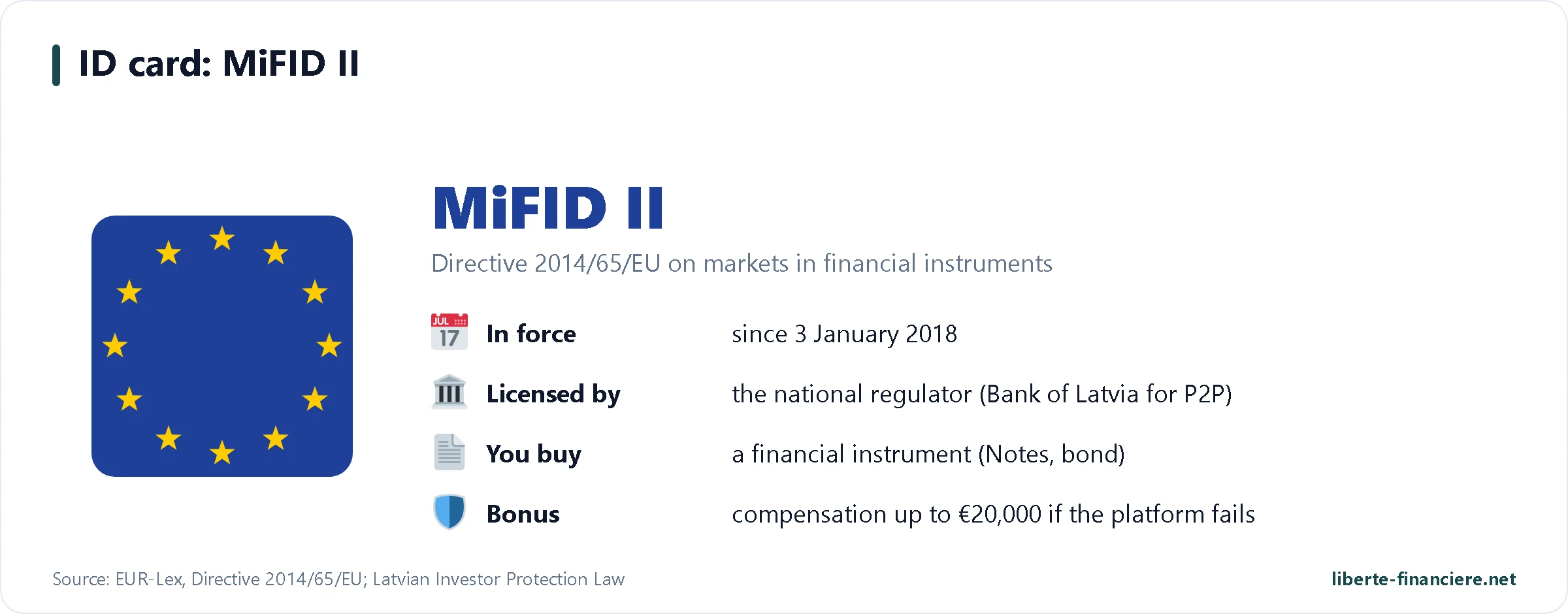
The Markets in Financial Instruments Directive II (MiFID II, European Commission) governs investment firms and the marketing of financial instruments. On paper, it's the same kind of regime as for a traditional broker.
 What MiFID II gives the investor
Segregation of client funds: your money must be kept separate from the platform's.
Fee transparency: commissions and kickbacks must be disclosed.
Standardised documentation: traceable contracts and risk information.
Recourse: internal complaints procedure, financial ombudsman, option to refer the matter to the national regulator.
Compensation of 90% of the loss, up to €20,000 (Latvian scheme, details on the Mintos website): only if the licensed company can't return its clients' assets (bankruptcy, serious misconduct). It never applies when a borrower doesn't repay their loan.
In practice, Latvian platforms turn loans into Notes (securities backed by the loans) or go through companies set up to hold the loans (SPVs): the product becomes a financial instrument. And there's a fundamental reason for this choice: ECSP doesn't cover loans to individuals (Article 1 of the Regulation). A platform that mainly offers consumer loans, like Mintos or Twino, could therefore only be regulated under MiFID II.
 Why are almost all MiFID II platforms Latvian?
Historically, Latvia was a P2P pioneer in Europe (Mintos from 2015, Twino right after). The Bank of Latvia (which in 2023 took over supervision from the former Financial and Capital Market Commission, the FKTK) gradually pushed the sector towards a solid framework. The result: an ecosystem (lawyers, auditors, compliance) concentrated in Riga. Other countries steered their players towards ECSP instead.
Platform | Country |
|---|---|
| |
| |
| |
| |
| |
|
 2. ECSP: the European crowdfunding standard
The EU regulation on European crowdfunding service providers (ECSP, or ECSPR) has applied since 10 November 2021, with a transition period that ended on 10 November 2023: since then, it's the only possible status for a crowdfunding platform in the European Union. In France, this same European status is called PSFP (prestataire de services de financement participatif); it's granted by the AMF, which counted 59 licensed PSFPs at the end of 2024. Across the whole Union, ESMA listed 229 of them at the same date (ESMA 2025 report). It's the status of La Première Brique in real estate crowdfunding, which is different from pure P2P but follows the same "protected investor" logic.
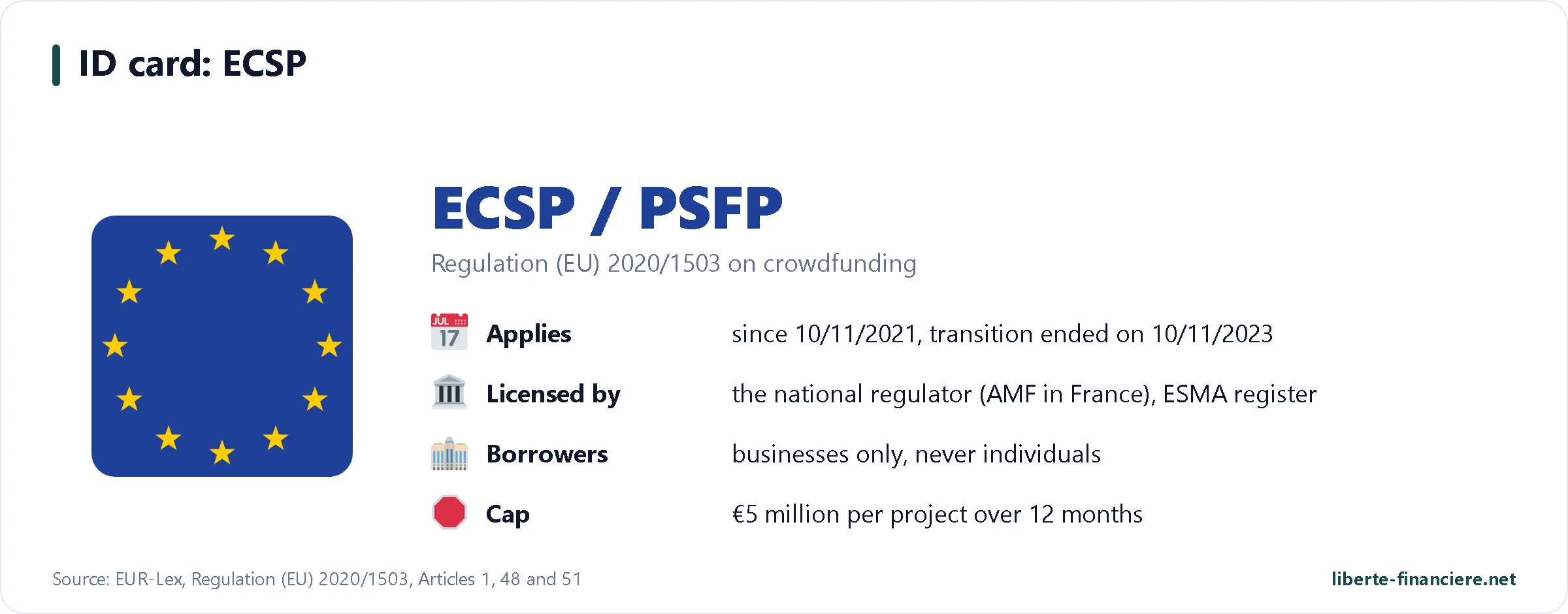
In crowdlending, ECSP brings in particular:
Key investment information sheet (KIIS), harmonised for each project.
Knowledge test and simulation of your ability to bear a loss for non-sophisticated investors, with a warning if you put more than €1,000 or 5% of your net worth into a project.
4 calendar day reflection period for non-sophisticated investors (not available under MiFID II).
Strict prohibition of certain conflicts of interest (tougher than MiFID II on this point, see below).
Segregated funds through a PSD2-licensed payment provider (often Lemonway, Mangopay…).
Minimum own funds: €25,000 or a quarter of the previous year's fixed overheads (whichever is higher).
Borrowers: businesses only, and 5 million euros at most per project over 12 months.
Getting an ECSP licence often takes more than a year of overhaul (governance, IT, compliance). It's not just an administrative form.
ECSP platform (a few examples) | Licensing country |
|---|---|
| |
Bienprêter |
|
| |
EstateGuru |
|
| |
| |
|
 Bulgaria
 France
 Ireland
* the Lendermarket platform holds an ECSP licence, but also keeps offering part of its range outside the ECSP framework, in particular loans to individuals from Creditstar group companies, which ECSP doesn't cover. The licence improves internal processes, but not all loans enjoy the same level of security.
 3. Investor-oriented national licences
Before ECSP, some countries had created local P2P frameworks. In  Lithuania, the combination of electronic money institution + P2P platform licence already protected investors (client money kept separate from the platform's). NEO Finance and FinBee are the historical examples; FinBee obtained the ECSP licence, while NEO Finance keeps the national framework for its loans to individuals, which ECSP doesn't cover.
In the  United Kingdom, AxiaFunder operates under the supervision of the FCA with shares in Scottish limited partnerships (SPVs), with real investor protection, but outside EU rules since Brexit.
This level is solid, without reaching MiFID II compensation or the ECSP passport, which is valid across the whole Union.
 4. Borrower-oriented national supervision
In  Estonia in particular, the Finantsinspektsioon issues licences for consumer lenders or credit intermediaries. The regulator makes sure the borrower doesn't end up over-indebted; it doesn't supervise the protection of P2P investors the way ECSP would.
Typical model, the assignment of claims: you buy the right to be repaid on a loan that's already been granted, often with a buyback guarantee from the lending company.
Platform | Country | Model |
|---|---|---|
| Go & Grow (pool) + loans | |
| Assignment of claims | |
| Savings product / loans |
 What changes on 20 November 2026: the CCD2 directive
Directive (EU) 2023/2225 on consumer credit (known as CCD2) applies across the whole Union from 20 November 2026, replacing the 2008 directive. It also covers platforms that connect individual borrowers with lenders: information for the borrower, checking their ability to repay.
Like the Estonian licences, it protects the borrower, not the investor: it changes nothing about your protection on an assignment-of-claims platform. And many countries hadn't yet transposed the text in time: the exact rules will still vary from one country to another for a few months.
 5. Anti-money laundering (AML / SRO): the bare minimum
Maclear (Switzerland, outside the EU) is a member of an SRO (self-regulatory organisation) recognised by FINMA. This requires anti-money laundering checks, audits and vetting of the managers (Gewähr, professional integrity). On the other hand, the Swiss SRO doesn't protect the investor in the event of a bad project or a credit default.
It's a plus compared with "no licence at all", but clearly below ECSP or MiFID.
 6. Platforms with no investor regulation (neither ECSP nor MiFID II)
Many Estonian, Croatian or Latvian platforms (outside MiFID II) operate through lending companies licensed for credit, with no "investment platform" licence. You sign an assignment or loan agreement with a commercial company; if there's a dispute, you're more in the realm of civil contract law than in a harmonised financial framework.
Platform | Headquarters |
|---|---|
| |
| |
| |
| |
| |
| |
| |
|
The PeerBerry / Crowdpear case: PeerBerry has no investor regulation, but shared shareholders created Crowdpear a few years later, an ECSP sister platform. This shows that a group adapts to regulation when it creates a platform. We'll see whether PeerBerry follows that path later on. I hope so.
 Nature of the contract: as many risks as there are labels
The regulator also looks at what you sign. In my comparison tool, the "Nature of the contract" criterion is cross-referenced with the regulatory framework:
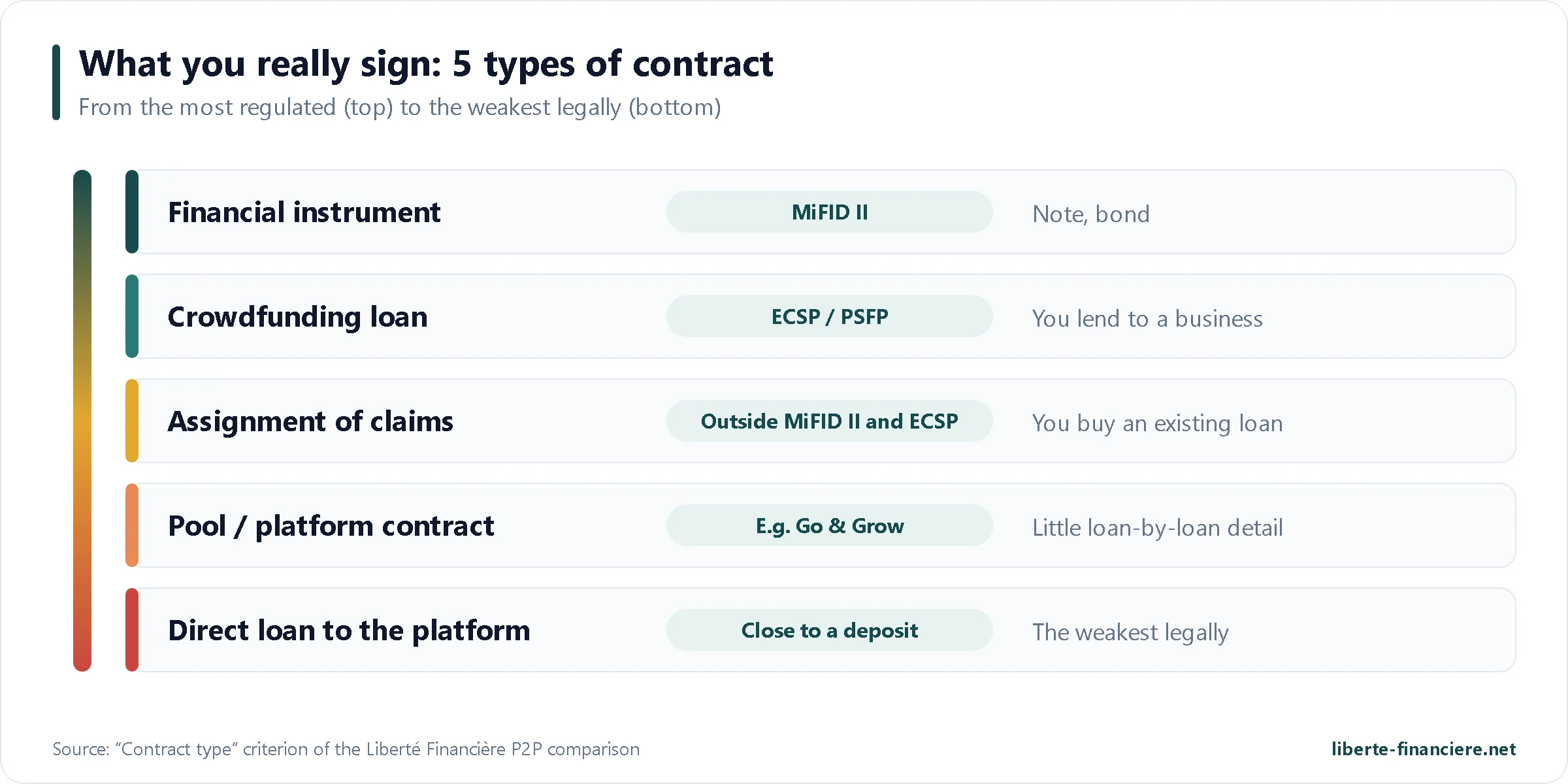
Financial instrument (MiFID II): note, bond; this is the most "securities-like" level.
Crowdfunding loan (ECSP): you lend through the licensed platform.
Assignment of claims: you buy an existing claim (the most common model outside MiFID/ECSP).
Pool / platform contract: e.g. Go & Grow (formerly Bondora): less transparency loan by loan.
Direct loan to the platform: the riskiest from a legal standpoint (close to a non-bank deposit).
You'll find the definitions in my crowdfunding and crowdlending glossary.
 Sensitive cases: non-subordinated loans and "unconditional" repayment
Some contracts promise repayment without clearly mentioning the risk of loss or subordination to other creditors.

On 5 May 2026, BaFin (the German regulator) found that Ventus Energy was carrying out deposit-taking without a banking licence, and ordered it to stop this activity and repay the sums collected. Real estate platforms such as Devon or Asterra switched their contracts in June 2026 to subordinated loans to clarify the risk; whether this is legally sufficient in the long term is still an open question.
To date, FF Forest is, in my view, in a comparable grey area (unclear answers on subordination). Cases like this show why regulatory risk and contract risk need to be looked at together.
 Examples worth understanding
 Regulation and performance: what the figures say
Don't confuse the regulatory framework with the quality of the loans and lending companies.
Mintos (MiFID II), large amounts of claims in recovery (order of magnitude: more than 100 million euros).
PeerBerry (no investor regulation), no losses for investors to date, thanks to the group guarantee of its lending companies. That guarantees nothing for the future, but it's a fact (details in my PeerBerry review).
Swaper, Robocash, Iuvo: long track record without any major incident for investors, but a lighter legal framework.
The answer for me: of course cross-check the regulation, but also the nature of the contract, the financial statements of the lending companies and diversification. You can explore the financial statements on the public P2P financial statements page and in the members' area for detailed analyses.
 Conflicts of interest: is ECSP stricter than MiFID II?
A regulatory paradox: ECSP prohibits a platform from accepting as project owners its shareholders holding 20% or more, its managers, its employees or the companies they control (Article 8 of the Regulation): they can only invest, and must say so clearly. MiFID II allows conflicts of interest as long as they're identified, managed and disclosed to clients (governance, separation of functions).
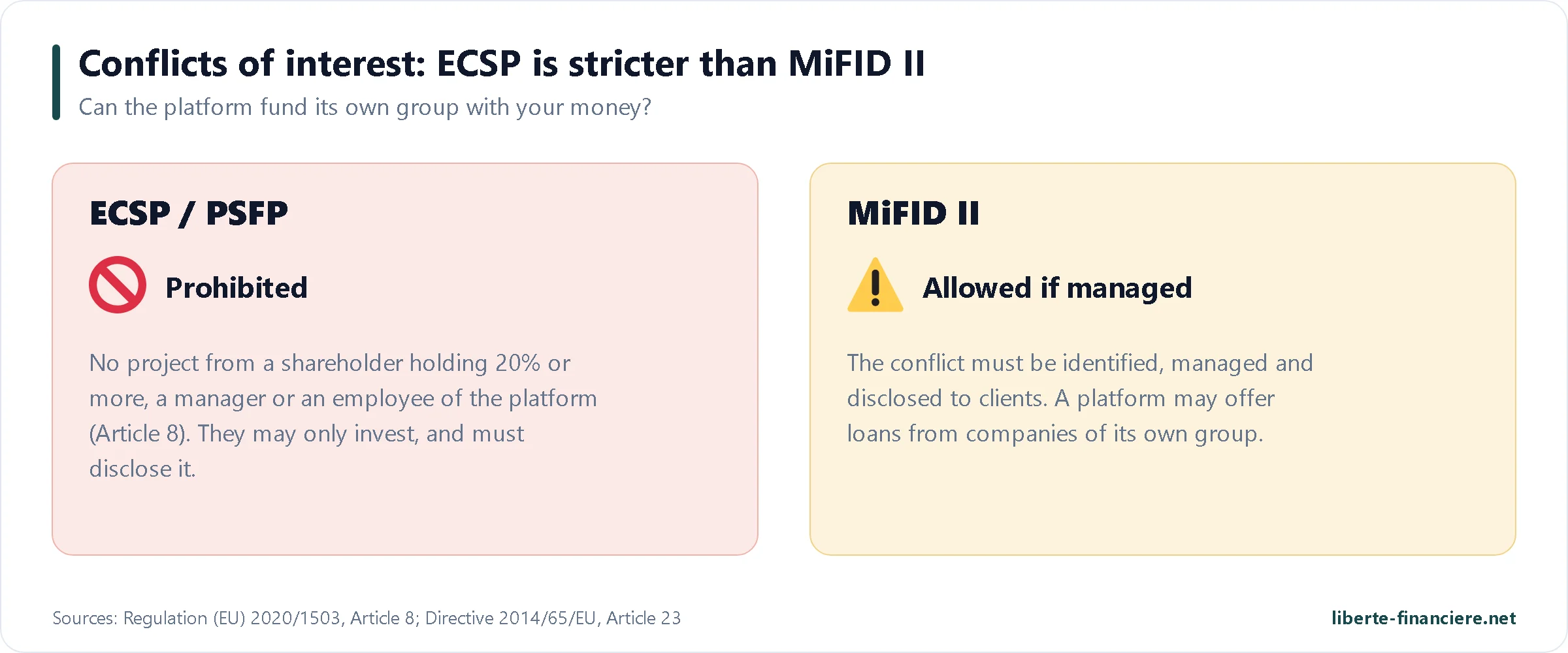
In plain terms: MiFID II can be "higher" in terms of capital and compensation, but ECSP can be "tougher" on set-ups where the platform funds itself through investors. That's why it matters to read both axes in the comparison tool: framework + nature of the contract.
 How to read a loan agreement before investing
Whatever the framework, download the standard agreement or the project sheet and check:
Who your debtor is: the final borrower, the lending company, the platform, an SPV?
Subordination: is it a subordinated loan (you rank behind other creditors) or not?
Buyback guarantee: who commits, within what time frame, with what exclusions (fraud, bankruptcy of the lending company)?
"Unconditional" repayment: a red flag if no risk is mentioned (see the Ventus case).
Governing law and court: Estonia, Latvia, Croatia…
That's exactly the work I did to feed the comparison tool: you can use it as a first pass, then confirm with the contractual PDF.
 Regulatory geography: Latvia, Estonia, Lithuania, Croatia…
Three Baltic countries, three strategies:
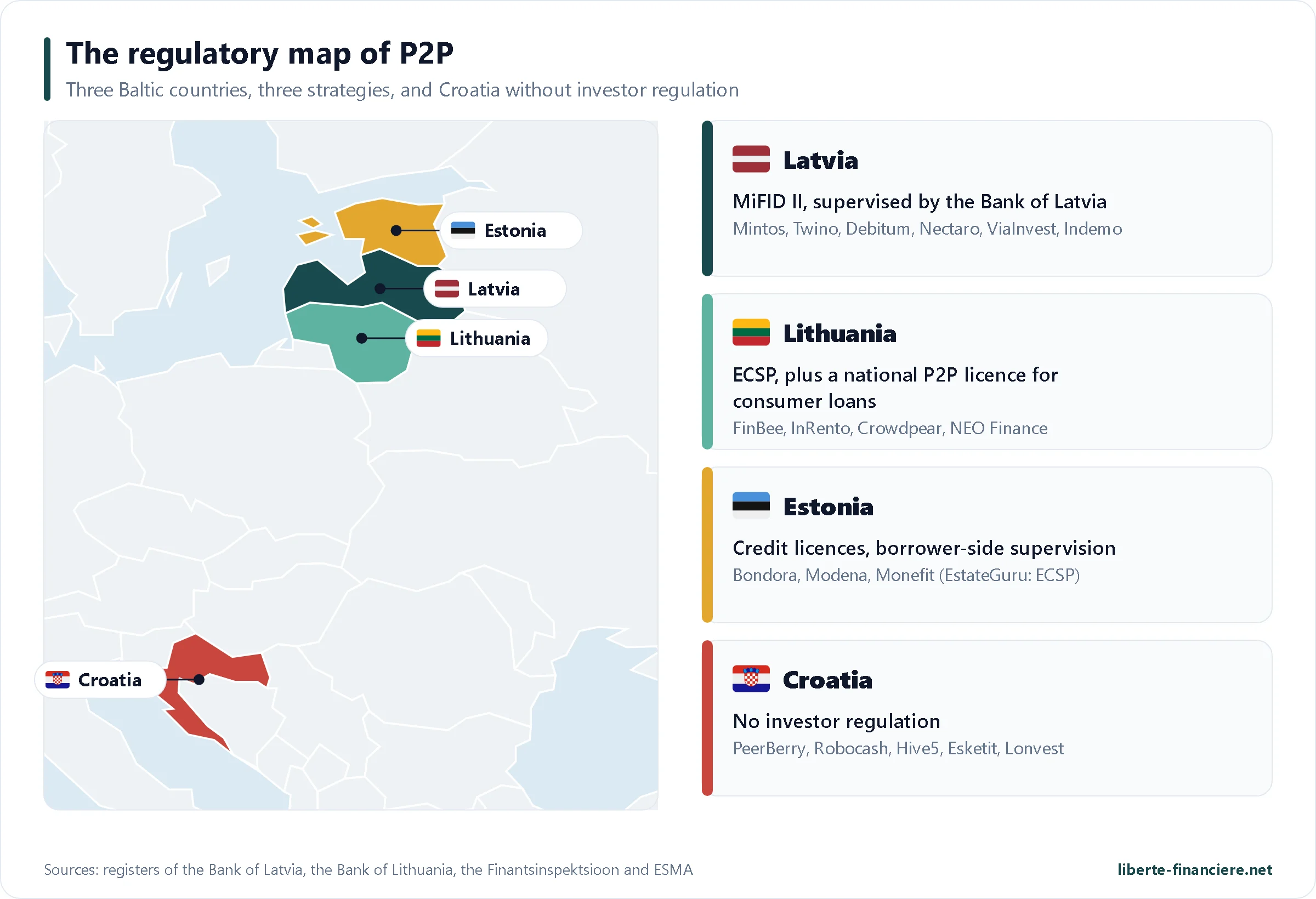
- Latvia: pushed by the central bank towards MiFID II for the historical players.
- Lithuania: electronic money + national P2P licence, then ECSP for business loans.
- Estonia: credit licences on the borrower side + assignment of claims; a few ECSP platforms all the same (EstateGuru).
As for  Croatia, it's now home to many platforms with no investor regulation (PeerBerry, Robocash, Hive5, Esketit, Loanch…). Local law doesn't require it to date: it's not illegal, it's a choice of jurisdiction.
To see which countries each platform lends in, open my world map of P2P.
 Official sources
Regulation (EU) 2020/1503 (ECSP): official text.
Directive 2014/65/EU (MiFID II): official text, and the European Commission page.
Directive (EU) 2023/2225 (CCD2): consumer credit, applicable on 20 November 2026.
AMF, crowdfunding service providers (PSFP): key figures 2024.
Regulators: Bank of Latvia, Finantsinspektsioon (Estonia), FINMA (Switzerland), BaFin (Germany).
Mintos, investor compensation: example of the Latvian scheme (90%, up to €20,000).
 Frequently asked questions about P2P crowdlending regulation
What's the difference between MiFID II and ECSP?
MiFID II governs the distribution of financial instruments (notes, bonds…) with broker-level requirements and possible compensation (90% of the loss, up to €20,000) if the platform goes bankrupt. ECSP is designed for crowdfunding (crowdfunding loans, equity…) with a KIIS, a reflection period and bans on conflicts of interest. Both protect the investor, but along a few different axes.
Are PSFP and ECSP the same thing?
Yes: PSFP is simply the French name for the European ECSP status, granted in France by the AMF. Bienprêter and La Première Brique are PSFPs; Afranga and Lendermarket are ECSPs in their licensing country.
Can a regulated platform still make me lose money?
Yes. The licence governs the platform (information, segregation, conflicts), not the repayment by the final borrower. A loan can default even on Mintos or on a French ECSP platform.
Does the €20,000 MiFID compensation cover loan defaults?
No. It covers cases where the investment firm can't return your client assets (platform bankruptcy, serious misconduct). Not investment losses on the underlying loans.
Why are all MiFID II platforms in Latvia?
The history of the local market, the central bank's choices and the legal ecosystem in Riga. And above all, their loans are largely consumer loans to individuals, which ECSP doesn't cover: MiFID II was the only way to be regulated.
What is an assignment of claims?
You buy from a lender (often the company affiliated with the platform) the right to be repaid on a loan that's already been granted. Legally, you're not always within a "regulated investment" framework in the ECSP/MiFID sense.
Does the buyback guarantee make up for the lack of regulation?
No. The buyback guarantee is a promise from the lending company, not a regulatory guarantee. If the lending company goes bankrupt, it may not be honoured.
PeerBerry isn't regulated: is it dangerous?
It's a clearly higher regulatory risk, but not a sentence of default on the loans you've invested in.
As a French investor, am I protected by the AMF on an Estonian platform?
The AMF doesn't directly supervise a platform licensed in Estonia. You depend on the regulator of the licensing country (Finantsinspektsioon in Estonia, Bank of Latvia…) and on the applicable EU law (ECSP or MiFID II passport). In a cross-border dispute, the FIN-NET network can point you to an ombudsman.
What's the 4-day ECSP reflection period for?
It lets non-sophisticated investors cancel their commitment without giving a reason for 4 calendar days. Useful to avoid impulsive decisions, but absent from purely MiFID platforms.
What happened with Ventus Energy? (May 2026)
BaFin considered that the model looked like deposit-taking without a banking licence (contracts with repayment presented as unconditional). On 5 May 2026, it ordered the activity to stop and the sums collected to be repaid: it's a case of legal requalification risk.
Is MiFID II always "better" than ECSP?
Not systematically, even if overall it's a notch above. MiFID II offers compensation up to €20,000 and the broker experience, but ECSP adds the reflection period and stricter bans on conflicts. The "best" framework also depends on the quality of the loans offered under that framework (in particular the nature of the contract).
Can I invest in an Estonian platform from France?
Yes, if the platform accepts French residents (KYC). You remain subject to the law of the licensing country for the investment relationship and to French taxation on your income.
Why doesn't Iuvo have an Estonian FSA licence any more?
Iuvo asked for its credit intermediary licence to be withdrawn in 2022. The platform carries on with an assignment model without any ECSP/MiFID investor licence, hence a low regulatory score in my comparison tool despite its long track record (details in my Iuvo review).
Does the November 2026 CCD2 directive protect investors?
No. It applies from 20 November 2026 and governs credit granted to individuals, including through peer-to-peer lending platforms: it protects the borrower. Your protection as an investor still depends on MiFID II, ECSP or the contract.
 Conclusion
P2P crowdlending regulation is neither an empty shell nor a guarantee of returns. Above all, it's a procedural protection mechanism: segregation, information, sometimes compensation if the platform fails. MiFID II and ECSP offer the highest level in Europe; Estonian or Croatian assignments of claims rely more on the strength of the lending companies and on the content of the contracts.
To take concrete action: open the P2P comparison tool, watch the video above, check the financial statements of the lending companies and the P2P map, read my reviews (Go & Grow, Twino, Monefit, PeerBerry, Iuvo), diversify, and keep in mind that the risk of capital loss is real everywhere.
And as always, NEVER give up!
Feel free to share your comments via the Contact page or in the YouTube comments under the videos.
Add a comment
A question or your own experience to share? Leave a comment: I reply personally.