
PeerBerry, launched in November 2017 by the lending group Aventus Group, is one of the most closely followed peer-to-peer lending platforms in Europe: €3.6 billion in loans funded, 124,000 users and, which is rare, no losses for its investors in nine years, the war in Ukraine included. I invested my first €2,000 there on 1 August 2024, pulled out in early 2026 in search of higher rates, then came back in February 2026 with my company account: around €63,000 is working there today, which makes it my largest P2P position.
In this review, I cover PeerBerry's history and its link with Aventus Group, the management team, how the loans and the two guarantees work, the platform's accounts (including a 2025 profit down 97%), regulation, statistics, the secondary market, my tips for limiting cash drag, the risks, taxation in France, the comparison with Mintos, Swaper, Robocash and IUVO, and my real return on my two accounts.
This article is not sponsored by PeerBerry. Some links are affiliate links: if you sign up with my link, you get +0.5% extra interest on all your investments during your first 90 days.
 PeerBerry at a glance
Criterion | PeerBerry |
|---|---|
Founded | November 2017, by Aventus Group (a non-bank lending group founded in 2009) |
Company | Peerberry d.o.o., headquartered in Zagreb (Croatia), offices in Vilnius (Lithuania) |
Management | Arūnas Lekavičius, CEO |
Regulation | No investment licence (neither ECSP nor MiFID II): simply a marketplace for loan claims |
Type of investment | Purchase of loan claims: consumer loans, business loans, real estate development and leasing |
Return | Rates of 7.5% to 10% a year depending on the loan originator; 10.99% average historical annual return |
Guarantees | Buyback guarantee on 100% of loans (at the latest after 60 days late) and group guarantee on most of them |
Volume | €3.6bn funded since 2017, €161m outstanding portfolio at the end of October 2026 (+38% since January) |
Investors | 124,254 verified users (October 2026) |
Losses | No losses for investors and no loan in default since launch, according to the platform |
Minimum ticket | €10 per loan |
Term | From a few days to 4 years; most short-term loans last less than 30 days |
Liquidity | Frequent repayments; free secondary market since January 2026 (resale after 180 days) |
Fees | None: no deposit, withdrawal, management or secondary market fees |
Withholding tax | None |
Trustpilot | 3.6 / 5 from 265 reviews (5 November 2026) |
Bonus | +0.5% for 90 days, then a loyalty programme of up to +1%; see my PeerBerry bonus code page |
PeerBerry belongs to the family of loan marketplaces, like Mintos or Robocash: you do not lend directly to a borrower, you buy part of a loan already granted by a loan originator, which undertakes to buy it back if it falls into arrears. What sets it apart is its caution: rates a little lower than the competition, but a track record without a single loss. You can compare its regulatory framework with that of other platforms in my P2P comparison (regulation view).
Open a PeerBerry account Sign up in less than 5 minutes, from €10, +0.5% for 90 days with my link. |
 My video: why I came back to PeerBerry
If you prefer video, here is my review recorded in June 2026, when rates went up: the platform's strengths, the group guarantee, the loyalty programme and my tips for getting the robot to invest all your money. This article goes further, with the 2025 accounts, the breakdown of the outstanding portfolio and my figures updated to 5 November 2026.
 From 2017 to 2026: the history of PeerBerry
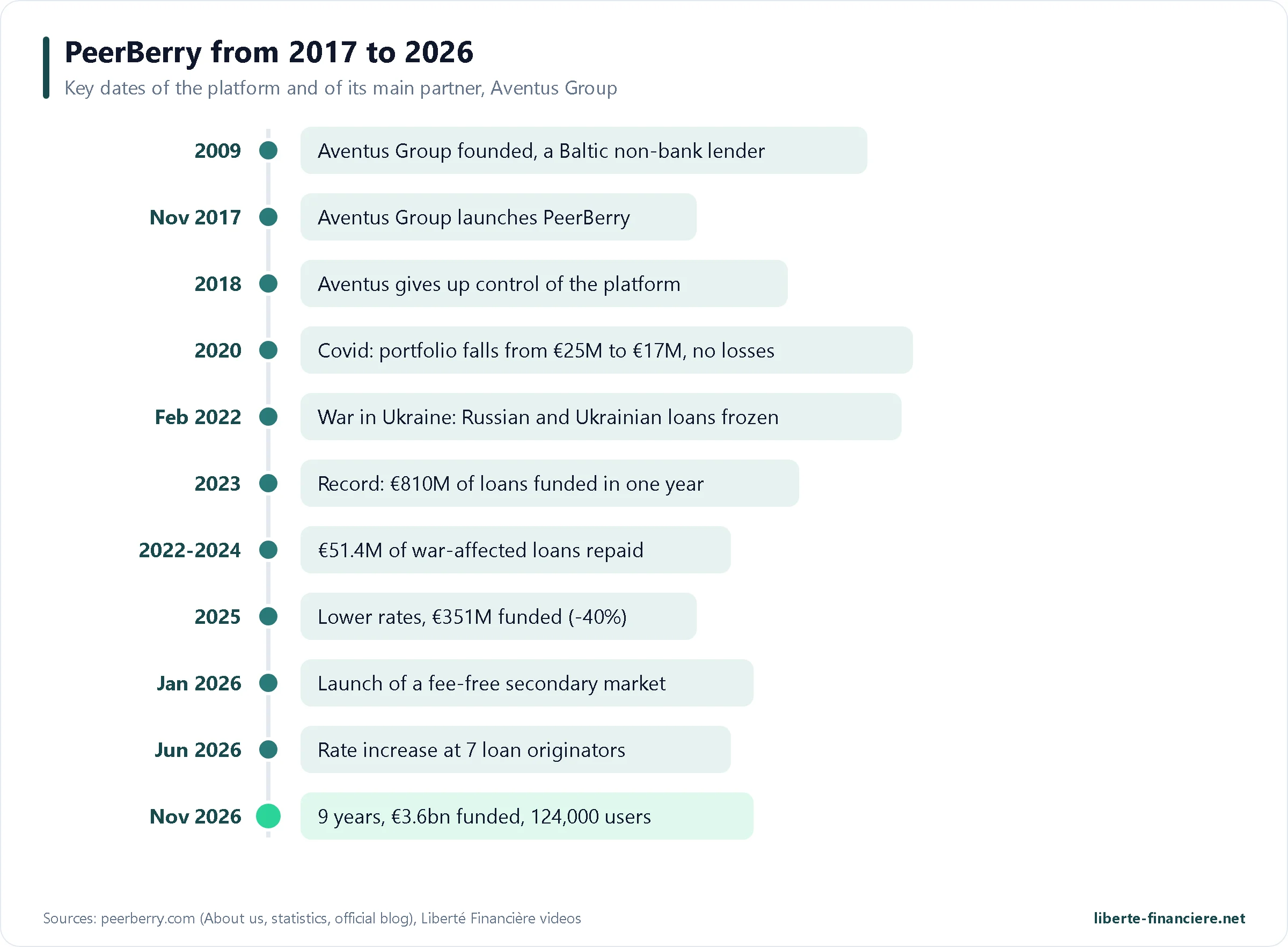
To understand PeerBerry, you have to start with Aventus Group. Founded in 2009 in the Baltic states, this non-bank lending group first funded its loans by offering them to investors on other marketplaces, including Mintos. In November 2017, it launched its own platform: PeerBerry. The following year, Aventus gave up control of it; today, PeerBerry presents the group as its "largest business partner", not as its parent company.
Growth was fast: €46m of loans funded in 2018, €145m in 2019. In 2020, the Covid crisis pushed the outstanding portfolio down from €25m to €17m in the spring, without any loss for investors. The platform bounced back even stronger in 2021, with €566m funded and an outstanding portfolio above €85m.
February 2022 was the real test. Some of the loans had been granted in Ukraine and Russia: overnight, they stopped being repaid. Rather than letting investors bear the loss, the Aventus Group companies triggered the group guarantee and repaid these loans in instalments. In total, €51.4m of loans affected by the war were repaid in full, principal and interest. This episode is what built PeerBerry's reputation. In 2023, the platform broke its record with €810m of loans funded in the year.
Then came two quieter years. As central banks cut rates, PeerBerry lowered its returns, and volume fell: €586m in 2024, then €351.5m in 2025 (-40%). Many investors, me included, left to look for better elsewhere. On 15 January 2026, the platform finally launched a fee-free secondary market, then on 3 June 2026 raised the rates of seven loan originators (up to 10%). The effect was immediate: the outstanding portfolio went from €116m in January to €161m at the end of October 2026. In early November, PeerBerry celebrated its 9th birthday.

 PeerBerry's management team
 Arūnas Lekavičius (LinkedIn) runs PeerBerry: he is the platform's CEO and the director of Peerberry d.o.o., whose annual accounts he signs. He has spent more than fifteen years in finance, first at Scandinavian banks and then in fintech, specialising in risk management. He is the one behind the platform's cautious approach: few new loan originators, moderate rates, and regular communication with investors.
Around him, the team presented on the official website is deliberately small:
Rita Simanavičiūtė (LinkedIn), head of marketing and communication, more than 20 years of experience, 17 of them at Scandinavian and Baltic banks. She is the one who answers investors in PeerBerry's Telegram group, almost every day.
Tadas Bulota (LinkedIn), lawyer and head of compliance, founder of the law firm Bulota Legal and an anti-money laundering specialist (ACAMS certified).
Viktar Kamiahin (LinkedIn), chief technology officer, more than 15 years of software development in fintech.
 On the partner side, the key figure is Andrejus Trofimovas (LinkedIn), founder and CEO of Aventus Group since 2009. Under his leadership, the group has grown from a Baltic lender into a network present in more than 22 countries, with more than 5,000 employees. He received several professional awards in 2026, including "FinTech CEO of the Year, Europe". For you, he is the one who matters most: most of PeerBerry's loans and the group guarantee depend on the health of his group.
One thing worth knowing: on paper, Peerberry d.o.o. has only one part-time employee and uses outside contractors for everything else, according to its 2025 annual report. There is nothing illegal about this set-up, but it explains why most of the platform's costs appear as "external services"; I come back to this in the section on the accounts.
 How does PeerBerry work?
In principle, the platform is a marketplace for loan claims. A loan originator grants a loan to a borrower, in Mexico, South Africa or Lithuania for example. It then lists this loan on PeerBerry to refinance it. When you invest €10, you legally buy part of the claim: an assignment agreement is concluded between you and the loan originator. The borrower keeps repaying the loan originator, which passes your share on to PeerBerry, which credits it to your account.
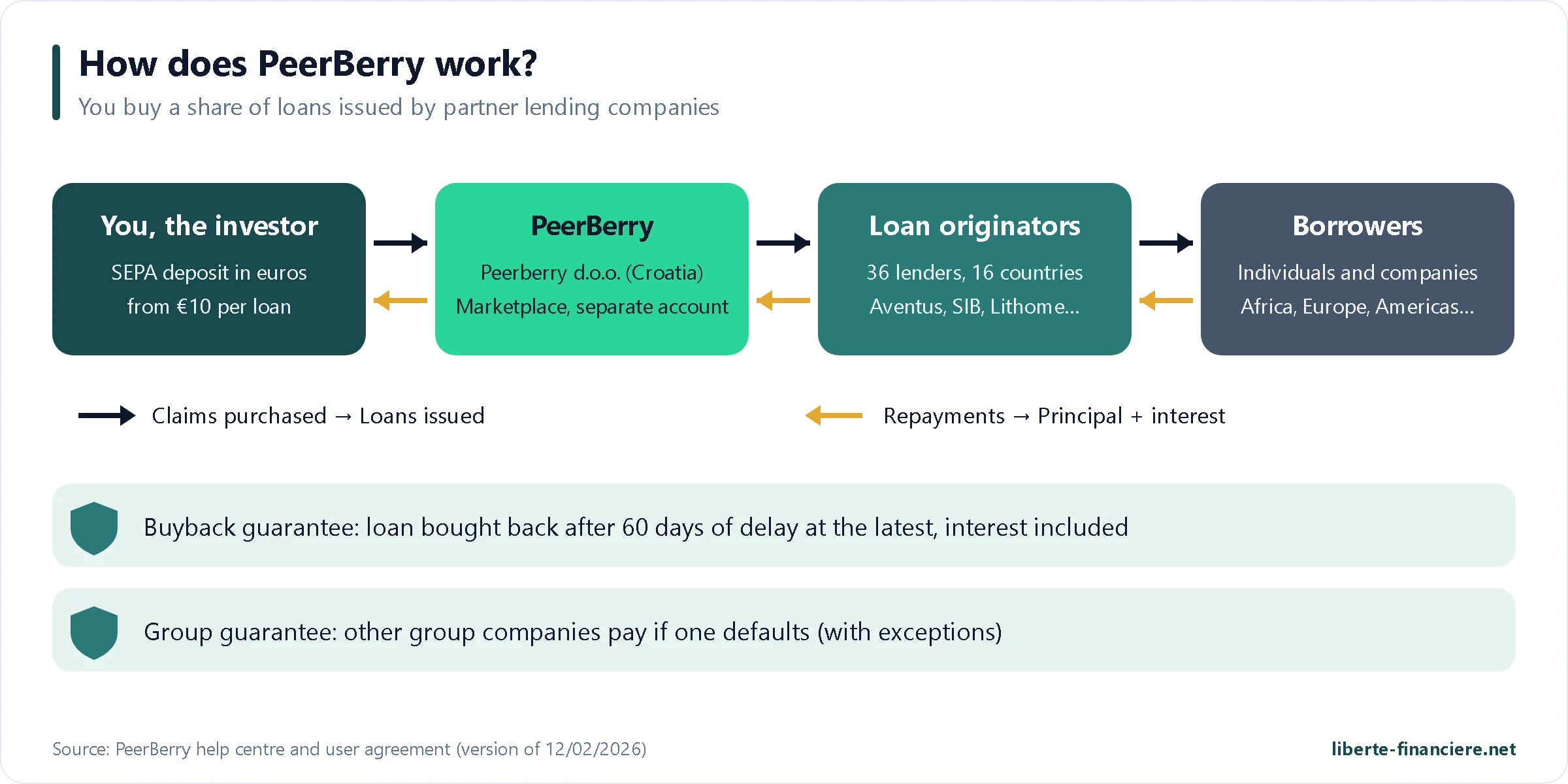
Your uninvested money is held in PeerBerry bank accounts kept separate from its own funds: according to the terms and conditions, it does not appear on the company's balance sheet as its own money. These funds earn no interest as long as they are not invested, hence the importance of setting up your automatic investment properly.
The 5 types of loans on offer
Type of loan | Term | Current rates | Share of outstanding portfolio |
|---|---|---|---|
Short-term (consumer credit) | Up to 180 days, most under 30 days | 8.5% to 10% | 24.1% |
Long-term (consumer credit) | From 180 days to 4 years | 8% | 3.7% |
Business | From 90 days to a few years | 7.5% to 9% | 20.0% |
Real estate (development in Lithuania and Spain) | 1 to 2 years remaining | 8% to 9% | 50.7% |
Leasing (car loans in Kazakhstan) | 3 to 12 months remaining | 8.5% | 1.5% |
So half of the outstanding portfolio is real estate, mainly development projects in Vilnius run by SIB Group and Lithome. These are not the loans most investors come for, and they are the ones that do not benefit from the group guarantee. Short-term loans, on the other hand, went from 7% of the outstanding portfolio in January 2026 to 24% at the end of October: this is the fastest-growing segment and the one I invest in.
36 loan originators in 16 countries
At the end of October 2026, 36 loan originators list their loans on PeerBerry, split into five groups: Aventus Group (the vast majority, from Moldova to Australia), Gofingo Group (Lithuania, South Africa), SIB Group and Lithome (real estate development in Vilnius) and Litelektra (wind energy in Lithuania). The newcomers of 2026 are mostly short-term lenders: Credit365 in Australia, TuParcero in Colombia, Jabulanimoney and Crediflow in South Africa, Paydayloanplus in Canada, and soon TunaiPantas in Malaysia.
The main loan originators by outstanding portfolio
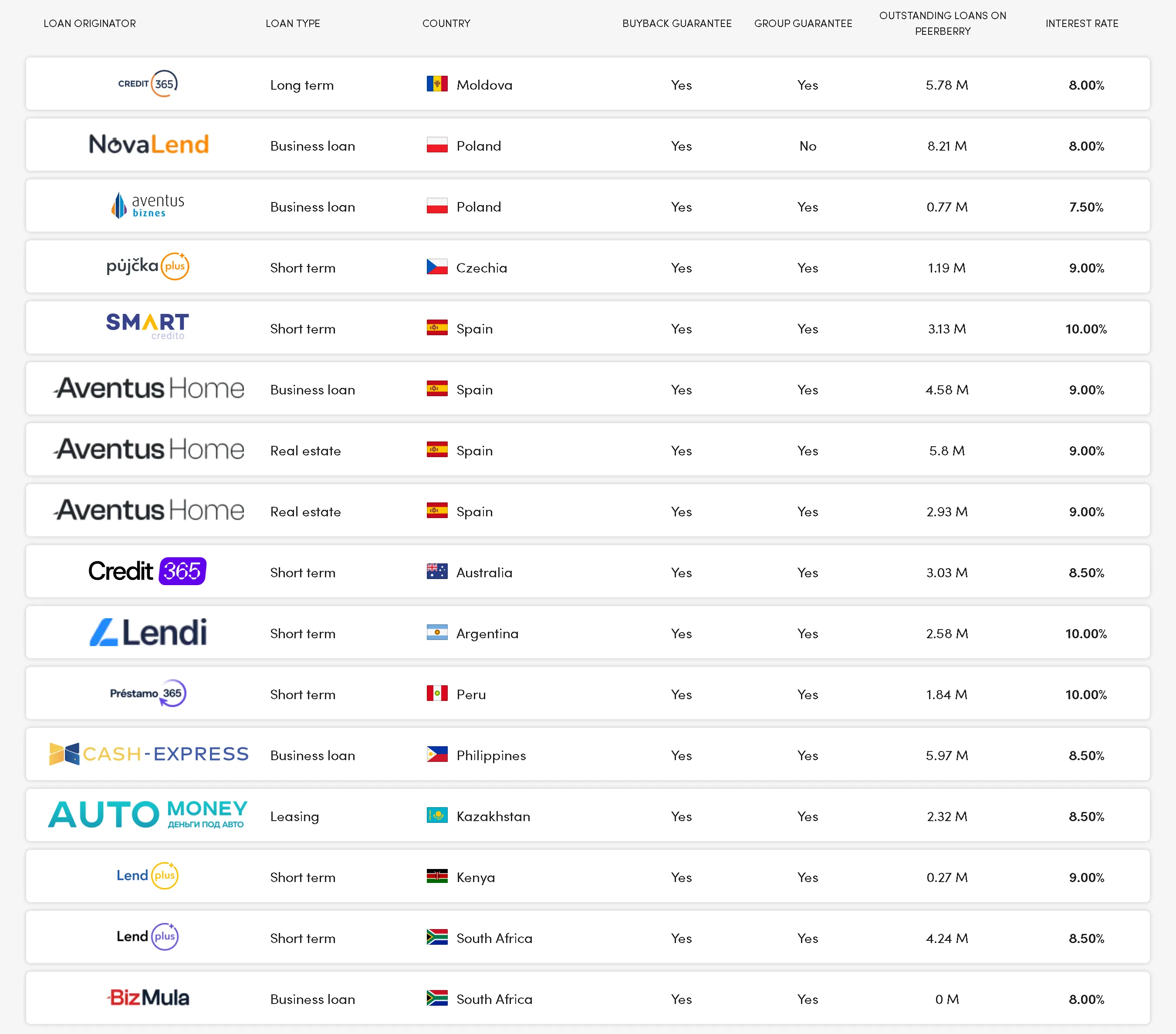
Here are the fifteen companies that weigh most in PeerBerry's outstanding portfolio on 5 November 2026 (their group in brackets). The top four have no group guarantee:
Loan originator | Country | Type of loan | Group guarantee | Outstanding | Rate |
|---|---|---|---|---|---|
Si Baltic (SIB Group) | Lithuania | Real estate | No | €43.8m | 8% |
Lithome | Lithuania | Real estate | No | €18.6m | 8.5% |
Pakrantės būstas (SIB Group) | Lithuania | Real estate | No | €10.6m | n/a |
NovaLend (Aventus) | Poland | Business | No | €8.2m | 8% |
Cash-Express (Aventus) | Philippines | Business | Yes | €6.0m | 8.5% |
Aventus Home | Spain | Real estate | Yes | €5.8m | 9% |
Credit365 (Aventus) | Moldova | Long-term | Yes | €5.8m | 8% |
Litelektra | Lithuania | Business (wind power) | Yes | €4.3m | 8.5% |
CrediWise (Aventus) | South Africa | Short-term | Yes | €4.3m | 8.5% |
LendPlus (Aventus) | South Africa | Short-term | Yes | €4.2m | 8.5% |
Prime Loans (Aventus) | South Africa | Short-term | Yes | €4.2m | 8.5% |
Credito365 (Aventus) | Colombia | Short-term | Yes | €3.8m | 10% |
SmartCredito (Aventus) | Spain | Short-term | Yes | €3.1m | 10% |
Credit365 (Aventus) | Australia | Short-term | Yes | €3.0m | 8.5% |
Credito365 (Aventus) | Mexico | Short-term | Yes | €3.0m | 10% |
This table clearly shows the two faces of PeerBerry. On one side, a handful of large Lithuanian real estate loans, without a group guarantee, which account for almost half of the money. On the other, a long list of Aventus Group short-term lenders, each with a few million euros outstanding, spread across three continents. It is this second group that has built the platform's reputation, and it is the one I choose.
You can find each company, its country, its guarantees and its rate on the official loan originators page. Their accounts, when they are published, are also on my P2P financial statements page: Credit365 in Moldova, Findom in Kazakhstan, LendPlus in Kenya and South Africa, NovaLend in Poland, SmartCredito in Spain, Lithome in Lithuania.
The buyback guarantee: at the latest after 60 days
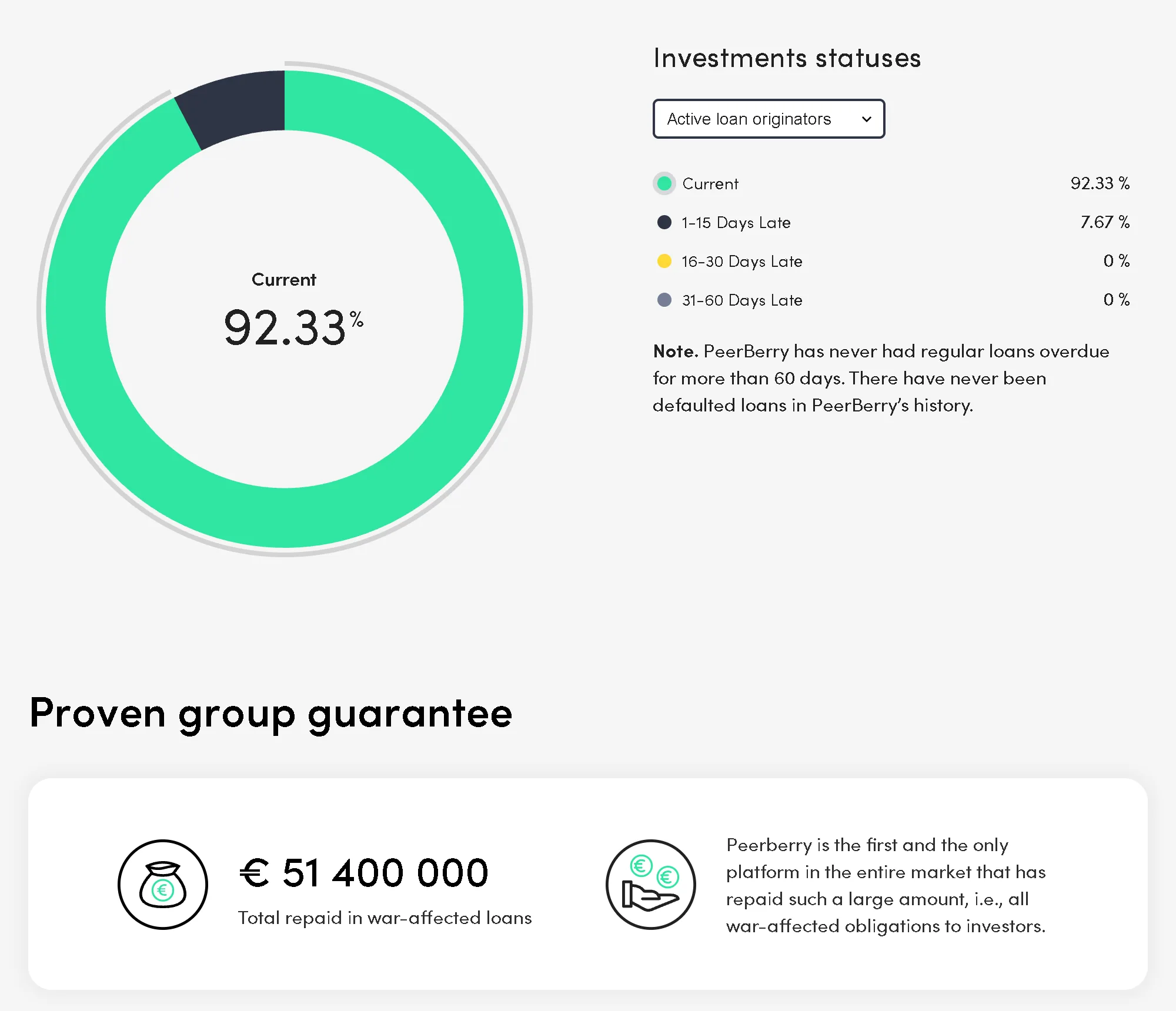
All PeerBerry loans come with a buyback guarantee: if the borrower is more than 60 days late, the loan originator buys back your claim, principal and interest included, interest for the late period included too. In practice, delays are very short: on 5 November 2026, 92.33% of investments are current, 7.67% are between 1 and 15 days late, and none is more than 15 days late. PeerBerry says it has never had a normal loan more than 60 days late.
This guarantee is only worth as much as the loan originator behind it: if it goes bankrupt, it can no longer buy back. That is where the second layer of protection comes in.
The group guarantee: the real safety net
The two main partner groups, Aventus and Gofingo, have signed cross-guarantee agreements with their loan originators: if one of them becomes insolvent, the other companies in the group take over its obligations towards investors. This guarantee worked for real in 2022 with the Ukrainian and Russian loans. The terms do, however, state that both guarantees may be "affected in the event of force majeure".
Be careful, it does not cover all loans: the real estate loans from SIB Group and Lithome, and the business loans from NovaLend in Poland, do not benefit from it. These three companies alone account for around €81m, or half of the outstanding portfolio. In the investment filter, tick "group guarantee" if you want to exclude them: that is what I do.
What the group guarantee contract says
The group guarantee rests on internal agreements signed between Aventus Group companies (the "Group Guarantee Agreements"). These contracts are not public: Aventus reserves the right not to disclose them, and PeerBerry, which holds a copy without being a party to them, is not allowed to publish them. You are not a party to these agreements either, and PeerBerry's user agreement does not mention the group guarantee: you could not invoke it yourself in court.
What we know about it comes from an interview with Andrejus Trofimovas published by PeerBerry in November 2020:
It only applies if a loan originator cannot honour its buyback guarantee: a "guarantor" company of the group then takes over its obligations.
It is not a parent company guarantee but a web of cross-guarantee contracts: every relatively new company active in P2P has signed them with at least two profitable companies of the group. In 2020, the Polish and Ukrainian companies played the largest role.
According to the CEO, every company of the group takes part, including those that do not raise funds through P2P.
Aventus does not publish consolidated accounts: in his words, consolidating and auditing them would cost too much given the differences in laws and taxes between countries, some companies are partly co-owned by other entities, and nothing requires it (no bonds issued, no stock market listing). Only the individual companies are audited, under the law of their country.
For you, the group guarantee is therefore worth mostly the trust you place in the group and its track record, in particular the €51.4m repaid after the war in Ukraine began, which PeerBerry presents as proof that it works. The group's figures (€95.7m net profit in 2025, €225.7m of equity at the end of 2025) are self-reported. To judge for yourself, I have gathered the 2025 accounts of more than twenty loan originators active on PeerBerry on my P2P financial statements page.
Invest with two guarantees Buyback guarantee on 100% of loans, group guarantee on most: it is up to you to filter. |
 Aventus Group, the partner that matters most
Since the group guarantee rests on Aventus Group, its financial health is, in my view, the first criterion for judging PeerBerry. The group operates in more than 22 countries across Europe, Asia, Africa and the Americas, in lending, real estate and IT. Its companies have granted around €8 billion of loans since 2009, and the group claims 17 consecutive years of profit.
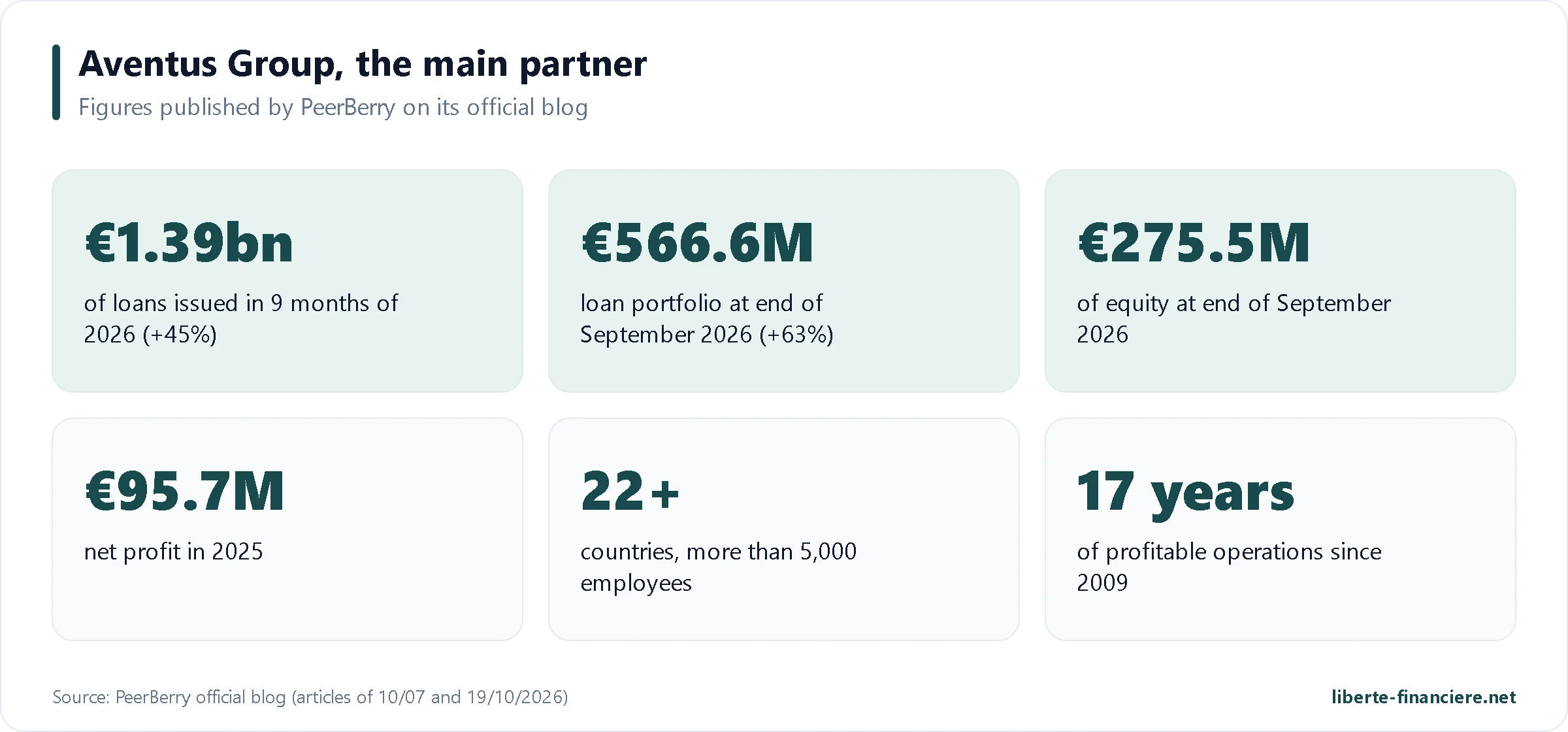
2025: record net profit of €95.7m (around €87m in 2024), for more than €1.3bn of loans granted.
First half of 2026: €49.1m of net profit, €851.6m of loans granted, €231.3m of interest income.
First nine months of 2026: €1.39bn of loans granted (+45% year on year), a loan portfolio of €566.6m (+63% since January) and equity of €275.5m (€225.7m at the end of 2025).
These figures are reassuring on one key point: a group that earns almost €100m a year and has €275m of equity has the means to honour its guarantee on the €80m or so of loans it has on PeerBerry. Two caveats, though. First, these are figures reported by the group itself, and I have not found any published audited consolidated accounts for Aventus as a whole: the group presents itself as a "brand" bringing together separate companies linked by cooperation agreements. Second, portfolio growth of +63% in nine months, with launches in Brazil, Malaysia and Zambia, also increases the risk: we will have to see how these new loans perform over time.
 PeerBerry's financial statements
The company that runs the platform, Peerberry d.o.o., publishes its annual accounts on its website every year. They are not audited by an independent firm. I have imported all of them into my P2P financial statements page:
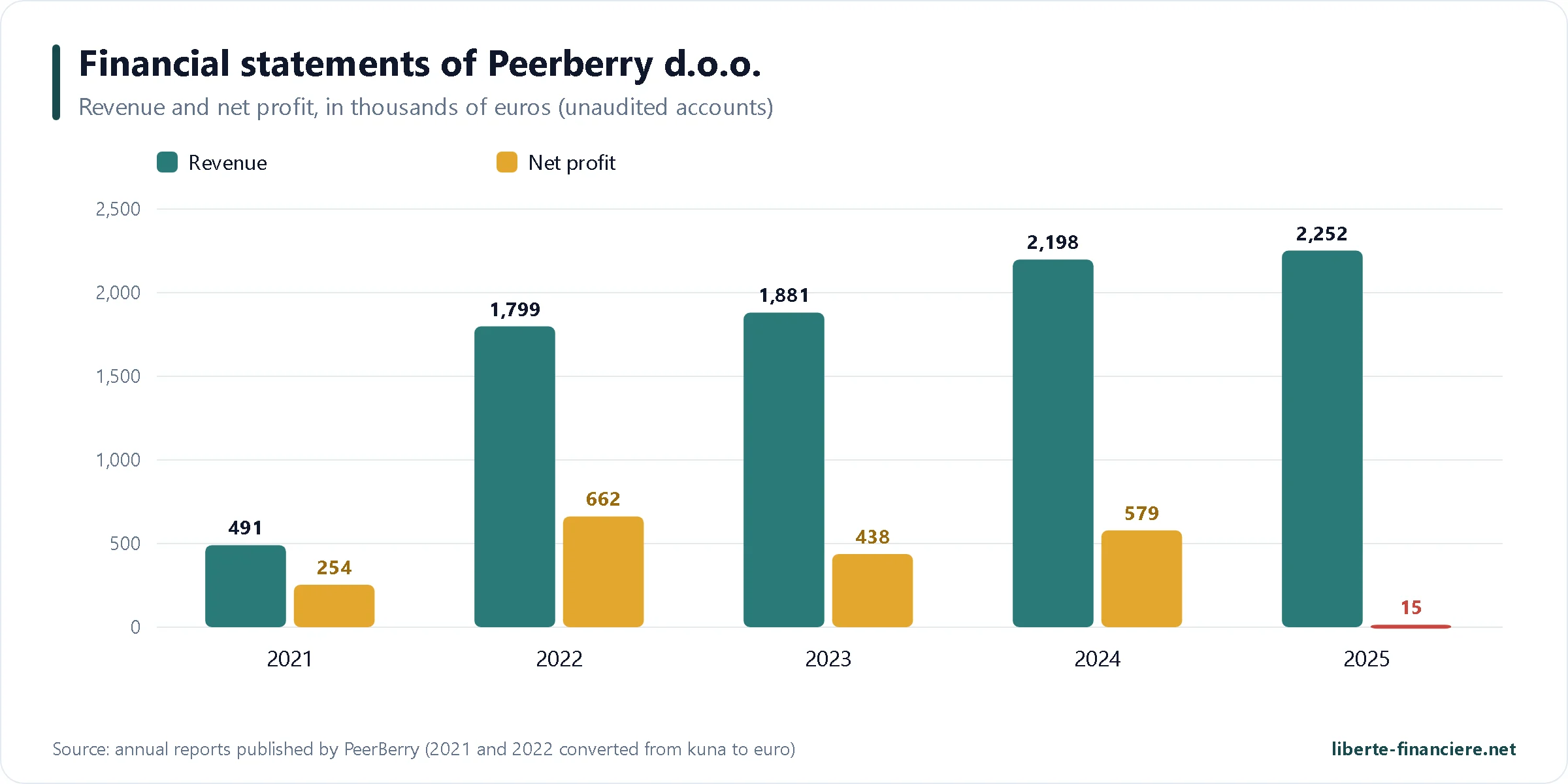
Peerberry d.o.o. (unaudited accounts) | 2023 | 2024 | 2025 |
|---|---|---|---|
Revenue | €1.88m | €2.20m | €2.25m |
External services | €1.74m | €2.41m | |
Profit before tax | €713,000 | €43,000 | |
Net profit | €438,000 | €579,000 | €14,896 |
Equity | €1.36m | €1.94m | €1.95m |
Cash | €3.62m | €3.23m | €2.75m |
Balance sheet total | €10.95m | €15.39m | €5.52m |
2025: profit down 97%
This is the figure that got the community talking this autumn. In 2025, PeerBerry's revenue was stable (€2.23m of sales, +1.5%), but net profit fell from €579,135 to €14,896. The explanation fits in one line: external services rose from €1.74m to €2.41m, i.e. +€671,000. Without this increase, profit before tax would have been around €715,000, in line with 2024: so the platform's core business remains profitable.
What this spending paid for is not detailed in the report, which only gives a generic list (professional services, advertising, intermediation, IT and so on). One explanation is doing the rounds among investors, according to which it was used for two projects unrelated to P2P, but PeerBerry has not confirmed it. I put the question to them in writing on 5 November 2026 and will update this article with their answer.
My takeaways
The reassuring points: stable equity at €1.95m, €2.75m in cash, no bank debt, and revenue that has grown every year since 2021. The liabilities (€3.29m of "other liabilities") correspond to investors' funds in transit on the platform's accounts.
The points to watch: unaudited accounts, a company without a real salaried team, and choices about how it invests its cash that are worth knowing about: a €500,000 loan to the Lithuanian bank Mano bankas, paying 8% until 2029, and €968,000 invested via the Crowdpear platform.
The right perspective: PeerBerry does not guarantee your loans; the loan originators and their groups do. The platform's balance sheet matters mainly for its ability to keep operating over the long term; the financial strength that protects your capital is that of Aventus Group and the other partner groups.
 Regulation and the safety of your money

This is PeerBerry's main weakness on paper: the platform has no investment licence at all. It is neither an investment firm authorised under MiFID II, like Mintos or Nectaro, nor a crowdfunding service provider authorised under ECSP, like Afranga. Peerberry d.o.o. is a Croatian limited liability company that runs a marketplace for loan claims. The terms and conditions are governed by Croatian law, and disputes go before the Croatian courts.
No investor compensation scheme and no deposit guarantee: if the two guarantees are not enough, nothing else protects you.
Uninvested money kept separate: it is held in PeerBerry accounts distinct from its own funds and is not part of its balance sheet.
If PeerBerry went bankrupt: the terms and conditions provide for new investments to stop, the money in your account to be paid back to you, your claims to remain in place (the platform's bankruptcy changes nothing about your rights against the borrower) and for them to be taken over by a third party for servicing.
The loan originators, for their part, are subject to the lending rules of their own country: a moneylender licence in Malaysia, provincial supervision in Canada, and so on.
A lack of regulation does not mean losses: PeerBerry has never made its investors lose money in nine years, whereas some licensed platforms have. But regulation would bring outside oversight that the platform does not have today. To understand the different statuses, read my article on P2P regulation.
 PeerBerry's statistics
PeerBerry publishes a detailed statistics page, updated continuously. The key figures on 5 November 2026:

Indicator | Value |
|---|---|
Loans funded since 2017 | €3,605m |
Outstanding portfolio (active loans) | €161m at the end of October 2026, €116m at the end of 2025 |
Interest paid to investors | €60.06m since 2017, including more than €10m in 2026 |
Average historical annual return | 10.99% |
Verified users | 124,254 |
Loans funded in October 2026 | €45.35m |
Active loan originators | 36 in 16 countries |
Share of the portfolio held by loyal investors (Silver, Gold, Platinum) | 91.7% (July 2026) |
Volume traded on the secondary market | Around €240,000 a month (May to July 2026) |
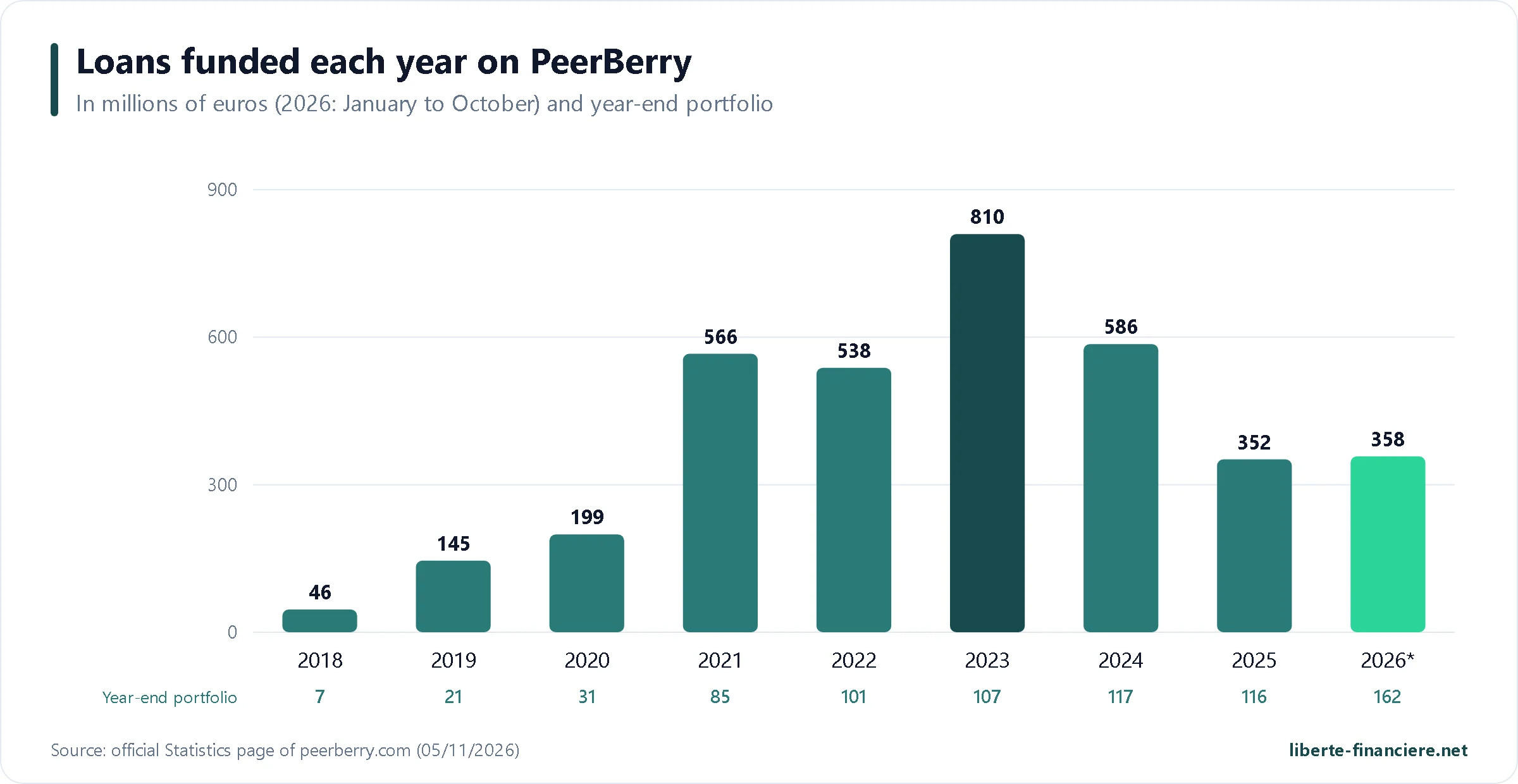
Two lessons. First, activity was more than halved between 2023 and 2025: this is the direct consequence of falling rates, which drove some investors away. The 2026 recovery is clear, with more loans already funded in ten months than in the whole of 2025. Second, the platform relies on a core of large investors: more than 9 euros out of every 10 invested belong to investors with a portfolio of at least €10,000, and portfolios of more than €100,000 add up to €50m.
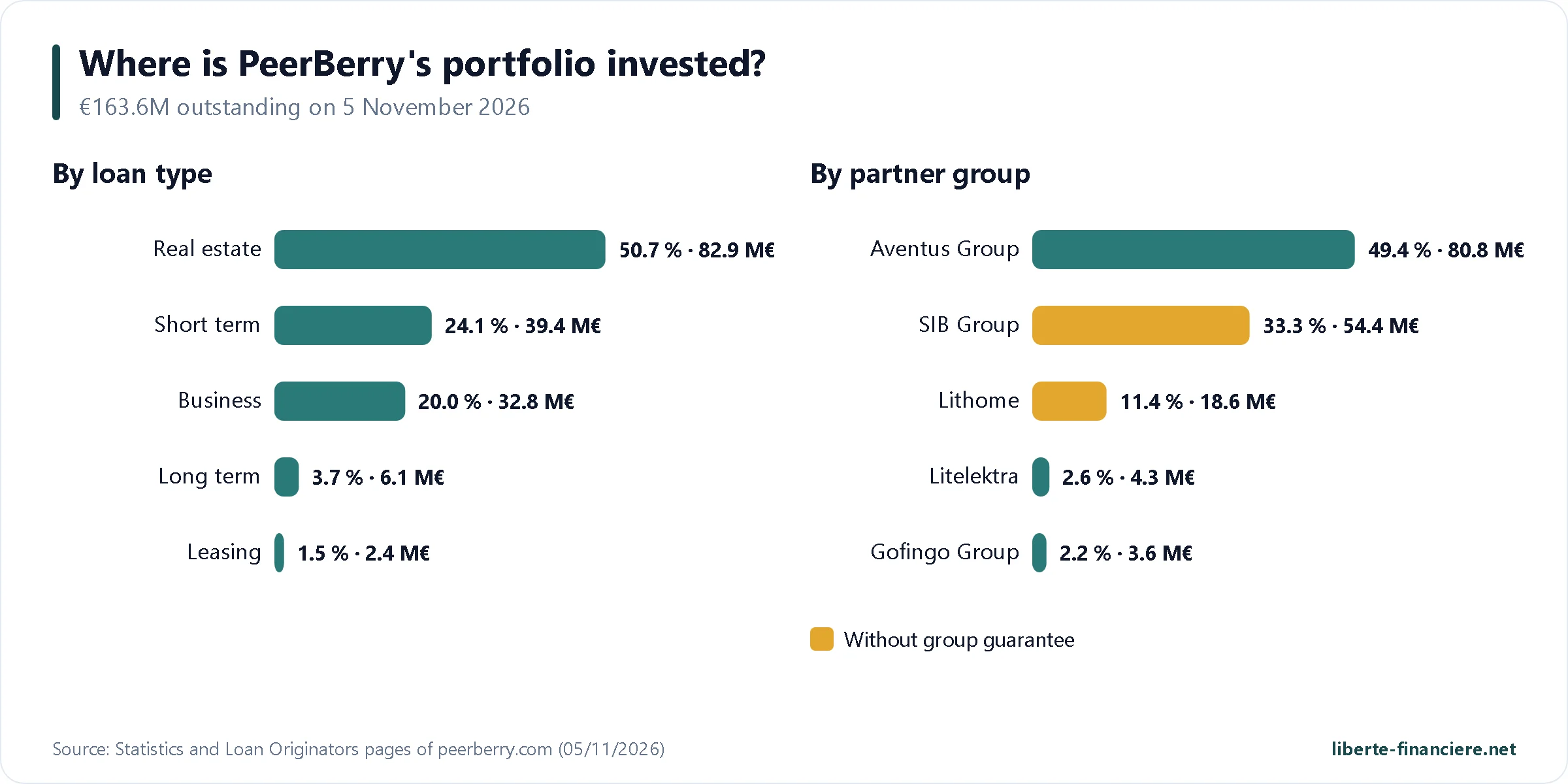
The breakdown of the outstanding portfolio is the figure I watch most closely: 51% of the outstanding portfolio is in Lithuania, almost 90% of it in real estate, and a third depends on SIB Group alone. The geographical diversification PeerBerry highlights (South Africa, Mexico, the Philippines, Australia and so on) is real for short-term loans, but it only shows up in your portfolio if you filter correctly.
 What return can you expect on PeerBerry?
Rates currently range from 7.5% to 10% a year depending on the loan originator. Since the increase of 3 June 2026, short-term loans in Spain (SmartCredito, RealCredito), Argentina (Lendi), Peru (Prestamo365), Mexico and Colombia (Credito365, TuParcero) pay 10%; most other short-term loans pay 8.5% to 9%. Interest is paid at each instalment: with short-term loans, you receive something almost every day.
On top of these rates come two bonuses that follow on from each other over time, applied only to new investments on the primary market:
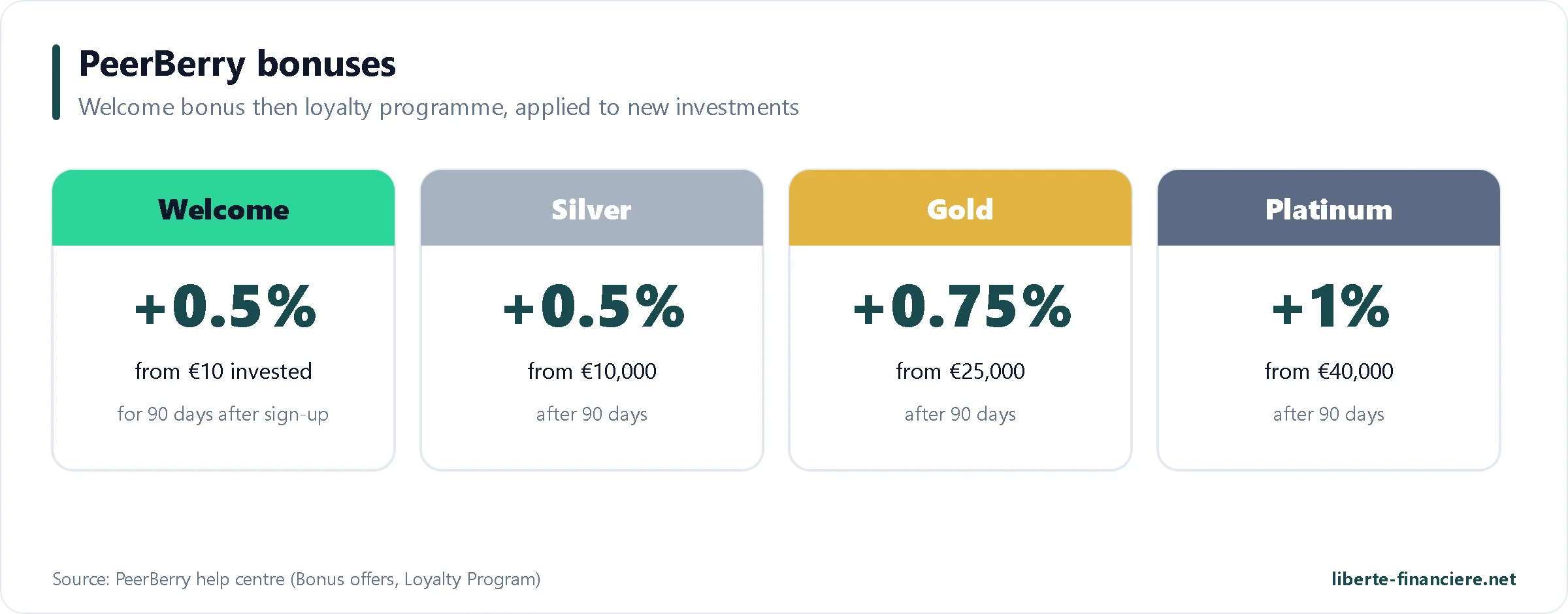
Welcome bonus: +0.5% on all investments made in the 90 days after signing up, provided you verify your identity, then deposit and invest at least €10 within 30 days.
Loyalty programme: after 90 days, +0.5% from a €10,000 portfolio (Silver), +0.75% from €25,000 (Gold) and +1% from €40,000 (Platinum). The portfolio counts both invested money and available money; it is reassessed on the 1st of each month.
In practice, a short-term loan at 10% earns 10.5% during your first three months, then up to 11% if you reach Platinum level. The loyalty level has a second, lesser-known advantage: it gives you priority in the automatic investment queue. Platinum goes before Gold, which goes before Silver.
Bear in mind that the real return is lower than the advertised rate, because of cash drag: repaid money sometimes waits a few days before being reinvested. On my two accounts, my real return is 9.68% and 8.47% (details below).
Simulation: €10,000 invested for 5 years
To give you an idea of scale, here is what €10,000 invested for five years becomes, with interest reinvested, depending on the average rate achieved. The "after tax" column deducts the French flat tax of 31.4% each year (for French tax residents). It is a simple projection: it takes into account neither cash drag nor any possible incident.
Average rate achieved | Capital after 5 years, before tax | Capital after 5 years, after tax | Net gain |
|---|---|---|---|
8% (loans at 8%, a little cash drag) | €14,693 | €13,062 | +€3,062 |
9% (short-term loans at 8.5% or 9% + loyalty) | €15,386 | €13,492 | +€3,492 |
10% (loans at 9% or 10% + Platinum level) | €16,105 | €13,934 | +€3,934 |
Put simply, the difference between a poorly set-up strategy and an optimised one comes to almost €900 net over five years for €10,000 invested. That is why I spend time on my automatic investment settings and aim for the highest loyalty level possible.
+0.5% for 90 days Your welcome bonus applies automatically with my link, no code needed. |
 Signing up to PeerBerry in less than 5 minutes

PeerBerry is open to adult individuals and to companies. You can have a personal account and also represent your company's account, as I do, but money does not move from one to the other: each account is funded from its own bank account.
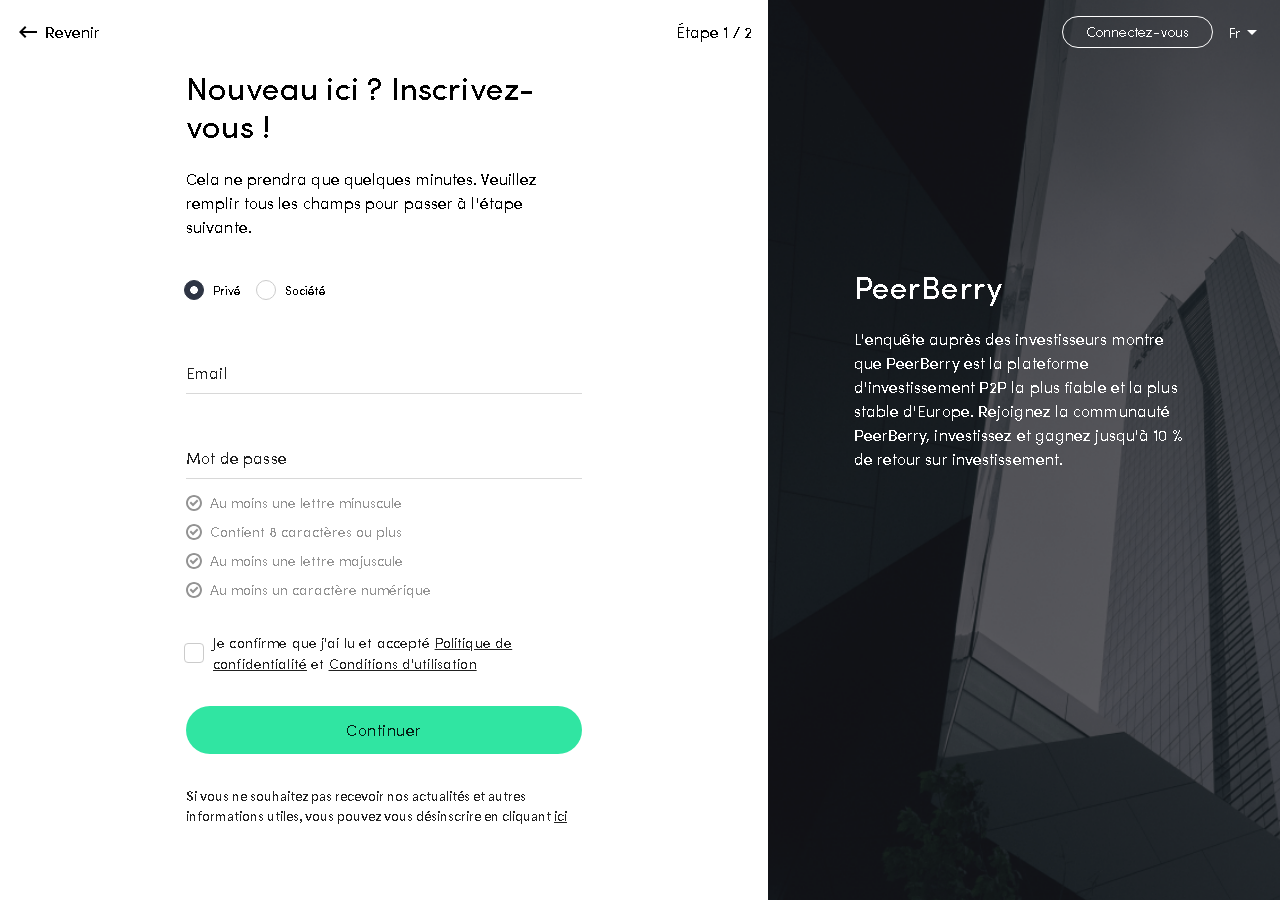
Open the website with my link to get the welcome bonus, then click "Register" and choose your account type (individual or company).
Confirm your email address, then fill in your details and turn on two-factor authentication (authenticator app). You can also sign in with a Google or Apple account.
Verify your identity: a live photo of your identity card or passport (driving licences and residence permits are not accepted) and a selfie. Verification is automatic and takes a few minutes.
Deposit funds by SEPA transfer in euros, putting your investor ID in the payment reference. Bank cards are not accepted; the money arrives within 2 business days at most.
Invest at least €10 within 30 days to activate the +0.5% bonus.
For a company, the procedure is the same, plus an extract from the company register and a document showing who represents the company and who its beneficial owners are, to be sent to support by email.
 Investing on PeerBerry: manual, Auto Invest and my tips
This is the topic people talk about most when it comes to PeerBerry: the platform is in such demand that loans go in a matter of seconds. If you do not set up your investments properly, your money sits idle. Here is how I do it, after two years of use.
Manual investing: the right time slot, in the morning
New loans are mostly published on business days, between 7:40 and 9:00 am (Paris time), in successive waves, one loan originator after another. To invest by hand, save a filter in the "Primary market" tab (up to 10 filters), then refresh the page at that time. PeerBerry's Telegram group, where investors flag each new wave, helps you avoid sitting in front of the screen for nothing.
That is how I invested my first €10,000 in August 2024, over three or four mornings: €500 to €700 on the first day, then €2,000 to €3,000 per morning. And it is still what I did in February 2026 for my company account, in two sessions of 30 to 40 minutes for €10,000. My filter: no real estate, group guarantee required, a rate of at least 8.5%, a term of less than a year.
Auto Invest: a queue you need to understand
Automatic investment works like a queue ("first come, first served"): the date a strategy was created or last modified determines its place, and the queue is processed several times a day. You can start from a ready-made plan (short-term, long-term or real estate) or create your own strategy: loan originators, countries, loan types, rate, remaining term, maximum amount per loan (€50 minimum), portfolio size and amount to leave uninvested.
In practice, a brand-new strategy can take several weeks to really start investing. When I started in 2024, the robot had placed only €117 out of €10,000 in a month. With my company account, the strategies started working after a few weeks, and since I reached Platinum level, my money has been reinvested almost without any wait.
My 5 tips against cash drag
Create several identical strategies (I have five) with broad criteria: each one takes its place in the queue, which multiplies your chances of being served on each pass. PeerBerry's support team is the one that told me about this method.
Do not keep changing your strategies: every change sends you to the back of the queue. If you need to change a criterion, change a single strategy and let the others age.
Raise the maximum amount per loan: with otherwise equal settings, a strategy with a higher amount per loan gets priority.
Aim for a loyalty level: beyond the bonus, Silver, Gold and then Platinum go ahead of the others in the queue.
After a large transfer, invest by hand between 7:40 and 9:00 am for a few days, until the robot takes over.
My current settings: all loan originators with a group guarantee, no real estate, remaining term up to 185 days and a rate of at least 8.5%. That covers around 90% of the companies on the platform. The list needs reviewing from time to time, because new companies are not added automatically to existing strategies.
Try PeerBerry with a small amount From €10 per loan, no fees, with +0.5% for 90 days. |
 Secondary market and liquidity
For eight years, PeerBerry had no secondary market: to get your money back, you had to wait for your loans to end. As they are often short, this was not much of a problem. Since 15 January 2026, you can resell your claims to other investors, from the website only for now (not yet in the app).
No fees, for either the seller or the buyer.
Sale at the remaining price or at a discount of up to 50%; selling at a premium is not possible.
Sale of the whole investment only, offer valid for 14 days, cancellable at any time.
180-day holding period: since the terms and conditions of 12 February 2026, an investment can only be resold 180 days after it was bought, and the same goes for a loan bought on the secondary market.
Claims bought keep their guarantees, but not the welcome and loyalty bonuses.
On launch day, I sold my last three loans (€50, €89 and €9) in a few seconds, without any discount, to close my personal account. Since then, the 180-day rule has changed the picture: for short-term loans, the secondary market is almost useless, since they are repaid before then. It is mainly useful for getting out of long-term loans and real estate loans. With around €240,000 traded per month against €161m of outstanding portfolio, it remains thin.
Withdrawals are simple: you can withdraw your available money at any time, free of charge, from €1 up to €15,000 per request (several requests possible). The withdrawal is processed the same day or the next business day, then the money arrives within 2 business days at most, only to a bank account that has already been used for a deposit. Each withdrawal is confirmed with a code received by email.
 PeerBerry's fees
There are no fees for the investor: none for signing up, depositing, withdrawing, management or the secondary market. PeerBerry earns its money from its partner loan originators, not from investors: that is where its €2.2m of revenue comes from. The only hidden cost is the money that is not working during cash drag, and possibly your bank's charges if it bills for SEPA transfers.
 Covid, war in Ukraine: how PeerBerry came through the crises
2020, the pandemic: the outstanding portfolio fell by a third in the spring, from €25m to €17m. The loan originators kept honouring the buyback guarantee; no investor lost any money.
2022, the war in Ukraine: Ukrainian and Russian loans were placed in a separate category, with delays of more than 180 days. In August 2024, 89% of these remaining loans were still late; the Aventus Group companies repaid them in instalments until they were fully settled. The outcome: €51.4m repaid, principal and interest. Investors waited, sometimes for a long time, but lost nothing.
2024-2025, falling rates: PeerBerry cut its returns in line with central banks, to the point of becoming one of the lowest-paying platforms on the market. Volume fell by 40% in 2025.
2026, shifting rules: new versions of the terms and conditions in January and then February 2026, including the 180-day holding period on the secondary market, only a few weeks after it was launched.
What sets PeerBerry apart is that in every crisis, it was the partner groups that absorbed the shock, not the investors. This is also what makes the group guarantee so important: without it, the story of 2022 would have been very different.
 The risks you need to know

First of all, a reminder: I am not a financial adviser. Every investment carries a risk of capital loss, and past performance is no guide to future performance. Nine years without a loss do not guarantee the next nine.
Capital loss: if a loan originator and its group could no longer pay, or in the event of force majeure (which the terms and conditions explicitly provide for), you could lose all or part of your capital. No compensation scheme covers you.
Illiquidity: your money is locked in until each loan is repaid, from a few days to four years. The secondary market is only accessible after 180 days of holding and remains not very active.
Geopolitical risk and concentration: 2022 showed it, a war can freeze loans overnight. Short-term loans are granted in emerging countries (South Africa, Kenya, Kazakhstan, the Philippines, Latin America), which are exposed to political and currency crises. And half of the outstanding portfolio is concentrated in Lithuania, with a handful of developers.
On top of these three basic risks come those specific to PeerBerry:
Dependence on Aventus Group: around half of the outstanding portfolio and almost all of the short-term loan supply come from this group. Its figures are published by the group itself, with no audited consolidated accounts available.
Loans without a group guarantee: SIB Group, Lithome and NovaLend, around €81m in total, rely only on the buyback guarantee of the company itself. If you invest in these loans, you are taking on property developer risk.
The lack of regulation: no supervisor oversees the platform, and its accounts are not audited.
A platform without much of a team: one part-time employee and contractors, a 2025 profit of almost zero, and spending that has not been explained to date.
Indirect currency risks: you invest in euros, but the loan originators collect in rand, tenge or pesos. A sharp devaluation weighs on their ability to buy back the loans.
My rule: do not put money you might need quickly on PeerBerry, or on any P2P platform, and spread your capital across several platforms and several lending groups.
 PeerBerry taxation in France
PeerBerry deducts no withholding tax: the platform withholds nothing from your interest, and there is nothing to reclaim on the Croatian side. In France, for French tax residents, interest is subject to the flat tax of 31.4% (12.8% income tax and 18.6% social contributions), or to the progressive income tax scale if that works out better for you.
Declare the interest on French forms 2047 and 2042, and your foreign account on form 3916 (one PeerBerry account per line).
Download the tax statement from the "Statement" section of your account: you choose the dates (the calendar year), then generate and download the document that gives the amounts to report.
Monthly return (form 2778-SD): since nothing is withheld at source, in France you may be required to declare the interest every month and pay the advance tax as you go, depending on your reference taxable income. Practice varies from one tax office to another: ask your tax office in writing. For my part, I file this monthly return.
Through a company: the interest goes into the company's taxable profit (French corporation tax). That is the case for my PeerberryPro account, booked as an investment of my company's cash.
The advantage of this "deferred" taxation is that your interest is reinvested in full throughout the year, which slightly improves your compound return. All the steps are detailed in my guide how to declare your P2P income for tax and in my article on withholding tax in P2P.
 PeerBerry against other lending platforms
To compare like with like, I first put PeerBerry up against platforms with the same model: unlicensed marketplaces where you buy claims on consumer loans backed by a buyback guarantee. The returns are my real XIRR excluding bonuses, calculated on my own transactions as at 4 November 2026.
|
|
|
| |
|---|---|---|---|---|
Headquarters |
|
|
|
|
Licence | None | None | None | None |
Type of contract | Assignment of claims | Assignment of claims | Assignment of claims | Assignment of claims |
Lenders | 36 companies, 5 groups | Robocash group | Several loan originators | Wandoo Finance group |
Withholding tax | 0% | 0% | 0% | 0% |
Automatic investment | Yes | Yes | Yes | Yes |
My XIRR excluding bonuses | ||||
|
 Robocash
 IUVO
 Swaper
 Croatia
 Estonia
PeerBerry earns a little less than Swaper, and about as much as Robocash and IUVO. What makes the difference is diversification (36 companies and five groups, against a single group at Robocash or Swaper), and the track record: no other platform in the table has repaid the equivalent of €51.4m of loans hit by a war. I covered IUVO in detail in my IUVO review.
If the lack of a licence bothers you, here are the regulated platforms I use for the same type of loans, with more legal protection but often a withholding tax:
|
|
|
| |
|---|---|---|---|---|
Headquarters |
|
|
|
|
Licence | MiFID II (Bank of Latvia) | MiFID II (Bank of Latvia) | ECSP (Bulgaria) | ECSP (Ireland) |
Type of contract | Financial instrument | Financial instrument | Crowdfunding loan | Crowdfunding loan |
Investor compensation | Up to €20,000 | Up to €20,000 | No | No |
Withholding tax | 5% | 5% | 10% | 0% |
My XIRR excluding bonuses | ||||
|
 Mintos
 Nectaro
 Afranga
 Lendermarket
 Latvia
 Bulgaria
 Ireland
These regulated platforms have earned me more than PeerBerry, within a more protective framework, but with less of a crisis track record and, for Afranga and Lendermarket, dependence on a single lending group. I combine them: PeerBerry is my "cautious" pot, the others my "yield" pot. All the offers are on my bonus and referral page.
 My experience in figures: €63,000 invested
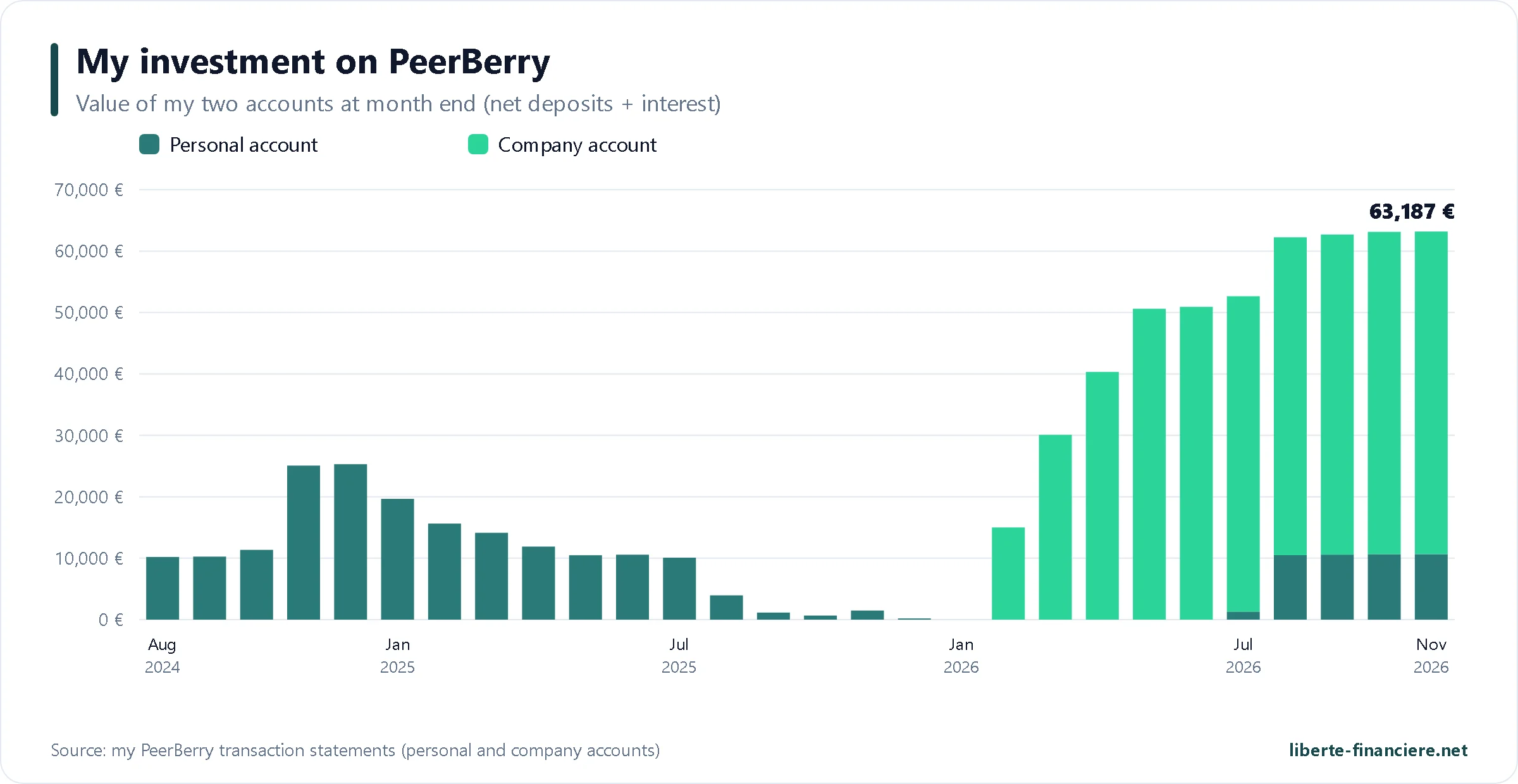
I have two accounts on PeerBerry: my personal account, opened on 1 August 2024, and my company's account, opened in February 2026. Here is how they have developed, rebuilt from my transaction statements:
Personal account: €2,000, then €25,000, then the comeback
I started with €2,000 on 1 August 2024, invested by hand in short-term loans at 9.5% to 10.5%, mainly in Kenya, South Africa, Mexico and Kazakhstan. Three weeks later, I was at €10,203 to reach Silver level. I kept adding money in November 2024: €27,810 in total, for an account that went past €25,000.
In 2025, rates fell: at the time I was looking for more than 10% on my personal account, and I withdrew my money as loans were repaid, from January 2025 to January 2026. On 15 January 2026, I sold my last three loans on the new secondary market and withdrew the remaining €162.83. Then, a few weeks after the June rate increase, I came back: €10,497.59 paid in between 22 July and 14 August 2026.
Company account: €50,000 for a more wealth-oriented approach
In my company, I am looking for a calmer approach, around 7% to 9% gross, with short-term loans to keep some flexibility. PeerBerry suits this well. I paid in €50,000 between 10 February and 25 May 2026, in six transfers. In the first few weeks, I had to invest by hand, while my automatic strategies moved up the queue. Since the summer, with Platinum level (+1%), the robot invests almost everything as soon as the money comes back.
As at 5 November 2026 | Personal account | Company account | Total |
|---|---|---|---|
Opened | 1 August 2024 | 10 February 2026 | |
Account value | €10,651 | €52,536 | €63,187 |
Interest received since opening | €1,651 | €2,536 | €4,187 |
Interest for October 2026 | €55 | €382 | €437 |
Loans bought | 1,116 | 1,274 | 2,390 |
Losses | €0 | €0 | €0 |
My XIRR (excluding bonuses) |
Those €437 of interest in October come to around €15 a day, before tax. The company account earns a little less than the personal account: it started with loans at 8% to 9%, before the June increase, and I accepted a few weeks of cash drag at the beginning. My personal XIRR, for its part, benefits from the higher rates of 2024 and from the welcome bonus.
One detail struck me while preparing this article: on my two accounts, 79% to 87% of the capital repaid was repaid through the buyback guarantee, in other words by the loan originator, and not directly by the borrower on the due date. There is nothing abnormal about this with short-term loans, where small delays are common, and I have always been paid with the interest. But it shows how much my return depends on the strength of the loan originators and their groups, far more than on the borrowers themselves.
I talked about my return to PeerBerry, along with my first steps investing through my company, in this video:
PeerBerry pros and cons
 The pros
Nine years without a loss for investors, with €51.4m of war-affected loans repaid.
Two guarantees: buyback at the latest after 60 days on all loans, group guarantee on most of them.
A very profitable partner: Aventus Group, €95.7m of profit in 2025.
Very short delays: no investment more than 15 days late in early November 2026.
Real diversification: 36 loan originators in 16 countries and five types of loans.
No fees, no withholding tax, and interest paid almost every day with short-term loans.
Bonuses that add up: +0.5% on sign-up, then up to +1% for loyalty.
 The cons
No licence and unaudited platform accounts, with a 2025 profit of almost zero that is still unexplained.
Lower rates than competing platforms, from 7.5% to 10%.
Cash drag at the start: automatic investment needs the right settings and a little patience.
Half the outstanding portfolio in Lithuanian real estate without a group guarantee, to exclude in your filters.
A secondary market limited by the 180-day holding period and low volumes.
 Who is PeerBerry for?
Your profile | Is PeerBerry right for you? |
|---|---|
You are looking for a cautious P2P platform with a long track record without losses | Yes |
You want regular, almost daily interest, with short-term loans | Yes |
You invest through a company and want to place cash for a few months | Yes |
You can aim for €10,000 or more to benefit from the loyalty programme | Yes |
You want to diversify across several countries and several lending groups | Yes |
You are aiming for 12% or more | Probably not |
You want a regulated platform with investor compensation | No |
You need to be able to get all your money back within a few days | Probably not |
You do not want to spend time setting up automatic investment | Probably not |
 PeerBerry bonus code and referral

There is no code to enter: sign up with my link, verify your identity, then deposit and invest at least €10 within 30 days. You then get +0.5% extra interest on all your investments during your first 90 days; you can check this in "My investments", by comparing each loan's rate with its initial rate. After that, the loyalty programme takes over, up to +1%. PeerBerry has no referral programme between individuals. When the platform launches a temporary offer, it appears right here:
The full conditions are on my PeerBerry bonus code page, and all the P2P offers are on my bonus and referral page.
+0.5% on PeerBerry Automatic welcome bonus for 90 days, from €10 invested. |
 FAQ: frequently asked questions about PeerBerry
Is PeerBerry reliable?
PeerBerry has been around since 2017, has never made its investors lose money and has repaid €51.4m of loans affected by the war in Ukraine. Its weak points are the lack of a licence, unaudited accounts and its dependence on Aventus Group.
Is PeerBerry regulated?
No. Peerberry d.o.o. is a Croatian company that runs a marketplace for loan claims, with neither an ECSP nor a MiFID II licence. Your uninvested money is kept separate from its own funds, but no compensation scheme covers you.
What is the link between PeerBerry and Aventus Group?
Aventus Group created PeerBerry in 2017, then gave up control of it in 2018. The group remains its main partner: it provides around half of the outstanding portfolio and almost all of the short-term loans, with its group guarantee.
What return can you get on PeerBerry?
Rates range from 7.5% to 10% a year, plus 0.5% for 90 days and up to 1% with the loyalty programme. The average historical annual return is 10.99%. My real XIRR is 9.68% on my personal account and 8.47% on my company account.
Can you lose money on PeerBerry?
Yes, as with any investment. Nobody has lost money on PeerBerry since 2017, but if a loan originator and its group could no longer honour their guarantees, or in the event of force majeure, a loss would be possible. No compensation fund covers investors.
How much does €10,000 earn on PeerBerry?
At current rates, between €800 and €1,000 of interest a year before tax, i.e. €550 to €690 after the French flat tax of 31.4%. On my company account, €52,500 earned me €382 of interest in October 2026.
What is the minimum amount?
€10 per loan. There is no maximum. The minimum deposit is 1 cent, the minimum withdrawal €1.
What happens if a borrower does not repay?
The loan originator buys back your claim at the latest after 60 days late, with the interest. If it is unable to do so, the group guarantee provides for the other companies in the group to pay in its place, except for loans that do not benefit from it (SIB Group, Lithome, NovaLend).
What happens if PeerBerry goes bankrupt?
According to the terms and conditions, no further investments are possible, the money in your account is paid back to you, and your claims continue to exist: their servicing is handed over to a third party. Your rights against the borrowers and the loan originators do not change.
Can you withdraw your money at any time?
Yes for available money: free of charge, up to €15,000 per request, paid out within 2 business days at most. Invested money comes back as loans are repaid; you can also resell your loans on the secondary market after 180 days.
Why is PeerBerry's Auto Invest not investing my money?
Because it works like a queue: older strategies and loyal investors go first. Create several identical strategies with broad criteria, do not keep changing them, and invest by hand between 7:40 and 9:00 am for the first few days.
How do you declare PeerBerry for tax?
In France, declare the interest (forms 2047 and 2042) and your foreign account (form 3916). No tax is withheld at source; depending on your reference taxable income, a monthly 2778-SD return may be required. My step-by-step guide is here.
Can you invest on PeerBerry through a company?
Yes. Registration is the same, with documents about the company to send to support. You can have a personal account and your company's account, but money does not move from one to the other.
Does PeerBerry have an app?
Yes, on iOS and Android. It lets you track your investments and statements; the secondary market is not yet available in it.
Which bonus code should you use on PeerBerry?
No code: go through my link to get +0.5% for 90 days. The current offer, if there is one, is shown at the top of this article and on my PeerBerry bonus code page.
 What users say
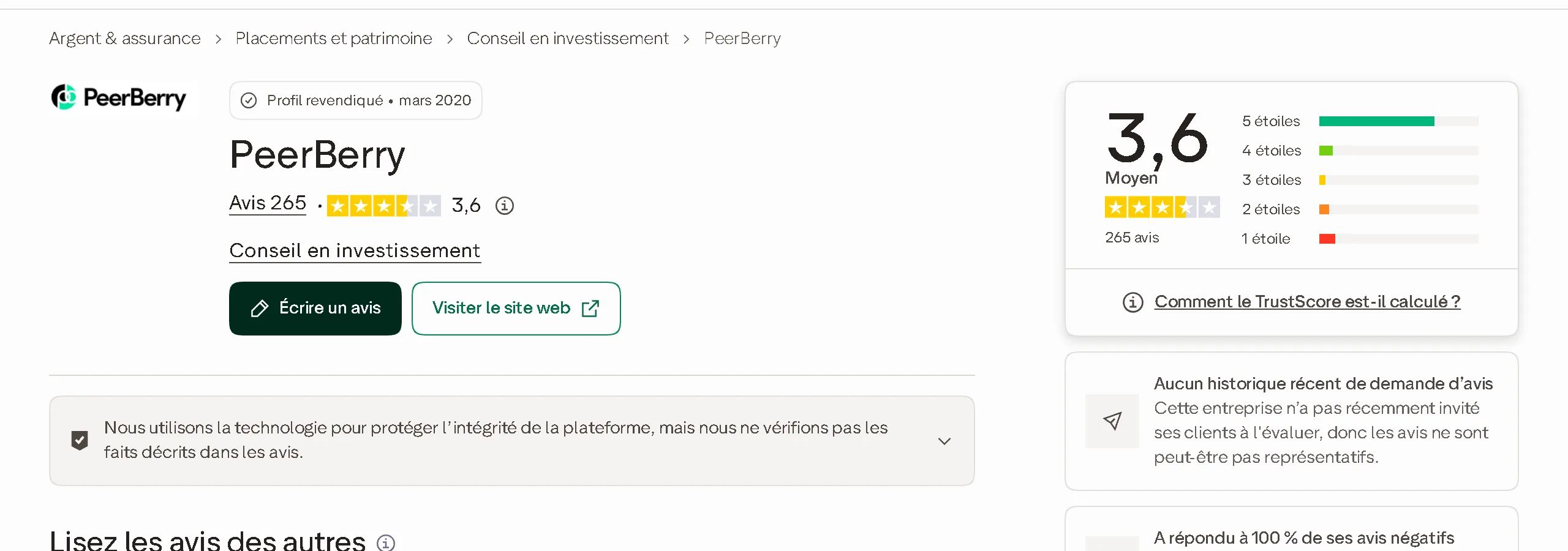
On Trustpilot, PeerBerry scores 3.6 / 5 from 265 reviews as at 5 November 2026. The score is modest, but so is the number of reviews: PeerBerry does not invite its customers to leave one, and unhappy customers speak up more. Recent negative reviews are mostly about money left uninvested; positive reviews praise the regularity of repayments and the absence of losses. The platform replies to every negative review.
In the community I follow every day, on Telegram and in the comments on my videos, PeerBerry remains one of the most respected platforms, precisely because of the way it handled 2022. The question that comes up most at the moment concerns the 2025 accounts, and that is why I went into them in detail above.
Conclusion: my verdict on PeerBerry
In my view, PeerBerry is the most reassuring P2P platform on the market because of its track record: nine years without a loss, a war weathered by repaying everyone, delays that never go beyond a few days, and a very profitable partner, Aventus Group. In return, you accept lower rates than the competition, an unlicensed platform with unaudited accounts, and a little effort to make sure your money is properly invested.
That is exactly why it is my largest P2P position, without being the most profitable: €63,000 spread across two accounts, earning me around €440 of interest a month. I am keeping an eye on three things: PeerBerry's answer about its 2025 accounts, the share of Lithuanian real estate in the outstanding portfolio, and how Aventus Group's new loans hold up in the countries where it is expanding. I will update this article as things develop. If you want to get started, go through my link to get +0.5% during your first 90 days.
Investing carries a risk of capital loss. This article reflects my personal experience: I am not a financial adviser.
Add a comment
A question or your own experience to share? Leave a comment: I reply personally.