Bondora, renamed Go & Grow in April 2026, is one of Europe's oldest peer-to-peer lending platforms: founded in Tallinn in 2008, it now claims more than 517,000 registered investors and €2.3 billion invested. I opened my account in January 2026 with €1,000, then added €4,000 on 2 June, after going through the group's 2025 accounts: just over €5,100 is working there today, at 6% a year.
In this review, I cover the history of Bondora and its split from Go & Grow, the management team, how the product works, the group's accounts, regulation and the two sanctions from the Estonian regulator, the statistics, real liquidity, fees, French taxation, the comparison with Monefit, Modena and Twino FLEXI, and my real return. I will update it with my results.
This article is not sponsored by Bondora. Some links are affiliate links: if you sign up with my link, you get a €5 sign-up bonus, which you keep if you deposit at least €50 within 30 days.
 Bondora Go & Grow at a glance
Criterion | Bondora Go & Grow |
|---|---|
Founded | Group founded in 2008 by Pärtel Tomberg, Go & Grow product launched in June 2018 |
Headquarters |
|
Companies | Go&Grow OÜ (no. 12831506) runs the platform; Bondora AS (no. 11483929) grants the loans |
Regulation | Bondora AS has held a lender's licence in Estonia since 2016; Go & Grow is neither a bank nor an investment firm (no MiFID II or ECSP) |
Product | Go & Grow: up to 6% a year, interest credited daily, nothing to configure |
Loans financed | Unsecured consumer loans: Finland 54%, Netherlands 24%, Estonia 14%, Denmark 6%, Latvia 2% (September 2026) |
Volume | €2.30 billion invested since 2009, €703 million outstanding at the end of 2025 |
Investors | 517,402 registered accounts, 221,000 active investors at the end of 2025 |
Buyback guarantee | No: internal reserves absorb the first losses, with no guarantee |
Liquidity | Withdrawal at any time, usually within 3 working days; withdrawals split up when demand is high (once only, in 2020) |
Minimum investment | €1 |
Fees | €1 per withdrawal, no other fees |
Withholding tax | None in Estonia |
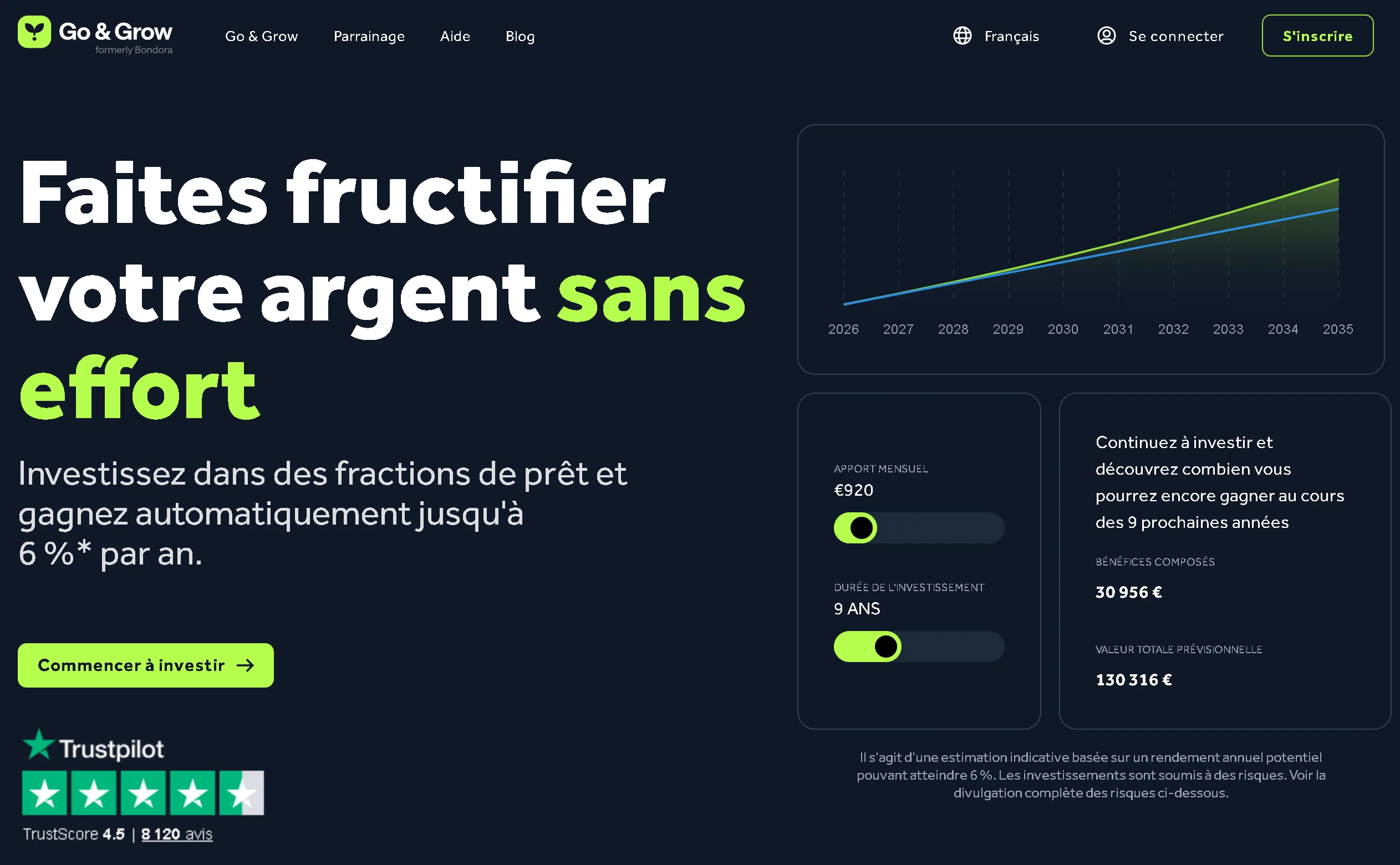
Trustpilot | 4.5 / 5 from 8,120 reviews (28 October 2026) |
Bonus | €5 on sign-up, see my Bondora bonus code page |
 Tallinn (Estonia)
Go & Grow is a product apart in P2P: no loans to pick, no robot to configure, no secondary market. You deposit, your money is spread automatically and earns interest every day. That puts it, like Monefit SmartSaver or Twino FLEXI, in the family of "liquid" crowdlending investments. You can compare its regulatory framework with other platforms in my P2P comparison (regulation view).
Open a Go & Grow account Sign up in under 5 minutes, from €1, with a €5 bonus through my link. |
 My video: Bondora Go & Grow review
If you prefer video, here is my review of Bondora, filmed after my first two months: how Go & Grow works, liquidity, returns, risks and how I use it. Since then, the platform has changed its name and I have multiplied my investment by five: this article gives the full picture as of the end of October 2026.
 From 2008 to 2026: the history of Bondora
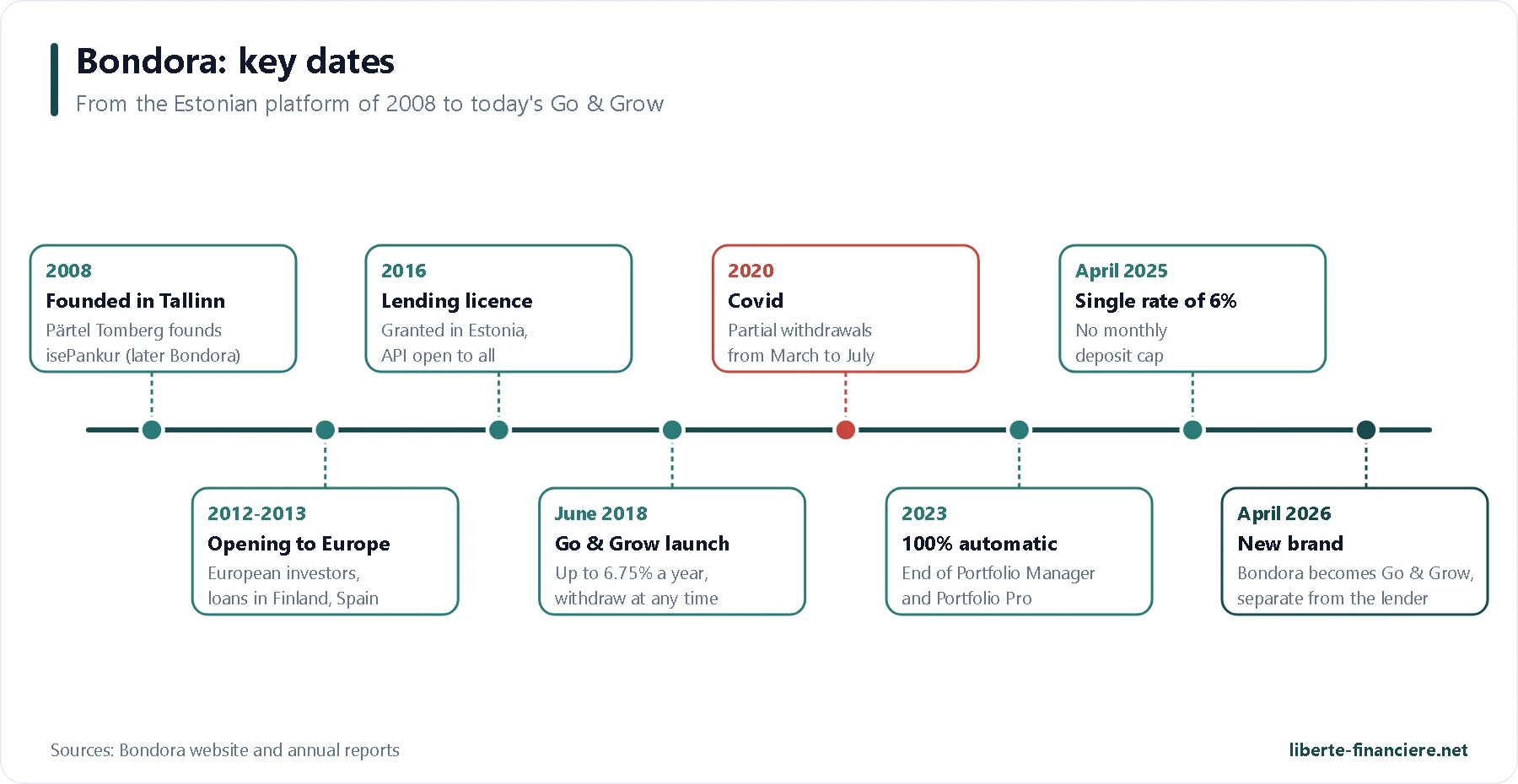
It all began in 2008 in Tallinn, in the middle of the financial crisis: Pärtel Tomberg founded isePankur, a peer-to-peer lending platform that would become Bondora. By 2009, it was one of the first platforms of its kind in the Nordic countries. In 2012 it opened up to investors across Europe, and in 2013 it began lending in Finland and Spain. The group raised €1.3 million in 2014 from Global Founders Capital, then €4.5 million in 2015.
2016 was a turning point: Bondora AS obtained its lender's licence from the Estonian financial authority on 21 March, separated loan management from the marketplace and opened its API to all investors. On 5 June 2018, the product that would make its name was opened to everyone: Go & Grow, "up to 6.75% a year" with withdrawals at any time.
Then came years of hardship and refocusing. In 2020, the pandemic forced the platform to split up withdrawals from March to July, the only time in its history. To control flows, Bondora then capped deposits (€1,000 a month in 2020, €700 in 2023), launched an uncapped version at 4% in 2022, then closed its manual Portfolio Manager and Portfolio Pro products in February 2023. On 1 April 2025, everything was simplified: a single rate of 6%, with no cap on deposits. The secondary market and the API closed on 30 September 2025, leaving a single product.
The final act came in 2026: in January, shareholders approved the demerger of the company that runs Go & Grow. On 20 April, Bondora Capital OÜ became Go&Grow OÜ, the bondora.com site started redirecting to goandgrow.eu, and the Bondora brand now refers only to the lender. Savings goals ("Goals") arrived the same week.
 Bondora or Go & Grow: what changed in 2026
This is the question I have been getting most since the spring. Go & Grow and Bondora are now two separate companies, owned by the same core of shareholders and led by the same founder:
Go&Grow OÜ (formerly Bondora Capital OÜ) operates the platform where you invest. It is wholly owned by a new holding company, Go&Grow Holding AS, registered on 2 June 2026. It grants no loans.
Bondora AS, a subsidiary of Bondora Group AS, remains the lender: it selects borrowers, signs the loans, collects the monthly payments and handles debt recovery.
For you, nothing changes day to day: same account, same rate, same underlying loans. The change is about clarity. The platform holding investors' money is separated from the credit group, which Bondora links to its plan for a banking licence for the lending business (in progress, not obtained to date). In this article, I write "Bondora" for the group and the lender, and "Go & Grow" for the product and the platform.
 The founder and the management team
 Pärtel Tomberg (LinkedIn) has been the founder and CEO of Bondora since 2008, and today also sits on the management board of Go&Grow OÜ. Before Bondora, he worked in the Nordic, Baltic and Central European management teams of the mail-order groups Quelle AG and Halens AB. He is a graduate of Oxford Brookes University. He is the beneficial owner of Bondora AS and Go&Grow OÜ, which means the founder is still at the helm and financially committed, eighteen years after launch.
Around him, the Bondora Group management board brings together Liisi Klettenberg (chief operating officer), Vytautas Jūras (chief risk officer, joined in 2024), Kerli Lõhmus (chief financial officer, joined in January 2024) and Olga Kikas (chief people officer). Go & Grow has its own management board, with Pärtel Tomberg and Triin Sarapuu, joined by Krzysztof Schmidt at the holding company.
The Bondora Group supervisory board includes solid profiles from European finance and tech:
João Monteiro (LinkedIn), chairman, an investor in Bondora since 2013;
Jevgeni Kabanov (LinkedIn), president of Bolt, on the board since 2021;
Mart Altvee (LinkedIn), founding partner of Redgate Capital and former CEO of SEB in Estonia;
Richard Groeneveld (LinkedIn), a former executive at the neobank N26;
Raimondas Berniūnas (LinkedIn), former chief risk officer of Revolut Bank in Europe.
The board of the lender Bondora AS also includes Falk Wagner (LinkedIn), former head of credit risk at T-Mobile US, and Mati Otsmaa (LinkedIn), a board member since 2013, with a background at Mastercard and Experian. Several of these directors come from credit risk and banking, which fits with the banking licence plan.
 How does Go & Grow work?
When you deposit money, Go & Grow uses it to buy partial claims on thousands of consumer loans granted by Bondora AS. Legally, you own a fraction of each loan agreement; the borrower is not informed and Bondora remains their point of contact. You choose nothing: the allocation is automatic, and your money is invested as soon as it arrives, with no waiting period (no "cash drag").
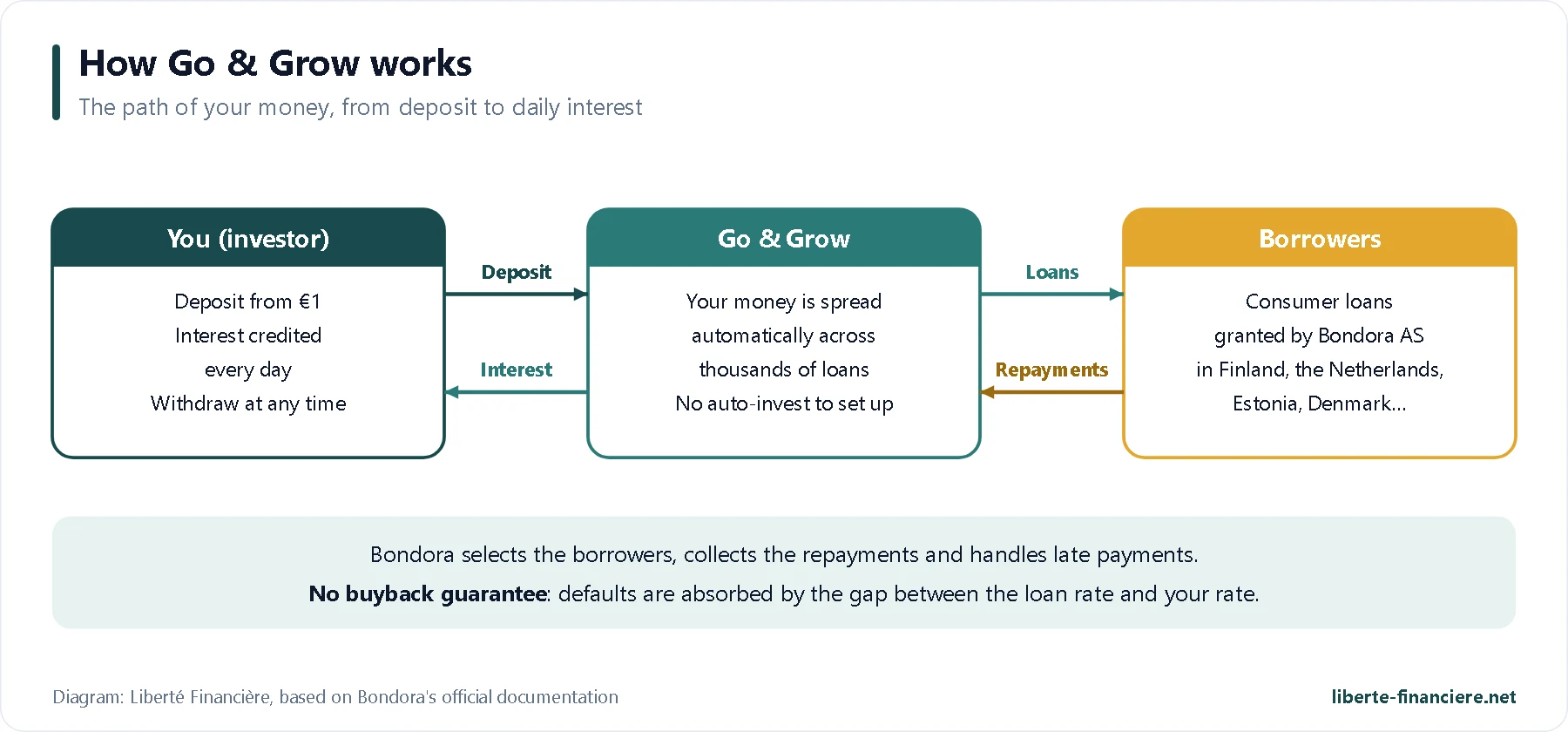
The underlying loans range from €100 to €20,000, over 6 to 120 months, with an annual percentage rate of 15.49% to 44.97% for the borrower. The gap between what borrowers pay and what you receive (6% at most) covers defaults, recovery costs and the group's margin. Go & Grow also builds up reserves that absorb the first losses: according to the risk statement updated on 22 October 2026, only once these reserves were exhausted would your return fall below 6%, and only then would your capital be affected. The amount of these reserves is not published.
Interest credited every day
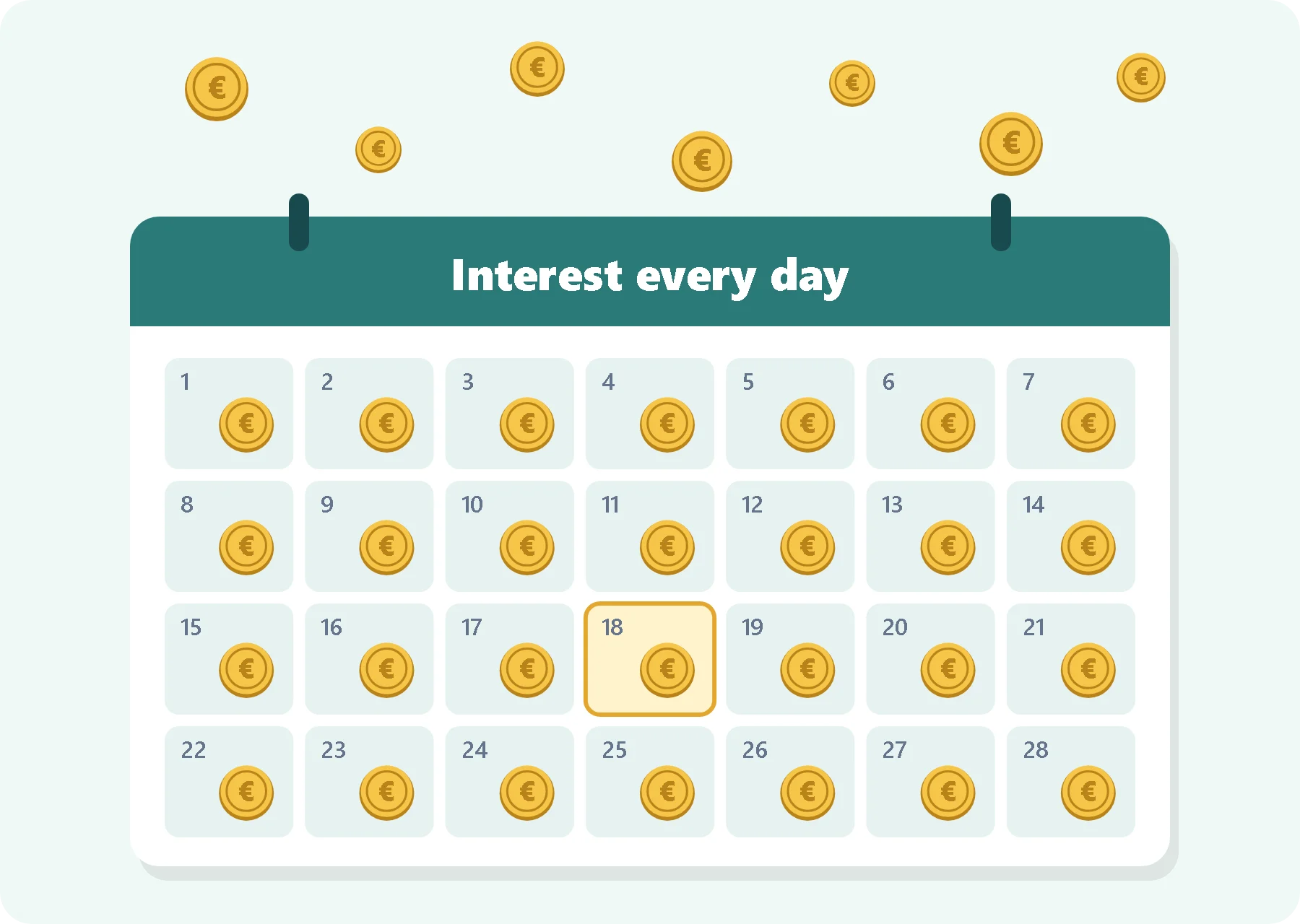
Your balance is revalued every day and interest compounds automatically. On my account, that comes to €0.82 a day on just over €5,100. This "6%" is a ceiling, not a promise: the terms speak of a return of "up to 6%", not guaranteed. According to Bondora, the return paid has remained constant since the product launched.
Goals and scheduled deposits
Since April 2026, you can divide your account into a maximum of 10 goals (emergency savings, travel, a down payment…), with a projection simulator. You can also set up a SEPA direct debit to invest every month without thinking about it. It is handy, but it changes nothing about the investment: all goals rest on the same loans and the same rate.
Try Go & Grow with €50 Deposit €50 within 30 days through my link and keep the €5 bonus. |
 Bondora's financial statements
Since there is no buyback guarantee, the strength of the Bondora group is your first safety net. I have imported all its annual accounts since 2016 into my P2P financial statements page. Revenue has multiplied by 15 in ten years, and the group has made a profit every year since 2017:
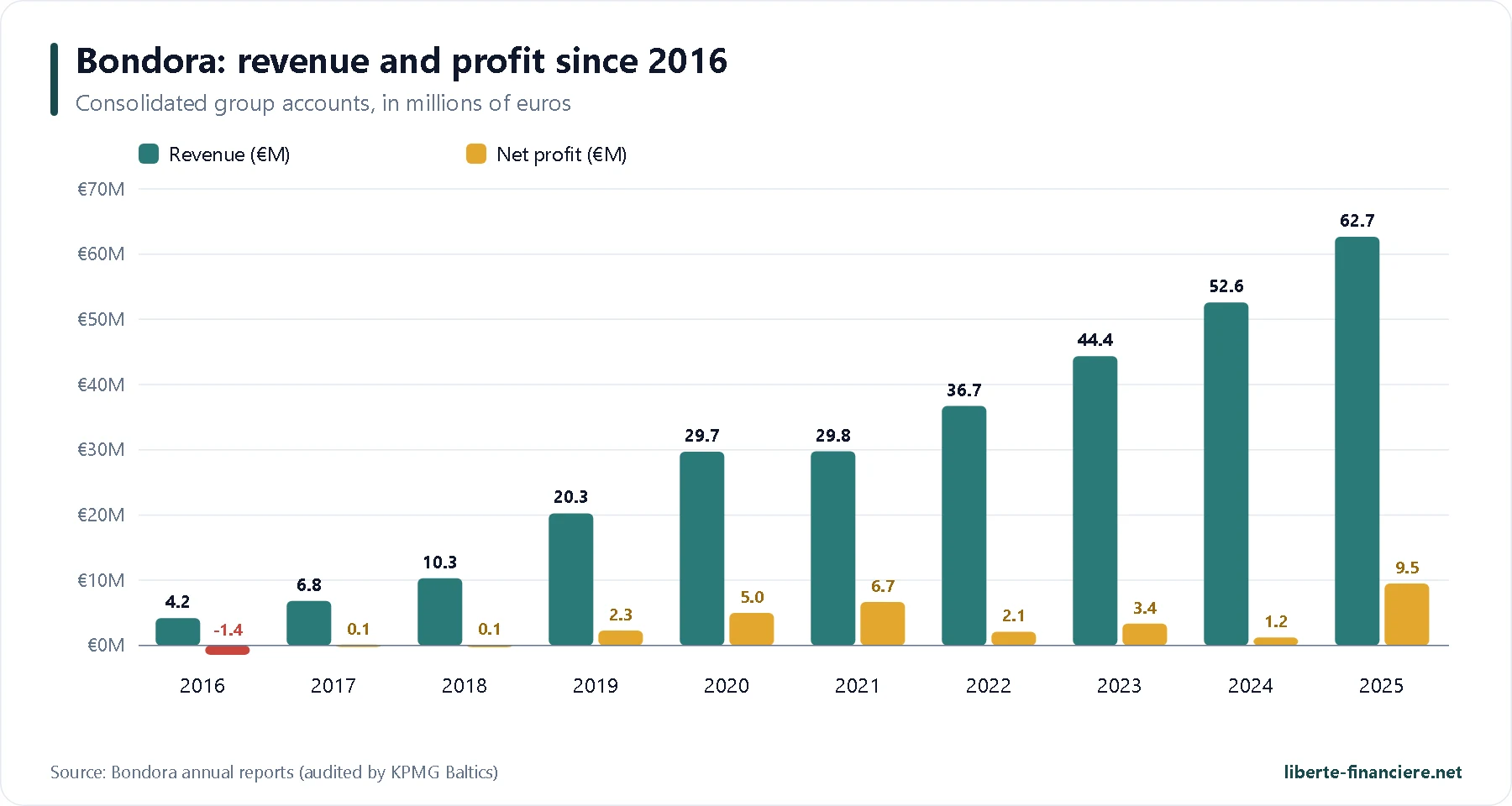
Bondora group (audited consolidated accounts) | 2023 | 2024 | 2025 |
|---|---|---|---|
Revenue | €44.4 million | €52.6 million | €62.7 million |
Net profit | €3.4 million | €1.2 million | €9.5 million |
Equity | €19.6 million | €19.6 million | €27.5 million |
Cash | €11.5 million | €13.8 million | €20.4 million |
Balance sheet total | €26.1 million | €27.5 million | €36.8 million |
Loans granted during the year | €202 million | €262 million | €349 million |
Loan impairments | €14.4 million | €6.9 million |
What I take away from this:
The strengths: a ninth consecutive profitable year, accounts certified without qualification by KPMG Baltics, no interest-bearing financial debt, €20 million in cash, and operating cash flow (€13 million in 2025) higher than profit. Equity funds three quarters of the balance sheet.
The caveat for 2025: the record profit includes a one-off item, the sale of part of the Finnish unpaid receivables to an institutional investor. The report does not say how much it brought in, and part of the price (€2.7 million) will be paid over three years. The "normal" 2025 result is therefore below €9.5 million.
Dependence on Finland: €35.3 million of 2025 revenue comes from Finland, €19.1 million from Estonia and €6.3 million from the Netherlands.
The scope: loans sold to investors do not appear on the group's balance sheet, and Go&Grow OÜ, the company running the platform, is small on its own (€2.7 million in revenue and €129,000 in profit in 2025). The strength that matters is that of the lender Bondora AS and its group.
I analysed this 2025 balance sheet in detail in a dedicated video:
 Regulation and security

This is Go & Grow's weak point on paper. Bondora AS, the lender, has held a lender's licence issued by the Estonian financial authority (Finantsinspektsioon) since 21 March 2016, and its activities in Finland, Latvia and Lithuania are monitored by the authorities of those countries. Go&Grow OÜ, the platform where you invest, on the other hand, describes itself as "neither a bank, nor an investment firm, nor a payment institution".
No European investor authorisation: neither MiFID II (like Mintos or Twino) nor ECSP (the status for crowdfunding platforms). You get no key information document and no knowledge test.
No deposit guarantee or investor compensation: the risk statement says so in black and white.
Uninvested money protected: it is held in a separate account at the Estonian bank LHV Pank, outside Go & Grow's assets.
If Go & Grow went bankrupt: the terms and conditions provide for new purchases to stop, uninvested money to be returned and claims already acquired to be kept, with their management transferred if possible.
This model is legal in Estonia, but it protects you less than an authorised platform. To understand the different statuses, I have written a full article on P2P regulation.
 Covid, sanctions and rule changes: the track record
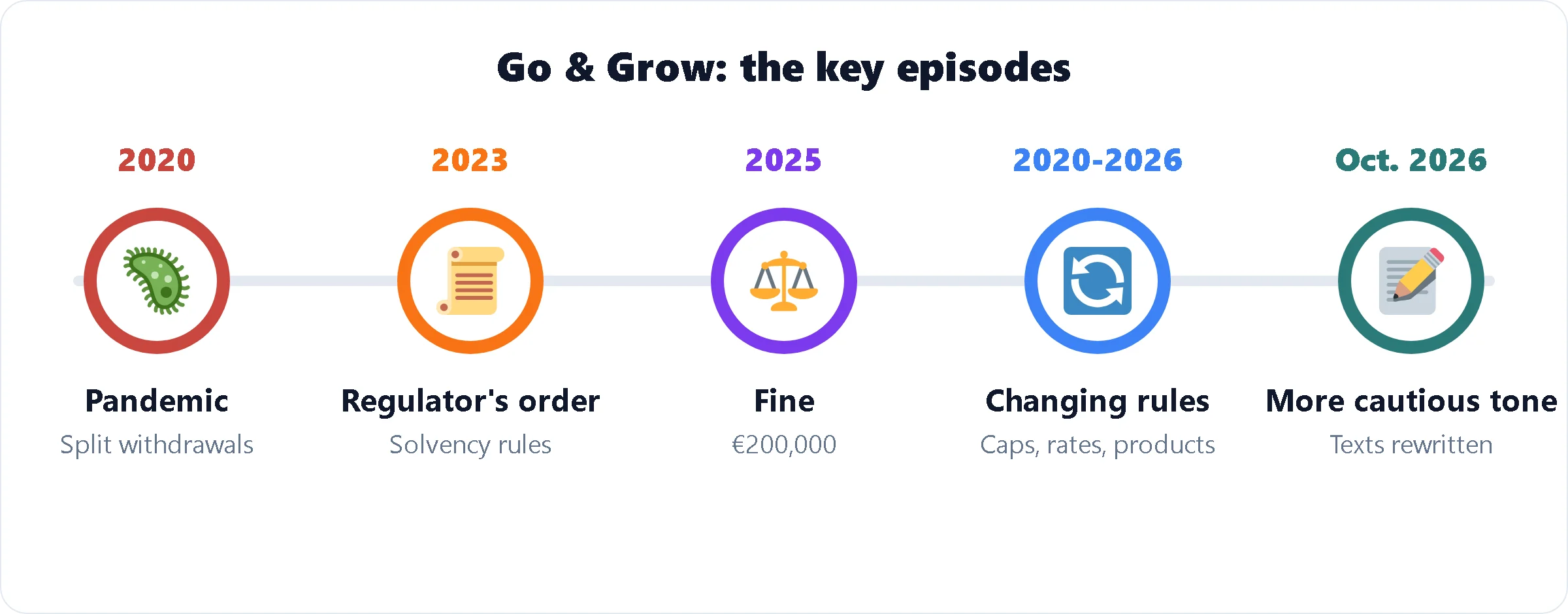
According to Bondora, the Go & Grow return has remained constant since launch, but the platform's track record includes a few episodes worth knowing about:
2020, the pandemic: faced with a surge of requests, the platform activated split withdrawals from March to July 2020 and suspended new loans through Go & Grow in April and May. Investors got their money back in pieces, more slowly than expected (details below). The mechanism has never been used since.
July 2023, an injunction: the Estonian regulator found that Bondora AS's internal rules for assessing borrower creditworthiness did not fully comply with the law, and demanded a correction by early August. Bondora spoke of "technical" shortcomings, pointing out that other lenders in the country had received similar injunctions.
April 2025, a €200,000 fine: between December 2023 and February 2024, Bondora AS granted loans without checking all the creditworthiness indicators required by law. This is a sanction for insufficiently responsible lending, which affects the lender and not investors' money, but it shows that the quality of borrower selection deserves watching.
Rules that keep moving: deposit caps between 2020 and 2025, rates of 6.75%, then 4%, then 6%, closure of Portfolio Manager and Pro (2023), of the secondary market and the API (2025), removal of the separate portfolio (May 2026). Long-standing investors have had to adapt each time.
October 2026, a more cautious tone: the risk statement and the help centre were rewritten on 22 and 23 October, with, for example, "request access to your money" instead of "withdraw at any time". I found no announcement of a change to the withdrawal rules, but I will keep following this.
 Bondora's statistics
Bondora publishes detailed statistics every month. The key figures as of 28 October 2026:
Indicator | Value |
|---|---|
Amount invested since 2009 | €2,299 million |
Loans granted since 2009 | €1,908 million across 859,742 loans |
Registered investors | 517,402 |
Active investors (end of 2025) | 221,000 |
Outstanding investments (end of 2025) | €703 million (+24% in one year) |
Borrowing customers since 2009 | 1,604,732 |
Investor deposits in September 2026 | €39.4 million |
Interest paid in September 2026 | €3.9 million |
Loans granted in September 2026 | €32.0 million (16,554 loans) |
Be careful not to confuse the 517,402 registered accounts highlighted by the platform with the 221,000 investors who actually had money invested at the end of 2025. Loan quality and defaults are detailed country by country just below.
 Where your money goes: loans by country, their quality and defaults
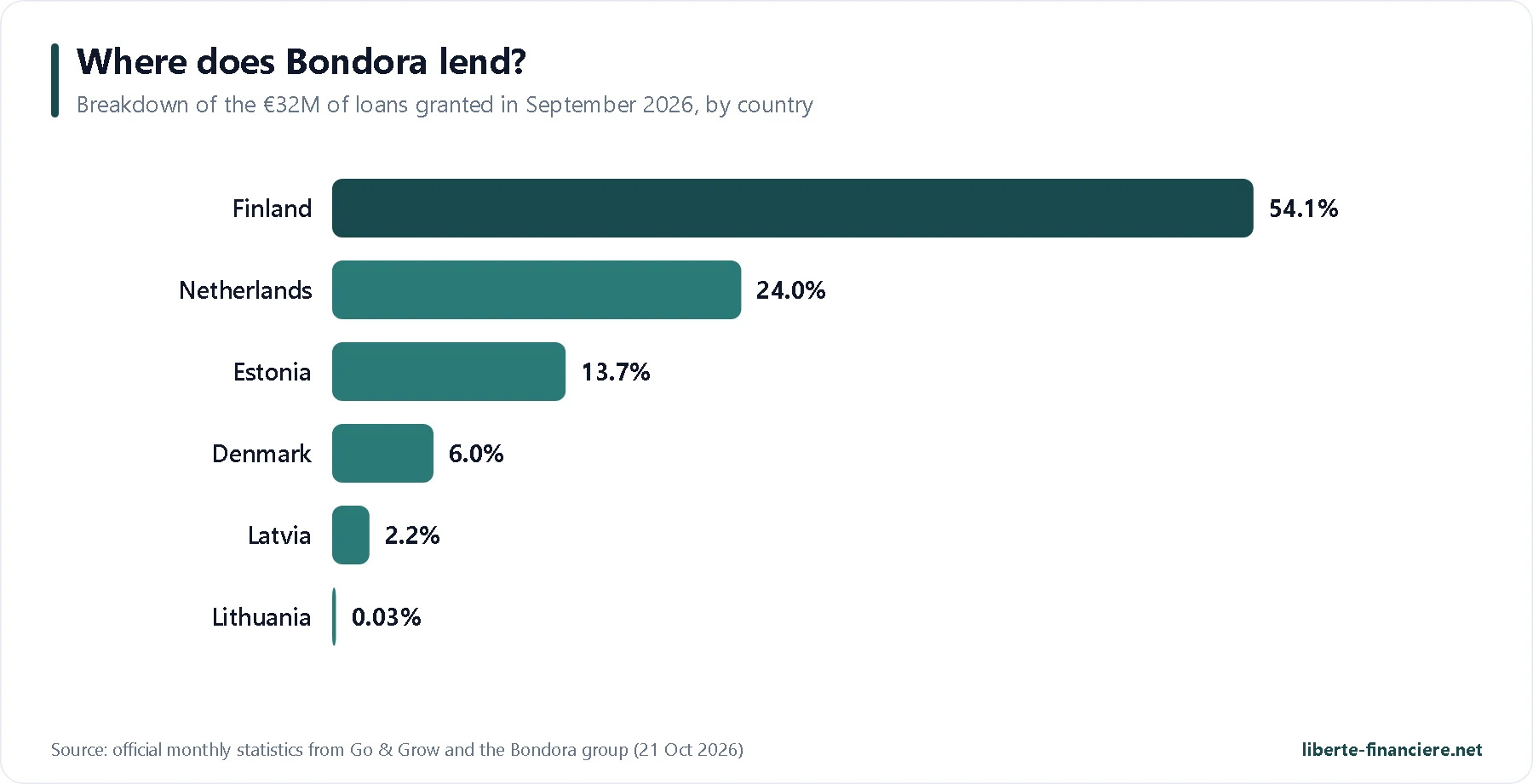
Go & Grow does not let you choose your loans, but Bondora publishes the breakdown of its lending every month. In September 2026, the group granted €32.0 million of consumer loans, overwhelmingly in the Nordic countries and the Benelux:
Borrower countries | Share of September 2026 loans | Group revenue in 2025 | What Bondora says |
|---|---|---|---|
| 54.1% | €35.3 million | Largest market, about 60% of the portfolio; 12-month defaults fell from 14% to 8.3% between Q3 2023 and Q1 2024 |
| 24.0% | €6.3 million | Opened in September 2022, best risk/return ratio reached by the end of 2023 |
| 13.7% | €19.1 million | Historic market, the oldest and most stable |
| 6.0% | Included in "other EU countries" (€0.5 million) | Opened in February 2025, still being fine-tuned |
| 2.2% | €0.7 million | Opened at the end of 2023, a young market |
| 0.03% | Included in "other EU countries" | Authorisation obtained at the end of 2024, almost inactive |
| 0% | €0.7 million | Older loans still being repaid, no loans granted in September 2026 |
 Finland
 Netherlands
 Denmark
 Latvia
 Lithuania
 Spain
The underlying loans range from €100 to €20,000, over 6 months to 10 years, with annual percentage rates of 15.49% to 44.97% for borrowers. Bondora says that nearly 80% of its portfolio consists of active loans being repaid normally, and that the share of new loans classified in its best risk categories (AA to C) is rising in all its markets. At the end of 2025, the managed portfolio reached €697 million, including €514 million of "performing" loans (+35% in one year).
Defaults, with no taboos
At Bondora, a loan goes into default after more than 90 days of arrears, when the agreement is terminated. This is not a dead loss: it is the start of recovery. For €1,000 of capital in default, Bondora projects recovering €667 over ten years in Estonia, the Netherlands and Latvia, and €689 in Finland (July 2026 transparency report). Recovery costs, up to 35% of the amounts recovered under the terms and conditions, are already built into these calculations.
What unpaid loans cost the group: €14.4 million of loan impairments in 2024, then €6.9 million in 2025, a sharp fall that reflects tighter selection. A further €20.2 million of receivables was written off in 2025.
The expected return on the portfolio: Bondora calculates a forecast internal rate of return on its loans, including defaults and recoveries, and says it has stayed above Go & Grow's 6% target in recent years, with a widening gap. It is this gap that funds the reserves protecting your return.
The Finnish point to watch: Finland, which accounts for more than half of the loans, has capped consumer credit rates. Bondora adjusted its rates there at the end of 2021 and tightened its criteria in 2023. Any further regulatory change in that country would have a direct effect on Go & Grow.
 Liquidity and withdrawals: what really happens
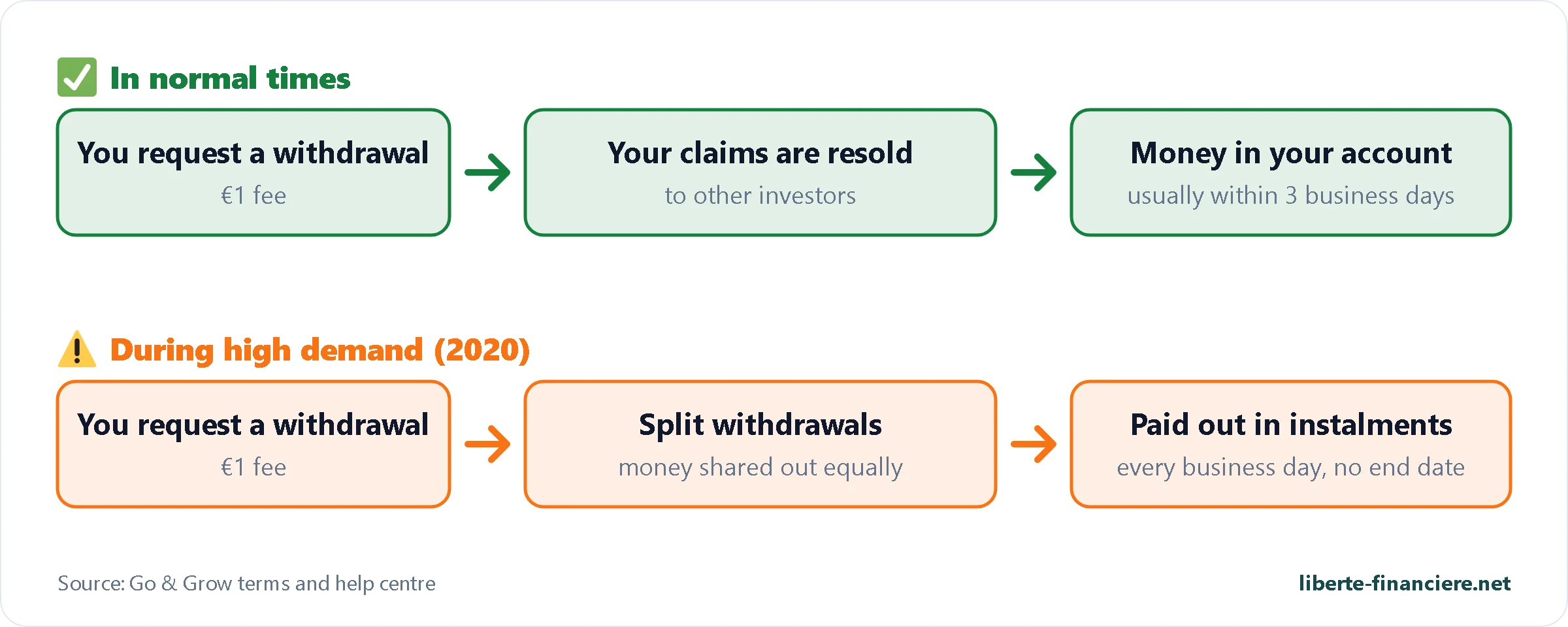
This is Go & Grow's number one selling point, and it needs to be properly understood. A withdrawal is not a repayment: it is the resale of your claims to other investors or to the platform. In normal times you do not notice this: you request a withdrawal and the money reaches your bank account, usually within 3 working days, for a €1 fee whatever the amount.
If withdrawal requests exceed the money available, Go & Grow activates split withdrawals ("partial payouts"): every working day at 10 a.m. (Tallinn time), the available money is shared equally among waiting investors until everyone has been paid, with no guaranteed end date. That is what happened in 2020. So this is not a current account: liquidity is strong in normal times, but it is not guaranteed in a crisis, precisely when you might need your money.
 2020: what really happened during the only liquidity crisis
Go & Grow has had only one liquidity crisis in eight years, at the start of the pandemic. Here is how it unfolded, based on Bondora's publications at the time:
Date | What happened |
|---|---|
From March 2020 | Surge of withdrawal requests at the start of the pandemic: Bondora activates split withdrawals for the first time. Every working day, the available money is shared among waiting investors. |
April and May 2020 | Bondora stops financing new loans through Go & Grow, to devote all repayments to withdrawals and preserve the return. The advertised rate stays at 6.75%. |
May 2020 | Bondora explains that it designed this mechanism when it created the product, drawing on withdrawal flows at banks and funds during the 2008 crisis. |
Early July 2020 | End of split withdrawals: withdrawals return to normal and Go & Grow starts financing loans again. |
September 2020 | To avoid another bottleneck, Bondora introduces a deposit cap of €1,000 a month per investor. |
The takeaway: for about four months, investors who wanted out got their money back in pieces, with no guaranteed date, but with no loss announced by Bondora and with the advertised return maintained. This is exactly the scenario set out in the current terms and conditions. It shows that Go & Grow is liquid in normal times, but that in a panic your money is not available overnight. That is why I do not keep money there that I might need urgently.
 How to open a Go & Grow account, step by step

You must be 18, live in the European Economic Area or Switzerland and have a bank account in your name in one of these countries. One account per person.
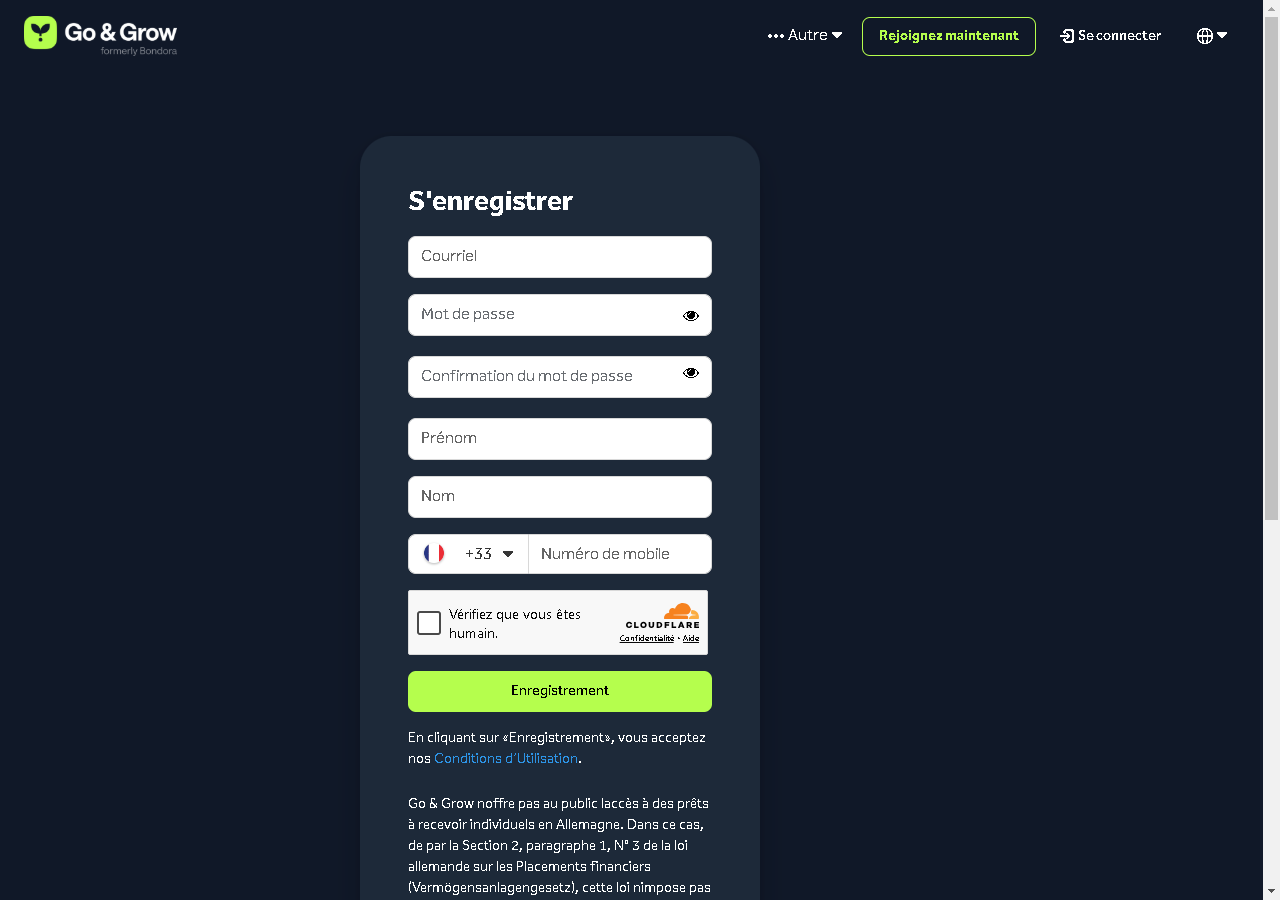
Open the site with my link (the site is also available in French), click "Sign up" and enter your email, a password, your name and your phone number.
Confirm your email address: your Go & Grow account is created and the €5 bonus is credited to it.
Verify your identity: a photo of your ID card or passport and a selfie, through the provider Onfido.
Enter your bank account and answer the regulatory questionnaire (occupation, source of funds). Validation takes about one working day; you may be asked for proof of the source of funds.
Make a SEPA transfer in euros with the reference shown in your account: the money is invested automatically as soon as it arrives.
Keep your bonus: deposit at least €50 within 30 days. If your balance stays below €55 after that period, the €5 is taken back.
The Go & Grow app is available on iOS and Android, with the same functions as the site. Companies are accepted: the terms and conditions open accounts to legal entities registered in the European Economic Area, and therefore to a French company.
 The history of Go & Grow rates and caps
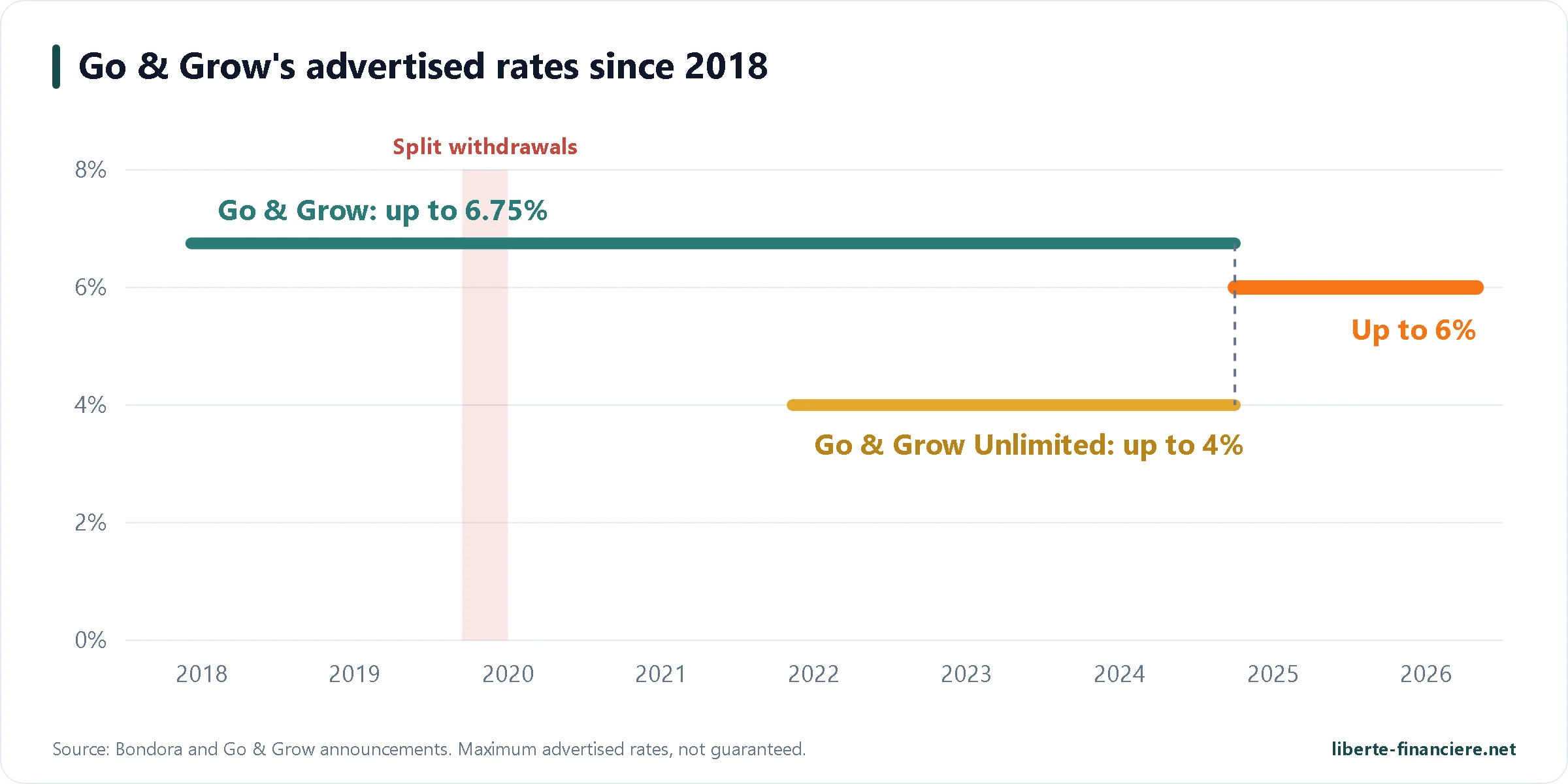
The product has changed a lot since 2018. Long-standing investors have seen rates and caps very different from today's:
Date | Rate | Deposit cap | What changed |
|---|---|---|---|
5 June 2018 | Up to 6.75% | Not specified | Launch of Go & Grow for all investors |
March to July 2020 | 6.75% maintained | Not specified | Split withdrawals and halt to new loans during the pandemic |
9 September 2020 | Up to 6.75% | €1,000 a month | First cap, "per investor and per month", across all accounts |
11 November 2021 | Up to 6.75% | €1,000 a month | Bondora announces that you can "now" invest up to €1,000 a month |
12 May 2022 | Up to 4% | None | Launch of Go & Grow Unlimited, uncapped but paying less |
24 August 2022 | 4% for newcomers | None | New investors can only access Unlimited; the capped 6.75% is reserved for existing investors |
10 May 2023 | Up to 6.75% | €400 then €700 a month | Cap on classic Go & Grow raised from €400 to €700 |
1 June 2023 | Up to 6.75% | €700 a month | Classic Go & Grow reopens to all investors |
23 January 2024 | Up to 6.75% | €1,000 a month | Cap raised to €1,000 |
21 February to 21 March 2024 | Up to 6.75% | €16,000 | One-off cap for Bondora's anniversary |
9 September 2024 | 6.75% on the whole account | €1,000 a month | The 6.75% also applies above the cap, offer extended until 31 March 2025 |
1 April 2025 | Up to 6% | None | Single rate for everyone, end of the 6.75% and 4%, unrestricted deposits |
Two lessons. First, the platform used the caps to keep deposit growth in step with its lending: ending the cap in 2025 is only sustainable because the group now lends nearly €350 million a year. Second, the move from 6.75% to 6% shows that the rate is not set in stone: it can still change, up or down, depending on loan returns.
 Fees
Operation | Fees |
|---|---|
Opening and maintaining the account | Free |
Deposit (SEPA transfer in euros) | Free |
Management fees | None (the platform's remuneration is already deducted from the rate) |
Withdrawal | €1 per withdrawal, whatever the amount |
Recovery costs | Up to 35% of amounts recovered on a defaulted loan, absorbed by the return |
In practice, the only visible fee is the €1 per withdrawal: group your withdrawals rather than making small, frequent ones.
 The risks to know about

A reminder: I am not a financial adviser. All investment carries a risk of capital loss, and past performance is no guide to future performance.
Capital loss: Go & Grow is not a savings account. If unpaid loans exceeded the platform's reserves, your return would fall and then your capital would be eaten into. No guarantee fund would reimburse you.
Illiquidity: in a wave of withdrawals, your money would be returned in pieces, with no guaranteed date, as in 2020. Do not keep money there that you must be certain of accessing within a few days.
Geopolitical and concentration risk: everything rests on a single Estonian credit group and a few countries, with Finland in the lead (54% of loans granted in September 2026). An economic crisis or tighter consumer credit rules in these countries would hit the whole portfolio.
Return not guaranteed: the 6% is a maximum. The amount of the reserves protecting it is not published.
Dependence on the lender: Bondora AS selects borrowers and handles recovery. The two sanctions from the Estonian regulator (2023 and 2025) concern creditworthiness assessment, of all things. The terms and conditions also state that you waive any claim based on the platform and the lender being related.
Rule changes: rates, caps and products have changed often, and the 2026 demerger is too recent to measure all its effects.
My approach: I see Go & Grow as a better-paid cash pocket, not as my main emergency savings, and I diversify across other platforms. You will find all my positions in my P2P portfolio.
 Taxation in France
Good news: Estonia levies no withholding tax on interest paid to a non-resident, so you have nothing to reclaim on the Estonian side. In France, interest is subject to the flat tax of 31.4% (12.8% income tax and 18.6% social contributions), or to the progressive scale if that works out better for you.
Declare the interest on forms 2047 and 2042, and your foreign account on form 3916.
Download the Go & Grow tax report from the statements section, in PDF or Excel, for the calendar year: it gives the amounts to report.
Monthly declaration (2778-SD): depending on your reference taxable income, you may have to declare interest month by month and pay the advance as you go. Practice varies between tax offices: ask yours in writing.
All the steps are detailed in my guide on how to declare P2P income for tax. If you invest through a company subject to corporation tax, the interest simply goes into its profit.
 Go & Grow versus the Livret A and other P2P platforms
Go & Grow is no longer alone in the "liquid" P2P niche, with rates of around 6 to 9%. Here is how it compares with the three products I use or follow closely, with my real returns (XIRR excluding bonuses, calculated on my own transactions):
Criterion |
|
|
|
|
|---|---|---|---|---|
Advertised return | Up to 6% | 7.5% | 8 to 11% advertised, 8.83% recent average | 6% |
My XIRR excluding bonuses | Too recent | |||
Withdrawal | Within 3 working days, €1 per withdrawal, split up in a crisis | €1,000 a month as instant withdrawal, above that up to 10 working days | 24 to 48 hours in normal times | Instant to the wallet, 2 days to the bank |
Better-paid locked products | None | Vaults of 12 to 24 months, from 9.42% to 10.52% | Fixed-term vaults | Notes of 3 to 12 months, from 8.5% to 12% |
Crisis track record | Split withdrawals from March to July 2020 | Product launched in 2022, no known liquidity crisis | Platform launched at the end of 2024, no known crisis | FLEXI launched in April 2026, too recent |
Investor authorisation | No | No | No (MiFID II application announced) | Yes (MiFID II) |
Group behind it | Bondora, founded in 2008, profitable every year since 2017 | Creditstar, active since 2006 | Modena Estonia, an Estonian lender created in 2019 | Fincard (Netcredit, Poland) |
Size | €2.3 billion invested, 517,000 registered | More than €300 million invested, more than 35,000 investors (according to Monefit) | €43 million invested, 7,068 users (according to Modena) | More than €2 million on FLEXI, more than 2,100 investors |
Withholding tax | None | None | None | 5% (reclaimable) |
|
If you want the best return: Monefit and Modena pay more, in exchange for a smaller or more indebted group. I analysed them in my Monefit review.
If you want the best legal framework: Twino FLEXI, backed by an authorised investment firm, covered in my Twino review.
If you want the longest track record and the largest volume: Go & Grow, with eight years of hindsight on the product and a group profitable since 2017.
Go & Grow and Monefit are the two liquid products most used by my community, and I have just over €5,000 on each. My trade-off: Monefit for the return, Go & Grow for longevity, the size of the group and a known crisis track record. Both rest on a single credit group with no investor authorisation, which is why I do not keep one without the other.
The smart reflex is not to choose: spreading your "liquid" pocket across two or three of these platforms reduces your dependence on a single group. My P2P comparison sets out all the platforms I follow side by side.
The comparison in figures: Go & Grow, Livret A, Monefit, Mintos and Swaper
To compare investments that share neither the same risk nor the same taxation, I simulated €10,000 invested for 5 years, with interest reinvested. For the P2P platforms, interest is taxed at the 31.4% flat tax; the Livret A is tax-exempt. For Mintos and Swaper, which do not display a single rate, I use my own annualised return (XIRR, excluding bonuses).
Investment |
|
|
|
|
|
|---|---|---|---|---|---|
Gross return | 1.70% | 6.00% | 7.50% | ||
After tax | 1.70% | 4.12% | 5.15% | 7.53% | 9.34% |
€10,000 after 5 years | €10,880 | €12,230 | €12,850 | €14,380 | €15,630 |
Liquidity | Immediate, guaranteed by the State | Within 3 working days, split up in a crisis | €1,000 a month as instant withdrawal, above that up to 10 working days | Resale possible on the secondary market, with no guaranteed timeframe | Money comes back as loans are repaid, in one to two months |
| None |


The Livret A, France's regulated savings account (1.7% net since 1 August 2026, capped at €22,950), remains unbeatable on safety: guaranteed capital and immediate withdrawal. After tax, Go & Grow pays about 2.4 points more per year, in exchange for a risk of capital loss and liquidity that is not guaranteed. Monefit, Mintos and Swaper pay more, each with its own constraint: a withdrawal cap for Monefit, the secondary market for Mintos, dependence on a single credit group for Swaper.
And against two better-paying platforms, Mintos and Swaper?
Mintos is one of Europe's largest P2P marketplaces and a MiFID II authorised investment firm in Latvia. You choose (or let a robot choose) loans from dozens of credit companies, with a buyback guarantee depending on the loan. My XIRR there is 11.0% excluding bonuses, well above Go & Grow, but you have to monitor your lending companies and resell on the secondary market to exit before maturity.
Swaper, launched in Estonia in 2016, finances very short-term loans from the Wandoo Finance group: more than €1.1 billion of loans funded since it began and about 10,000 users, according to Swaper. On Wandoo Finance loans, a buyback guarantee applies after 60 days of arrears, with no investor authorisation. My XIRR there is 13.6% excluding bonuses. Allow one to two months to get all your money back: this is not a cash pocket.
In short, Go & Grow is not the best payer, but it is simpler and more liquid than these two platforms. It plays a different role: a cash pocket, alongside platforms like Mintos or Swaper for return. You will find each one's welcome offers on my bonuses and referrals page.
Add Go & Grow to your liquid pocket The oldest liquid product in European P2P, €5 free with my link. |
 My experience in figures
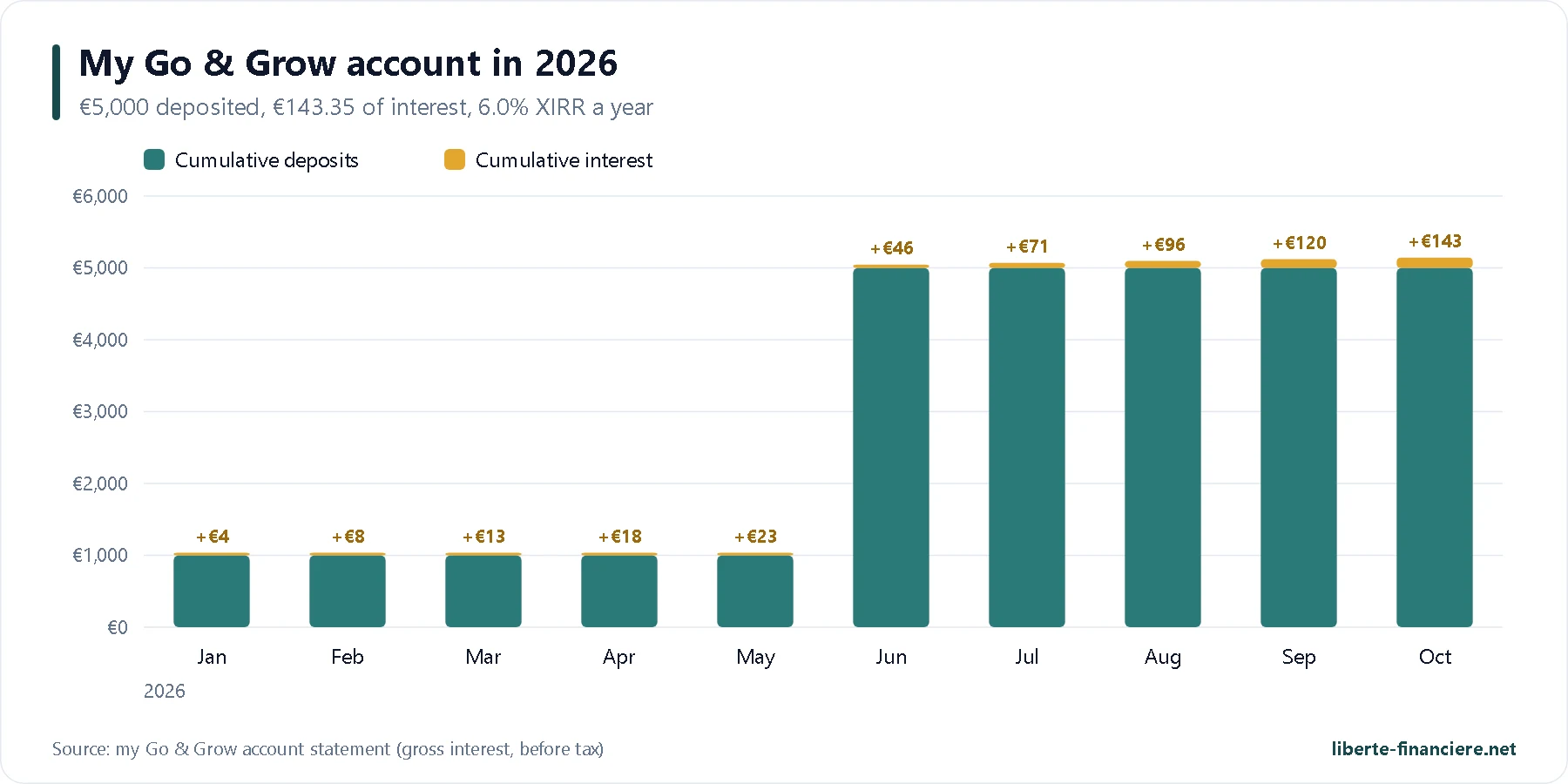
I opened my account on 7 January 2026 and put in €1,000 to test the platform. After the 2025 accounts came out, which I found solid, I added €4,000 on 2 June 2026. As of 28 October 2026, my account shows €5,143, which is €143 of gross interest in ten months.
Indicator | Value on 28/10/2026 |
|---|---|
Deposits | €5,000 |
Interest received (gross) | €143.35 |
Account value | €5,143.35 |
Annualised return (XIRR) | 6.0% |
Daily interest | €0.82 |
Withdrawals | None so far |
The real return matches the advertised rate: interest credited every day, with no drop since January. I have not made a withdrawal yet; that will be the real test of liquidity, and I will share it here. I use Go & Grow as a cash pocket: money I want to keep available without leaving it idle in a current account, alongside better-paying but less liquid platforms.
 Pros and cons
 Pros
Complete simplicity: no loans to pick, no robot to configure, money invested as soon as it arrives.
Interest every day, compounded automatically.
Withdrawal at any time for €1, usually within 3 working days.
Longevity: 18 years in business, more than 500,000 registered, €2.3 billion invested.
Profitable, audited group: nine profitable years in a row, accounts certified by KPMG.
Transparency: monthly statistics, reports on defaults and recovery.
Accessible: from €1, site and app in French, company accounts accepted.
No withholding tax in Estonia.
Cons
Return limited to 6%, far from the 10 to 12% of more traditional P2P platforms.
No investor authorisation (neither MiFID II nor ECSP) and no buyback guarantee.
No choice: you depend entirely on the selection of a single lender, sanctioned twice by the Estonian regulator.
Changing rules: caps, rates and products have changed often.
€1 per withdrawal, a penalty for small, frequent withdrawals.
 Who is Go & Grow for?
Profile | Go & Grow? |
|---|---|
You are looking for a cash pocket that pays better than a current account | Yes |
You are new to P2P and want zero configuration | Yes |
You already have a P2P portfolio and want a position you can access quickly | Yes |
You are investing a company's cash | Yes |
You are aiming for 10% or more | Probably not |
You want a State guarantee, as with a savings account | No |
You must be certain of accessing your money within a few days | Probably not |
You want to choose your own loans | No |
 Go & Grow bonus code and referral

No code to enter: go through my link to get a €5 bonus as soon as you sign up. It is locked for 30 days, then becomes withdrawable if you have deposited at least €50 in the meantime. Once registered, you also get a referral link in your account (under "Referral") to invite friends and family. Go & Grow's temporary offers, when there are any, come on top of this basic bonus.
The full conditions are on my Bondora bonus code page, and all P2P offers are on my bonuses and referrals page.
€5 free on Go & Grow Free sign-up, bonus credited automatically, yours to keep with €50 deposited. |
 FAQ: Bondora Go & Grow
Is Bondora reliable?
Bondora has existed since 2008, its group has been profitable every year since 2017 and its accounts are certified by KPMG. The points to watch are the lack of investor authorisation, the concentration on Finland and the two sanctions received over borrower creditworthiness assessment.
What is the difference between Bondora and Go & Grow?
Since 20 April 2026, Go & Grow has been the platform where you invest (the company Go&Grow OÜ) and Bondora the lender that grants the loans (Bondora AS). Your account, your rate and your loans have not changed; only the platform's name has.
Is Bondora Go & Grow regulated?
The lender Bondora AS holds a lender's licence in Estonia. The Go & Grow platform has neither MiFID II nor ECSP authorisation, and your investment is not covered by any guarantee scheme.
Is the 6% return guaranteed?
No. It is a maximum, protected by internal reserves whose amount is not published. In practice, my XIRR has been 6.0% since January 2026.
What is the minimum amount?
€1. There has also been no maximum amount since April 2025. To keep the €5 bonus, you need to deposit at least €50 within 30 days.
Can I withdraw my money at any time?
Yes, for €1 per withdrawal, usually within 3 working days. When demand is high, withdrawals are paid out in pieces every working day, as in 2020.
What happens if Go & Grow or Bondora goes bankrupt?
If Go & Grow went bankrupt, uninvested money held at LHV Pank would be returned to you and your claims would continue to be repaid. If the lender Bondora AS went bankrupt, loan recovery would be disrupted and losses would be possible.
How do I declare Bondora for tax?
Declare the interest (forms 2047 and 2042) and your foreign account (form 3916). There is no Estonian withholding tax to offset. My step-by-step guide is here.
Can you invest through a company?
Yes, the terms and conditions accept legal entities registered in the European Economic Area or Switzerland.
Go & Grow or Monefit?
Monefit pays more (7.5%), Go & Grow has a longer track record and a bigger group. Neither has investor authorisation: I hold both so as not to depend on a single group.
Go & Grow or Livret A?
The Livret A (1.7% net) is guaranteed and immediately available: it remains the foundation of emergency savings. Go & Grow pays about 4.1% after tax, with a risk of loss and liquidity that is not guaranteed in a crisis. I use it as a complement, never as a replacement.
Did investors lose money in 2020?
Bondora announced no losses: from March to early July 2020, withdrawals were paid out in pieces every working day, then everything returned to normal, with the advertised rate of 6.75% maintained. The mechanism still exists.
Which bonus code should I use?
No code: go through my link to get €5 on sign-up. The current offer, if there is one, is shown at the top of this article and on my Bondora bonus code page.
 What users say
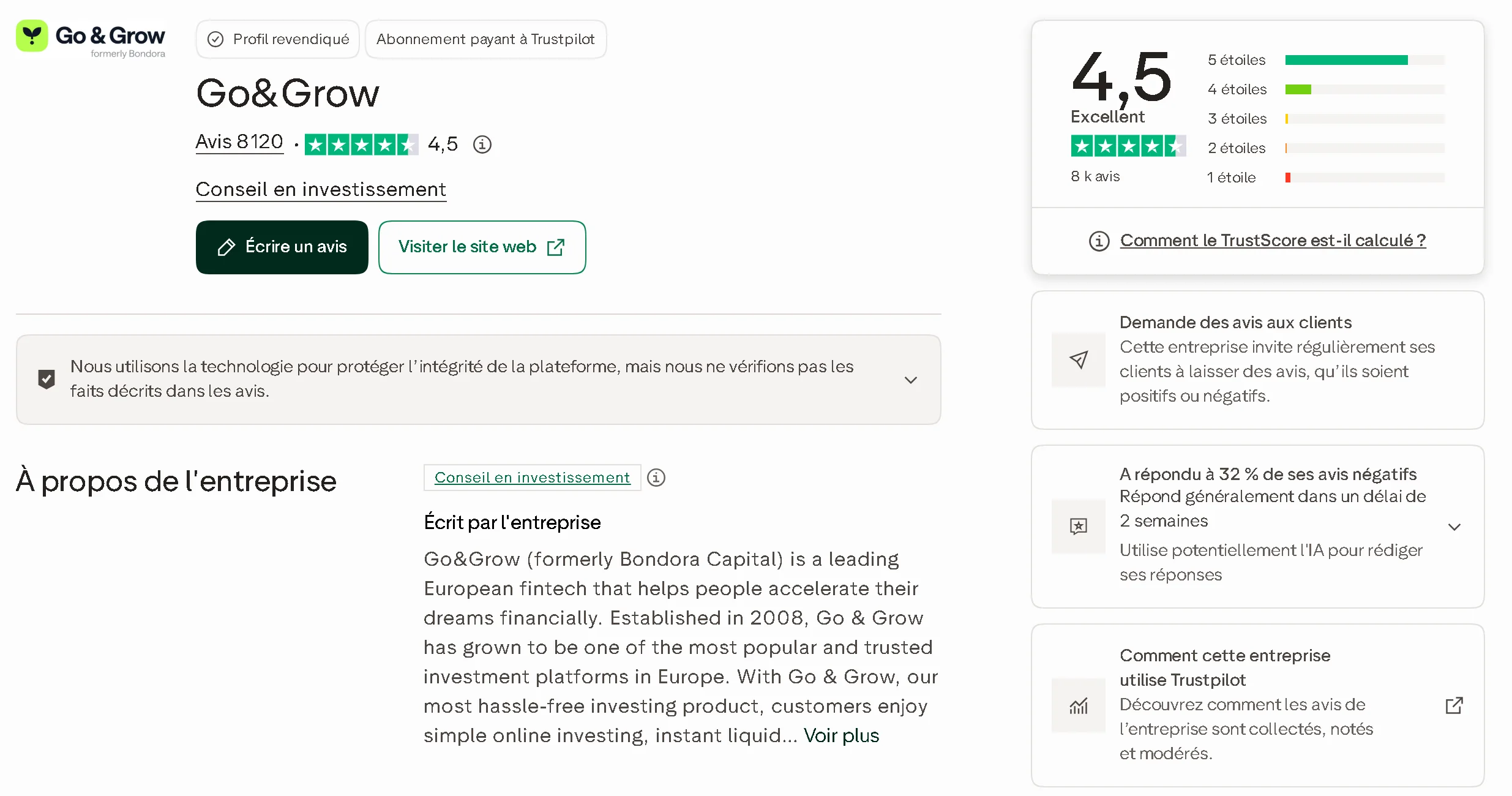
On Trustpilot, Go & Grow (formerly Bondora) scores 4.5 / 5 from 8,120 reviews as of 28 October 2026, with 78% of ratings at 5 stars. The platform itself invites its customers to leave a review, which pushes the score up: I treat it as one indicator among others.
 Conclusion: my review of Bondora Go & Grow
Go & Grow is the simplest product in European P2P: you deposit, you earn 6% a year paid daily, and you can ask for your money whenever you like. Behind it, the Bondora group is profitable, audited and transparent, with eighteen years of history. Its limits are clear: no investor authorisation, no guarantee, a capped return, and liquidity that can seize up in a crisis.
For me, it is a very good cash pocket, alongside better-paying investments and without putting all my emergency savings into it. I have invested €5,000 there and will keep you posted, especially on my first withdrawal. If you want to get started, go through my link to get your €5 bonus.
Investing carries a risk of capital loss. This article reflects my personal experience: I am not a financial adviser.
Add a comment
A question or your own experience to share? Leave a comment: I reply personally.