In October 2026, four World ETFs share the PEA (French tax-advantaged stock savings plan): the Amundi PEA Monde (DCAM) at 0.20% in fees, the iShares MSCI World Swap PEA (WPEA) at 0.20%, the long-standing Amundi MSCI World (CW8) at 0.38% and, since July 15, 2026, the very first PEA-eligible MSCI ACWI ETF, the Amundi PEA Global (GPEA) at 0.30%. For a new PEA, my choice comes down to the WPEA or the DCAM, now at the same fee level. The WPEA is actually the one I picked for my own PEA: €23,489 invested to date, over 8 purchases.
In this guide, I compare every World ETF available in a PEA on fees, size, counterparty and above all real performance, measured on market prices since 2024: that is what counts, not the advertised fees. I also cover the new ACWI ETF, the make-up of the MSCI World, the mechanism that lets a World ETF into a PEA, nearly 17 years of returns in euros, the monthly investing strategy, the cheapest brokers to buy these ETFs and the tax side.
This article is not sponsored. Some links are affiliate links: if you open your account with Interactive Brokers through my link, you can get up to $1,000 in IBKR shares ($1 for every $100 deposited in the first year), and with Saxo, up to €500 in free trading fees.
🏆 The best World ETF for a PEA at a glance
🥇 My pick iShares MSCI World Swap PEA (WPEA) MSCI World · 0.20% a year · €7.12 per share
| 🥈 The Amundi pick Amundi PEA Monde (DCAM) MSCI World · 0.20% a year · €6.30 per share
| 🌍 The all-in-one Amundi PEA Global (GPEA) MSCI ACWI · 0.30% a year · €5.08 per share
|
If you already hold CW8, no need to panic: it is a very good ETF, just more expensive and sold at over €700 per share. Further down, I show you with figures when it is worth switching. And to pick the broker that will cost you the least, my PEA comparison tool puts the 16 main offers on the market side by side.
📹 My video: which is the best World ETF for a PEA?
If you prefer video, here is my comparison of the PEA World ETFs (CW8, EWLD, WPEA and DCAM), with my conclusion depending on your situation. The GPEA, which arrived since, is covered further down in this article.
📊 Comparison of PEA-eligible World ETFs
Here are the four World ETFs that matter in a PEA, with the issuers' official data and closing prices as of October 22, 2026. All four are accumulating (dividends are reinvested automatically, with no fees or tax) and use synthetic replication, the only way to get American or Japanese shares into a PEA (I explain why further down).
Criterion | DCAM | WPEA | CW8 | GPEA |
|---|---|---|---|---|
Name | Amundi PEA Monde (MSCI World) | iShares MSCI World Swap PEA | Amundi MSCI World Swap | Amundi PEA Global (MSCI ACWI) |
Issuer | Amundi 🇫🇷 | BlackRock (iShares) 🇺🇸 | Amundi 🇫🇷 | Amundi 🇫🇷 |
Index | MSCI World | MSCI World | MSCI World | MSCI ACWI |
Ongoing charges | 0.20% | 0.20% | 0.38% | 0.30% |
Assets under management | €1.73bn | €2.36bn | €6.85bn | €87m |
Launch | March 2025 | March 2024 | June 2009 | July 2026 |
Domicile | 🇫🇷 France | 🇮🇪 Ireland | 🇱🇺 Luxembourg | 🇫🇷 France |
Swap counterparty | Société Générale | Several banks (not named) | BNP Paribas, Société Générale | Société Générale |
Price per share | €6.30 | €7.12 | €706.32 | €5.08 |
12-month performance | +18.62% | +18.71% | +18.45% | Too recent |
Gap to the index over 1 year (official reports as of 09/30/2026) | -0.18% | -0.16% | -0.42% | Too recent |
Daily trading volume (3 months) | €6.3m | €7.3m | €4.7m | €0.9m |
ISIN | FR001400U5Q4 | IE0002XZSHO1 | LU1681043599 | FR0014017NX3 |
Other World ETFs exist in the PEA, but I do not keep them as a core holding:
ETF | Ticker | Fees | Why not as a core holding |
|---|---|---|---|
Amundi MSCI World Swap (distributing) | EWLD | 0.38% | Pays out its dividends, which serves no purpose in a PEA, and costs 0.18 points more than the DCAM |
Amundi MSCI World (2X) Leveraged | LWLD | 0.60% | Daily 2x leverage: double the volatility, and value erosion when the market swings up and down |
iShares MSCI World Swap PEA EUR Hedged | WPEH | 0.20% | Hedged against the dollar: this choice weighs on long-term performance (+14.2% over 12 months versus +19.2% for the WPEA), and assets remain very small |
Amundi MSCI World Swap, USD share class | CW8U | 0.38% | Same fund as the CW8 but listed in dollars: no point for a euro-based investor |
In October 2026, no equal-weight, ex-US or ESG World ETF is eligible for the PEA: for these variants, you need a regular brokerage account or a French life insurance policy (assurance-vie).
🔬 Advertised fees or real performance: what the numbers say
The advertised ongoing charges do not tell the whole story. What counts is what the ETF actually earns you compared with the index it tracks: this is called the tracking difference. It depends on fees, but also on the swap cost charged by the counterparty bank, the tax treatment of dividends and the quality of management. So I compared the ETFs' closing prices over the same periods. Since they all track the same index, the difference between them is exactly what you gain or lose by choosing one over another.
Period | DCAM | WPEA | CW8 | EWLD (distributing) |
|---|---|---|---|---|
Since April 2, 2024 (WPEA launch) | Not launched yet | +42.71% | +42.15% | +42.11% |
Year 2025 | Not launched yet | +6.85% | +6.62% | +6.65% |
Since March 11, 2025 (DCAM launch) | +34.29% | +34.44% | +34.06% | +34.01% |
Since January 1, 2026 | +16.23% | +16.40% | +16.13% | +16.16% |
Over 12 months | +18.62% | +18.71% | +18.45% | +18.51% |
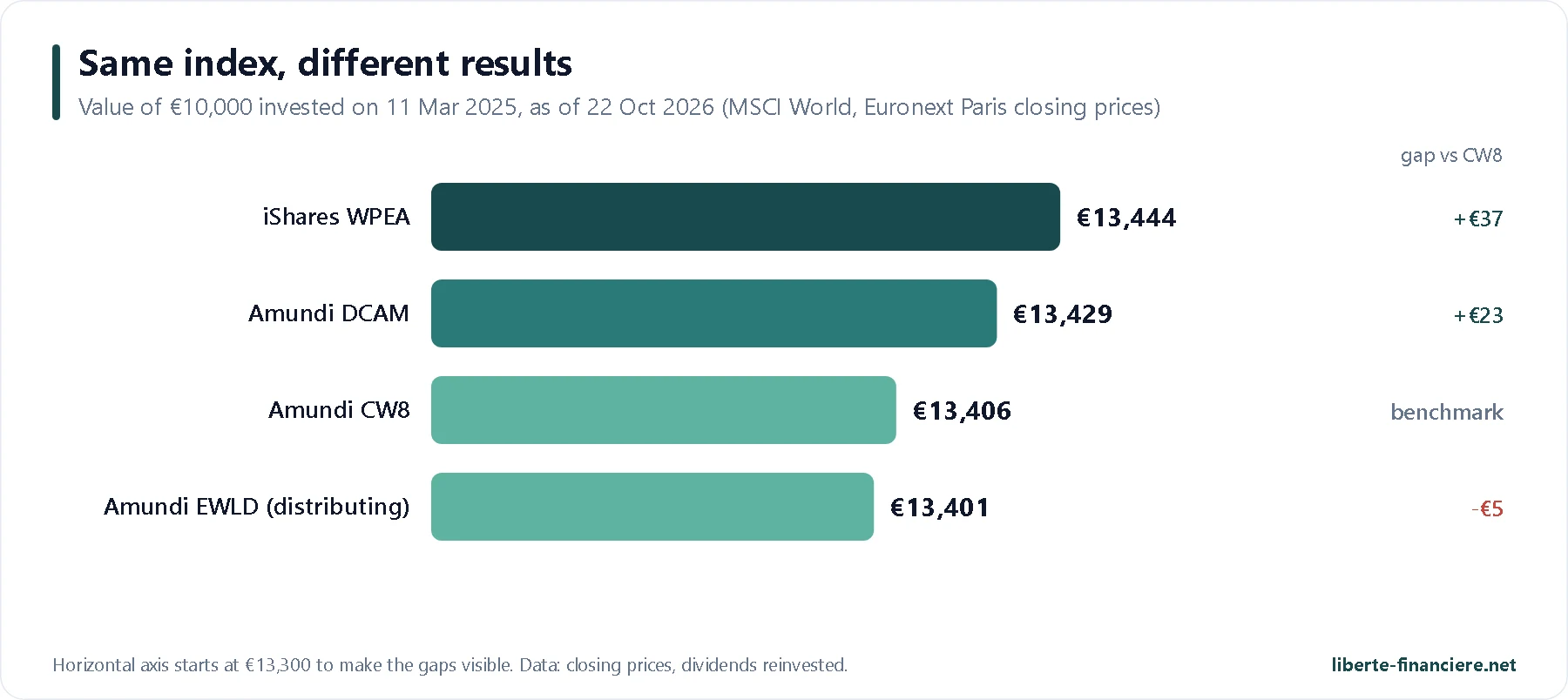
The issuers' official reports as of September 30, 2026 say the same thing: over one year, the WPEA returned 0.16 points less than the MSCI World, the DCAM 0.18 points and the CW8 0.42 points. Three takeaways. First, the CW8 does pay for its higher fees: 0.24 points behind the DCAM over one year according to the official reports, about 0.11 points a year on my own measurements since March 2025. Second, at identical fees (0.20%), the WPEA does slightly better than the DCAM (+34.44% versus +34.29% since the DCAM launch): the difference comes from the swap terms negotiated by BlackRock. Finally, these gaps remain tiny, a few hundredths to a few tenths of a point a year. Choosing between DCAM and WPEA will neither make nor break your wealth: what matters far more is investing regularly and not selling at the wrong time.
As a benchmark, the big MSCI World ETF for regular brokerage accounts, the iShares Core MSCI World (IWDA, physical replication, 0.20% in fees), returned +34.81% over the same period. It is slightly ahead, but it is not PEA-eligible: after tax, the PEA advantage wins by a wide margin over the long term (see the tax section).
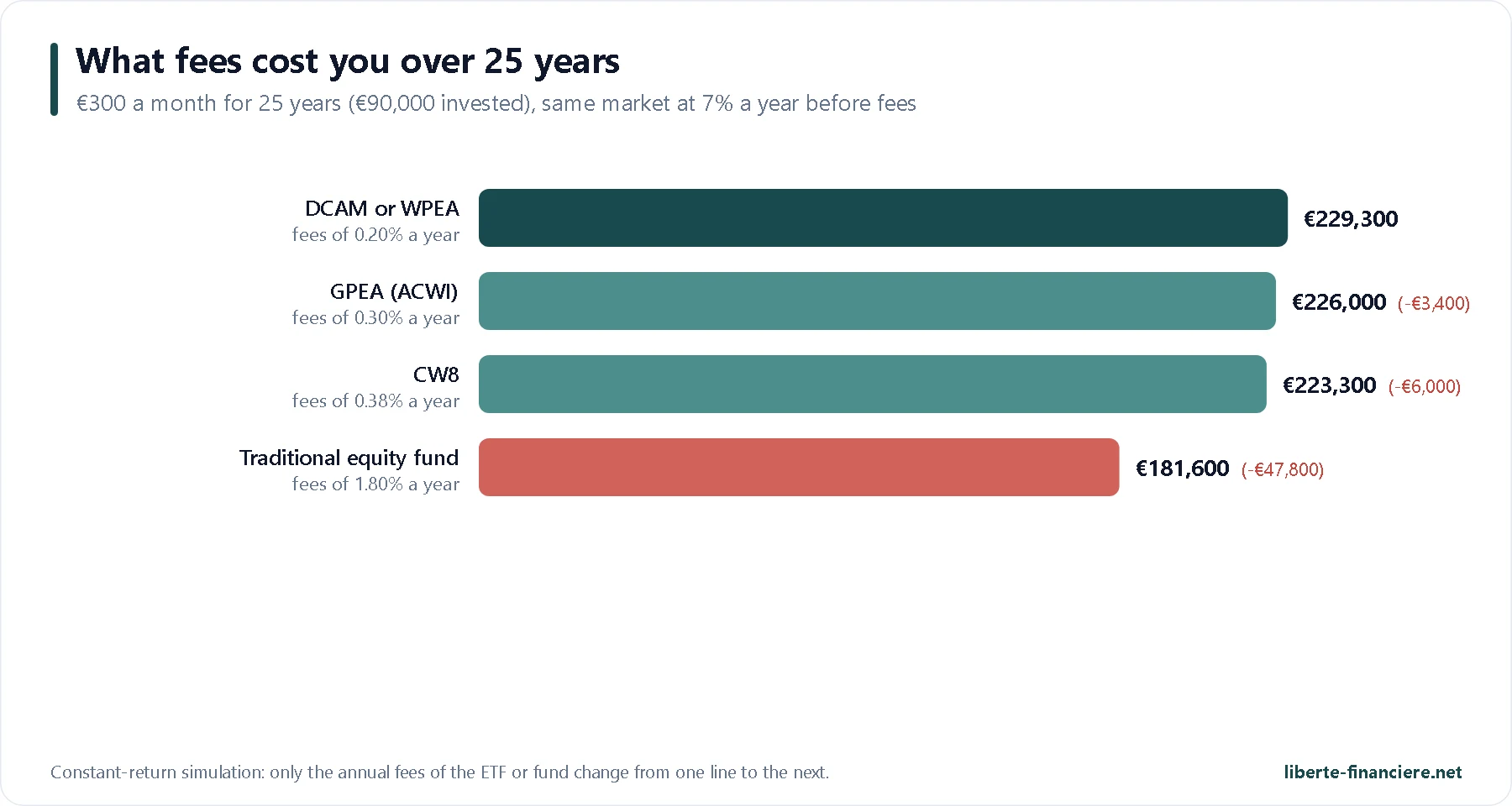
Over 25 years, the difference between an ETF at 0.20% and one at 0.38% adds up to thousands of euros, but it is nothing compared with the fees of a typical equity fund from a bank or life insurance policy, often around 1.8% a year. That is the real lesson: a World ETF, whichever one, costs very little. The trap lies elsewhere.
🔎 The PEA World ETFs in detail
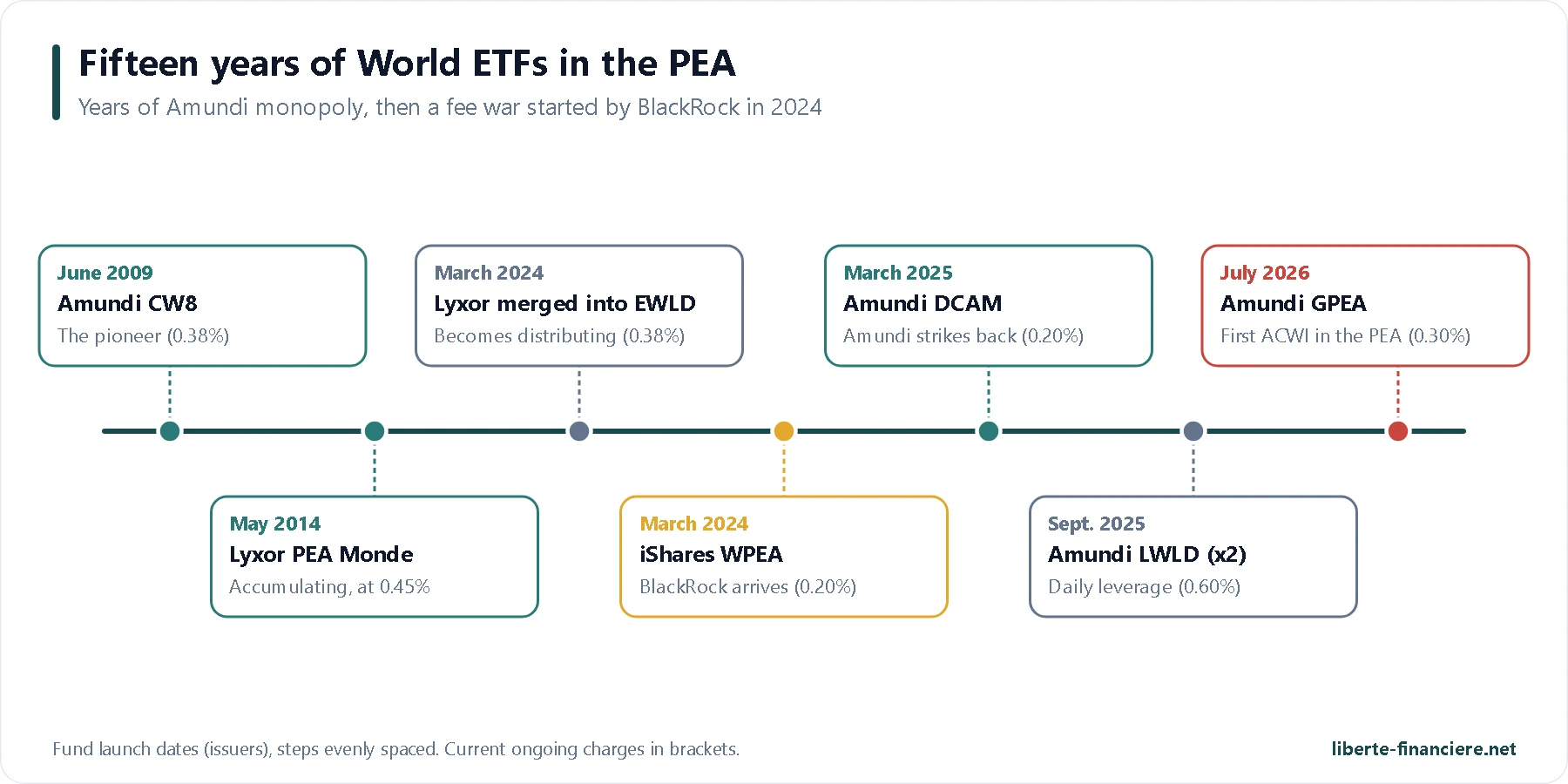
For fifteen years, the PEA offered only one or two World ETFs, all from Amundi. BlackRock's arrival in 2024 triggered a real fee war, and 2026 brought the first ACWI ETF:
Amundi PEA Monde MSCI World (DCAM): the Amundi pick
Launched by Amundi in March 2025 as a direct response to BlackRock, the DCAM is a French-law ETF that tracks the MSCI World for 0.20% a year in fees, the lowest level on the market, since matched by the WPEA. Its share, priced around €5 at launch, lets you invest exactly the amount you want each month, down to the cent. In a year and a half, it has passed €1.7 billion in assets, which rules out any risk of closure for lack of size. Its swap is with Société Générale, and its basket of European shares is exchanged for the performance of the MSCI World.
Pros: 0.20% in fees, the lowest on the market alongside the WPEA, a share at around €6 that is perfect for investing small amounts each month, and already solid assets.
Cons: a still short track record (March 2025) and a result slightly behind the WPEA so far, at equal fees.
Who it suits: anyone opening a PEA or starting to invest monthly.
Buy the DCAM in your PEA At Interactive Brokers, a €500 ETF order costs €2.50 (the PEA legal cap). Bonus: up to $1,000 in IBKR shares. |
iShares MSCI World Swap PEA (WPEA): my pick
Launched at the end of March 2024, the ETF from iShares (BlackRock, the world's largest asset manager) broke Amundi's monopoly on the MSCI World in the PEA. Its fees, initially 0.25%, are now 0.20% a year, the same level as the DCAM. With over €2.3 billion in assets, it is now the second-largest World ETF in the PEA and one of the most traded every day in Paris. Over every period I measured, it is also the one that tracked its index best. Those are the reasons it is the World ETF in my own PEA.
Pros: the best real performance among PEA World ETFs since 2025, backed by the world's largest asset manager, and among the highest daily trading volumes.
Cons: an Irish-law fund for which BlackRock does not publish the names of the swap counterparty banks.
Who it suits: those who want to diversify their issuer (BlackRock rather than Amundi) or who already hold Amundi funds.
Buy the WPEA in your PEA It is the World ETF in my PEA. Available at Interactive Brokers at the same price as other ETFs. |
Amundi MSCI World (CW8): the long-standing one
The CW8 is the original MSCI World ETF of the PEA: created by Amundi in 2009, it was for a long time the only way to give your PEA exposure to the whole world, hence its nearly €7 billion in assets. It tracks the same index as the DCAM and the WPEA, with the same mechanism, but at 0.38% a year in fees. Its other drawback is its share price, around €700: since the PEA does not allow fractional purchases, investing €200 a month is impossible, and €1,000 a month leaves up to €700 waiting in the cash account.
Pros: the oldest (June 2009) and the largest (€6.85bn), with over 15 years of track record.
Cons: 0.38% in fees, and a share at over €700 that prevents investing small amounts (no fractional ETFs in a PEA).
Who it suits: those who already hold it. For new money, the DCAM tracks exactly the same index for less.
Its twin EWLD (same index, same 0.38% fees) distributes its dividends instead of reinvesting them. In a PEA, this brings nothing: dividends land in the cash account with no tax advantage, and you have to pay order fees to reinvest them. I only find it interesting if you want a regular income to withdraw from your PEA after 5 years.
Amundi PEA Global MSCI ACWI (GPEA): the newcomer
It is the PEA event of the year: on July 15, 2026, Amundi listed in Paris the first ETF tracking the MSCI ACWI, that is the developed countries of the MSCI World plus 24 emerging countries (Taiwan, South Korea, China, India, Brazil…). Until then, you needed two holdings in a PEA to get this result: a World ETF and an emerging markets ETF, the latter always filtered on ESG criteria. The GPEA does it all in a single holding, for 0.30% a year in fees. Starting from €1 million at launch, it manages about €87 million three months later: a fast start, but still far from the billions of the DCAM and the WPEA.
Pros: developed and emerging markets in a single holding, no rebalancing to do, and the only way to hold emerging markets without an ESG filter in a PEA.
Cons: 0.30% in fees, still small assets (€87m) and only 3 months of existence: impossible to judge its tracking difference.
Who it suits: investors who want a single holding for life, especially with modest contributions.
Buy the GPEA in your PEA The first MSCI ACWI ETF of the PEA is available at Interactive Brokers. |
What about the leveraged World ETF (LWLD)?
Amundi also offers an ETF that delivers twice the daily change of the MSCI World (LWLD), for 0.60% in fees. Watch out for the word "daily": over several months, the ETF does not deliver twice the index performance. When markets rise steadily, it does better than double; when they swing up and down, it loses value even if the index ends flat, and a 50% fall in the index would take it close to zero. Over 12 months, it returned +27.2% versus +18.6% for the DCAM. It is a speculative product, not a core portfolio holding, and I do not use it for long-term investing.
🌍 MSCI World or MSCI ACWI: should you switch to the GPEA?
The MSCI ACWI (for "All Country World Index") takes the 1,249 companies of the MSCI World and adds 1,165 companies from 24 emerging countries, 2,414 companies in total. Emerging markets weigh about 12% of the index: the United States drops from 73% to 64%, and Taiwan becomes the third country, ahead of the United Kingdom. Otherwise, nothing changes: the top ten companies are almost the same, with one exception, the Taiwanese chipmaker TSMC.
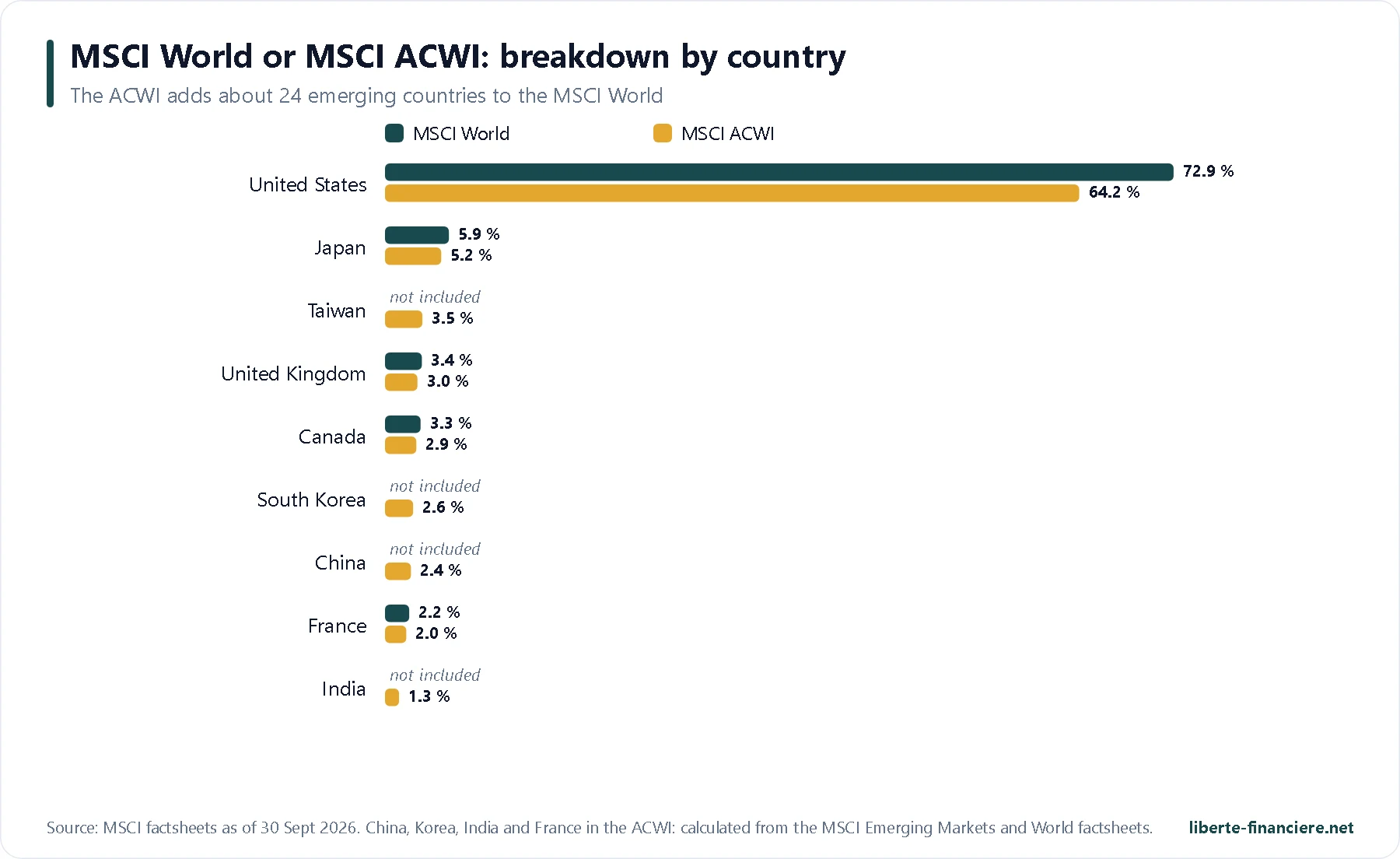
Beware of preconceptions: today's "emerging countries" are no longer the Brazil and China of the 2010s. As of September 30, 2026, the MSCI Emerging Markets index is made up of 29% Taiwan, 21% South Korea, 20% China and 11% India, with Brazil down to just 4%. It is now first and foremost an Asian, technology-driven bloc, powered by semiconductors (TSMC, Samsung, SK Hynix). Adding emerging markets therefore does not reduce your exposure to technology; it actually increases it slightly (33.2% technology in the ACWI versus 31.8% in the World).
How much does the ACWI really cost?
The GPEA costs 0.30% a year, versus 0.20% for the DCAM or the WPEA. But the fair comparison is with what you would pay to rebuild the ACWI yourself: 88% World ETF at 0.20% and 12% PEA emerging markets ETF at about 0.30%, roughly 0.21%. The real gap is therefore only 0.09 points a year: €9 a year per €10,000 invested, €135 a year on a full €150,000 PEA. In return, the GPEA saves you from rebalancing two holdings, and it gives access to emerging markets without the ESG filter imposed by every emerging markets ETF in the PEA. On performance, over 10 years to September 30, 2026, the World returned 12.7% a year in euros and the ACWI 12.3%; over one year, it is the reverse (20.8% for the ACWI versus 19.2%). The two indices are 99% correlated: over an investing lifetime, this choice is not what will make the difference.
World or ACWI: my view by investor profile
You are a beginner or want a single holding for life: the GPEA is the simplest solution, provided you accept that it has only three months of track record. Use limit orders.
You want the cheapest option and a solid track record: DCAM or WPEA, possibly topped up with 10 to 15% of an emerging markets ETF if you want emerging countries.
You already have World + emerging markets: change nothing, your allocation already does almost the same thing as the GPEA for a bit less.
You have a large PEA: above €100,000, the 0.09-point gap starts to add up, and the two-holding solution remains the cheapest.
🧭 What exactly is a World ETF?
An ETF (exchange-traded fund) is a fund that simply replicates an index, with no manager picking stocks, hence its very low fees. A "World" ETF replicates a global index, most often the MSCI World, calculated by the American company MSCI: the large and mid-sized companies of 23 developed countries, 1,249 companies as of September 30, 2026. By buying a single share, you become a proportional shareholder of Nvidia, Apple, Microsoft, LVMH, Toyota or Nestlé. It is the simplest and cheapest way to diversify your savings on the stock market.
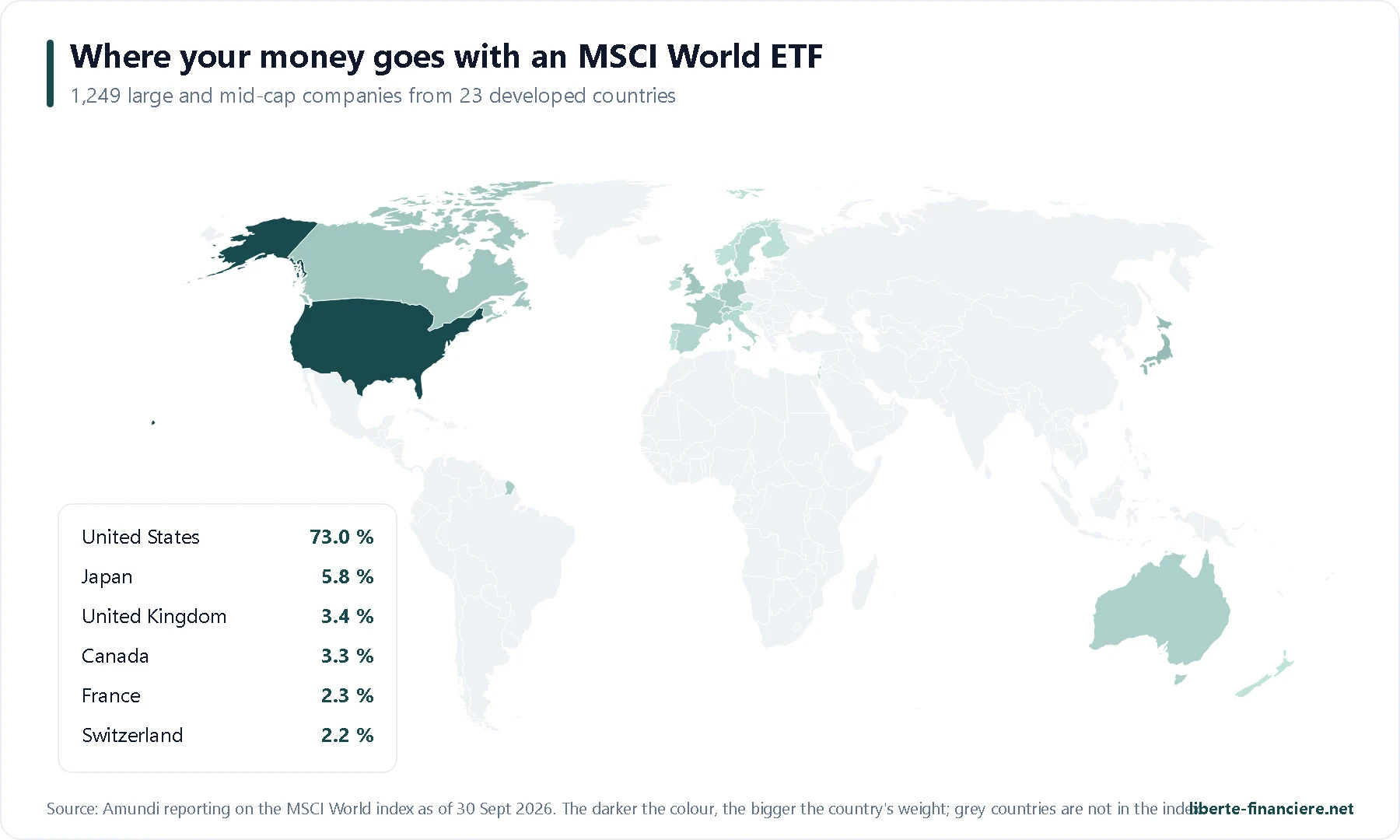
The MSCI World in figures
Criterion | MSCI World | MSCI ACWI |
|---|---|---|
Companies | 1,249 | 2,414 |
Countries | 23 developed | 23 developed + 24 emerging |
United States weight | 72.9% | 64.2% |
Weight of the top 10 companies | 27.9% | 25.4% |
Technology | 31.8% | 33.2% |
Dividend yield | 1.52% | 1.58% |
10-year performance (per year, in €) | 12.7% | 12.3% |
Performance since end-2000 (per year, in €) | 6.7% | 6.6% |
Worst drawdown in euros | −53.6% (2001-2009) | −53.1% (2007-2009) |
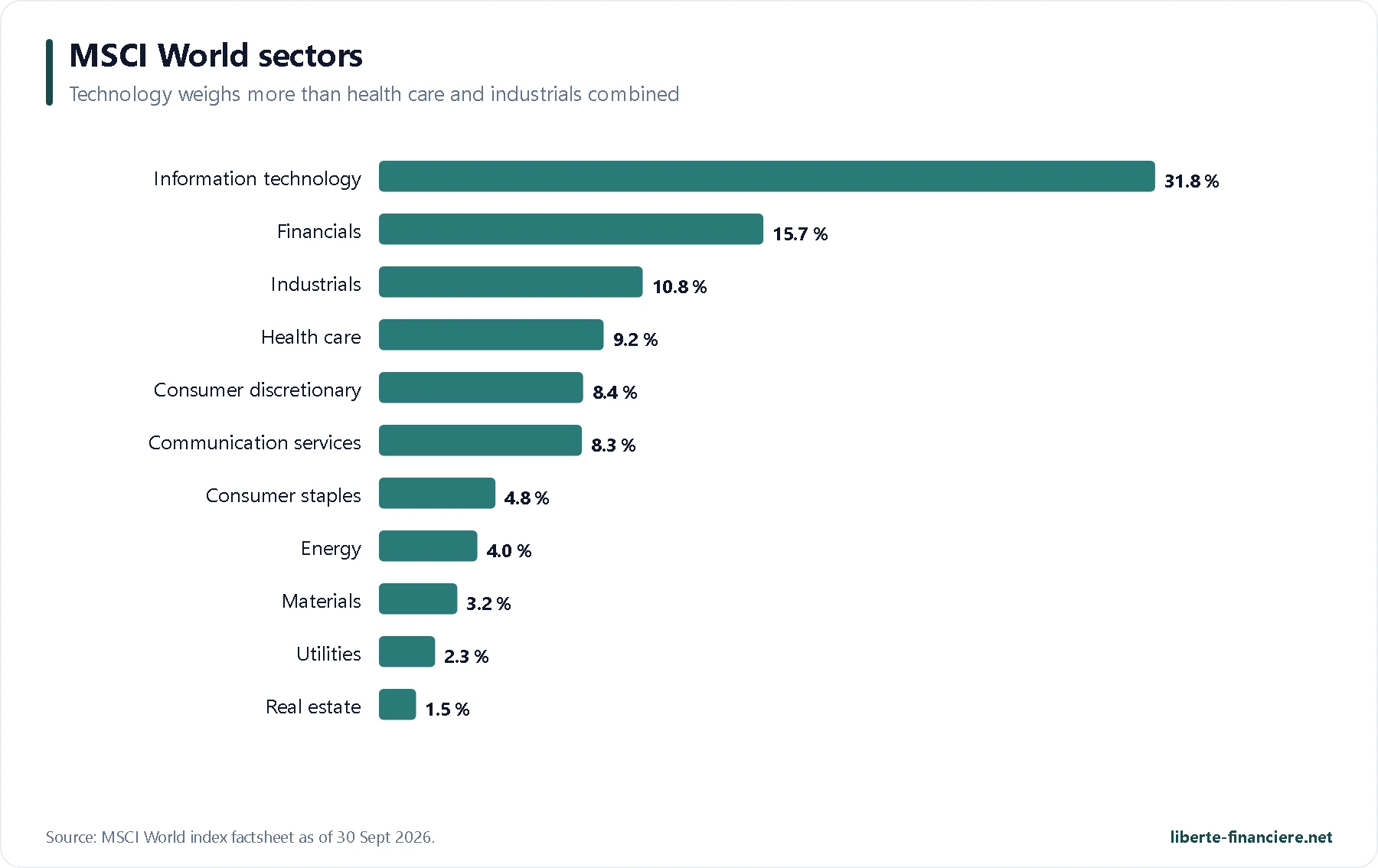
The top 10 companies of the MSCI World
Rank | Company | Country | Weight |
|---|---|---|---|
1 | Nvidia | 🇺🇸 United States | 5.81% |
2 | Apple | 🇺🇸 United States | 5.41% |
3 | Microsoft | 🇺🇸 United States | 4.00% |
4 | Amazon | 🇺🇸 United States | 2.67% |
5 | Alphabet (Google), class A | 🇺🇸 United States | 2.23% |
6 | Alphabet (Google), class C | 🇺🇸 United States | 1.76% |
7 | Meta (Facebook) | 🇺🇸 United States | 1.76% |
8 | Broadcom | 🇺🇸 United States | 1.76% |
9 | Micron Technology | 🇺🇸 United States | 1.33% |
10 | Tesla | 🇺🇸 United States | 1.12% |
The top ten holdings are all American and together weigh 27.9% of the index (MSCI data as of September 30, 2026). Twenty years ago, you would have found Exxon, General Electric or Nokia there: the index renews itself, growing companies move up and declining ones move down, without you having to do anything.
How the index is built
Free-float market cap weighting: each company weighs according to the value of its shares actually tradable on the market (excluding stakes held by the state or founders).
About 85% of each market: the index keeps the large and mid-sized companies of each country; small companies are excluded.
Quarterly reviews: MSCI updates the composition in February, May, August and November. A large IPO can enter faster, from its first days of trading.
Net dividends reinvested: the reference version used by ETFs assumes dividends are reinvested after withholding tax.
The "World" is not the whole world
Despite its name, the MSCI World covers neither China, India, Taiwan, South Korea nor Brazil: these are "emerging" countries in MSCI's sense, which classifies countries by how open and accessible their market is, not by their wealth (South Korea was kept in emerging markets in June 2026). It does not include small companies either. With about 1,250 companies, it still represents roughly 85% of the stock market value of developed countries and about 88% of the global market tracked by the ACWI.
🔄 How can a World ETF get into a PEA?
The PEA is reserved for European shares: a fund is only allowed in if it permanently holds at least 75% in shares of companies headquartered in the European Union or the European Economic Area (Article L221-31 of the French Monetary and Financial Code). An ETF that actually bought Apple, Nvidia and Toyota would therefore be excluded. PEA World ETFs get around this with synthetic replication: they buy a basket of European shares (ASML, SAP, LVMH, Infineon…), then sign an exchange contract, the swap, with a large bank, under which they pay it the performance of this basket and receive the performance of the MSCI World in return.
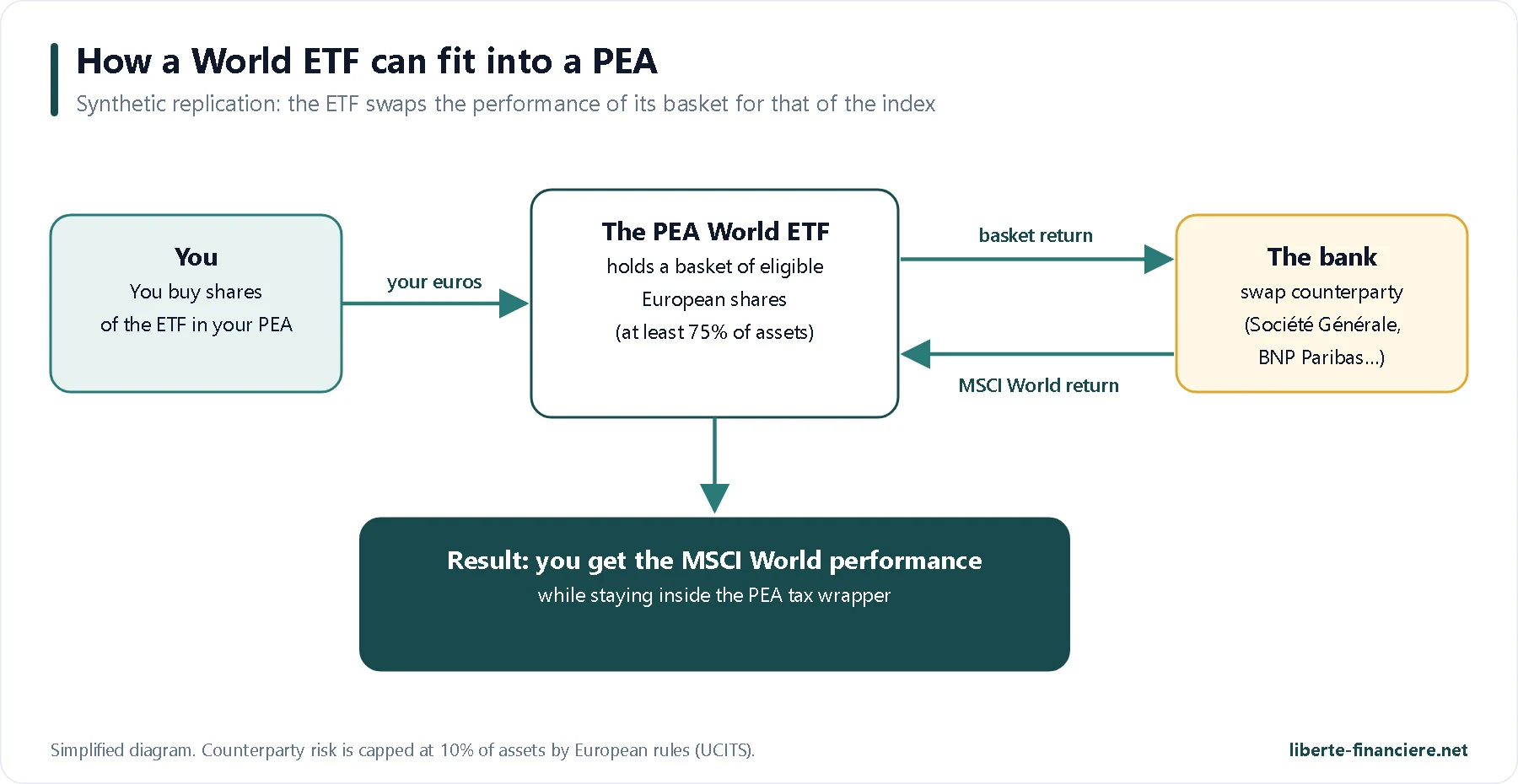
Counterparty risk, taken seriously
What you actually own: shares in a fund that holds very real European shares, kept by a custodian bank and separated from the assets of Amundi or BlackRock. If the issuer went bankrupt, these shares would not go to its creditors.
What you risk: that the swap bank defaults on the day it owes the ETF a performance gap. European fund regulation (UCITS) caps this debt at 10% of the fund's assets: beyond that, the swap is reset and the gap settled. In the worst case, with the bank failing at the worst possible moment, the theoretical maximum loss would therefore be around 10%, not the whole amount.
In practice, the gap is settled much more often and generally stays well below this limit. The counterparties are among the most closely supervised institutions in Europe (Société Générale, BNP Paribas). And even in a default, the fund keeps its basket of European shares, which it can sell or use to sign a new swap.
My view: it is a real but small risk, far below market risk (−33% in one month in 2020). If you want to reduce it further, splitting your savings between two issuers (Amundi and BlackRock) that do not necessarily use the same bank is a simple precaution.
The hidden advantage of the swap: dividends
Synthetic replication has an advantage that is rarely mentioned. The benchmark index, the MSCI World "net dividends reinvested", assumes dividends suffer the most punitive withholding tax (30% for US dividends). A physical ETF pays at least 15% on its US dividends. The synthetic ETF, on the other hand, receives from the swap the performance set by the index, and its counterparty bank, in a better tax position, sometimes shares part of the gain: that is why a good synthetic ETF can do as well as, or even slightly better than, the index despite its fees. It is one of the reasons why two ETFs with identical fees, like the WPEA and the DCAM, do not get exactly the same result.
Are World ETFs going to disappear from the PEA?
The question stirred up the forums throughout 2026. The facts, as of October 22, 2026: in July, a note from the professional federations (asset managers, banks, intermediaries) revealed that the French Treasury was considering excluding from the PEA the funds that use a swap to gain exposure outside Europe, as part of the 2027 budget. More than 7 million PEAs were affected. On August 26, 2026, the Minister for Public Action and Accounts ruled the idea out: the government will not propose any measure to exclude these ETFs from the PEA. The 2027 finance bill tabled at the end of September contains no such measure, and no amendment to that effect has been adopted to date. At European level, the work to revise fund rules (UCITS) does not affect PEA eligibility, which is a French rule. So the risk is not zero, since an amendment remains possible until the budget vote in December, but it has receded. And even in the worst-case scenario, such a reform would have to go through a law, with time to adapt: no text currently provides for forcing the sale of ETFs already held.
📈 What a World ETF has returned since 2010
To measure what a French investor actually earned, I used the daily prices of the CW8, the oldest MSCI World ETF in the PEA (dividends reinvested, fees deducted, in euros). €10,000 invested at the end of 2009 is worth about €70,900 as of October 22, 2026, or 12.4% a year for nearly 17 years.
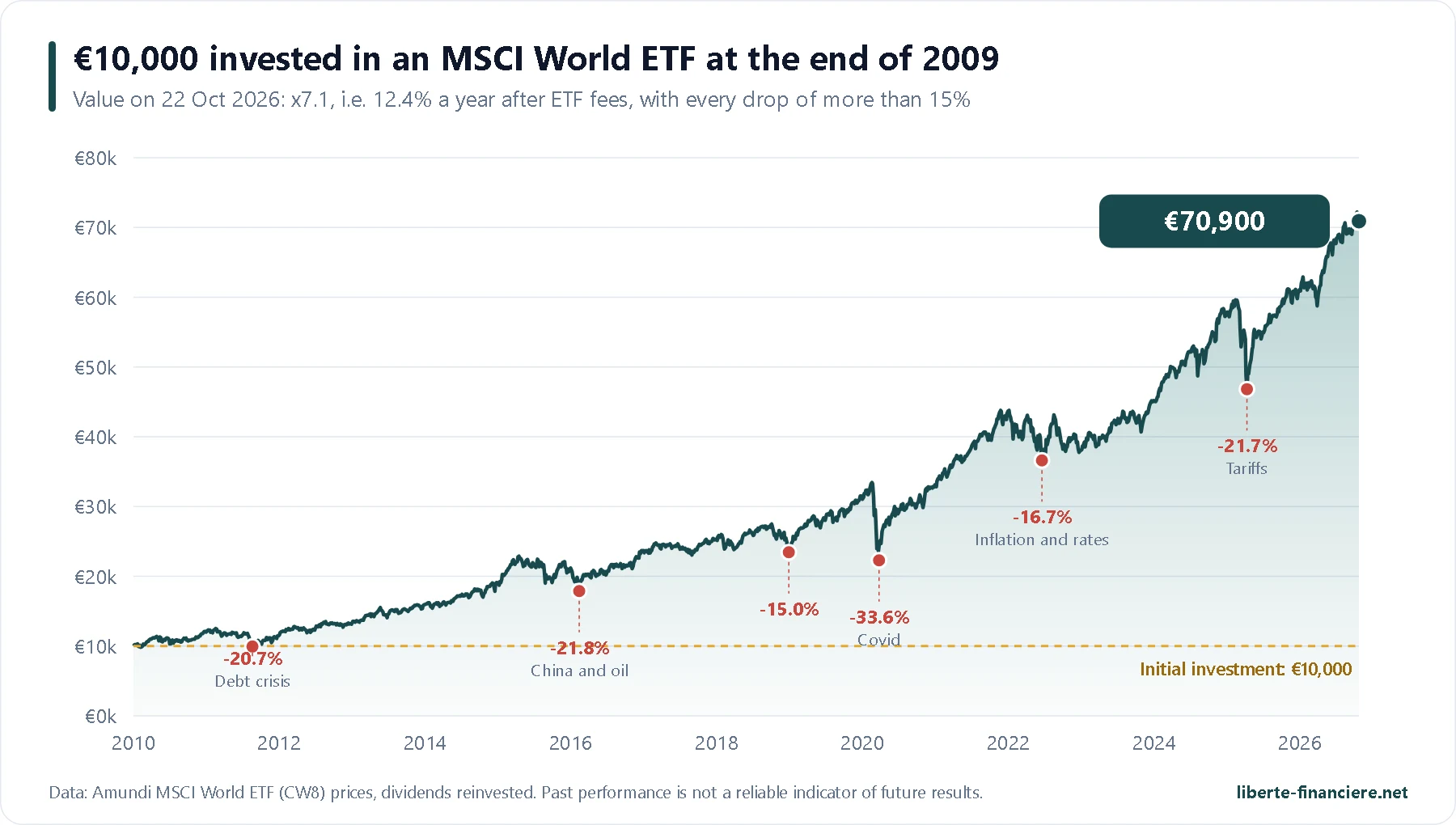
This figure should not hide the journey. The chart shows six drops of more than 15% in 17 years, and each one seemed, at the time, to be "the end":
Crisis | Maximum drop | Peak to trough | Back to the peak |
|---|---|---|---|
Eurozone debt crisis (2011) | -20.7% | February to August 2011 | March 2012 (1 year after the peak) |
China, oil and the dollar (2015-2016) | -21.8% | April 2015 to February 2016 | December 2016 (20 months) |
US rate hikes (late 2018) | -15.0% | October to December 2018 | April 2019 (6 months) |
Covid (2020) | -33.6% | February 19 to March 23, 2020 | January 2021 (11 months) |
Inflation and rising rates (2022) | -16.7% | January to June 2022 | December 2023 (23 months) |
US tariffs (2025) | -21.7% | February 19 to April 9, 2025 | October 2025 (7 and a half months) |
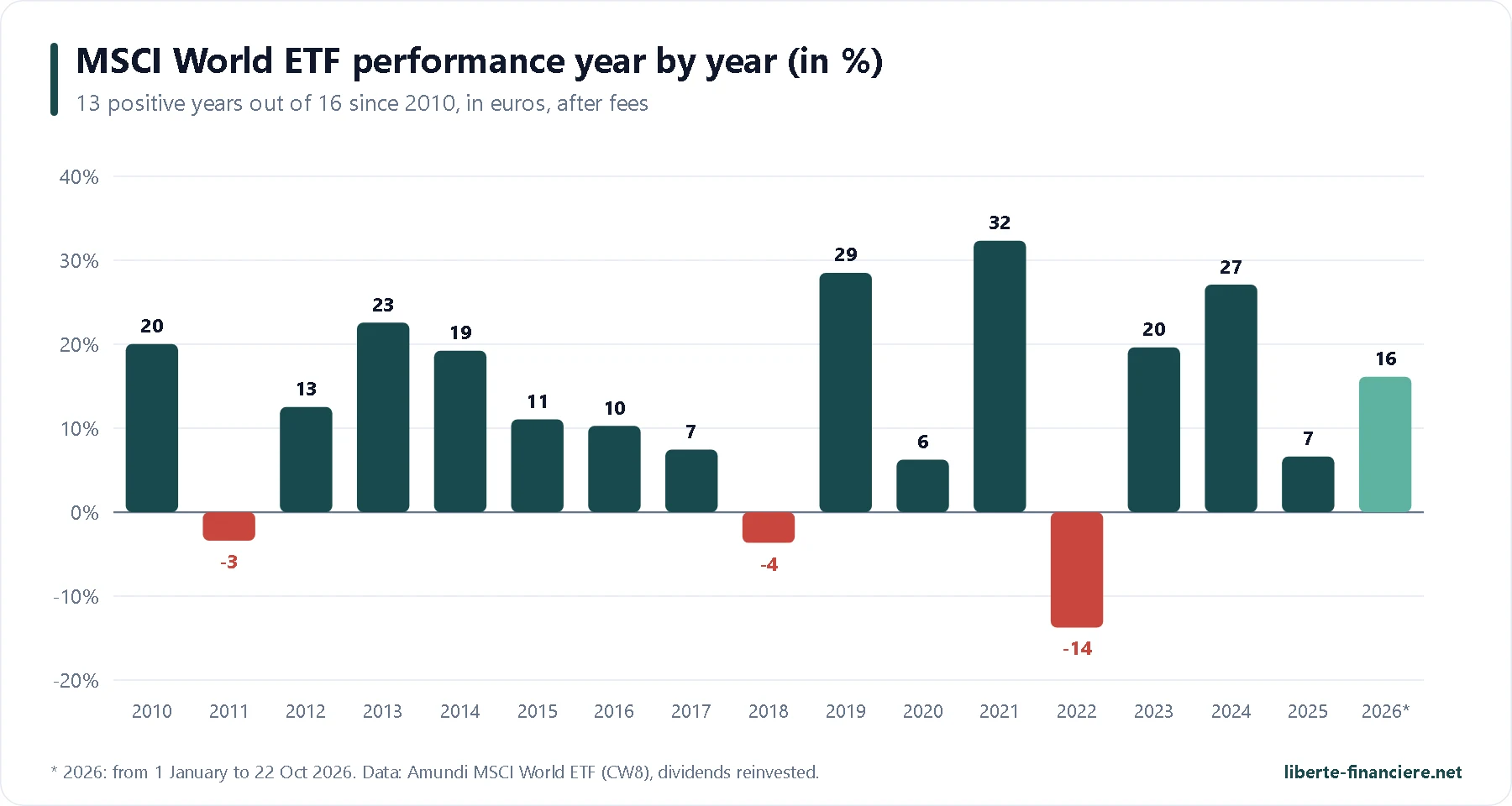
These 17 years were exceptional, driven by large American tech companies and by the rise of the dollar. Over a longer period, the MSCI World returned 6.7% a year in euros from the end of 2000 to the end of September 2026, despite the dot-com crash and the 2008 crisis: that is a more reasonable order of magnitude for your projections. And it has also gone through difficult decades: in euros, with dividends reinvested, an investor who bought at the January 2001 peak had to wait until February 2013, twelve years, to get their money back.
And investing €200 every month?
This is the most realistic scenario: most of us invest part of our salary every month. By buying €200 of an MSCI World ETF on the first trading day of every month since January 2010, without ever selling anything, you would have paid in €40,400 and your portfolio would now be worth about €128,900.
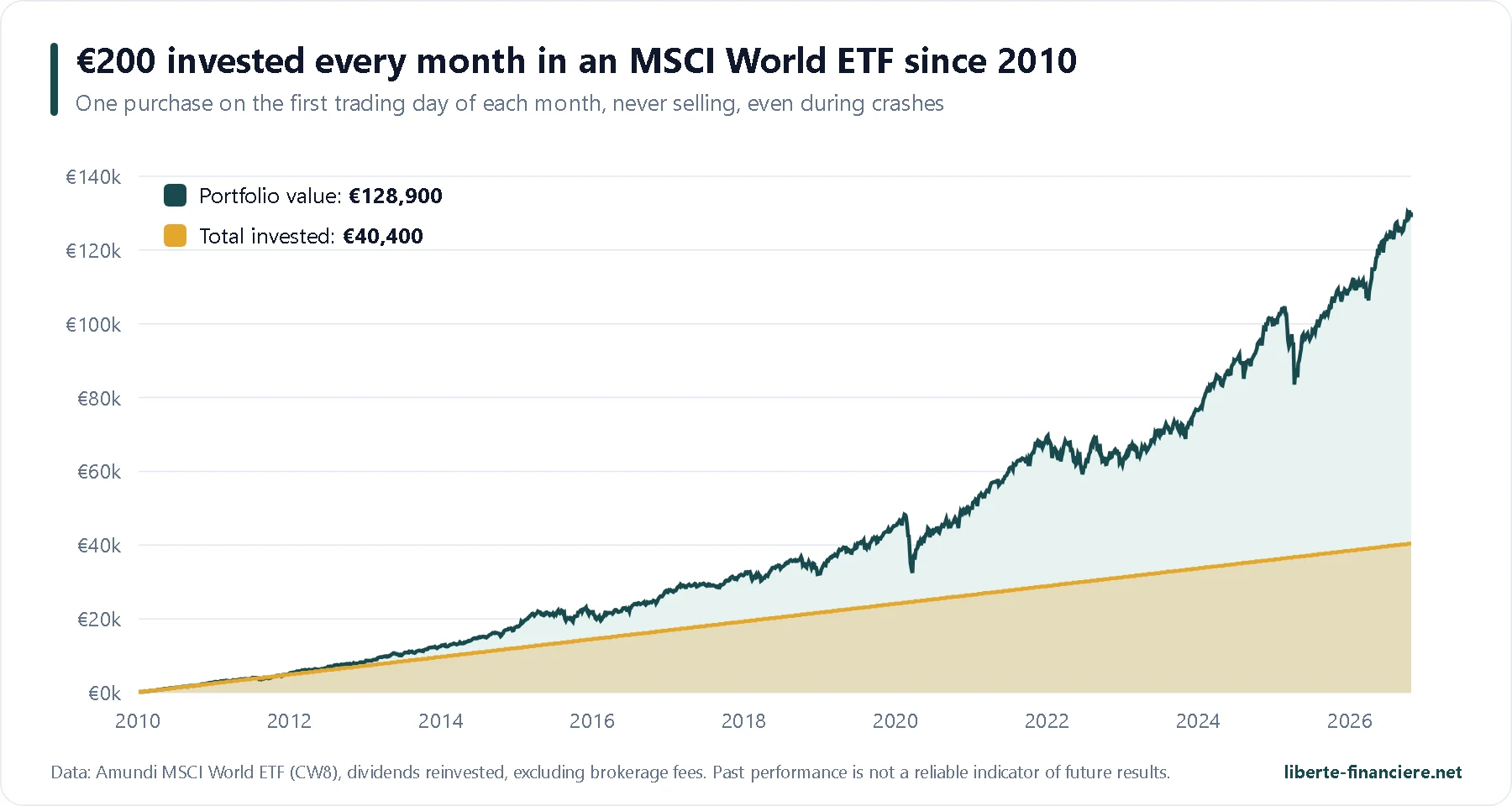
The big advantage of investing monthly is that it frees you from timing the market: you accumulate more shares when prices fall and fewer when they rise. The purchases made in March 2020, in the middle of the Covid panic, are now among the most profitable in the simulation.
Invest in a World ETF every month Open your PEA with Interactive Brokers: €1 for a €200 purchase, every European exchange, and up to $1,000 in free IBKR shares. |
🏦 Where to buy a World ETF in a PEA?
Your choice of broker matters as much as your choice of ETF: on a monthly investment, €2 in order fees on €200 costs you 1% a year, five times the DCAM's fees. Here are the offers I prefer for buying a World ETF in a PEA, with fees checked against the official price lists as of October 22, 2026:
Broker | €200 order | €1,000 order | World ETF at €0 | Bonus |
|---|---|---|---|---|
€1.00 | €2.55 | No (0.05% commission plus exchange fees, all European exchanges) | ||
€1.00 | €2.00 | Purchases of over 200 Amundi ETFs, including the CW8, until 12/31/2026 | ||
€0 (first order of the month) | €0 on Amundi ETFs | Purchases from €500 to €100,000 on 120 Amundi ETFs, including DCAM, CW8 and GPEA, until 12/31/2026 | ||
€1.00 | €5.00 | Purchases of Amundi ETFs from €100 (since 10/5/2026) | ||
€1.00 | €1.00 | Free savings plans, in whole shares | ||
Bourse Direct | €0.99 | €1.90 | First purchase of the month on a selection of Amundi ETFs, free scheduled plans | None |
Fees for an ETF buy order on Euronext Paris in a PEA, standard price lists as of October 22, 2026, including the legal cap of 0.5% of the amount. At Interactive Brokers, on the tiered plan, the 0.05% commission (minimum €1.25) is added to the exchange fees on ETFs (0.006%, minimum €1.20) and €0.10 in clearing fees; the fixed plan (€3 minimum) becomes cheaper between about €3,400 and €66,000 per order.
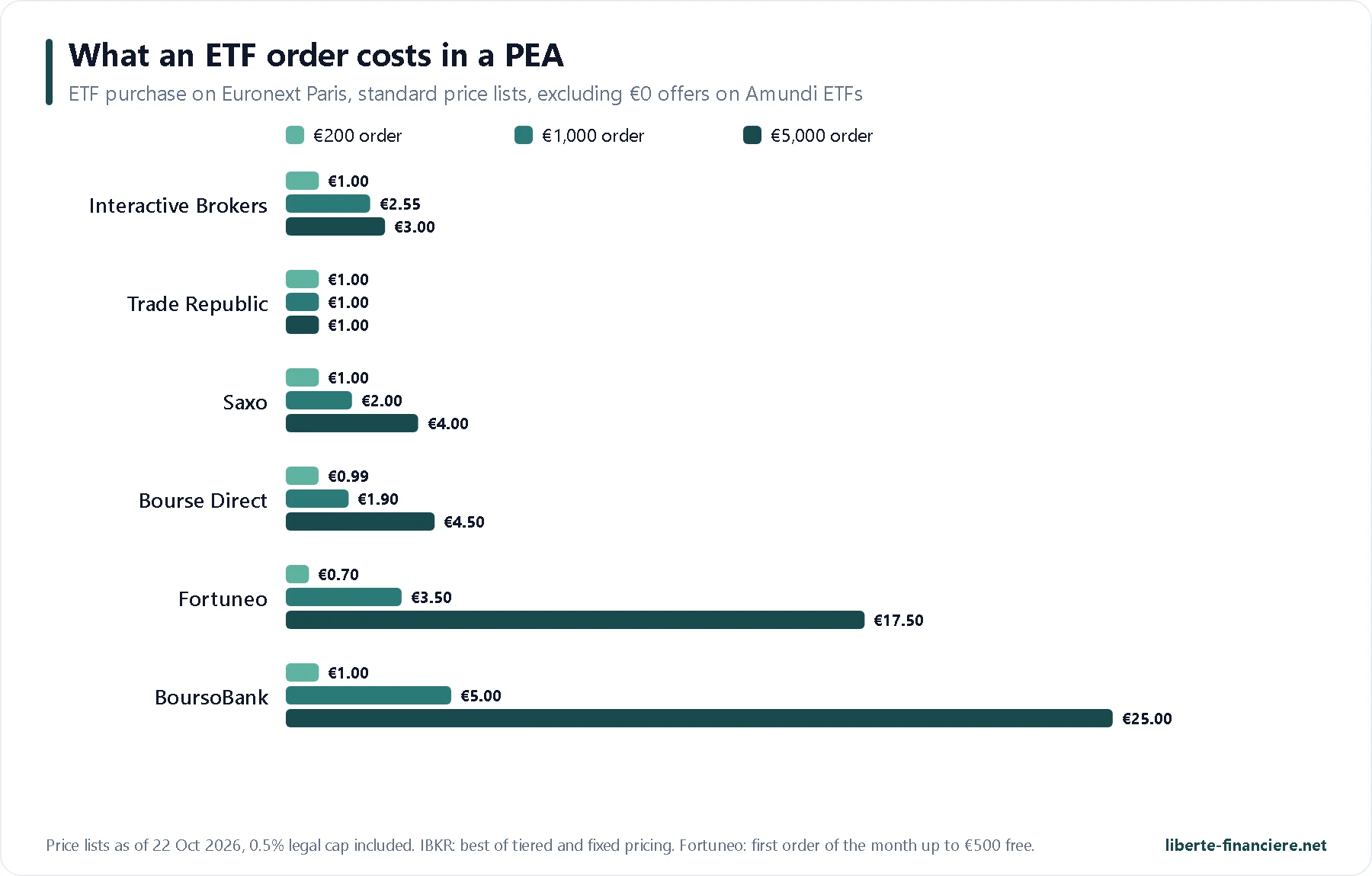
How to read this table? If you buy an Amundi ETF (DCAM, CW8 or GPEA), the €0 offers from Fortuneo, Saxo and BoursoBank are unbeatable until December 31, 2026 (they are funded by Amundi, which can end them or change its list). If you choose the WPEA, which is no longer free anywhere since BoursoBank switched from iShares to Amundi on October 5, 2026, Trade Republic remains the cheapest per order (€1 per order); at Interactive Brokers, expect €2.55 for a €1,000 order and €3 for €5,000 on the fixed plan. Yet it is the one I prefer if you want a single broker for your PEA and your regular brokerage account, with every exchange in the world and a share bonus when you open your account. Finally, Trade Republic is the simplest for investing automatically every month thanks to its free savings plans, in whole shares.
My favorite broker for a World ETF Interactive Brokers: €3 per ETF order between €3,400 and €66,000 on the fixed plan, every European exchange, and up to $1,000 in free IBKR shares. |
To compare all the other criteria (security, PEA-PME, transfers, app), see my PEA comparison tool, as well as the Interactive Brokers bonus code and Saxo bonus code pages.
🧾 Buying a World ETF with Interactive Brokers, step by step
Open your account online through the Interactive Brokers link on this page: identity, address, employment status and investment experience. Allow about 15 minutes, then 1 to 3 days for approval.
Request the opening of the PEA from your client area by adding an account. It is reserved for adult French tax residents, one per person.
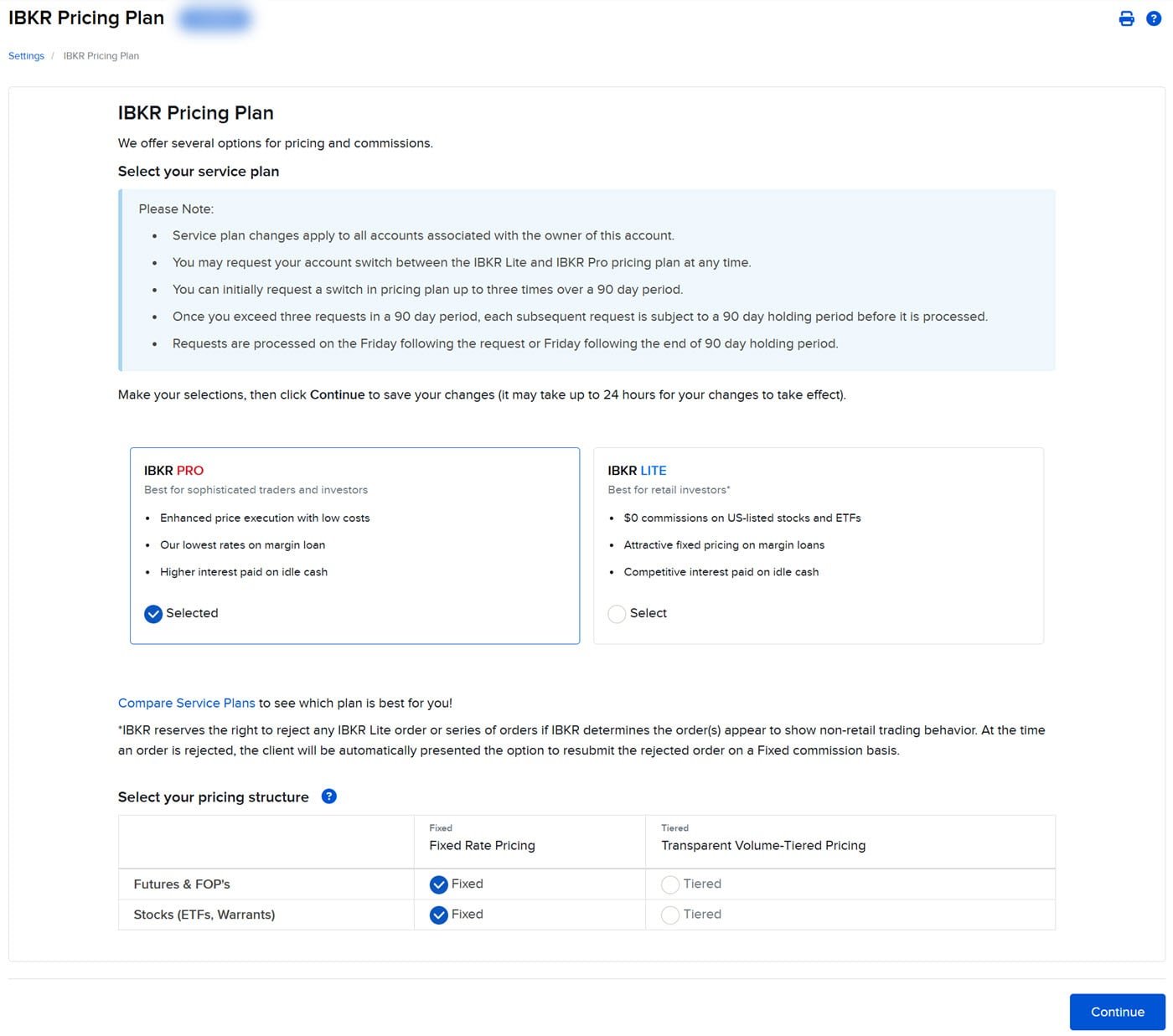
Choose your pricing plan in the account settings: the "tiered" plan for ETF orders up to about €3,400 (€2.55 from €500 to €2,000, capped at 0.5% of the amount in a PEA), the "fixed" plan above that (€3 for €5,000, €5 for €10,000).
Make a transfer in euros from a bank account in your name to your PEA. Funds usually arrive within one business day.
Search for the ETF by its ticker (WPEA, DCAM or GPEA) and check the ISIN and the euro listing on Euronext Paris.
Place a limit buy order for a whole number of shares, with a limit close to the last price, preferably between 9:30 a.m. and 5 p.m.
Repeat every month: since the PEA does not accept fractions, Interactive Brokers' automatic investing does not work there, as far as I know. Two minutes a month is enough.
You choose between the tiered and fixed plans in the account settings, under the pricing plan section:
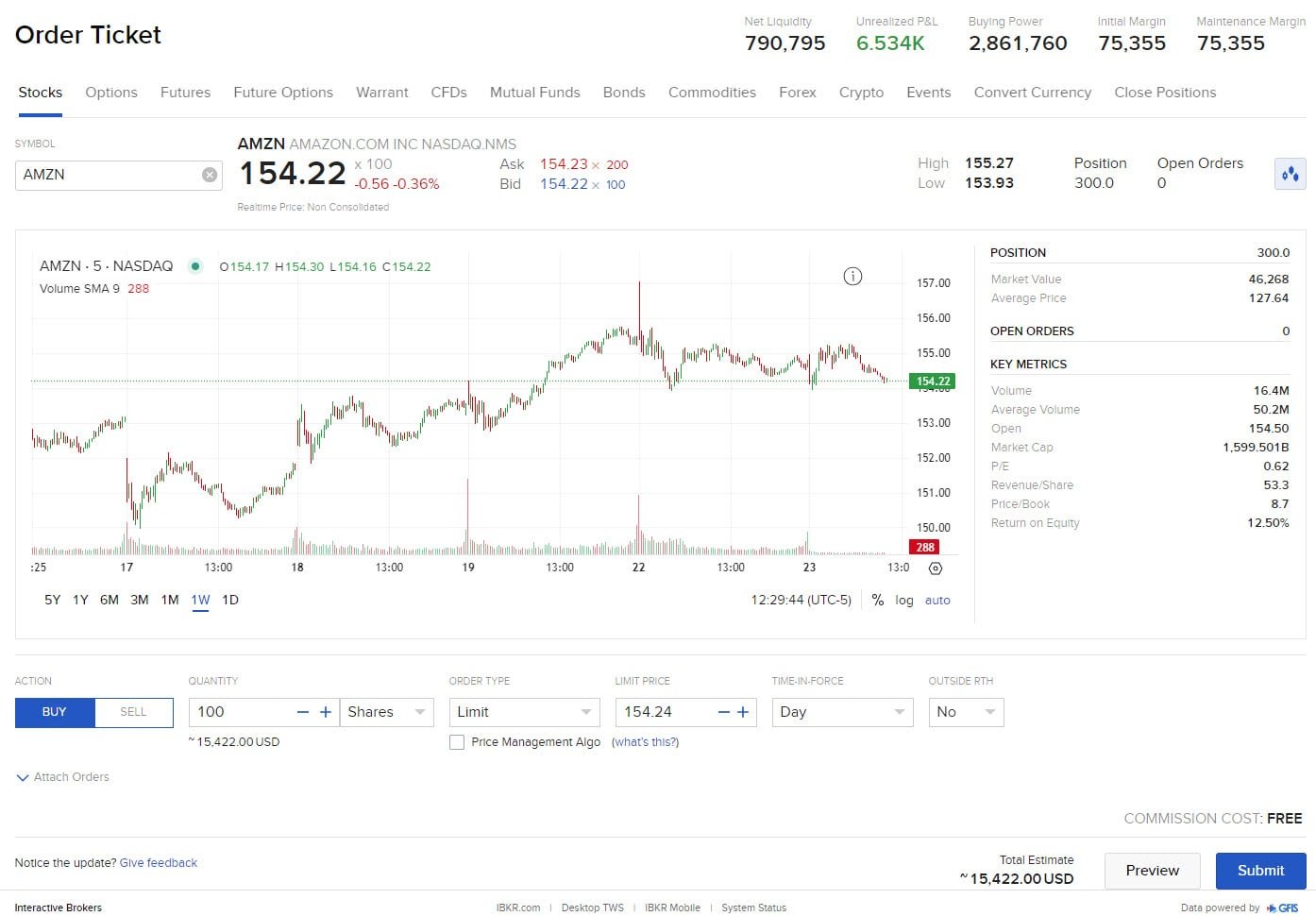
For the purchase, the order ticket lets you choose the order type: pick a limit order ("LMT") with a price close to the last price, and a quantity in whole shares.
Interactive Brokers charges no opening fees, custody fees, account maintenance or transfer fees on its PEA, and provides a single tax form (IFU) every year. The account is held by Interactive Brokers Ireland: as with the regular brokerage account, you must declare it every year on form 3916. All the details are on my Interactive Brokers bonus code page.
🧠 Which strategy with a World ETF?
Is a single World ETF enough?
Yes, for the vast majority of investors. A single World ETF already means about 1,250 companies from 23 countries, rebalanced automatically: when a company grows, its weight increases; when it declines, it leaves the index. Adding an S&P 500 or Nasdaq ETF diversifies almost nothing (the United States already weighs more than 70% of the World): it simply doubles down on your bet on the United States. The only additions that really change the picture are emerging markets (about 10% of the global market, missing from the World) and, if you want to reduce the weight of the US giants, a Europe ETF or a small caps ETF. In my PEA, I went for World plus emerging Asia; the GPEA does the same in a single holding, with all emerging markets.
Should you sell your CW8 to switch to the DCAM?
This is the question I get the most. In a PEA, selling triggers no tax: the only bill is the order fees and the gap between the buying and selling price (the "spread", about 0.05% on these heavily traded ETFs). On a €10,000 holding, the switch costs about €20 at Interactive Brokers (two €5 orders on the fixed plan and two spreads). On the other side, the DCAM actually returns about 0.11 points more per year than the CW8 according to my measurements, or €11 a year on €10,000. The switch therefore pays for itself in under two years, and even faster with a broker that does not charge for Amundi ETFs. My view: if your horizon is longer than 3 years, switch, in one go or over several months; otherwise, keep your CW8 and simply direct your new contributions to the DCAM or the WPEA.
Accumulating or distributing?
In a PEA, go for an accumulating ETF (as the DCAM, WPEA, CW8 and GPEA are). The dividends of the 1,250 companies are reinvested automatically in the ETF, with no order fees and no tax, letting compound interest work in full. A distributing ETF would pay these dividends into your cash account: since the PEA does not tax them as long as you withdraw nothing, you gain nothing, and you would have to pay fees to reinvest them. A distributing ETF only makes sense for someone who wants to live off their dividends after 5 years of PEA, and even then, regularly selling a few shares of an accumulating ETF amounts to the same thing.
When to buy, and when to sell?
The best time to buy a World ETF is when you have the money, and the best method is to invest a fixed amount every month, whatever happens. Nobody can predict crashes: the six drops of more than 15% since 2010 were all followed by a new high in under two years, and those who sold in March 2020 missed the recovery. As for selling, the only good reason is a project: buying property, retirement, a specific need. If that project is getting close, gradually lock in your gains over the 2 to 3 years before rather than selling everything at once. And keep in mind that in a PEA more than 5 years old, you can withdraw part of your money without closing it.
🔎 The World ETF in my PEA
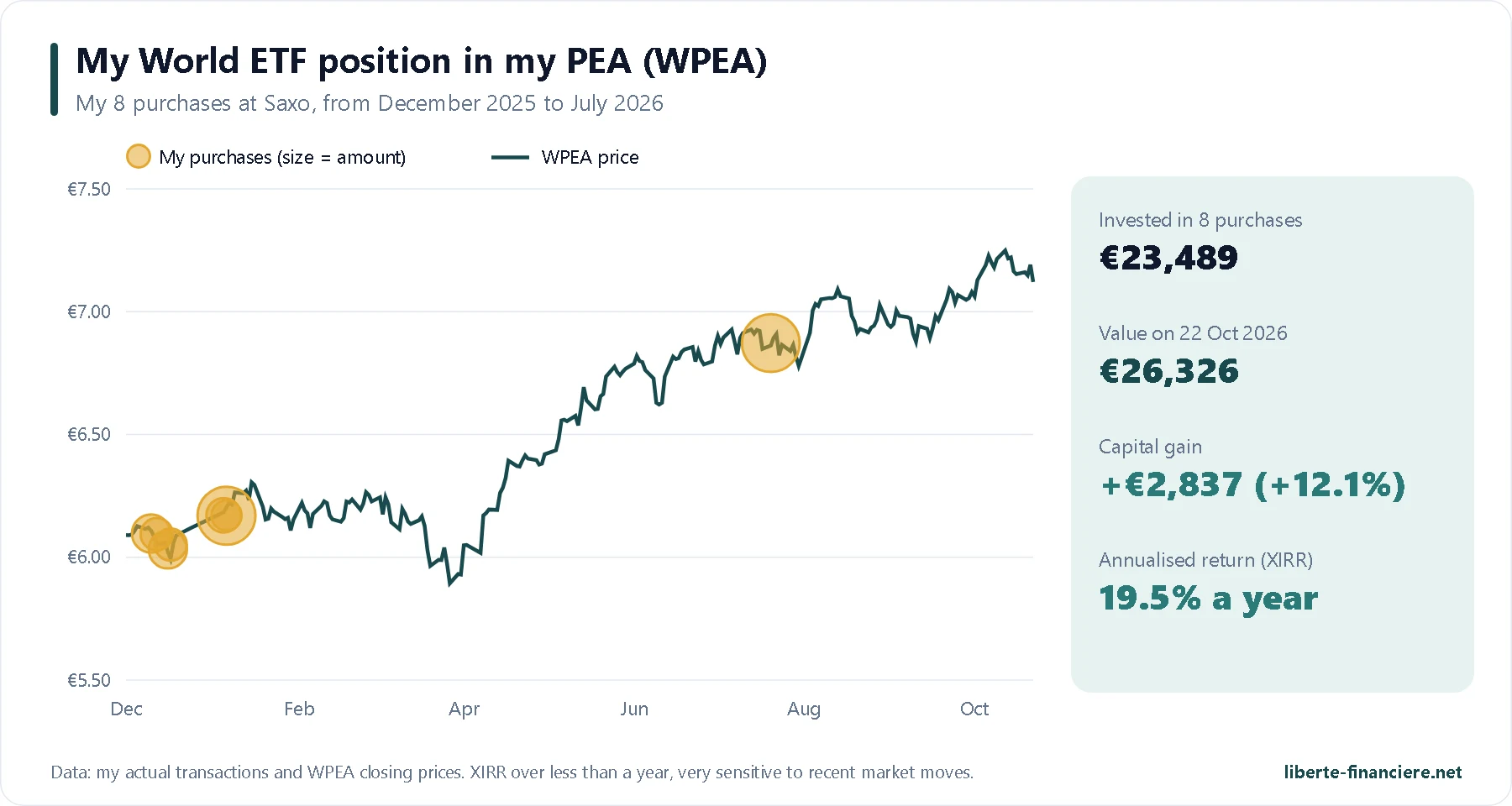
My PEA is with Saxo. I built my MSCI World holding there between December 2025 and July 2026, in 8 purchases of €740 to €7,700, for a total of €23,489 invested in the WPEA. At the close on October 22, 2026, my 3,697 shares are worth about €26,300, or about +€2,840 (+12%). On fees, these 8 orders cost me €6.12 in total, as Saxo credited back the other commissions.
Why the WPEA rather than the DCAM? Because I like to split my savings between two issuers (alongside it, I am building up the Amundi PEA Asie Émergente ETF to complement the World with the emerging countries of Asia), and because the numbers have backed it for two and a half years. If I were starting today, I would take either one, and I would not buy the GPEA until it has a year of track record. I have not yet invested in a World ETF on my Interactive Brokers account, which I mainly use for US dividend stocks and ETFs in a regular brokerage account.
⚠️ The risks to know
As a reminder: I am not a financial advisor. Any investment carries a risk of capital loss, and past performance is no guarantee of future performance.
Capital loss: a World ETF follows the stock markets, both up and down. It lost 33.6% in one month in 2020 and about half its value between 2007 and 2009. Money you will need within the next 5 years does not belong there.
Concentration in the United States and technology: about 73% of the MSCI World is American and the top ten companies make up more than a quarter of it. A sharp fall in the tech giants would weigh heavily. The ACWI reduces this dependence a little (about 63% United States), without removing it.
Currency risk: the ETF is listed in euros, but its companies are valued in dollars, yen or pounds. In 2025, the fall of the dollar brought the MSCI World's gain down to about +7% in euros, versus over 20% in dollars.
Counterparty risk: specific to synthetic PEA ETFs, capped at 10% of assets by regulation (see the swap section).
Regulatory risk: PEA eligibility rules could change, even though nothing has been decided (see above).
Liquidity: low risk on the large ETFs (several million euros traded every day in Paris), to watch on the GPEA whose volumes remain modest: limit orders are a must.
🧮 Taxes: PEA or regular brokerage account for a World ETF?
The PEA is the ideal wrapper for a World ETF: as long as your money stays in the plan, neither reinvested dividends nor switches between ETFs are taxed. When you withdraw, after 5 years, you only pay the French social contributions (prélèvements sociaux), raised to 18.6% since January 1, 2026 (CSG increase voted in the 2026 Social Security financing act).
PEA | Regular brokerage account | |
|---|---|---|
Gains withdrawn before 5 years | 12.8% income tax + 18.6% social contributions = 31.4%, and the plan is closed (with exceptions: redundancy, disability, early retirement, starting a business) | 31.4% on capital gains in each year you sell |
Gains withdrawn after 5 years | 0% income tax, 18.6% social contributions | 31.4% |
Dividends reinvested by an accumulating ETF | No tax | No tax as long as you do not sell |
Switching from one ETF to another | No tax | Capital gain taxed |
Contribution cap | €150,000 (€20,000 for a PEA jeune) | None |
Withdrawals | Partial withdrawals possible after 5 years, without closing | Unrestricted |
World ETFs available | Synthetic only (DCAM, WPEA, CW8, GPEA…) | All, including physical |
Example: for €10,000 of capital gains withdrawn after 5 years, you pay €1,860 in a PEA, versus €3,140 in a regular brokerage account. The gap far exceeds the few hundredths of a point that separate a synthetic ETF from a physical one. One point is still debated among specialists: the rate applicable to gains accumulated between 2018 and 2025 in a PEA withdrawn from 2026 onwards (18.6% on a literal reading of the law, 17.2% according to some firms); only gains made before 2018 definitely keep their old rates. Otherwise, remember that a PEA opened with a foreign broker, such as Interactive Brokers, must be reported every year on form 3916.
In a PEA held by a French broker, the single tax form (IFU) is enough. For an account held abroad (the Interactive Brokers PEA and regular brokerage account), I use FlashFiscal, a French tool that imports the broker's statements and prepares the tax return forms (3916, 2074, 2047). With my link, you get €15 off your first year. I walk you through the whole process in this tutorial:
FlashFiscal: €15 off the first year Your foreign account tax return prepared from your broker's statements. |
And in a regular brokerage account, which World ETF?
If your PEA is full (€150,000 in contributions) or if you cannot open one, a regular brokerage account gives access to the cheapest World ETFs in Europe, with physical replication (they actually hold the shares). Gains are taxed at the flat rate in each year you sell, and dividends reinvested by the ETF are not taxed as long as you do not sell, hence the appeal, here too, of accumulating versions.
ETF | Index | Fees | Replication |
|---|---|---|---|
iShares Core MSCI World (IWDA) | MSCI World | 0.20% | Physical, €133bn in assets |
Xtrackers MSCI World (XDWD) | MSCI World | 0.12% | Physical |
SPDR MSCI World (SWRD) | MSCI World | 0.12% | Physical |
Amundi Core MSCI World (MWRD) | MSCI World | 0.12% | Physical, listed in Paris |
Vanguard FTSE All-World (VWCE) | FTSE All-World (developed + emerging) | 0.14% | Physical, €56bn in assets |
SPDR MSCI ACWI IMI (IMIE) | MSCI ACWI IMI (including small companies) | 0.17% | Physical |
iShares MSCI ACWI (SSAC) | MSCI ACWI | 0.20% | Physical |
A brokerage account for ETFs from around the world Interactive Brokers gives access to all these ETFs, with near-free currency exchange. |
❌ Mistakes to avoid
Piling up overlapping ETFs: World + S&P 500 + Nasdaq means holding Apple, Microsoft and Nvidia three times. A World (or ACWI) ETF is enough as a core.
Choosing the CW8 for small amounts: with a share at over €700 and no fractions in the PEA, part of your savings stays uninvested every month.
Placing market orders on a small ETF: on a thinly traded ETF like the GPEA, always use a limit order, and avoid the first and last half hour of trading.
Paying 1% in order fees: €2 on a €200 purchase is five times the DCAM's annual fees. Group your purchases or choose a suitable broker (see the broker table).
Selling during a crash: this is the most costly mistake, far more than any fee difference between ETFs.
Switching ETFs with every new launch: the gaps between DCAM, WPEA and GPEA are counted in tenths of a point a year. Consistency matters a hundred times more.
Opening your PEA too late: the 5-year clock starts with the first deposit. Open it now with a few euros, even if you only really invest later.
Believing a World ETF cannot fall: −33.6% in one month in 2020. Only put in money you will not need for at least 8 to 10 years.
FAQ: World ETFs in a PEA
What is the best MSCI World ETF for a PEA?
The DCAM (Amundi PEA Monde) and the WPEA (iShares MSCI World Swap PEA), both at 0.20% a year in fees with a share price of around €6 to €7. The WPEA has tracked its index slightly better since 2025; the CW8 remains a good ETF, but more expensive.
Is there a PEA-eligible MSCI ACWI ETF?
Yes, since July 15, 2026: the Amundi PEA Global (MSCI ACWI), ticker GPEA, ISIN FR0014017NX3, at 0.30% a year in fees. It is eligible thanks to a basket of European shares exchanged for the index performance.
DCAM or WPEA: which one to choose?
Both are equally good: same fees, same index, assets of several billion. The WPEA has done about 0.15 points better since March 2025. Take the one your broker charges the least for, or both to split between Amundi and BlackRock.
Should you sell your CW8?
If your horizon is longer than 3 years, switching to the DCAM or the WPEA pays for itself in under two years, tax-free within the PEA. Otherwise, keep it and invest new money elsewhere. See the strategy section.
MSCI World or MSCI ACWI?
The ACWI adds about 12% of emerging countries to the World. Over the long term, their performances are very close. The ACWI is more complete and simpler; the World is cheaper and has a solid track record in the PEA.
What return can you expect from a World ETF?
The CW8 returned 12.4% a year in euros from the end of 2009 to October 2026, an exceptional period. Over several decades, count instead on 7 to 9% a year on average, with years at −20% or −30%.
How much do you need to start?
The price of one share: about €6 for the DCAM, €7 for the WPEA, €5 for the GPEA. Ideally, invest a fixed amount every month, grouping small amounts if your broker charges a minimum per order.
Can you lose everything with a World ETF?
The world's 1,250 largest companies would all have to go bankrupt at the same time. On the other hand, a 30 to 50% drop is possible in a crisis, as in 2008 or 2020: that is why you need a horizon of at least 8 to 10 years.
What happens if Amundi or iShares goes bankrupt?
An ETF's assets are separate from those of its manager and kept by a custodian bank. If the issuer went bankrupt, the ETF would be liquidated or taken over, and its value would come back to you. The real risk is the swap counterparty risk, which is regulated and capped (see above).
Can an ETF close?
Yes, if it stays too small. You lose nothing: the value of your shares is paid to you in cash in your PEA, tax-free, and you can reinvest right away. This risk no longer concerns the DCAM or the WPEA, and is receding for the GPEA.
Is there a currency risk?
Yes. The ETF is listed in euros, but about 85% of the companies are valued in dollars, yen or pounds. If the dollar falls against the euro, your ETF falls accordingly, and vice versa. Over 15 to 20 years, this effect tends to even out.
Can you buy fractional ETF shares in a PEA?
No, not as of October 2026: the PEA requires whole shares. That is why low-priced ETFs (DCAM, WPEA, GPEA) are more practical than the CW8 for investing every month.
Can you put a World ETF in a life insurance policy?
Yes, many online French life insurance policies (assurance-vie) offer MSCI World ETFs, often with physical replication. But you also pay the policy's management fees (about 0.5% a year). The PEA remains cheaper for a World ETF; life insurance is a useful complement, for passing on wealth.
Conclusion
In 2026, the PEA has never served so well the investor who wants the whole world for next to nothing. The DCAM and the WPEA share first place at 0.20% a year in fees, with a slight measured edge for the WPEA. The CW8 remains solid but no longer makes sense for new money. The GPEA is the good news of the year for those who want the whole world, emerging markets included, in a single holding: I am giving it a few months to prove itself. In the end, the choice of ETF matters far less than three habits: investing every month, choosing a broker that does not eat into your contributions and never selling in a panic.
To take action, you can open your PEA with Interactive Brokers and get the share bonus, or first compare the offers with my PEA comparison tool.
And as always, NEVER give up!
ETF data as of October 22, 2026. Past performance is no guarantee of future performance.