I funded my first project on La Première Brique in November 2021. Five years later, I have invested more than €235,000 in total there, spread across 144 projects. I have interviewed its founders several times and analysed dozens of projects on video. Suffice to say, I know the platform from the inside, with its very strong points and its weak spots.
In this review, I walk you through everything: the history and the team, how the loans work, the real figures on delays and legal proceedings, the guarantees, the Jimbots, the interest-bearing balance, the new rental offer, taxation, my own numbers and how it compares with competitors. The goal: to let you decide with full knowledge of the facts, not on the basis of an advertised return.
This article is not sponsored by La Première Brique. Some links are affiliate links: if you sign up with my link and the code FLR2AX, you get a 1% bonus on your first investment, and you support my work at no extra cost.
La Première Brique at a glance
Criterion | La Première Brique |
|---|---|
Founded | 2019 |
Headquarters | 🇫🇷 Lyon (France) |
Business | Property crowdlending (property dealers, property development, credit lines) and commercial rental real estate |
Licence | European crowdfunding service provider licence (ECSP/PSFP) issued by the AMF |
Volume funded | 914 projects, €451.4m (including 5 rental projects) |
Average rate | 11.4% gross per year |
Average duration | 16 months (closer to 2 years on recent projects) |
Minimum investment | €1 |
Investor fees | None |
Definitive losses | €0 in the official indicators, but a first loss has been announced and others will probably follow |
Trustpilot rating | 4.4 / 5 (more than 1,500 reviews) |
Bonus | 1% cashback on your 1st project, then 1% on eligible projects |
To put it in context: with nearly €450m funded, La Première Brique plays in the same league as Bricks or Raizers, far ahead of most French property crowdfunding platforms, and all of this in barely seven years. Its average rate of 11.4% puts it at the top end of the market. You can find its indicators, year by year and alongside those of other platforms, on my Performance indicators page.
My video: my review of La Première Brique
If you prefer video, here is my detailed feedback on La Première Brique: its strengths, its weaknesses, the issue of delays and my project selection criteria.
From €7,500 to more than €440m: the story of La Première Brique
The idea was born in 2018 in Lyon. The company La Première Brique SAS was set up on 25 February 2019 with €7,500 of starting capital (RCS Lyon 848 713 442, share capital of €150,000 today), with its head office at 91 cours Charlemagne, 69002 Lyon.
The beginnings were modest: 3 projects in 2019 for €430,000, 10 projects in 2020. The first employees arrived at the end of 2020, at the HUB 612 incubator. Then everything sped up: €13m funded in 2021, €35m in 2022, €72m in 2023, €96m in 2024 and €131.5m in 2025. Today the platform claims more than 220,000 registered users (the famous "briqueurs").
Two things I like about this journey. First, the company was profitable from its very first year and grew without a sales force, mainly through word of mouth and referrals. Its 2024 accounts show €6.46m in revenue and €2.12m in profit, which is rare in the sector. Second, the platform has stayed focused on its core business: real estate debt.
The key milestones: European PSFP licence in September 2023, a mobile app at the end of 2024, then in 2025 two funds, iXO Private Equity and Elige Capital, took minority stakes, along with a new visual identity. In 2026, two big new features: rental projects (commercial real estate) and interest on uninvested cash. More on that below.
The founders: Hugo Berthe and Thomas Danset
La Première Brique is first and foremost the story of two people from Lyon, Hugo Berthe and Thomas Danset, who launched the platform in 2019 with €7,500 and still run it together: Hugo as chairman, Thomas as managing director.
 Hugo Berthe is the co-founder and chairman of La Première Brique (LinkedIn). He is the face of the platform: he hosts the investor events, answers criticism without beating around the bush and regularly comes on my channel to explain himself. Together with his partner, he is the largest investor on the platform: they have funded around 120 projects together through a joint company, and almost the whole team invests too. That is the kind of alignment of interests I like to see.
 Thomas Danset is the other co-founder and the company's managing director (LinkedIn). A lawyer by training and an EM Lyon graduate, he brings the legal culture, which matters a lot in a business where everything comes down to contracts and guarantees.
Around them is a team of about forty people in Lyon. The two founders remain at the helm day to day. Alongside them are notably Benjamin Grenier, chief operating officer (a former investor on the platform, who actually followed my channel before joining the team), Olivier Bernassau, head of quality and real estate expertise (around ten years at CBRE), and Adrien Combey, head of business development. Several analysts work on auditing the deals, and a legal team handles the projects in difficulty.
I have interviewed Hugo Berthe several times. In the most recent interview, he reviews 2025, talks openly about the first project that is expected to result in a loss and details the plans for 2026 (secondary market, tools, a more defensive range):
In the first one, in the middle of the real estate crisis, he went back over the platform's history, its audit method and how it obtained the European licence:
How does La Première Brique work?
The principle is simple: together with other investors, you lend money to a company carrying out a real estate operation (the "project owner"). In return, you earn an interest rate set in advance, around 11 to 13% gross per year, and you get your capital back at the end of the operation. Legally, it is a loan agreement between you and the borrowing company. La Première Brique selects the deals, organises the fundraising, monitors the project and enforces the guarantees if something goes wrong.
Three types of operations are offered:
Property dealer (the vast majority): a professional buys a building, renovates or divides it, then sells the units. These are short operations on tangible assets.
Property development: new construction, with a higher risk linked to off-plan sales and construction delays.
Credit line: a loan granted to a solid operator to finance its business, backed by properties it already owns.
The amounts are small: on average €450,000 to €500,000 per project, sometimes rising to several million. That is the platform's historical positioning: human-scale projects, complementing bank financing, all over France (Corsica, Haute-Savoie, Alsace, Gironde, Île-de-France...).
Interest is most often paid at the end of the project (bullet repayment), sometimes monthly, and some projects include partial repayments along the way. All the money goes through Mangopay, the licensed payment institution that holds investors' funds, kept separate from the platform's own.
The groups: how access to projects is allocated
During the boom years, from 2022 to 2024, many projects filled up in a few minutes, sometimes in a few seconds. That is no longer the case in 2026, but the system that allocates access is still in place: the platform sorts investors into three groups.
Group 1: you have never invested yet. You get access to the project as soon as it opens.
Group 2: you have already invested, but not in the latest project. You get access 15 seconds later.
Group 3: you invested in the latest project. You get access another 15 seconds after that.
The groups are recalculated 15 minutes after each project closes. So you don't miss the projects you're interested in, I have gathered all my techniques in the article 11 tips for investing on La Première Brique, and today there is also an automatic solution: the Jimbots, presented below.
La Première Brique statistics
Like all licensed platforms, La Première Brique publishes its performance indicators using a method common to the sector, by year of funding. Here are the figures as of 30 September 2026:
Year | Projects | Funded | Rate | Duration | Repaid |
|---|---|---|---|---|---|
2019 | 3 | €0.43m | 10.1% | 11.3 months | 100% |
2020 | 10 | €0.90m | 10.0% | 9.0 months | 100% |
2021 | 66 | €13.0m | 14.6% | 8.7 months | 98.7% |
2022 | 151 | €35.0m | 10.6% | 17.0 months | 71.0% |
2023 | 201 | €72.5m | 11.1% | 17.9 months | 64.4% |
2024 | 174 | €95.7m | 11.5% | 20.0 months | 40.9% |
2025 | 184 | €131.5m | 11.6% | 21.9 months | 28.3% |
2026 (9 months) | 120 | €97.6m | 11.8% | 23.3 months | 11.0% |
Total | 909 | €446.6m | 11.4% | 16.1 months | 38.7% |
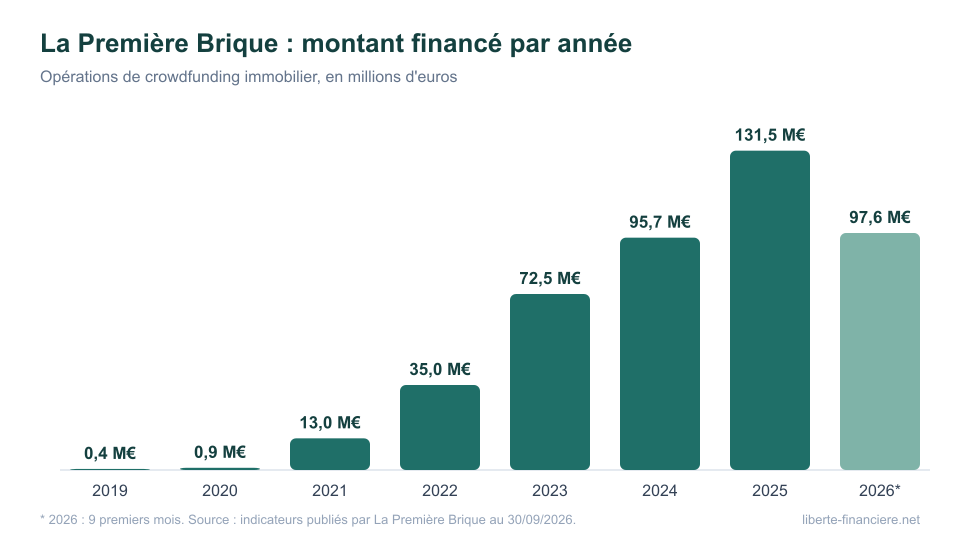
Three takeaways. First, the growth is spectacular: the last three years account for more than three quarters of the total volume. Second, the average rate stays stable at around 11 to 12%, even though bank rates have moved a lot: according to Hugo Berthe, good project owners are courted by every platform, which keeps rates from falling. Finally, and this is the point to watch, project durations are getting longer: less than 9 months in 2021, more than 2 years for projects funded in 2026. Your money is therefore tied up for longer than in the platform's early days.
In total, €172.8m of capital and €31.6m of interest have already been returned to investors, and 484 projects have been repaid in full. Be careful, though: of these 484 projects, 117 were repaid late (€28.4m). A "repaid" project is therefore not necessarily a project that went according to plan. The figures on delays and proceedings are detailed in the section on delays and proceedings.
Regulation and platform security

La Première Brique holds the European crowdfunding service provider licence (ECSP/PSFP), the European status created by the 2020 crowdfunding regulation. It was issued by the AMF on 28 September 2023 under number FP-2023-15, for the activity of facilitating the granting of loans. Before that, it was a crowdfunding intermediary (IFP), the former French status.
In practice, this licence imposes several protections:
a key investment information sheet for each project, with the risks and the loan terms;
a knowledge test and a simulation of your ability to bear losses before investing;
a 4-day reflection period during which a "non-sophisticated" investor can cancel their subscription free of charge;
annual publication of default rates using a harmonised method;
a wind-down plan: if the platform disappeared, another entity would take over the monitoring and recovery of all ongoing projects.
On top of that come professional liability insurance and the ring-fencing of funds at Mangopay, of which La Première Brique is a tied agent (hence fairly thorough identity checks when you sign up). The platform is supervised by the AMF and the ACPR.
Don't be mistaken about what the licence protects: it governs how the platform operates, it does not guarantee your capital. If a project owner goes bankrupt, you can lose money, licence or no licence. All the details on the different statuses are in my article on crowdfunding regulation.
How to invest on La Première Brique, step by step
Here is the sign-up page when you go through my link: the referral code FLR2AX is already applied and the 1% bonus is displayed automatically.
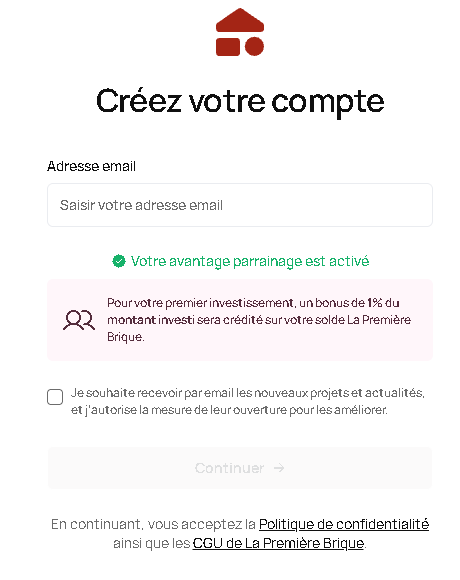
Create your account with this referral link: the code FLR2AX is already filled in and gives you a 1% bonus on your first investment. If you forget it, you can still add it as long as you haven't invested.
Verify your identity: ID document, proof of address and bank details. You also take the knowledge test required by the regulation. You can open a company profile on the same account.
Top up your wallet: by bank transfer (no limit, faster with the built-in transfer), by bank card (€500 maximum per transaction) or by Apple Pay and Google Pay. Deposits are free.
Analyse the projects announced a few days before the fundraising opens: project page, guarantees, margin, the project owner's experience, documents (see the next section).
Subscribe when it opens, from €1, entering the gift code LF if possible for 1% cashback on eligible projects. Once the target is reached, a waiting list takes over in case of withdrawals.
Collect the interest and capital at maturity (or monthly, depending on the project). Tax is withheld directly by the platform.
Reinvest or withdraw your money to your bank account: withdrawals are free and take 24 to 72 hours.
Interface and project pages
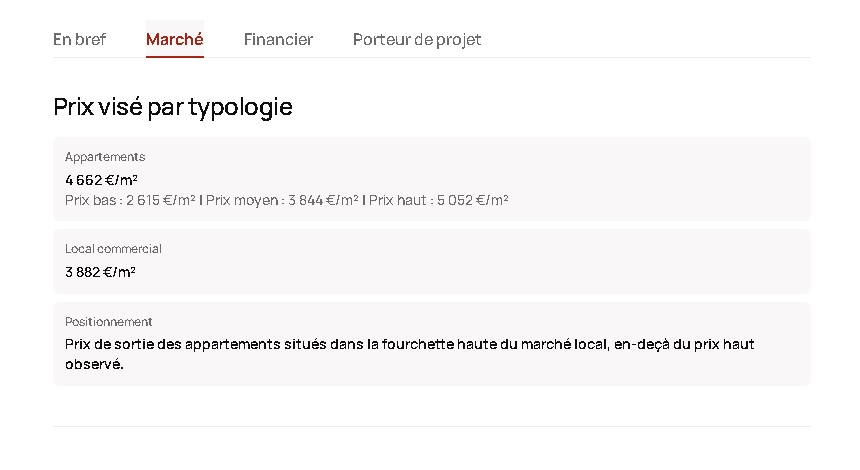
The quality of information is one of La Première Brique's great strengths, and it has improved further with the new website launched at the end of 2025. Each project has a complete page: overview, type of property, key figures, location, financing plan, terms, guarantees and downloadable documents (loan agreement, key investment information sheet, detailed brochure). It is organised into four tabs: Overview, Market (price per square metre in the area, local data), Financial (projected balance sheet) and Project owner (experience, past operations).
The Market tab compares the target resale price with prices in the area, and the Financial tab details the purchase price, the works and the full cost price of the operation:
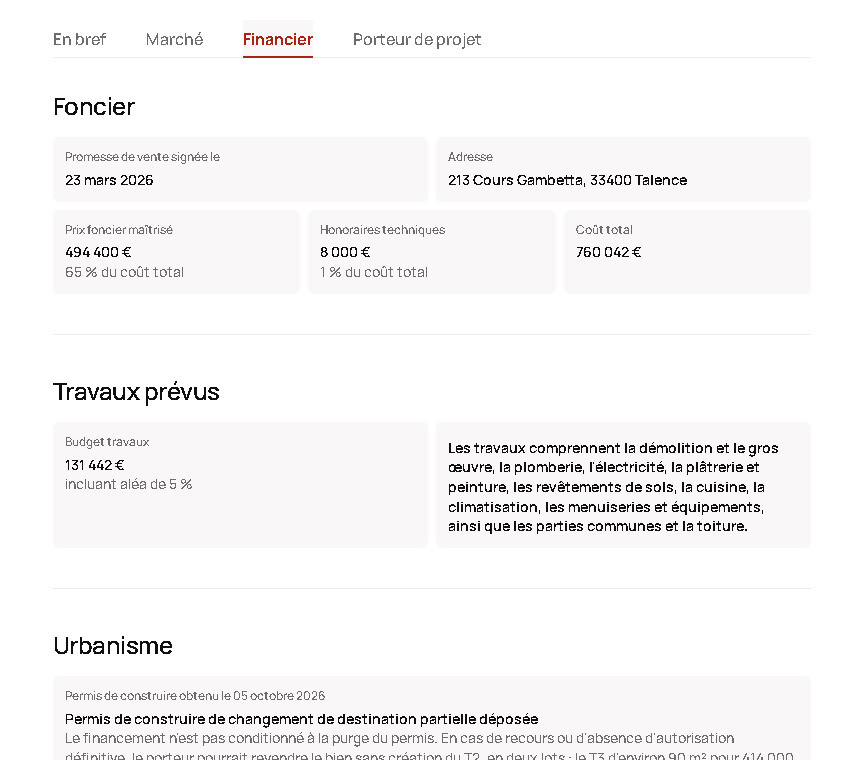
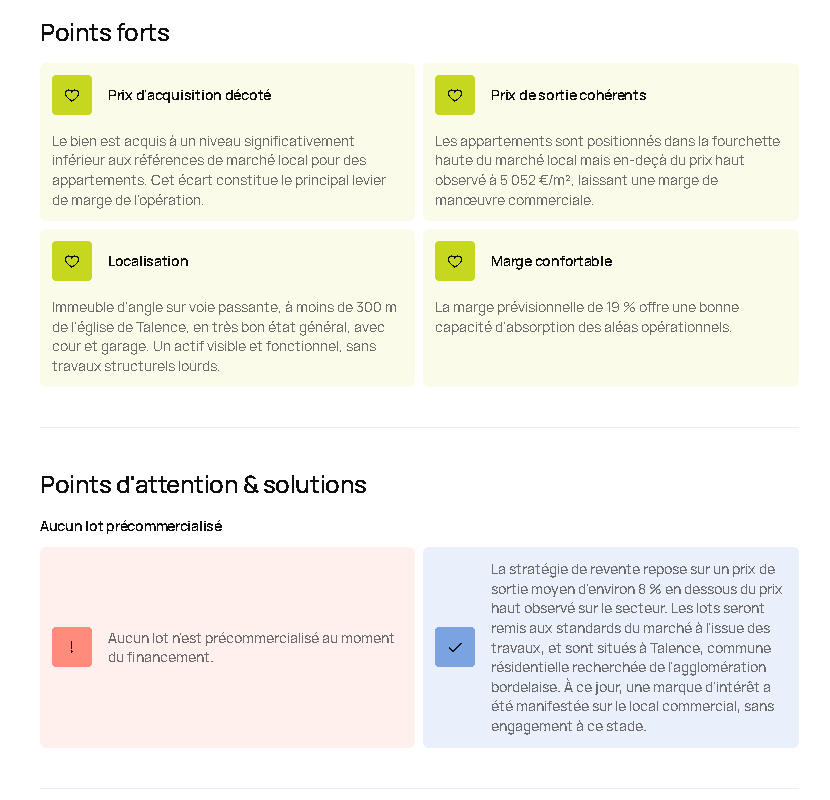
What I particularly appreciate are the "Strengths" and "Points to watch and solutions" sections: the platform spells out the weaknesses of the deal in black and white (for example, no unit pre-sold) and explains how it offsets them. Few competitors are this transparent.
Three ratios to look at first on each project page:
LTA (amount lent relative to the purchase price) and LTC (amount lent relative to the total cost of the operation): the lower they are, the more money the project owner has put in themselves;
LTV (amount lent relative to the value of the property): this is how well your claim is covered by the guarantee;
the project owner's projected margin: personally, I aim for at least 20%; below 15%, the slightest delay or price drop can tip the operation over.
A habit few investors have: recalculate the margin at the maximum duration. The projected balance sheet is built on the target duration, yet every extra month costs the project owner interest. A simple example: for €500,000 borrowed at 11%, each additional month costs about €4,600 in interest. An operation planned over 6 months that lasts 15 months therefore pays more than €40,000 in extra interest, and a margin shown at 14% can melt to below 9%. The bigger the gap between target duration and maximum duration, the more comfortable the margin needs to be.
Case study: the Le Gambetta project
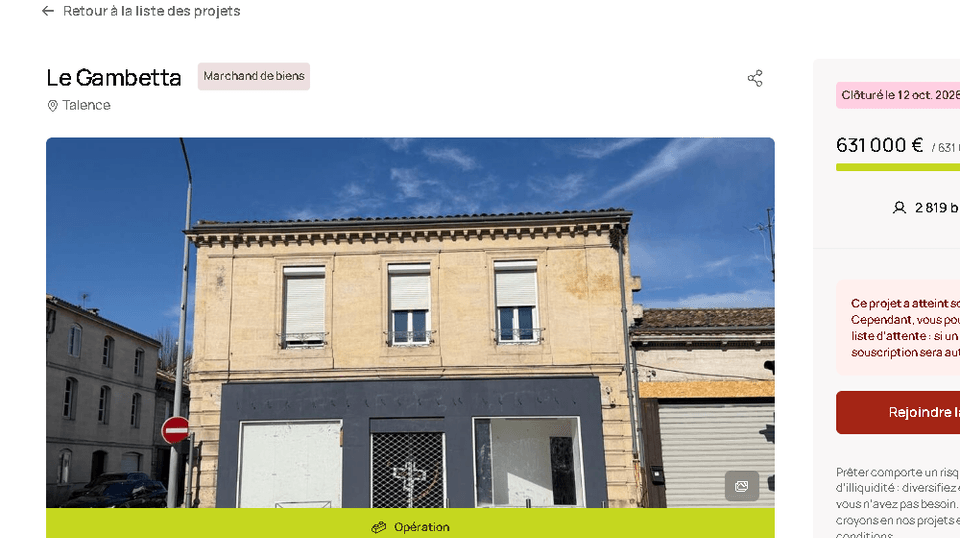
To make this concrete, here is how I read a recent project, Le Gambetta, in Talence (Gironde), a property dealer deal funded in October 2026:
Criterion | Le Gambetta and my analysis |
|---|---|
Amount and rate | €631,000 at 11.50% per year, repaid at the end 👉 Rate in line with the platform average |
Duration | 12 months targeted, 6 to 24 months possible 👉 Large gap between target and maximum duration: margin to be checked |
Operation | Purchase and division of a building into a 3-room flat, a 2-room flat with garage and a commercial unit 👉 Classic operation, on an existing property |
Margin | 19% (about €176,000) 👉 Decent, but just below the 20% I personally aim for |
Project owner's equity | €129,042, i.e. about 17% of the total cost 👉 A bit low: I like the project owner's equity to exceed 20% |
Guarantees | First-ranking mortgage (76% coverage, then 101% after the first drawdown) and a personal guarantee of €757,200 👉 Good guarantee, coverage a little tight at the start |
Pre-sales | No unit sold at the time of funding 👉 Main weak point, offset by a resale price below the top prices in the area |
My personal criterion: I like both the margin and the project owner's equity to exceed 20%. With a 19% margin, 17% equity and no unit pre-sold, Le Gambetta doesn't tick all my boxes. This is just one example among many: what matters is analysing all the criteria on a project page, not just the advertised rate. This is not investment advice, just my way of reading a deal.
The monitoring lives up to expectations: regular progress updates, percentage of funds already released to the project owner, monthly schedule of your repayments, document history. As for tools, you have a mobile app on iPhone and Android and a sync with Finary. The only real downside: no phone support, only chat and the address contact@lapremierebrique.fr.
The products: operations, rental, Jimbots and interest-bearing balance
The classic operations (property dealer, property development, credit lines) are detailed above. The platform also offers three other products: rental, Jimbots and the interest-bearing balance. Here is first a summary of the whole range, then the details of these three products.
Product | Return | Duration | Payment | Minimum |
|---|---|---|---|---|
Operations (property dealer, development, credit line) | 11 to 13% gross per year, fixed | 6 to 36 months | Most often at the end | €1 |
Rental (commercial real estate) | Rents of 6 to 9% gross per year, plus a share of the capital gain | Up to 5 years | Every month | €1 |
Interest-bearing balance | 3% gross per year, subject to change | No fixed term | Every month | None |
Rental: commercial real estate from €1
Launched at the end of May 2026 with a partner specialising in commercial premises (the company Myvesta, according to the press), the rental offer lets you finance the purchase of commercial premises already leased to retailers (gym, convenience store, pharmacy...) and receive the rent every month, on the 15th. The property is held by a dedicated company, secured by a double security trust (fiducie), and it is scheduled to be put up for sale from the 42nd month, after 5 years at the latest. On resale, you get your capital back plus a share of any capital gain.
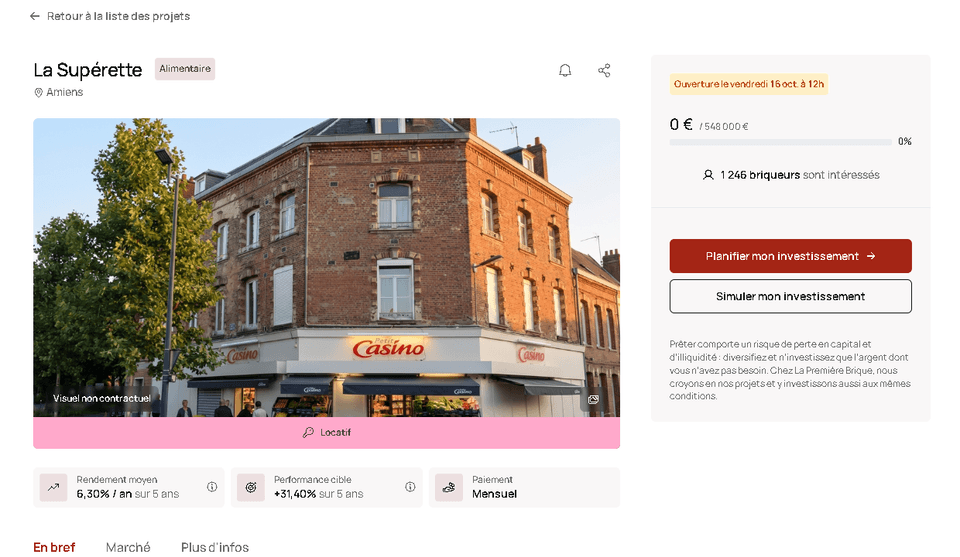
As of 30 September 2026, 5 rental projects had been funded for €4.8m, with an average return of 6.2% per year. It is a very different product from the classic operations: a lower return but paid every month, a much longer duration, and capital that depends on the resale price. On selection, the partner receives about fifty deals a week, and any asset that does not generate at least 6% gross rent for the investor is rejected. A double security trust protects the operation: one isolates the properties from the operator's creditors, the other covers its parent company so that a third party can take over management if it defaults. If no buyer is found at maturity, the properties can be refinanced to allow you to exit.
The fees, which you don't pay directly but which reduce your return, are higher than on the classic operations. According to the platform's help centre:
Stage | La Première Brique's remuneration |
|---|---|
Entry | 5% excl. VAT of the amount raised (structuring and distribution) |
During the term | 2.5% excl. VAT of the rent collected |
Resale | 15% of the capital gain above the capital repaid |
On resale, the capital gain is split as follows: 60% for investors, 25% for the partner and 15% for the platform. The partner also receives its own management fee. Before investing, read the project's key investment information sheet to know all the fees. Tax-wise, rent and capital gains are subject to the flat tax, withheld directly by the platform.
Jimbots: the investment robot
Since 2025, you can create up to 5 robots, the Jimbots, which invest for you according to your criteria: amount per project, monthly cap and total budget, minimum rate, maximum duration, type of operation, required guarantees (security trust or first-ranking mortgage, for example), minimum coverage and margin.
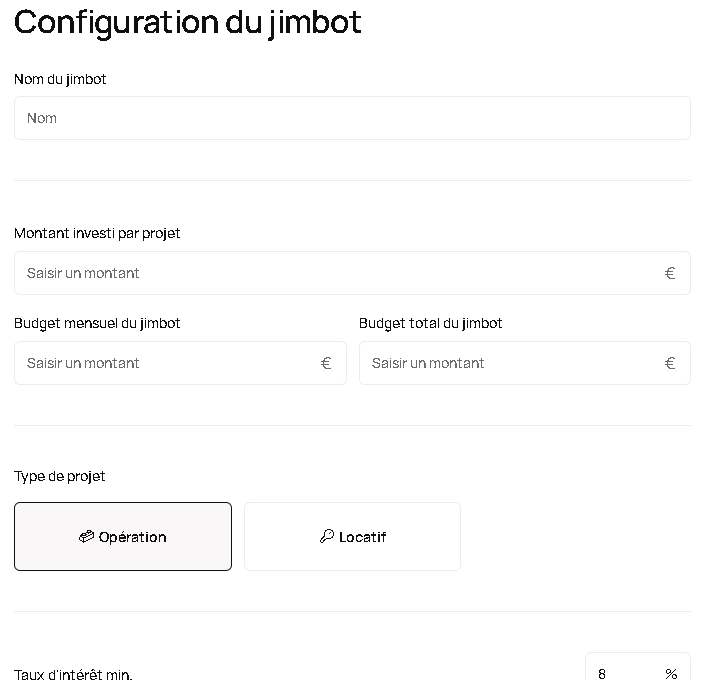
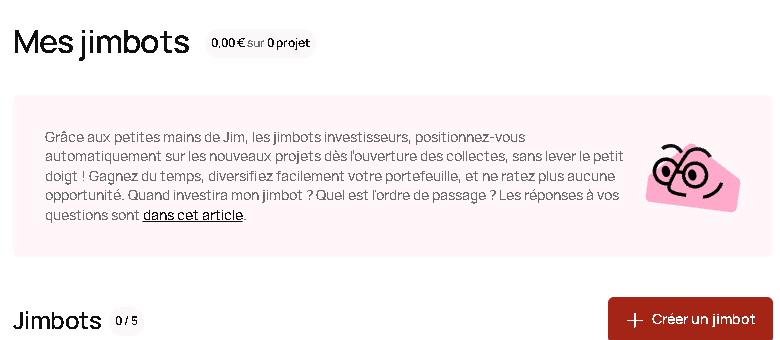
The rules to know: the robots go 15 seconds after group 3, so after the investors who are logged in, and priority goes to the one whose last subscription is the oldest. You then receive an email and have 24 hours to confirm, otherwise the reservation is cancelled. The robot doesn't enter the gift code. You can also set a Jimbot on a single project spotted in advance, with the "Schedule my investment" button. The robot switches itself off if your balance is insufficient or if you don't confirm the subscription. On small fundraisings, it is often served too late: logged-in investors fill the project before it gets there. More than 6,800 investors were already using Jimbots in 2025. My take: it's very handy for diversifying without spending your life in front of the screen, but the robot doesn't replace analysis. I explain my settings in this video:
The interest-bearing balance
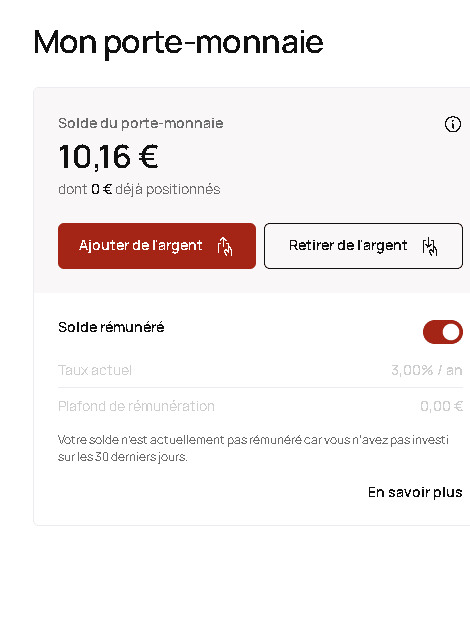
Money sitting idle in your wallet earns 3% gross per year (the launch rate was 5%), calculated twice a month and paid on the 1st of the following month. But watch out for the cap: only an amount equal to what you invested over the last 30 days earns interest. So it is a small bonus for active investors, not a savings account. Example: with €1,000 in your wallet and at least €1,000 invested over the past month, you earn about €2.50 per month. The overall cap is €1m. For tax purposes, this interest falls under the flat tax, but it is not withheld at source like project interest: it appears on your annual tax statement (IFU) and you have to report it yourself on your tax return.
The guarantees: what really protects your capital
Each loan is backed by one or more guarantees, detailed on the project page. La Première Brique acts as representative of all the lenders and enforces them itself if there is a problem. Here are the main ones, from the most protective to the weakest:
Security trust: the property or the company's shares are transferred to a trusted third party. It is the strongest guarantee, because it remains effective even if the project owner enters insolvency proceedings.
First-ranking mortgage: you are repaid first from the sale of the property. A very good guarantee, but it can be frozen during insolvency proceedings, and auction sales often happen at a discount.
Promise of mortgage and first-demand guarantee: less direct, they depend on the strength of the entity providing them.
Personal guarantee from the company director: only useful if they have substantial assets, and often hard to enforce.
Pledge of shares: you have a right over the shares of the company carrying out the project.
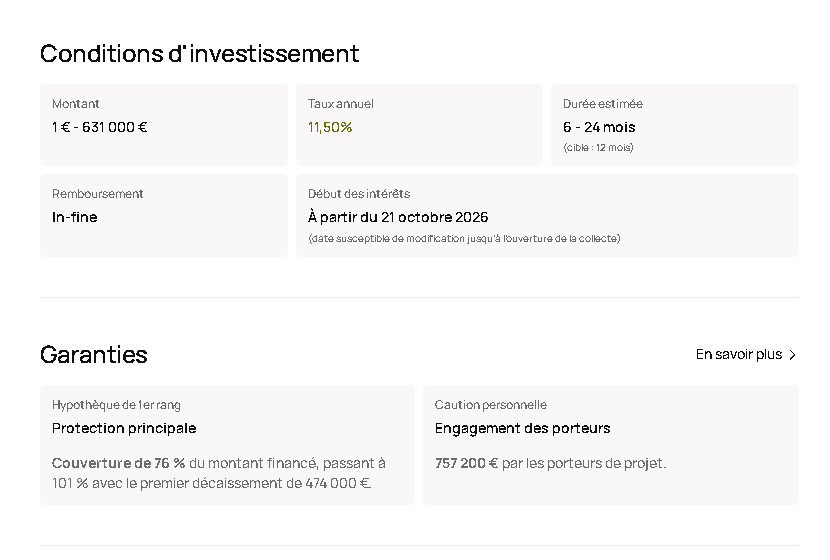
Good news: the platform has learned from the 2021-2022 projects. For about two years now, it has been funding almost exclusively projects with a first-ranking mortgage or security trust, no longer accepts deals backed only by a personal guarantee, and releases construction funds to the project owner gradually, against invoices and photos. The coverage shown is calculated in the worst-case scenario, as if all the funds had already been released. My personal rule: I only invest with these two guarantees, with coverage of at least 100%, ideally 130%.
Delays, proceedings and default rates: the real figures
This is THE sore subject, and I'd rather give you the raw figures. Here is the situation of the 425 projects still ongoing as of 30 September 2026:
Status | Projects | Outstanding capital |
|---|---|---|
Performing, on schedule | 209 | €142.1m |
Maturity pushed back (extension), but met | 108 | €64.9m |
Less than 6 months late | 24 | €19.3m |
More than 6 months late | 1 | €0.2m |
Out-of-court proceedings | 41 | €25.5m |
Insolvency or court proceedings | 42 | €21.8m |
Definitive loss | 0 | €0 |
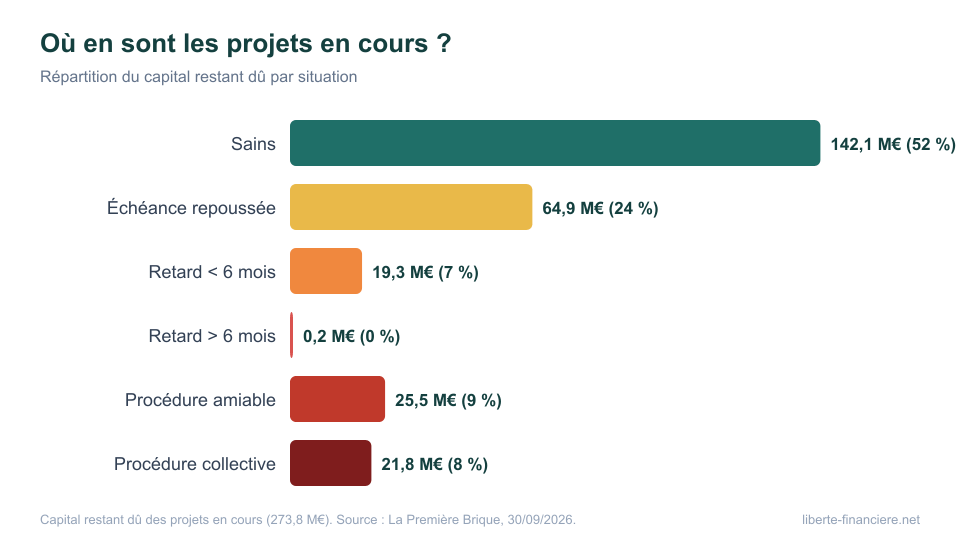
Depending on how you count, you will read very different rates online, and that's normal:
9.2%: the regulatory default rate published by the platform (loans more than 90 days late or whose guarantees are likely to be enforced), relative to everything that has been funded.
10.6%: projects in proceedings or more than 6 months late (€47.5m), relative to the €446.6m funded.
17%: the same €47.5m relative only to the capital still outstanding (€273.8m). In my view this is the most meaningful figure, because it doesn't mix completed projects with those that aren't.
More than 40% of the outstanding amount if you add extended projects and delays of less than 6 months. Extensions are not counted as delays in the official indicators, even though they lengthen the duration of your investment.
The breakdown by year of funding is even more instructive. The regulatory default rate reaches 13.9% for projects funded in 2022 and 15.9% for 2023, then falls back to 11.5% for 2024 and 6% for 2025 (projects that are still young, so to be watched). It is the projects launched just before the rise in interest rates and the slump in property sales that are suffering. To compare with other platforms, have a look at my Performance indicators page.
To go further, here is, for each year of funding, the share of the amount lent that is currently in difficulty, depending on whether or not extensions are counted:
Year | Regulatory default | Proceedings or delay > 6 months | Including extensions | Repaid late |
|---|---|---|---|---|
2021 | 0% | 0% | 1.3% | 15 out of 65 |
2022 | 13.9% | 16.7% | 24.9% | 42 out of 113 |
2023 | 15.9% | 16.9% | 32.3% | 48 out of 130 |
2024 | 11.5% | 16.6% | 47.2% | 12 out of 95 |
2025 | 6.0% | 10.2% | 19.8% | 0 out of 56 |
2026 | 0% | 0% | 9.1% | 0 out of 12 |
Calculated from the indicators published by the platform as of 30 September 2026, as a percentage of the amount funded each year.
The figure that strikes me: nearly half of the amounts funded in 2024 have had their maturity pushed back or are in difficulty. 2024 projects are less often in proceedings than those from 2022-2023, but many have been extended. The coming months will tell whether these extensions end in repayments or in new proceedings.
How La Première Brique handles a late project
I asked Hugo Berthe and the platform's head of legal about this specific point. Here is the process:
Late payment penalty: as soon as the repayment deadline is passed, the rate rises by up to 5 points (a project at 11% goes to 16%). That is far more of a deterrent than the usual 1 to 2 points at competitors. The flip side, according to some investors: such a heavy penalty can push a project owner who is already struggling towards bankruptcy rather than towards an agreement. On the other hand, the project owner has to sell the property for less if they exceed the target duration, which encourages them not to drag their feet.
But be careful, this 5% remains theoretical: the platform can put a vote to investors to reduce or waive the penalty. I have already voted for a one-off waiver, when the property dealer had a genuine personal problem, but most of the time I vote against, because this penalty is part of their contractual commitment. Many investors are, in fact, uncomfortable seeing that initial commitment called into question by a vote. And when the project is no longer viable at all, the penalty doesn't mean much any more: it is the interest, or even the capital, that is at stake.
Extension: when the project is progressing but needs more time, a 12-month extension is offered, sometimes with an investor vote, particularly on whether to remove the penalties. Watch out: if the community agrees to waive the penalties or lower the rate to save the operation, your return over the extended period can drop well below the initial rate. Some investors have seen a project planned over 16 months last nearly 3 years, with the rate brought down to around 4% in the final year, while still getting their capital back.
Amicable phase, then pre-litigation: the account manager reviews the situation, then the head of projects takes over the file with a lawyer. A project owner who stops responding sees a lawyer turn up within a few days.
Litigation: enforcement of the guarantees, filing of the claim in the event of insolvency proceedings (all have been admitted so far). In practice, proceedings last 1 to 3 years.
Two important details. Legal fees are contractually borne by the investors, but the platform advances them and only gets reimbursed if everything is recovered, which is more favourable than at many competitors that take a commission on the sums recovered. And there is still no definitive loss, but Hugo Berthe acknowledged in early 2026 that a first project, Le Bartholomé, is expected to result in a capital loss; in that case, the platform waives its commission in proportion to the loss. "Zero losses" is therefore only true on paper: with the court proceedings under way, other losses will inevitably follow.
Liquidity: can you get out before the end?
No. Once your money is lent, it is locked in until the project is repaid, which may happen earlier than planned (early repayment) or later (extension, delay). There is no secondary market yet to sell your loans to other investors: Hugo Berthe announced one for 2026 and the platform says it is working on it, but it is not available to date. The 4-day reflection period after a subscription remains the only way to cancel an investment.
In practice, with a portfolio of several dozen projects, repayments come in almost every month, which creates a form of natural liquidity. But only put money into La Première Brique that you won't need for at least 2 to 3 years, taking possible delays into account.
The risks to be aware of
Capital loss: if a project owner goes bankrupt and the sale of the property doesn't cover the debt, you can lose part of your money. Guarantees limit this risk, they don't eliminate it.
Delays and tied-up money: this is the most frequent risk. A project planned over 18 months can last 3 years, and even if the penalty partly compensates, your money isn't working elsewhere.
Real estate market: a fall in prices or a slowdown in sales reduces property dealers' margins and can turn a profitable operation into a loss-making one.
Concentration: the platform works a lot with repeat project owners. Avoid having a large share of your portfolio with the same operator.
Platform risk: if La Première Brique failed, your funds would remain at Mangopay and the wind-down plan would take over, but recovery would probably be slower.
My basic rule: property crowdfunding should only be one part of your wealth, and you need to diversify across many projects (the €1 minimum makes this easy) and across several platforms.
Taxation in France

Interest counts as investment income. For an individual who is a French tax resident, it is subject to the flat tax (PFU) of 31.4% in 2026 (12.8% income tax and 18.6% social contributions). Good news: for project interest, everything is automatic. The platform withholds the tax on each payment, pays it to the tax authorities and sends you an annual tax statement (IFU) every year; the amounts are pre-filled in your income tax return. No foreign account form to fill in, unlike European lending platforms.
To give you an idea: €1,000 invested at 11.5% over 18 months earns €172.50 in gross interest. After the 31.4% flat tax, you are left with €118.33, i.e. about 7.9% net per year, provided the project is repaid on time. On a real portfolio, you then have to factor in delays (which lengthen the duration) and any losses: that is why diversifying across many projects is essential.
Option for the progressive income tax scale: worthwhile if your tax bracket is 0 or 11%; you opt in on your tax return and it applies to all your investment income.
Exemption from the 12.8% advance payment: possible if your reference tax income is below €25,000 (€50,000 for a couple), on request before 30 November for the following year.
Losses: capital losses on this type of loan can be offset against interest of the same kind in the same year and the following 5 years.
Company: interest is financial income included in your company's profit, with no withholding by the platform.
PEA-PME: the projects are not eligible for this French share savings plan for SMEs.
IFI: your loans are receivables, not real estate you own, so they are not subject to the French real estate wealth tax (IFI).
Interest-bearing balance: the only exception to the automatic process; its interest is not withheld at source and must be reported by you using the IFU.
La Première Brique vs its competitors
Criterion |
|
|
|
|
|---|---|---|---|---|
Minimum investment | €1 | €10 | €100 | €500 |
Amount funded | €447m | €361m | €112m | €454m |
Incidents * | 10.6% | 6.9% | 20.5% | 22.6% |
ECSP/PSFP licence | Yes | Yes | Yes | Yes |
🎁 Bonus |


* Incidents: proceedings and delays of more than 6 months, as a % of the amount funded. Figures collected in September 2026, based on the indicators published by each platform.
To place La Première Brique within the sector as a whole, the average across some 45 property crowdfunding platforms is around a 9.4% rate, a 28-month average duration and 13% default, compared with 11.4%, 16 months and just over 10% at La Première Brique. Other major players have been hit harder: around 19% incidents at ClubFunding, 22% at WiSEED, 31% at Homunity and 35% at Anaxago, according to the September 2026 figures.
My analysis: Bricks shows fewer incidents, but a large share of its lending projects are recent, so they haven't reached maturity yet; we will have to judge in two years. Baltis and Raizers were hit harder by the crisis, with larger development projects. La Première Brique long did better than average, thanks to its property dealer operations and because it had funded little before 2022. That is less true today, as its indicators have deteriorated in recent months: you can follow how they evolve on my performance indicators page. I compared Bricks and La Première Brique in detail in this video:
You can find all the platforms and their welcome offers on my Bonuses and referrals page.
My experience on La Première Brique, in figures
I made my first deposit on 3 November 2021 and funded my first project, "Le République Club", a few weeks later. Since then, La Première Brique has been the core of my property crowdfunding allocation. Here is my track record to date, taken from my full transaction history:
144 projects funded for €235,474 invested in total (counting the reinvestment of repayments);
€158,947 of capital already repaid and €28,371 of gross interest received, of which €8,609 was withheld for taxes and social contributions;
85 projects fully repaid, 26 partially, 33 with no repayment to date;
around €76,600 still invested, including nearly €54,500 in 45 projects funded more than 18 months ago and therefore beyond their planned duration;
no definitive loss recorded so far, but it's only a matter of time: the loss is almost certain on the Le Bartholomé project, and several of my projects are in court proceedings.
Year | Amount invested | New projects | Capital repaid | Gross interest |
|---|---|---|---|---|
2021 | €8,000 | 4 | €0 | €0 |
2022 | €85,464 | 47 | €24,890 | €1,459 |
2023 | €74,568 | 53 | €35,173 | €5,396 |
2024 | €56,939 | 36 | €49,735 | €8,220 |
2025 | €10,503 | 8 | €35,528 | €9,489 |
2026 | €0 | 0 | €13,621 | €3,807 |
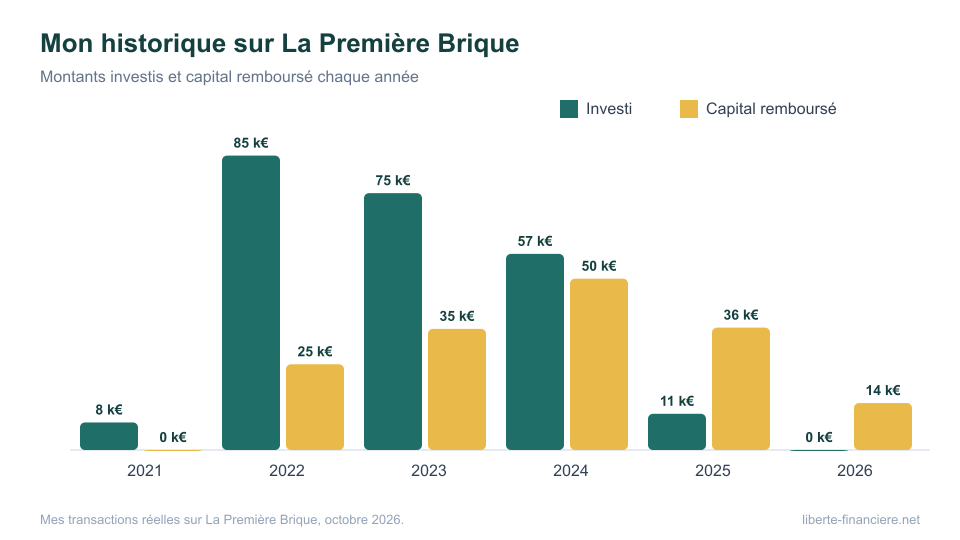
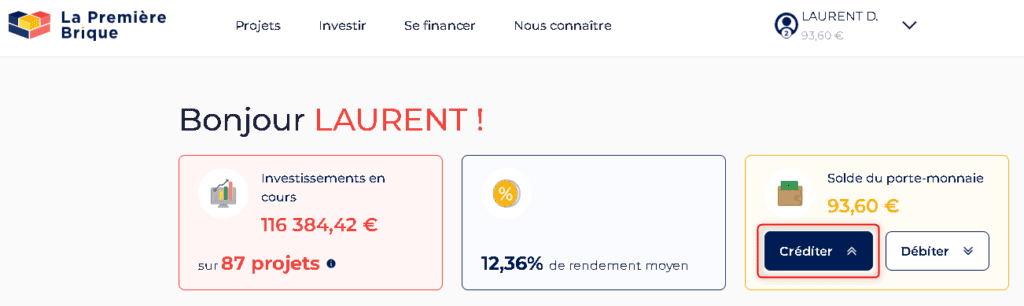
As a side note, at the end of 2024, on the old interface, I had more than €116,000 invested in 87 ongoing projects, with an average displayed return of 12.36% including bonuses. That was the peak of my exposure to the platform.
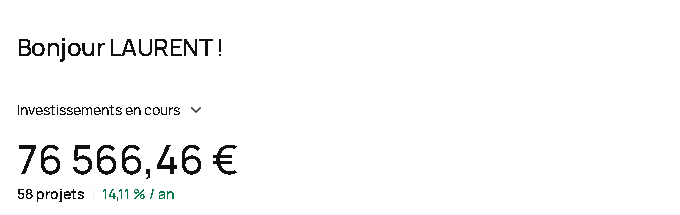
And here is my personal dashboard today. The platform shows €76,566 still invested in 58 projects, with an average displayed rate of 14.11% per year.
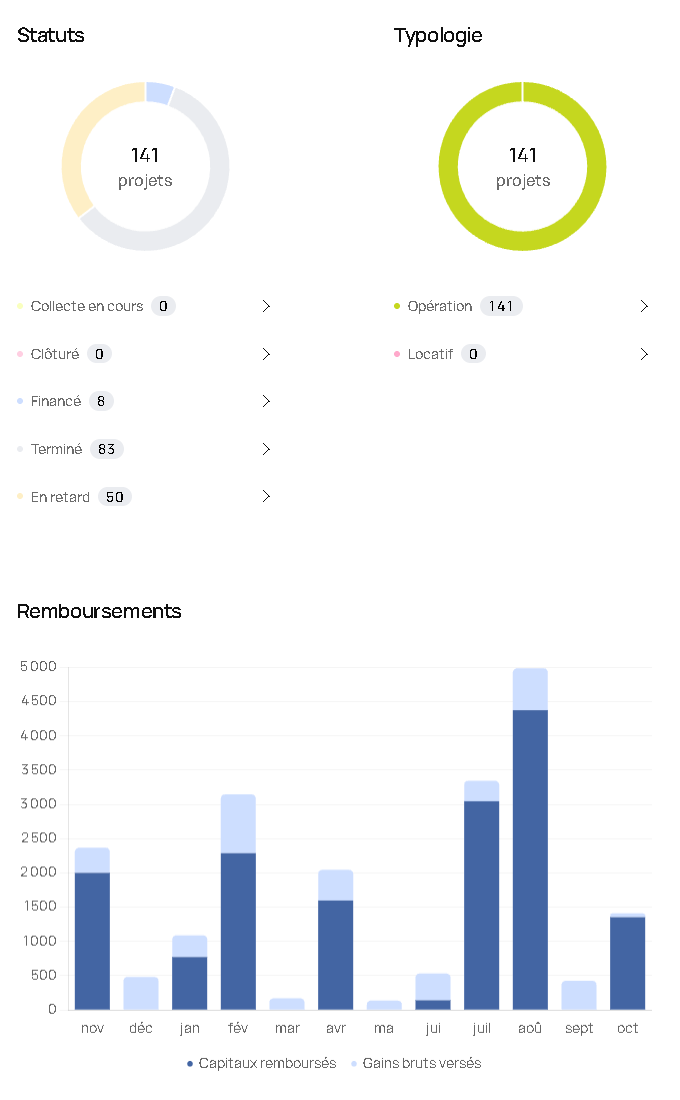
The breakdown by status is even more telling: out of my 141 projects, 83 are completed, 8 are ongoing and on schedule, and 50 are late. In other words, almost everything I still have to recover has passed its planned date. The repayments chart shows that money nevertheless keeps coming in every month, sometimes in big waves when several projects get unblocked.
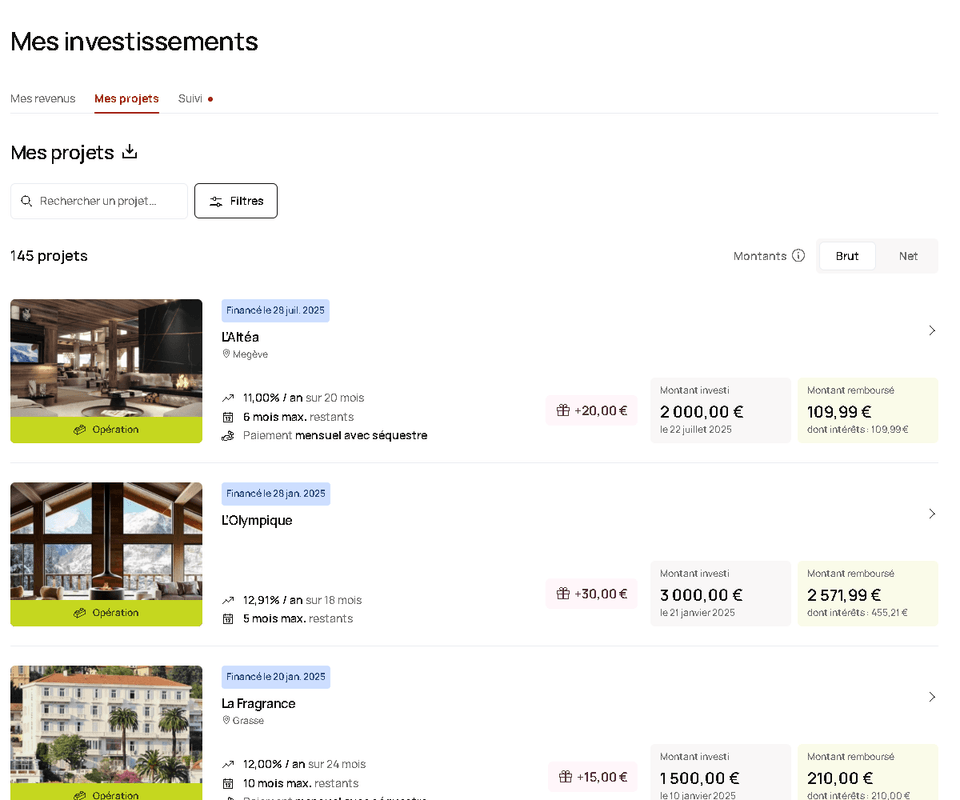
Each project is tracked in the "My investments" tab: amount invested, rate, remaining duration, amount already repaid and bonus received.
You can see it in the table: I invested very heavily in 2022 and 2023, then scaled back, for two reasons. First, I was overexposed: at one point La Première Brique accounted for nearly half of my investments outside physical real estate, which put far too much weight on a single platform. Second, and above all, the French real estate market is sluggish: sales down, prices under pressure, property dealers' margins melting away. All of property crowdfunding is suffering from it, and La Première Brique is no exception, even though it keeps real advantages, starting with project monitoring that is far better than at many other platforms. In 2026, I have made no new investments: I invested a lot in the past and I am now in the phase of reducing my portfolio, given the risks. I am waiting for the projects to be repaid little by little, hoping to come out on top on most of them. I will probably come back later, if the market becomes favourable again.
As for results, my internal rate of return on the platform remains positive, but it is well below the 11 to 12% shown on the projects. This is the direct consequence of the context: my 2022-2023 projects are the ones piling up delays, as the statistics by year above show, and capital tied up for longer mechanically lowers the real annual return.
My selection criteria, which I still apply: first-ranking mortgage or security trust only, debt coverage of at least 100%, a project owner margin of at least 20% (9 to 10% is too tight), an experienced project owner whose equity also exceeds 20%, a resale price consistent with the local market, and not too many projects with the same operator. I also write down why I invested, so I can judge my choices a year later.
What other investors say
My opinion is just one among many, so here is what comes out of the public ratings and comments:
Source | Rating |
|---|---|
4.4 / 5 (1,591 reviews) | |
Google reviews | 4.5 / 5 (more than 800 reviews) |
The positives that come up: simplicity, the €1 minimum, the quality of the project pages, the responsiveness of chat support and the transparency of the founders at events and webinars.
The negatives that come up: "repeated" delays and extensions on some projects and, on some projects, communication that could be a little more frequent when a deal deteriorates.
My advice: read the negative reviews, they almost all concern the 2022-2023 projects, which matches exactly the figures presented above.
⚖️ Pros and cons
✅ Pros
📈 Returns among the highest on the market (11.4% on average), with a deterrent late payment penalty.
🧱 €1 minimum and no fees (deposit, investment, withdrawal).
🔍 Transparency: detailed project pages, points to watch stated openly, regular monitoring, accessible founders.
🏢 Solid company: profitable, ECSP/PSFP licensed, founders who are themselves big investors.
🧾 Automatic taxation, no paperwork.
🤖 Tools: Jimbots, interest-bearing balance, app, rental offer to diversify.
⚠️ Cons
The main drawback: delays, significant on the 2022 and 2023 projects, with durations getting longer, court proceedings under way and losses to come.
Interest most often paid at the end of the project.
No secondary market to date, money locked in until repayment.
No phone support and not eligible for the PEA-PME.
Who is La Première Brique for?
✅ La Première Brique is for you if:
you are looking for a higher return than savings accounts and euro funds, and accept a risk of capital loss;
you can tie up your money for 2 to 3 years, or even longer in case of delays;
you want to diversify into real estate without managing tenants, with small amounts;
you are willing to read the project pages, or to set up a Jimbot with strict criteria.
⚠️ Give it a miss if:
you need this money in the short term or it is your emergency savings;
you can't stand the idea of a delay of several months or of a loss;
you want regular income every month (look at the rental offer instead).
As for allocation, I advise you not to put more than 10 to 15% of your savings on a single platform, and to spread each amount across at least twenty or so different projects. If you are hesitating between crowdfunding and real estate funds, keep in mind that an SCPI (French real estate investment fund) pays out around 5% per year, with different liquidity and risks.
La Première Brique bonus and referral codes
Two codes can be combined:
Referral code FLR2AX, at sign-up: a 1% bonus on your first investment. It is already filled in if you go through my link.
Gift code LF, with each subscription: 1% cashback on eligible projects (about half of all projects), paid a few days after the fundraising closes.
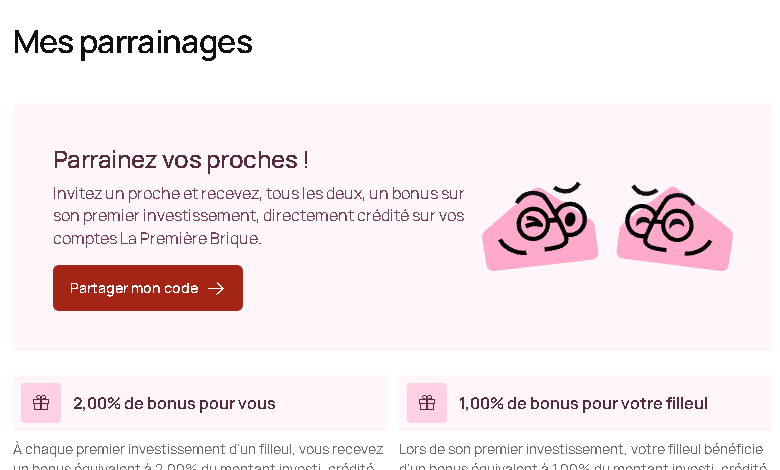
Once you have signed up, you can refer your friends and family in turn: you get 2% of their first investment and they get 1%. All the details, with a step-by-step guide in pictures, are on my La Première Brique bonus code page.
FAQ: frequently asked questions about La Première Brique
Is La Première Brique reliable?
Yes, it is a profitable French company, licensed by the AMF since 2023, which has funded more than 900 projects and returned more than €200m to investors, with no definitive loss recorded to date. But losses are expected: the one on the Le Bartholomé project is almost certain, and other deals are in court proceedings. Reliable doesn't mean risk-free: around 17% of the outstanding capital is in proceedings or more than 6 months late (see the real figures). You will need to be patient to hope for a positive outcome.
What real return can you expect?
Projects show 11 to 13% gross per year, i.e. about 7.5 to 9% net after the flat tax. The real return then depends on delays (which lengthen the duration, but trigger penalties) and on any losses. The referral bonus and the gift code improve the result a little.
What is the minimum amount to invest?
€1 per project. The maximum amount varies depending on the size of the fundraising. Card deposits are limited to €500 per transaction; bank transfers have no limit.
What are the fees?
None for the investor on the classic operations: the platform earns its money through a commission paid by the project owner. For rental projects, check the fees in each project's key investment information sheet.
Can you get your money back before a project ends?
No, there is no secondary market yet. Only uninvested money in your wallet can be withdrawn at any time, free of charge, within 24 to 72 hours.
What happens if La Première Brique goes bankrupt?
Your funds are held at Mangopay, separate from the platform's, and your loans are still owed by the project owners. A wind-down plan provides for another entity to take over the monitoring and recovery of ongoing projects.
How is the interest taxed?
At the 31.4% flat tax, withheld directly by the platform, with an annual tax statement (IFU) sent every year and the amounts pre-filled in your tax return. You can opt for the progressive tax scale if your tax bracket is low.
Is it still hard to get into a project?
Much less than before: the frenzy of 2022 to 2024, when projects sold out in a few seconds, has died down. For the most popular projects, get your money ready in advance, be logged in when it opens, use the Jimbots and apply my 11 tips for investing on La Première Brique.
Can you invest through a company?
Yes, you can add a company profile to your account. The interest is then the company's financial income, with no withholding by the platform. The projects are, however, not eligible for the PEA-PME.
My project has been extended: do I still earn interest?
Yes, interest keeps accruing during the extension. When a project is late, the penalty can add up to 5 points to the rate, but if investors vote to remove it or lower the rate to save the operation, your return over that period will be lower than planned.
How many projects do you need to diversify properly?
Aim for at least twenty or so projects, from different project owners and regions, with identical amounts. The €1 minimum lets you start small, and the Jimbots help spread your investments over time.
Can you invest from abroad?
Yes, residents of the European Union can open an account, except for people considered US persons by the US tax authorities and residents of countries under sanctions. Taxation then depends on your country of residence (see the taxation section).
Are the loans subject to the IFI?
No. You hold receivables on companies, not real estate: they are not subject to the French real estate wealth tax (IFI).
Can you cancel an investment?
Yes, during the 4-day reflection period following the subscription. After that, you are committed until the project is repaid. A reservation made by a Jimbot is cancelled simply by not confirming it within 24 hours.
Which bonus code should you use?
The referral code FLR2AX at sign-up (1% on your first investment), then the gift code LF on eligible projects (1% cashback). Details on my La Première Brique bonus code page.
Conclusion: my review of La Première Brique
After five years and 144 projects, La Première Brique remains for me one of the very best property crowdfunding platforms in France: high returns, no fees, a €1 minimum, good transparency, and a team that invests its own money and comes forward to explain itself when things go less well. It has also managed to evolve, with stronger guarantees, the Jimbots, the interest-bearing balance and the rental offer.
But it is not immune to the gloom of the French real estate market: the 2022 and 2023 projects are piling up delays, durations are getting longer, a first loss has been announced on the Le Bartholomé project, and my real return, still positive, remains below the advertised rates. Its indicators are deteriorating, other losses will probably follow, and project monitoring, even if it remains among the best on the market, is not perfect and can't work miracles when a project owner goes bankrupt. The platform will be judged on how it recovers these deals. If I'm not investing there for now, it's mainly because I'm already heavily exposed: otherwise, I would carry on. My advice: go in gradually, select projects with solid guarantees (security trust or first-ranking mortgage), diversify as much as possible and don't put all your eggs in one basket.
If you want to get started, open your La Première Brique account with a 1% bonus. And to discuss projects with other investors, join my Telegram group.
And as always, never give up!
Last updated: October 2026.