JPMorgan's JEPQ and iShares' WINC are two European ETFs that make the same promise: pay out a monthly income close to 10 % a year, by selling call options on stock indices. I have been investing in the JEPQ since April 2025: 2,519 shares today, about 53,700 € invested and 7,927 € in gross income received over 18 payments. I also bought some WINC in September 2025, then sold it in January 2026, because it did not pay monthly. Since September 2026, the WINC pays every month: that change, and your many questions in the comments of my videos, are what pushed me to redo the full comparison.
In this comparison, I explain how covered call options work, the JPMorgan and iShares ranges, the real make-up of the two funds (sectors, countries, options held), the full history of their distributions, their performance in euros since November 2024 against the Nasdaq-100 and the MSCI World, the effect of the dollar, French taxation step by step, my own figures and what I am doing now.
This article is not sponsored by JPMorgan or by BlackRock. Some links are affiliate links: if you open an Interactive Brokers account through my link, you can get up to $1,000 in IBKR shares depending on the amount deposited.
 JEPQ and WINC at a glance
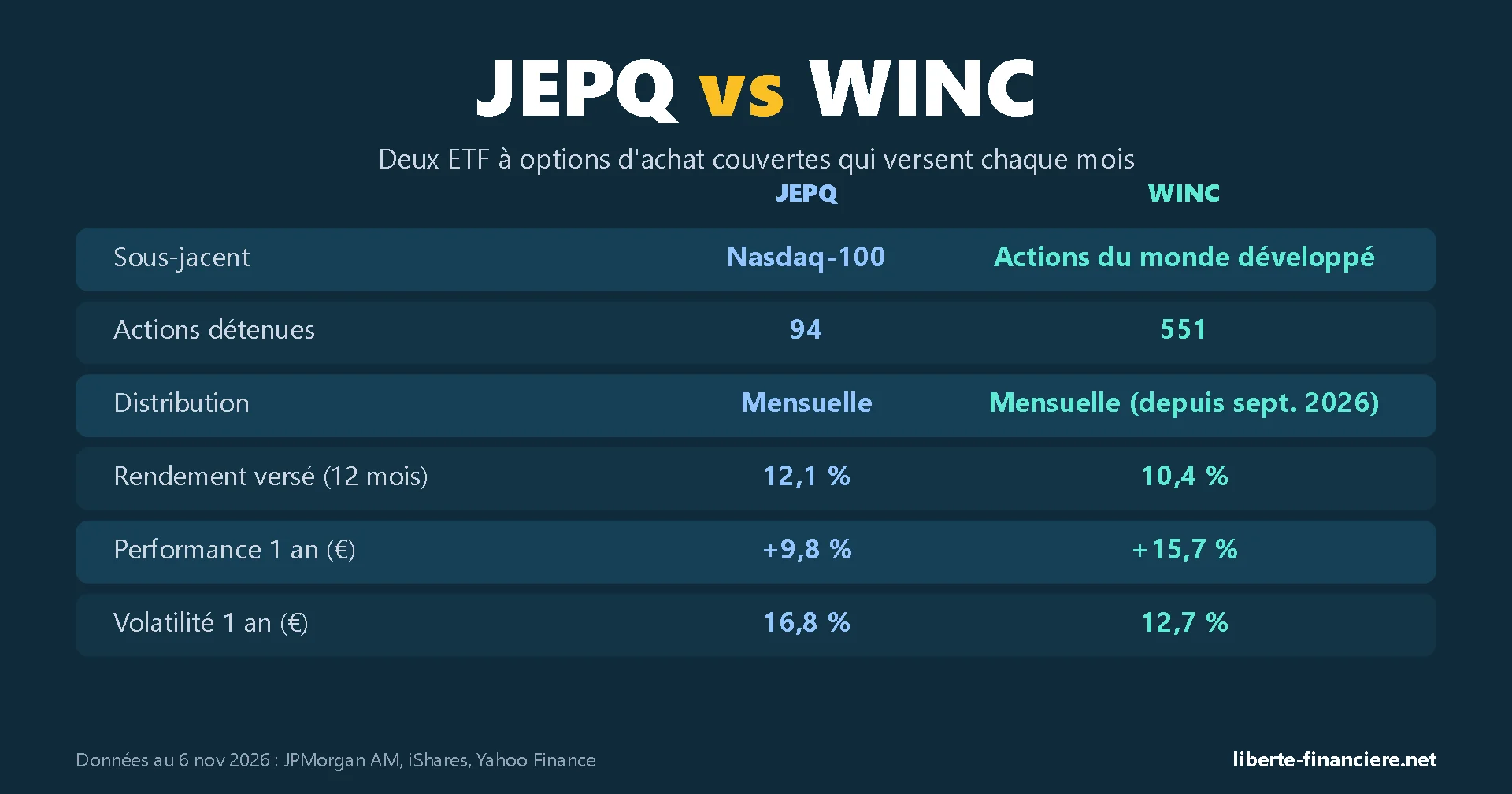
JEPQ (JPMorgan) | WINC (iShares) | |
|---|---|---|
Full name | JPM Nasdaq Equity Premium Income Active UCITS ETF | iShares World Equity High Income Active UCITS ETF |
Issuer | J.P. Morgan Asset Management | BlackRock (iShares) |
ISIN (dollar share class, distributing) | IE000U9J8HX9 | IE000KJPDY61 |
Domicile |
|
|
Launch | October 29, 2024 | March 22, 2024 |
Universe | Mostly the Nasdaq-100 ( | Developed-market stocks (MSCI World) |
Stocks held | 94 | 551 |
Options sold | Calls on the Nasdaq-100 | Calls on the S&P 500, the Euro Stoxx 50, the FTSE 100 and the Nikkei 225 |
Management | Active (JPMorgan team) | Systematic active (quantitative models) |
Annual fees | 0.35 % | 0.35 % |
Assets (11/06/2026) | $4.53 bn | $1.04 bn |
Distribution | Monthly | Monthly since September 2026 (quarterly before) |
12-month distribution yield | 12.1 % | 10.4 % (10.45 % published by iShares) |
1-year performance in € | +9.8 % | +15.7 % |
1-year volatility in € | 16.8 % | 12.7 % |
PEA-eligible |
|
|
My view in one line | The biggest income, but heavily concentrated on US tech | A bit less income, far more diversified and steadier |
 No
Figures as of November 6, 2026. Distribution yield: sum of the last 12 distributions divided by the price. Performance: distributions reinvested, prices converted into euros every day.
 My video: JEPQ vs WINC, which ETF for monthly income?
If you prefer video, here is my comparison in 20 minutes: options strategy, ranges, make-up, payment dates, performance, taxation, liquidity and what I am going to do with my JEPQ position. The portfolio I show in it is my Interactive Brokers account, where I have held the JEPQ since April 2025.
The broker I use for the JEPQ London, Xetra, Amsterdam, Milan: JEPQ, WINC and all their share classes, with up to $1,000 in IBKR shares offered when you open an account. |
 How does a covered call ETF work?
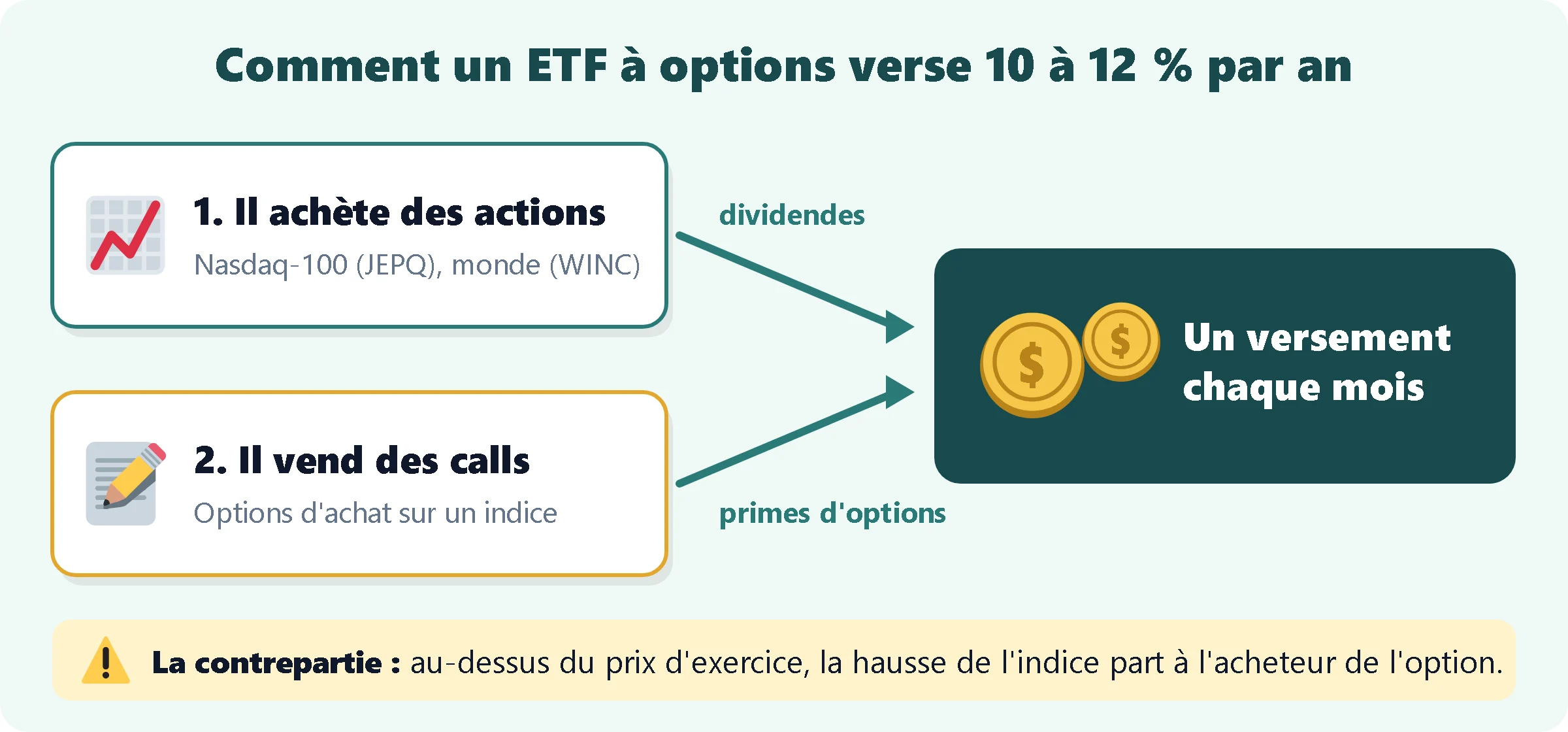
A covered call ETF does two things at the same time. First, it buys stocks, like any ETF: mostly Nasdaq-100 stocks for the JEPQ, developed-market stocks for the WINC. Then it sells call options (calls) on a stock index. Whoever buys these options pays a premium to the ETF, right away, in exchange for the right to benefit from the index's rise above a certain level, called the strike price, for a short period (often one month).
For the ETF, the premium is immediate income, whatever happens next. Added to the dividends of the stocks it holds, it lets the fund pay out every month an amount far higher than the dividend of a classic ETF: about 0.7 % a year for the Nasdaq-100, 1.5 % for the MSCI World, against 10 to 12 % here.
 The price to pay: capped upside
This income is not free. The premium stays with the ETF in every case. But if the index rises above the strike price before expiry, the ETF has to pay the option buyer the difference: it keeps its stocks, but gives up the gains above that threshold. The options are on an index and are settled in cash, without selling any securities. On the other hand, if the index falls, the premium only offsets a small part of the loss. This is the sentence to remember: the upside is capped, the downside almost isn't.
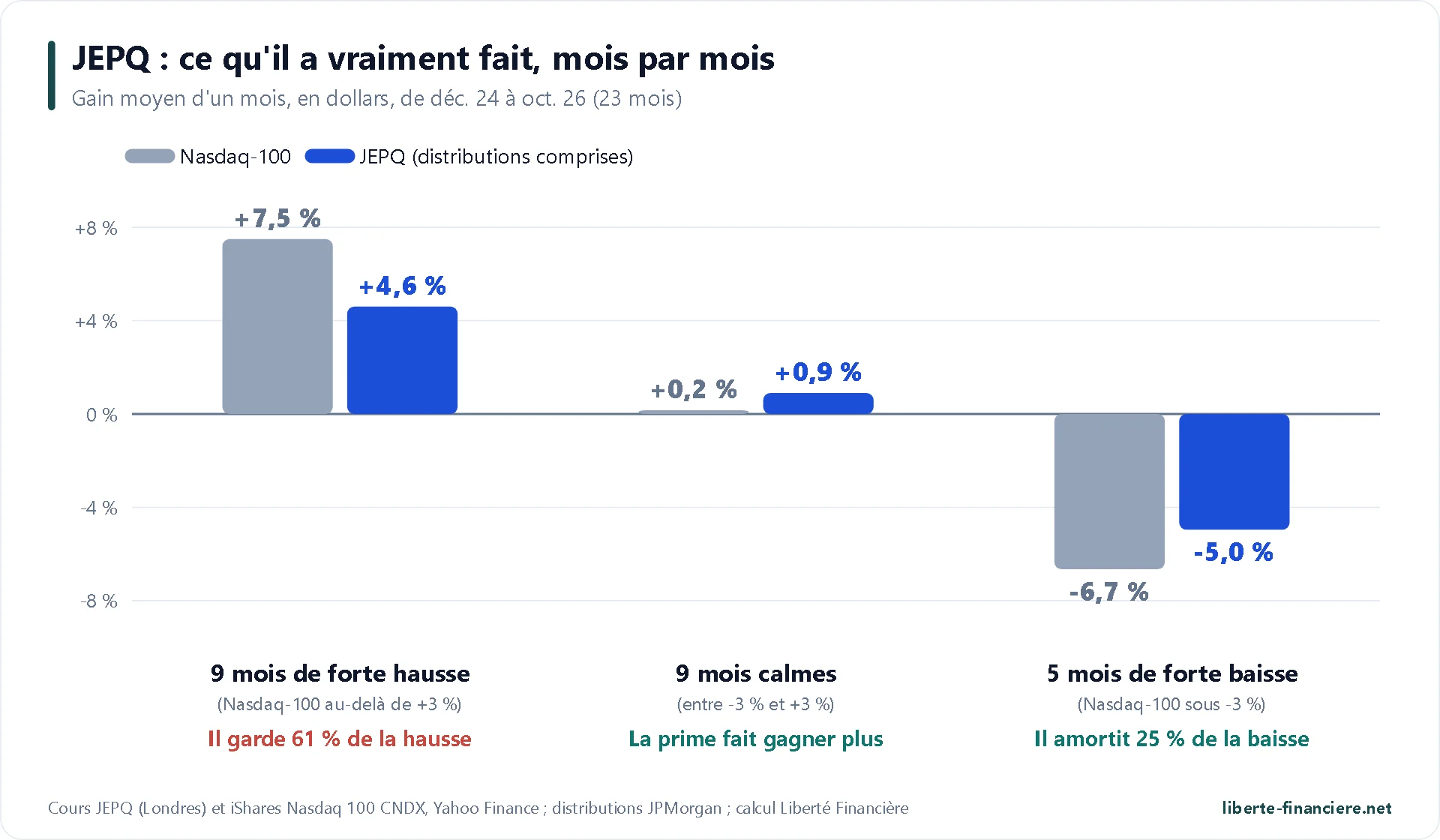
The chart above shows what the JEPQ actually did from December 2024 to October 2026, in dollars, distributions included. I sorted the 23 months according to the Nasdaq-100: during the 9 months of strong gains (more than 3 %), the index rose +7.5 % on average and the JEPQ +4.6 %, i.e. 61 % of the gain. During the 9 calm months, the premium made the difference: +0.9 % for the JEPQ against +0.2 % for the index. During the 5 months of sharp decline, it lost 5.0 % against 6.7 %: it cushions about a quarter of the fall.
Since the stock market goes up more often than it goes down (9 months of strong gains for 5 of sharp decline over the period), the JEPQ ends up behind its index over time: it turns part of the upside potential into regular income and smooths out the results. It is an income choice, not a way to beat the market.
 How much of the fund is covered by options?
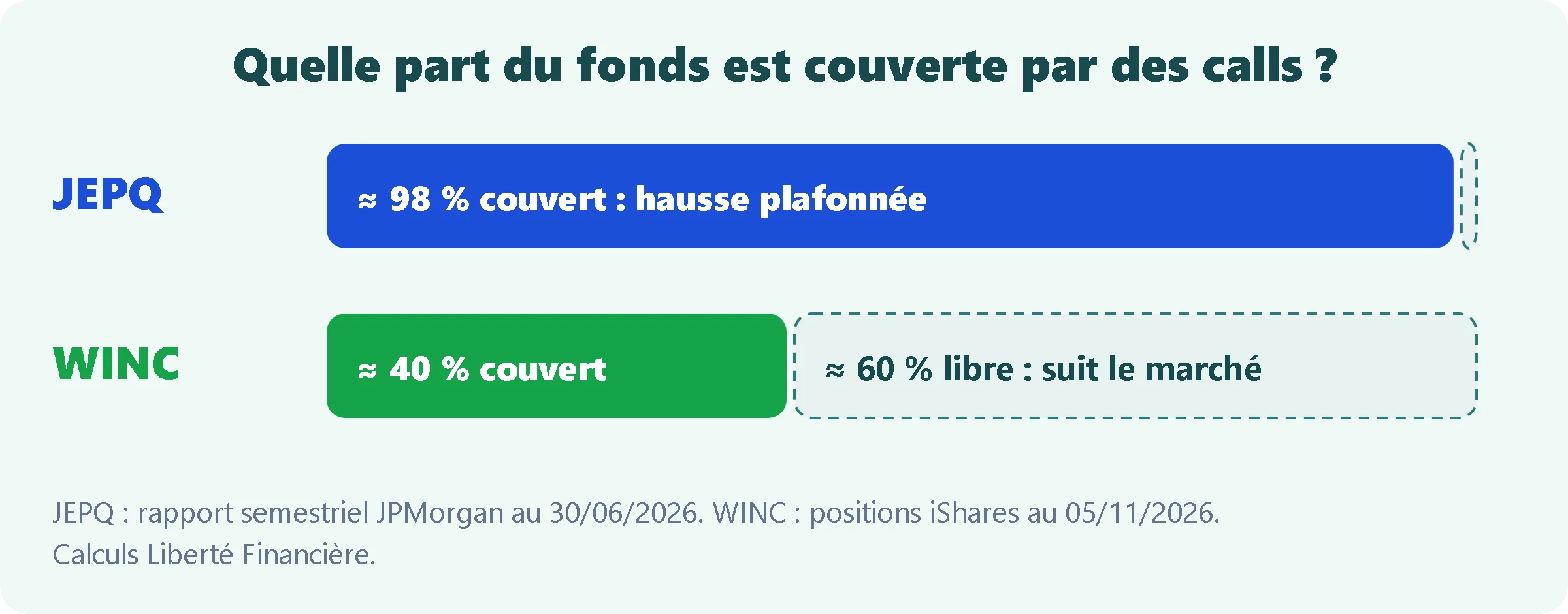
This is the big difference in how the two funds are built. The JEPQ covers almost its whole portfolio: on June 30, 2026, it had sold 15 series of calls on the Nasdaq-100, of about 233 million dollars each, staggered day by day over five weeks, i.e. 3.5 billion dollars of exposure for 3.57 billion in assets, about 98 % of the fund (JPMorgan semi-annual report, my calculation). Each tranche is rolled over at expiry, at a strike price slightly above the current price. The WINC, for its part, only sells calls on about 40 % of its value (my calculation from the iShares holdings file of November 5, 2026), on four indices, and also buys futures contracts: the rest of the fund fully benefits from the upside.
Both managers set the strike price according to market volatility: when the market is nervous, premiums are higher and income goes up (that is what happened in spring 2025). This difference in coverage largely explains the results: the JEPQ pays more, but it has let more of the upside slip away than the WINC, which kept pace with the MSCI World.
 Income paid out does not mean return
An ETF that pays 12 % a year can very well lose money: if its price falls 15 % in the same year, the result is negative. The right figure to look at is the total return (price + distributions), which I compare further down. The second reflex is to check that the price does not erode over time: a fund that distributes more than it earns gives back part of your capital, and its future income falls with it.
 The JPMorgan and iShares ranges
JPMorgan is the pioneer of these income ETFs: its US JEPI, launched in May 2020 on US stocks, then the US JEPQ in May 2022, have become some of the biggest active ETFs in the world. The European (UCITS) range follows the same principles, with funds domiciled in Ireland and available to French savers. iShares (BlackRock) responded in March 2024 with two systematically managed funds. The six ETFs in these two ranges, with all their share classes, can be bought at Interactive Brokers, which gives access to London, Xetra, Amsterdam and Milan.
JPMorgan: 4 "Equity Premium Income" ETFs

ETF | Universe | Launch | Assets | Displayed yield* | Fees |
|---|---|---|---|---|---|
JEPQ (Nasdaq) | US large caps, Nasdaq-100 benchmark | 10/29/2024 | $4.53 bn | 11.27 % | 0.35 % |
JEPI (US) | Diversified, low-volatility US stocks | 10/29/2024 | $711 M | 7.16 % | 0.35 % |
JEPG (Global) | Developed-market stocks | 11/30/2023 | $1.70 bn | 5.69 % | 0.35 % |
JEPE (Europe) | European stocks | 02/12/2026 | $154 M | 5.10 % (≈ 9.3 % over its first 8 payments) | 0.35 % |
JPMorgan AM data as of November 6, 2026, distributing share classes. * Last distribution × 12 ÷ price: a figure that changes every month.
All four funds pay out every month and cost 0.35 % a year. The JEPQ is by far the biggest and the one that distributes the most, because the Nasdaq-100 is more volatile: its options bring in higher premiums. The JEPG ("Global") is the WINC's direct cousin at JPMorgan, with a much lower yield (5.7 %). According to the fund's accounts, stock dividends only amounted to 13.6 million dollars in 2025, for 183.3 million distributed (2025 annual report, 2026 semi-annual report): most of what the JEPQ pays out comes from option premiums and portfolio gains, not from dividends (my calculation from their accounts).
Why the WINC pays 10 % and the JEPG 5.7 %
Both funds invest in developed-market stocks and sell call options, but they do not aim for the same payout level. The JEPG distributes what it collects: dividends and option premiums, hence a yield around 5.7 %. The WINC, on the other hand, carries the name "High Income": its stated goal is a high income. Neither BlackRock nor JPMorgan publishes a figure-based explanation of the gap, but the WINC's accounts give a clue: over its financial year ended June 30, 2026, it distributed 13.17 million dollars, while it had collected 10.71 million in income (9.16 million in dividends, 0.98 million in interest and 0.57 million in derivatives income, iShares III annual report). Part of the payout therefore comes from the portfolio's capital gains (my calculation from their accounts). This is not a problem as long as the fund grows: over the same financial year, it returned +21.04 %, in line with the MSCI World. But in a down year, paying out 10 % would mean giving back part of the capital.
 Why the WINC is 4 times smaller than the JEPQ
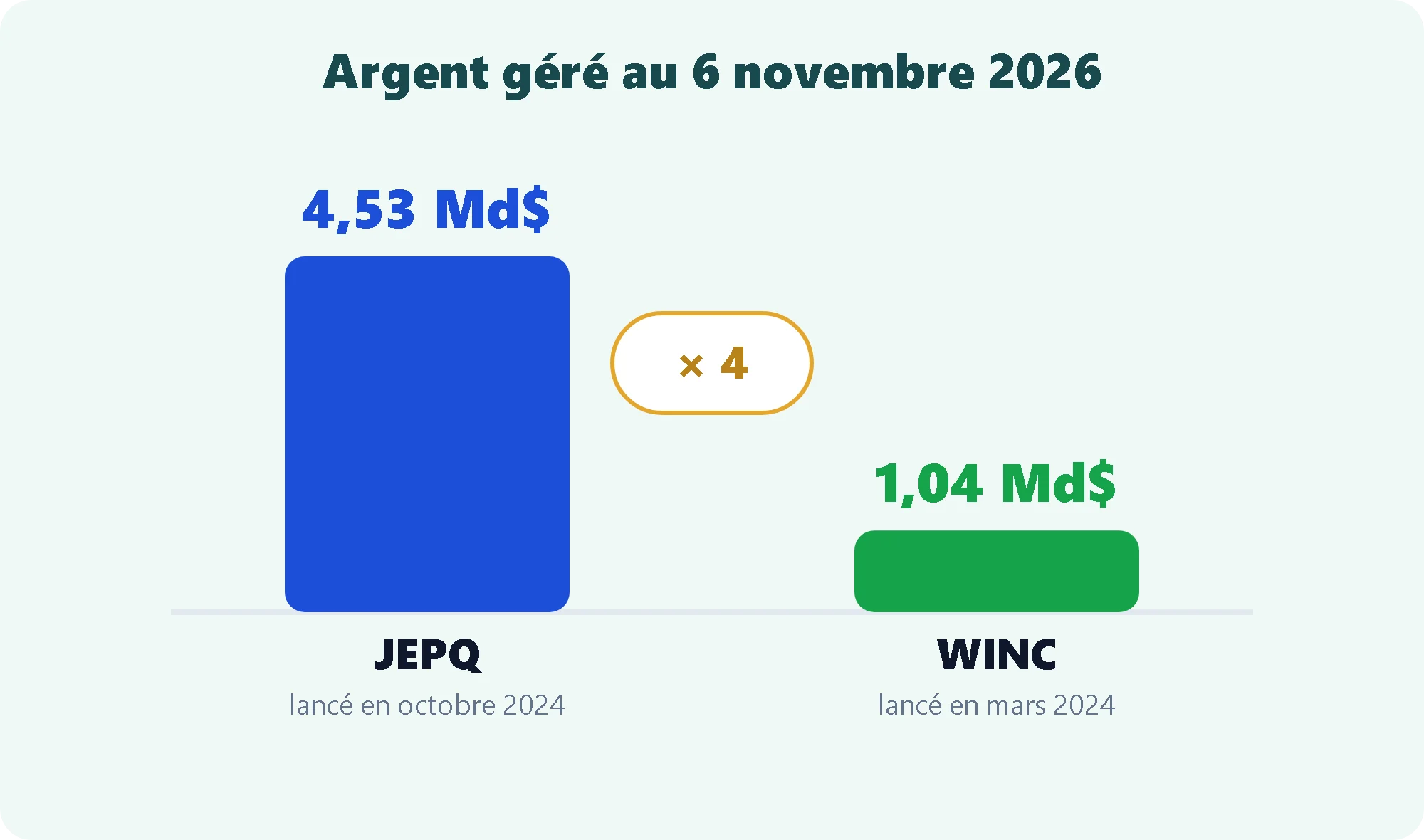
The WINC was launched seven months before the European JEPQ, and yet it manages four times less money (1.04 billion dollars against 4.53). Neither issuer comments on these figures, but several reasons are plausible. First, the brand: the US JEPI and JEPQ are among the biggest active ETFs in the world, and the European version of the JEPQ arrived with that reputation, while the WINC is a 2024 creation with no well-known US big brother. Then the displayed yield: 11 to 12 % for the JEPQ, paid every month, against a WINC that only paid quarterly until September 2026, a decisive criterion for anyone looking for monthly income. Finally, the appeal of the Nasdaq-100 and of technology in 2025 and 2026, and the JEPQ's presence at mainstream brokers (at Trade Republic under the ticker JEQP; at Interactive Brokers, both funds are available on all their exchanges). These are my hypotheses, not an official explanation.
iShares: 2 "Equity High Income" ETFs

ETF | Universe | Launch | Assets | 12-month yield | Fees |
|---|---|---|---|---|---|
WINC (World) | Developed-market stocks, compared with the MSCI World | 03/22/2024 | $1.04 bn | 10.45 % | 0.35 % |
INCU (U.S.) | US stocks, compared with the S&P 500 | 03/22/2024 | $117 M | 8.42 % | 0.35 % |
iShares data as of November 5 and 6, 2026. 12-month yield: distributions over the last 12 months divided by the price.
Both funds switched to monthly distribution at the same time, in September 2026. The iShares prospectus spells out the WINC's mechanism: call options sold on indices, and futures contracts bought to soften the effect of the cap on the upside (iShares III plc prospectus). Over its financial year ended June 30, 2026, the WINC returned +21.04 % against +21.34 % for the MSCI World, for generated income of 10.59 % (iShares III annual report).
 The JEPQ in detail
The European JEPQ is the UCITS version, domiciled in Ireland, of the US JPMorgan Nasdaq Equity Premium Income ETF launched in May 2022. US ETFs are not available to European retail investors (because they have no key information document, the KID), hence this version launched on October 29, 2024, which already manages 4.53 billion dollars as of November 6, 2026 according to JPMorgan.
 Why only 110 holdings?
This is a question you asked me: the JEPQ shows 110 holdings as of November 6, 2026. They break down as follows: 94 stocks (90 ordinary shares, 1 share listed in New York, 2 American depositary receipts and 1 listed real estate company), 15 call options sold on the Nasdaq-100 and 1 cash line (4.1 % of the fund). The Nasdaq-100 has about a hundred companies: the manager keeps 94 of them, and adjusts their weights around those of the index. So it is not a lack of diversification compared with the Nasdaq-100, it is the Nasdaq-100 itself that is concentrated.
Rank | Company or holding | Weight |
|---|---|---|
1 | Apple | 8.6 % |
2 | Nvidia | 7.9 % |
3 | Microsoft | 7.0 % |
4 | Alphabet (class C share) | 5.1 % |
5 | Amazon | 5.1 % |
6 | Micron Technology | 4.2 % |
7 | Cash | 4.1 % |
8 | AMD | 3.8 % |
9 | Meta | 3.3 % |
10 | Tesla | 2.6 % |
Holdings published by JPMorgan as of November 6, 2026.
 Active management, with options on the index
The JEPQ is actively managed by a JPMorgan team, which selects stocks with a data-driven approach, then sells call options on the Nasdaq-100 index. Unlike the US JEPQ, the European version does not use structured notes (the "ELNs"): the options are held directly. Its official objective: to provide income and long-term capital growth. JPMorgan does not display any target yield, and the amount paid out changes every month with the premiums collected.
The different JEPQ share classes
The same fund exists in several "share classes", with different ISINs. The ticker also changes depending on the exchange: JEPQ in London (in dollars) and in Switzerland, JEQP in Frankfurt / Xetra (in euros) and at Trade Republic, JEPQ in Milan in euros. Personally, I buy the dollar share class in London, at Interactive Brokers.
Share class | ISIN | Ticker (exchange) | Launch | For whom? |
|---|---|---|---|---|
Dollars, distributing | IE000U9J8HX9 | JEPQ (London, USD), JEQP (Xetra, EUR) | 10/29/2024 | The original share class, the most traded: it is mine |
Dollars, accumulating | IE000N6I8IU2 | JEQA (London in USD, Xetra and Milan in EUR, Switzerland) | 10/29/2024 | Same strategy without payouts: income is reinvested |
Euros, distributing | IE0006CJGQR9 | JQPD (Xetra, Milan) | 11/06/2025 | Payouts in euros, but still exposed to the dollar |
Euros hedged, distributing | IE0006FIW9Z0 | JEQE (Xetra, Milan) | 11/06/2025 | Largely neutralizes the dollar's swings |
Share classes and dates according to JPMorgan AM; London Stock Exchange ticker in pounds: JEQP. A CHF-hedged share class also exists.
The accumulating share class does exist (JEQA), since day one, contrary to what you often read. It manages 153 million dollars, against 4.34 billion for the distributing share class, and delivers exactly the same performance: +29.48 % since launch as of October 31, 2026 for both share classes, in dollars, according to JPMorgan. There is no euro-hedged accumulating share class. JEQA suits anyone who wants to benefit from the strategy without receiving income, with the tax advantage of only paying tax when you sell. But for an investor who accumulates, a classic accumulating ETF on the Nasdaq-100 has done much better over two years: the point of an options ETF remains the income.
The WINC in detail
The WINC is an ETF from iShares, BlackRock's ETF brand, launched on March 22, 2024 under the name "iShares World Equity High Income UCITS ETF"; it now carries the word "Active" in its name. It manages 1.04 billion dollars as of November 6, 2026 according to iShares. Its official objective is more cautious than the JEPQ's: income and capital growth, with less volatility than developed-market stocks.
Systematic management
The WINC is managed by BlackRock's systematic investment team: the selection of the 551 stocks relies on quantitative models, with environmental and social exclusions (the fund is classified Article 8 under the European SFDR regulation). The extra income comes from call options sold on several indices (S&P 500, Euro Stoxx 50, FTSE 100 and Nikkei 225 in the holdings of November 5, 2026), complemented by futures contracts bought on these same indices, which adjust the fund's market exposure.
What the WINC holds
Rank | Holding | Weight |
|---|---|---|
1 | Cash held as collateral for derivatives | 7.5 % |
2 | BlackRock money market fund (dollars) | 4.6 % |
3 | Apple | 4.6 % |
4 | Nvidia | 4.1 % |
5 | Microsoft | 3.7 % |
6 | Amazon | 1.75 % |
7 | Alphabet (class A share) | 1.4 % |
8 | Costco | 1.4 % |
9 | Alphabet (class C share) | 1.3 % |
10 | Intesa Sanpaolo | 1.15 % |
iShares holdings file as of November 5, 2026. The cash serves as collateral for the options and futures contracts.
Two things stand out. The US giants are indeed there, but with weights half as large as in the JEPQ. And the fund deliberately deviates from the MSCI World: more Japan (7.1 % against 5.7 %), a little less United States (70.7 % against 72.8 %) and less technology (26.2 % against 29.8 % in the index). You also find European dividend stocks, such as the Italian bank Intesa Sanpaolo.
 The switch to monthly payouts
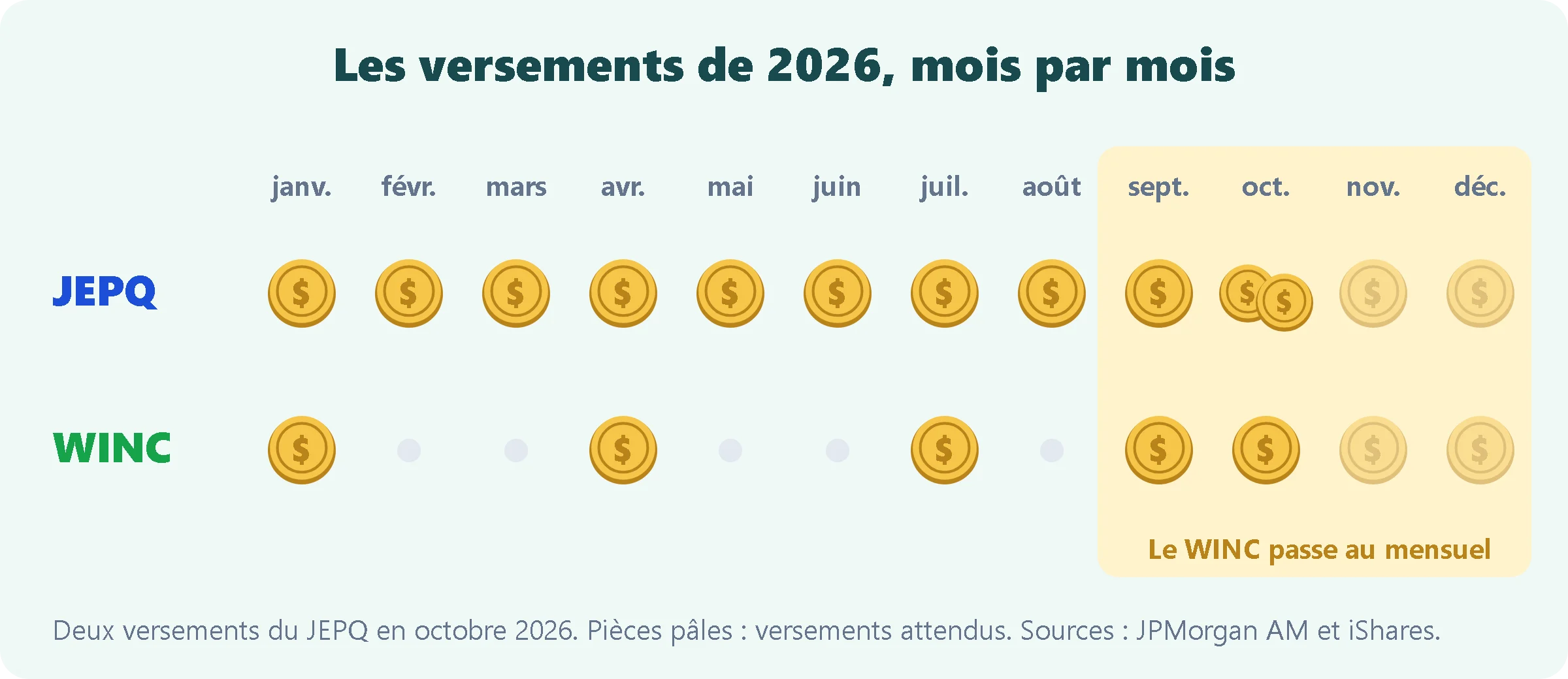
This is the big news of 2026. In a letter to shareholders dated August 21, 2026, iShares announced that the WINC would move from a quarterly distribution to a monthly distribution "around September 4, 2026", citing feedback from its clients. The costs of this change are borne by BlackRock, and the fund's risk level does not change. The first monthly distribution was paid on September 30, 2026 ($0.0891 per share, which presumably covers August and September), the next one on October 28, 2026 ($0.0470). At Interactive Brokers, each payment lands directly in dollars in your account.
The different WINC share classes
Share class | ISIN | Ticker (exchange) | Launch | Share class assets |
|---|---|---|---|---|
Dollars, distributing | IE000KJPDY61 | WINC (Xetra in EUR, Amsterdam in USD, London in GBP) | 03/22/2024 | $1.01 bn |
Dollars, accumulating | IE0000P0RPE6 | WINA (Amsterdam in USD, Milan in EUR, Switzerland): not on Xetra | 03/22/2024 | $28.6 M |
Euros hedged, accumulating | IE000EB0LQO5 | CEMY (Xetra) | 06/26/2026 | 0.55 M€ |
Euros hedged, distributing | IE0006HLR5N4 | EDMC (Xetra) | 10/14/2026 | 0.35 M€ |
Share classes according to iShares (BlackRock), assets as of November 5, 2026. A pound-hedged share class (WCGH) also exists.
In practice, almost all the money is in the dollar distributing share class. The WINA accumulating share class delivered the same performance (+14.31 % over one year as of October 31, 2026, according to iShares), but it only manages 28.6 million dollars and is not listed on Xetra: trading is rare, so a limit order is a must. The euro-hedged share classes, launched in 2026, are still tiny: their buy and sell prices can drift from the fund's value, especially during the hours when the US market is closed.
 Make-up compared: sectors and countries
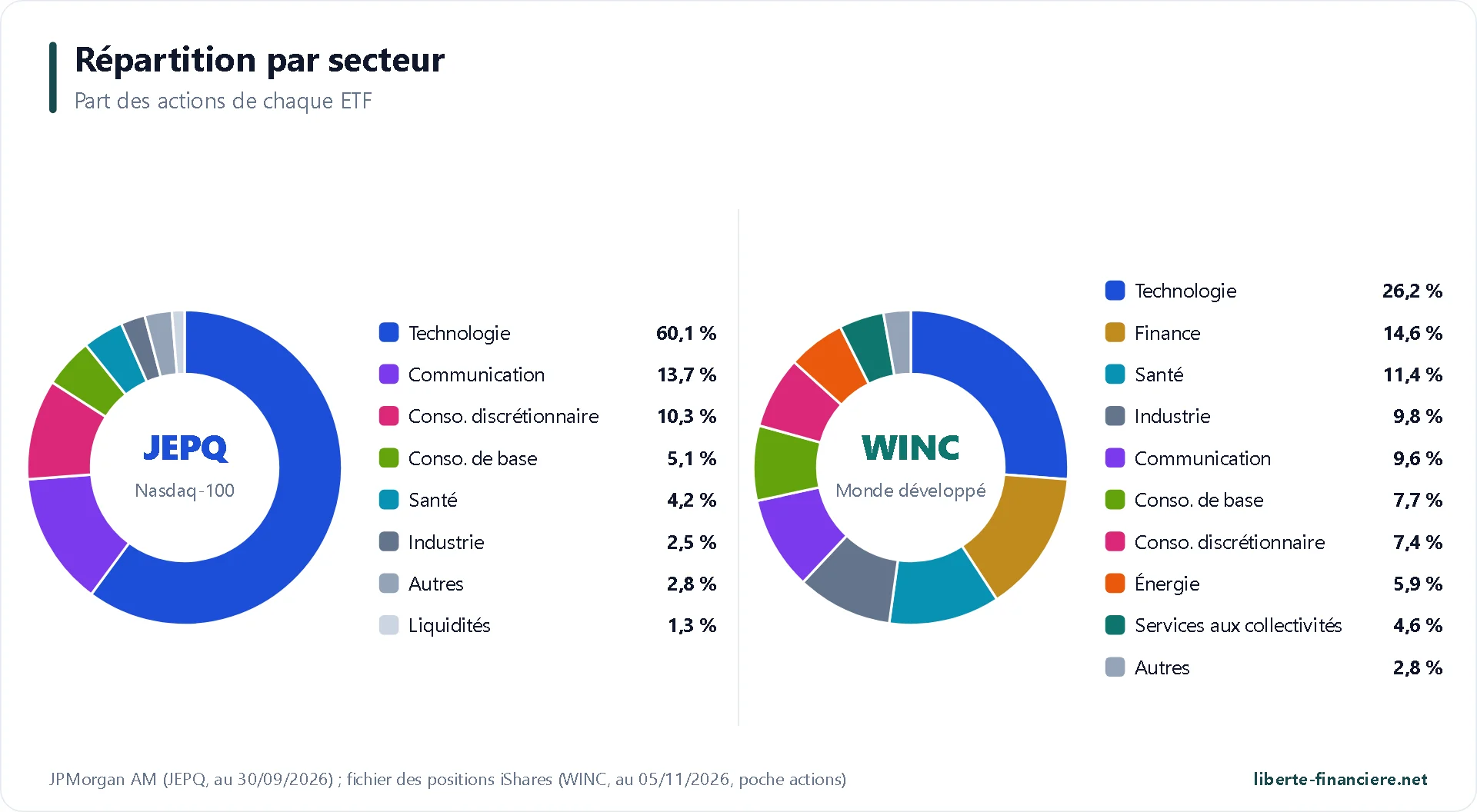
This is the fundamental difference between the two ETFs. The JEPQ is 60 % technology (59.9 % for the Nasdaq-100 itself), 13.7 % communication (Alphabet, Meta, Netflix) and 10.3 % consumer discretionary (Amazon, Tesla): three quarters of the fund in the digital economy, and almost no banks, no energy companies. The WINC spreads its money across all sectors: 26.2 % technology, then financials (14.6 %), healthcare (11.4 %), industrials (9.8 %), communication (9.6 %), consumer and energy.
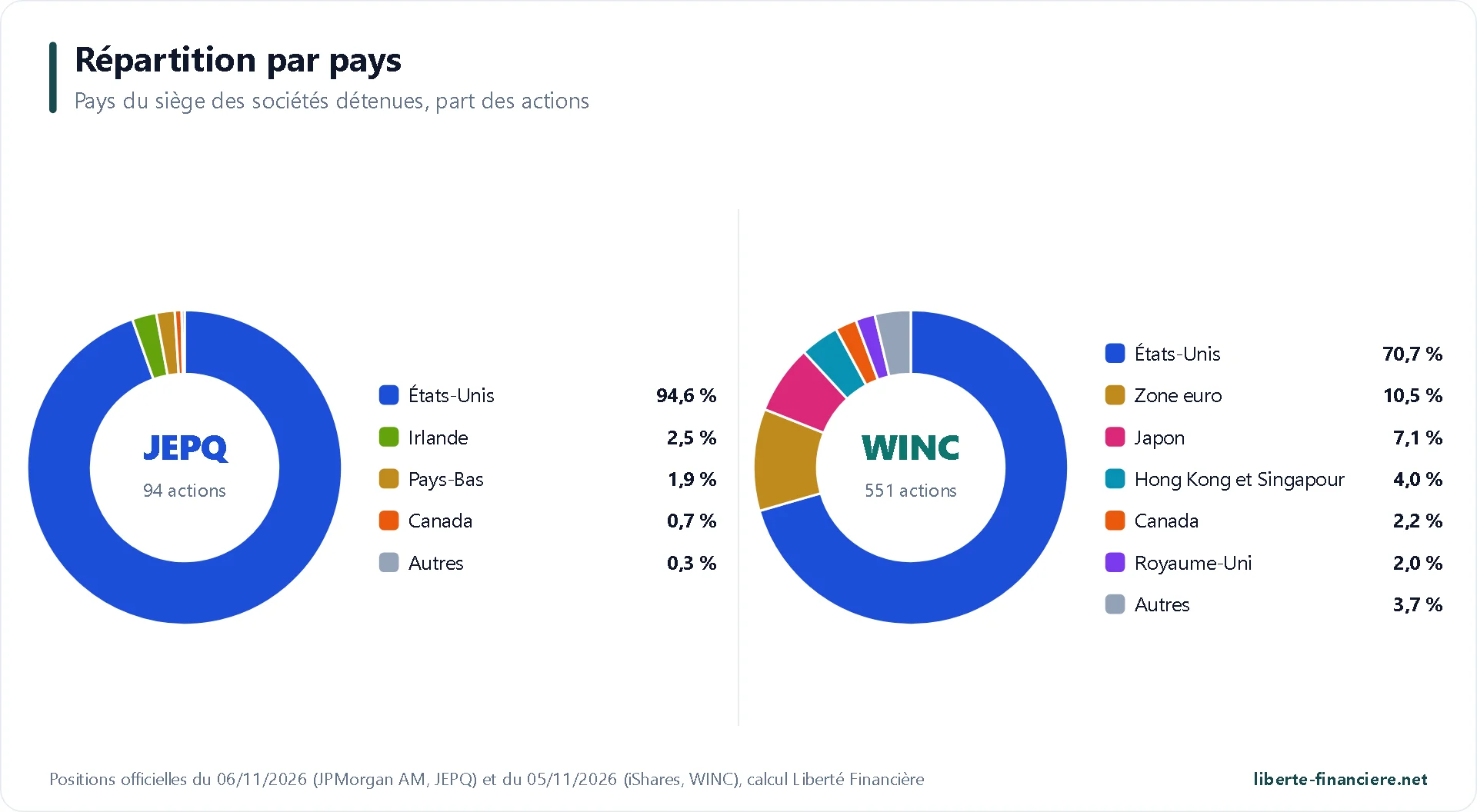
Same picture by country. The JEPQ is 94.6 % American. The rest mainly consists of Nasdaq-100 companies registered elsewhere: Seagate and Linde in  Ireland, ASML, NXP and Nebius in the
 Netherlands, Shopify in
 Canada, Arm in the
 United Kingdom. So the Nasdaq-100 itself is not 100 % American. Another little-known point: the JEPQ is not limited to the Nasdaq-100. Its prospectus states that the portfolio "may include, but is not limited to" the index's stocks, with at least 67 % in US stocks. As of November 6, 2026, 19 of its stocks (5.1 % of the fund) are outside the Nasdaq-100: AbbVie, Deere, Eaton (Ireland), Mastercard, NextEra, Southern, Lowe's, Coca-Cola, Hilton, Thermo Fisher, Bristol-Myers, Corpay, Chipotle, Prologis, UnitedHealth, ServiceNow, Uber, HubSpot and UPS (JPMorgan holdings compared with the official Nasdaq-100 list, my calculation). Often less volatile stocks, chosen by the managers. The WINC is 70.7 % American, and spreads the rest between the euro area (10.5 %, including
 Italy and
 Spain),
 Japan (7.1 %),
 Hong Kong and
 Singapore (4.0 %), Canada and the United Kingdom.
Criterion | JEPQ | WINC |
|---|---|---|
Number of stocks | 94 | 551 |
Weight of the top 3 stocks | 23.5 % | 12.4 % |
| 94.6 % | 70.7 % |
Technology | 60.1 % | 26.2 % |
Financials | 0.6 % | 14.6 % |
Healthcare | 4.2 % | 11.4 % |
Energy | 0.3 % | 5.9 % |
Share of each fund's stock holdings. JEPQ: sectors as of 09/30/2026, countries as of 11/06/2026; WINC: holdings as of 11/05/2026, equity sleeve, Liberté Financière calculation.
In practice, holding both already means diversifying: the WINC brings the financials, healthcare, energy, Europe and Japan that the JEPQ lacks. On the other hand, adding the JEPQ to a classic World ETF mostly means piling even more into Apple, Nvidia and Microsoft, which are already the top holdings in the World.
 Distributions compared
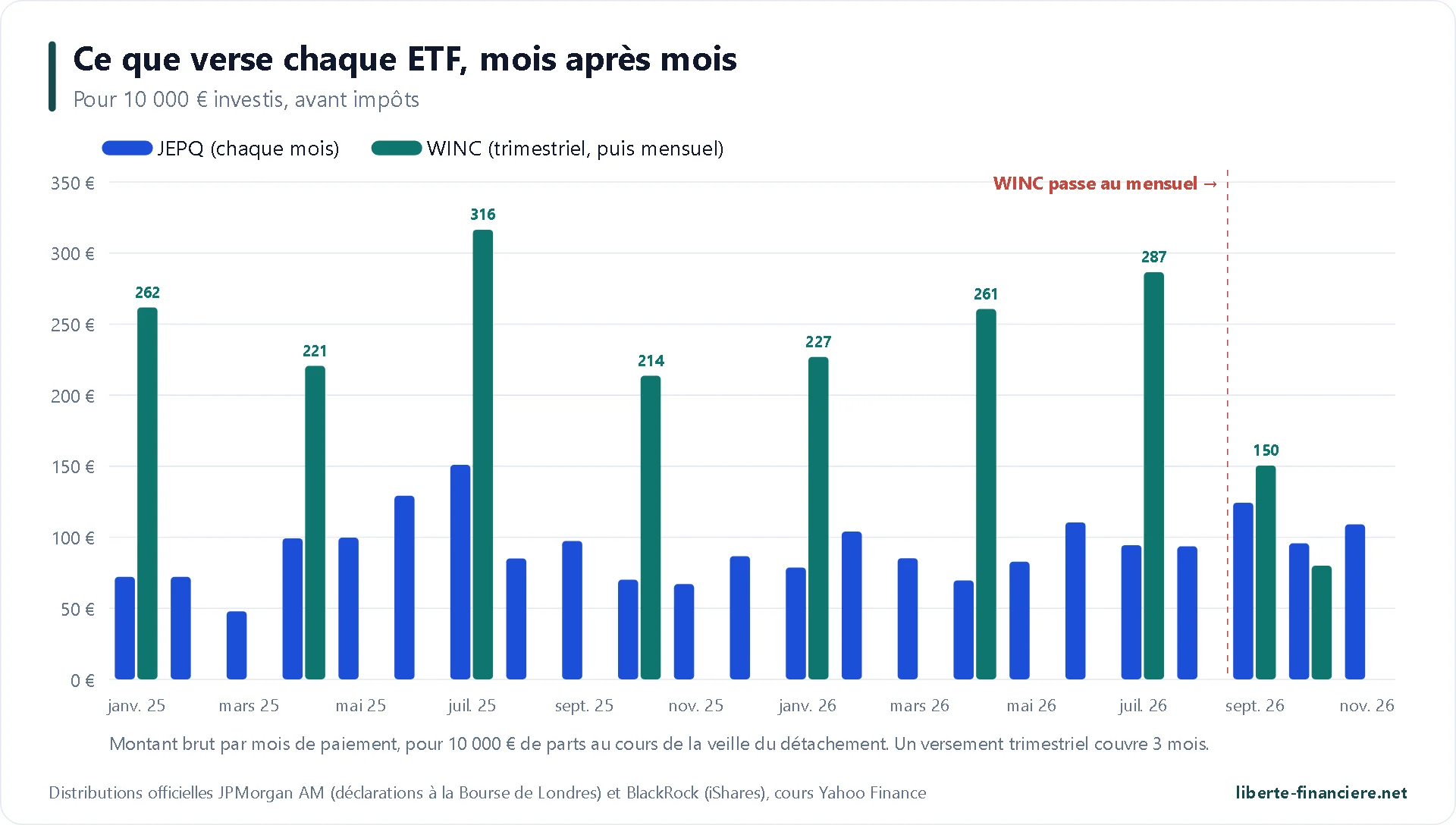
Over the last 12 months, the JEPQ distributed 12.1 % of its current price, and the WINC 10.4 % (iShares publishes 10.45 % as of November 5, 2026). JPMorgan, for its part, displays an "annualized" yield of 11.27 %: that is the last distribution multiplied by 12, a figure that varies a lot from one month to the next. On 10,000 € invested, the difference amounts to about 170 € a year before tax in favor of the JEPQ.
 Why the amount changes every month
Neither JPMorgan nor iShares guarantees an amount. Each distribution passes on the dividends and option premiums collected: when the market is calm, premiums are low and the payout falls; when it is turbulent, they rise. For the JEPQ, the payout per share has ranged from $0.1247 (February 2025) to $0.3672 (June 2025, right after the tariff crisis), i.e. it tripled.
Ex-dividend date | Payment | JEPQ ($ per share) |
|---|---|---|
12/12/2024 | 01/08/2025 | 0.1904 |
01/16/2025 | 02/07/2025 | 0.1860 |
02/13/2025 | 03/07/2025 | 0.1247 |
03/13/2025 | 04/07/2025 | 0.2375 |
04/10/2025 | 05/07/2025 | 0.2086 |
05/08/2025 | 06/06/2025 | 0.3040 |
06/12/2025 | 07/08/2025 | 0.3672 |
07/10/2025 | 08/07/2025 | 0.2095 |
08/14/2025 | 09/08/2025 | 0.2472 |
09/11/2025 | 10/07/2025 | 0.1795 |
10/09/2025 | 11/07/2025 | 0.1755 |
11/13/2025 | 12/05/2025 | 0.2312 |
12/11/2025 | 01/08/2026 | 0.2104 |
01/15/2026 | 02/06/2026 | 0.2771 |
02/12/2026 | 03/06/2026 | 0.2261 |
03/12/2026 | 04/07/2026 | 0.1823 |
04/09/2026 | 05/08/2026 | 0.2156 |
05/21/2026 | 06/05/2026 | 0.3021 |
06/11/2026 | 07/08/2026 | 0.2517 |
07/09/2026 | 08/07/2026 | 0.2523 |
08/13/2026 | 09/04/2026 | 0.3427 |
09/10/2026 | 10/07/2026 | 0.2627 |
10/08/2026 | 10/23/2026 | 0.2472 |
11/12/2026 | 11/27/2026 | 0.2751 |
Dividend declarations by JPMorgan ETFs (Ireland) ICAV on the London Stock Exchange (investegate), dollar share class IE000U9J8HX9. The November 2026 distribution has been announced, not yet paid.
Ex-dividend date | Payment | WINC ($ per share) | Frequency |
|---|---|---|---|
01/16/2025 | 01/29/2025 | 0.1372 | Quarterly |
04/17/2025 | 04/30/2025 | 0.1081 | Quarterly |
07/17/2025 | 07/30/2025 | 0.1700 | Quarterly |
10/16/2025 | 10/29/2025 | 0.1195 | Quarterly |
01/15/2026 | 01/28/2026 | 0.1299 | Quarterly |
04/16/2026 | 04/29/2026 | 0.1504 | Quarterly |
07/16/2026 | 07/29/2026 | 0.1705 | Quarterly |
09/17/2026 | 09/30/2026 | 0.0891 | Monthly |
10/15/2026 | 10/28/2026 | 0.0470 | Monthly |
Official iShares distribution table, dollar share class IE000KJPDY61 (the very first, partial distribution of April 2024 is not included).
Ex-dividend date and payment date: how long do you wait?
To receive a distribution, you need to hold the shares the day before the ex-dividend date (the "ex" date). The payment then lands in your account. For the WINC, it arrives about twelve days after the ex-date. For the JEPQ, it used to arrive about 4 weeks later; since the October 2026 distribution, it arrives about 2 weeks later (ex-date October 8, payment October 23; ex-date November 12, payment announced for November 27). JPMorgan has not published any announcement about this change: nothing guarantees that it is permanent. That is why I received two payments in October 2026, on the 7th and the 23rd.
Another practical detail: both funds pay out in dollars, even if you bought the share class listed in euros. At Interactive Brokers, the dividend lands in your dollar balance; you then choose to keep it, reinvest it or convert it.
Buy JEPQ and WINC at the best price London, Xetra, Amsterdam: both ETFs in all their currencies, with currency conversion at 0.002 %. |
 Performance compared
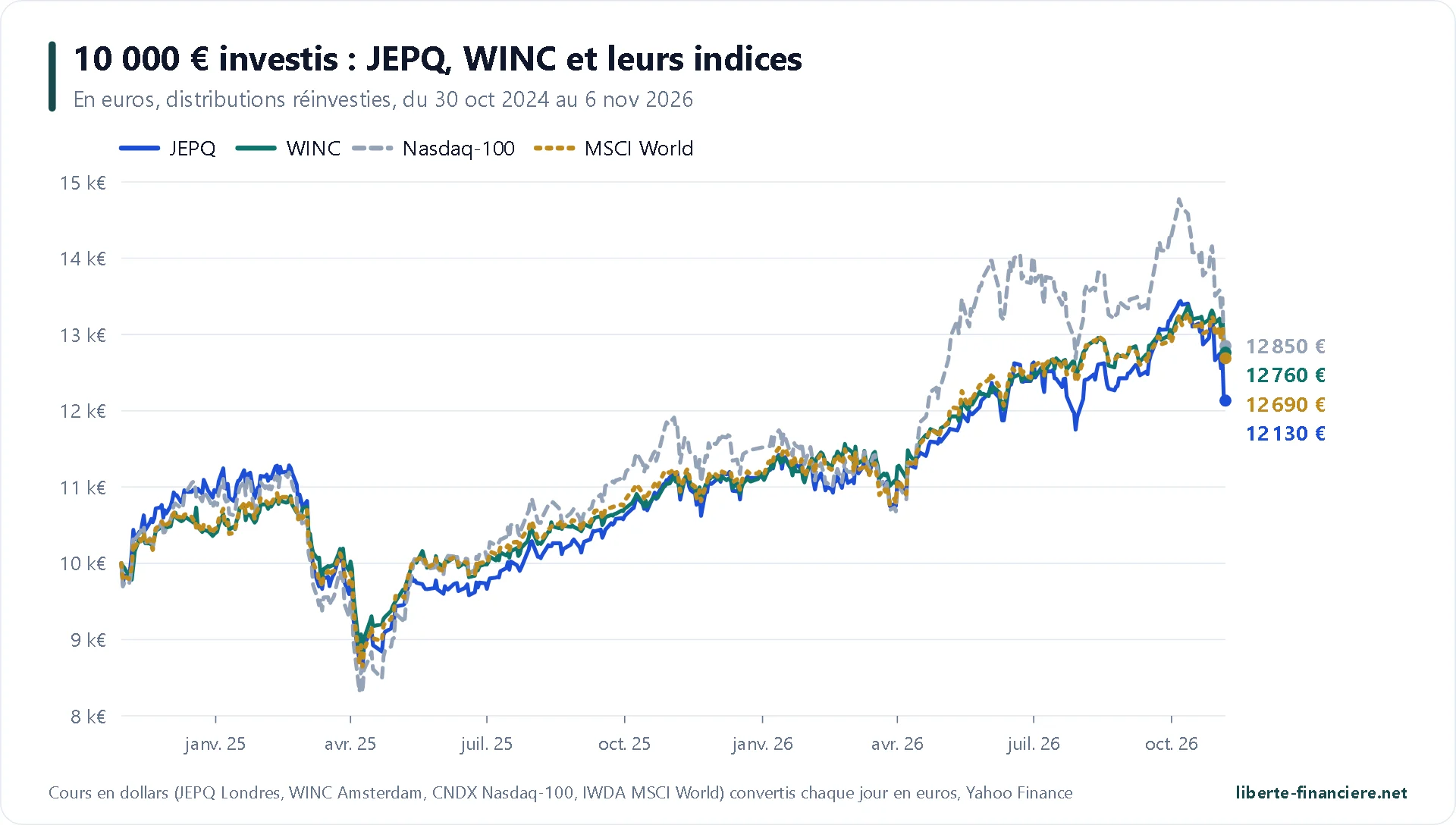
To compare like with like, I took the same period for all four investments: from October 30, 2024 (the day after the European JEPQ's launch) to November 6, 2026, in euros, distributions reinvested. Dollar prices are converted every day at the euro/dollar rate, which gives exactly what a French investor experienced.
In euros, distributions reinvested | JEPQ | WINC | Nasdaq-100 | MSCI World |
|---|---|---|---|---|
10,000 € invested on 10/30/2024 are worth | 12,130 € | 12,760 € | 12,850 € | 12,690 € |
Cumulative performance | +21.3 % | +27.6 % | +28.5 % | +26.9 % |
Performance per year | +10.1 % | +12.8 % | +13.2 % | +12.5 % |
1-year performance | +9.8 % | +15.7 % | +10.9 % | +14.3 % |
1-year volatility | 16.8 % | 12.7 % | 21.3 % | 13.9 % |
Spring 2025 drop | -23.8 % | -18.8 % | -25.7 % | -20.8 % |
Price only (without distributions) | -1.8 % | +4.1 % | n/a | n/a |
Liberté Financière calculation based on Yahoo Finance closing prices (JEPQ in London, WINC in Amsterdam, iShares Nasdaq 100 CNDX and iShares Core MSCI World IWDA, accumulating), converted into euros. Spring 2025 drop: from the February high to the low of April 9, 2025.
The result is clear: over two years, the WINC almost kept pace with the MSCI World (and even did slightly better), while the JEPQ did noticeably worse than the Nasdaq-100, about 7 points less. Over one year, the gap between the two ETFs exceeds 6 points in favor of the WINC, with lower volatility.
The official figures, in dollars
In dollars, as of 10/31/2026 (issuer sources) | JEPQ | Nasdaq-100 | WINC | MSCI World |
|---|---|---|---|---|
Over 1 year | +10.06 % | +10.26 % | +14.31 % | +12.11 % |
Since launch, cumulative | +29.48 % | +39.45 % | +47.85 % | +46.87 % |
Since launch, per year | +13.75 % | +18.03 % | +16.19 % | +15.90 % |
Year 2025 | 4.44 points below the index | +20.77 % | +21.09 % |
JPMorgan AM (JEPQ since 10/29/2024) and iShares fact sheet for October 2026 (WINC since 03/22/2024): the two "since launch" periods are not the same.
Why the JEPQ does worse than the Nasdaq-100
The Nasdaq-100 saw very strong rallies over the period (in dollars, +31 % between April 8 and the end of July 2025, then another +29 % in the second quarter of 2026). That is exactly the scenario in which a covered call strategy loses the most: in every month of strong gains, the fund gives up whatever exceeds the strike price. Fees (0.35 %) and the cash holding add a slight drag. It is not a management flaw, it is the deal: less upside in exchange for high income.
Why the WINC tracked the MSCI World
The WINC covers a smaller part of its portfolio, on less volatile indices (S&P 500, Euro Stoxx 50, FTSE 100, Nikkei), and its futures contracts let it keep an exposure close to the market's. Its country and sector tilts (more Japan and dividend stocks, less technology) also worked in its favor in 2026. Over a period in which US technology alone took the lead of the market again, the gap could reverse.
 Price only: is the capital holding up?
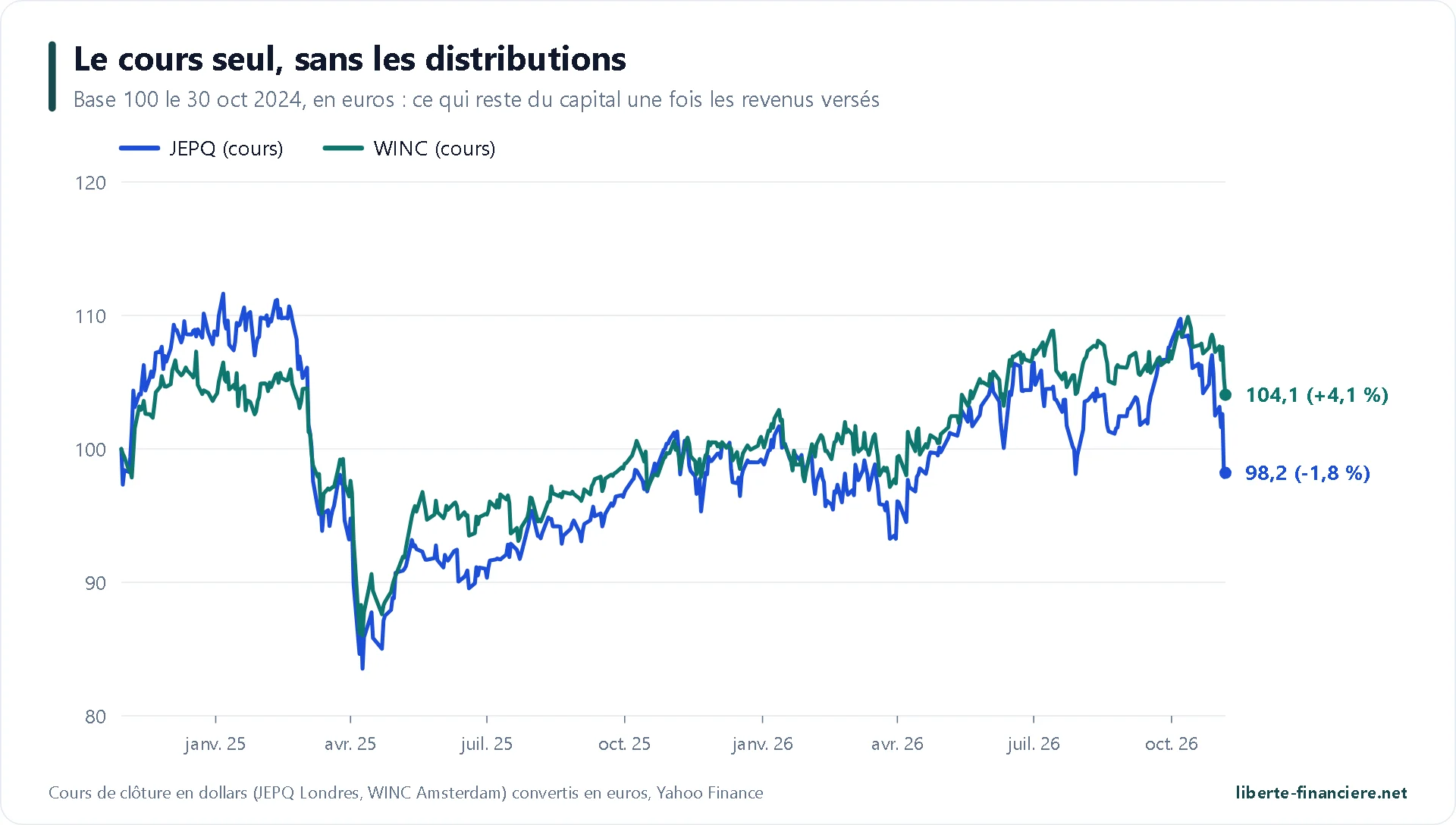
This is my number 1 criterion for this type of ETF: I want to receive income without seeing my capital melt away. Over two years, in euros, the WINC's price (without distributions) rose +4.1 %, while the JEPQ's fell -1.8 %. In dollars, both are positive (JEPQ +1.9 %, WINC +8.0 %): it is the rise of the euro that pushes the JEPQ slightly underwater for a French investor. So both are keeping their promise for now, with an edge for the WINC, which distributes a bit less and therefore leaves a bit more growth in the price.
 The dollar: currencies, euro share classes and hedging
Both ETFs are managed in dollars and hold stocks in dollars (and in yen, euros or pounds for the WINC). Buying the share class listed in euros on Xetra changes nothing about your exposure: the euro price is just the dollar price converted. If the dollar falls 10 % against the euro, your position loses about 10 % in euros, whichever exchange you chose. That is what happened in 2025: the euro gained about 13 % against the dollar, and the JEPQ only returned +2 % in euros according to justETF.
To neutralize the dollar, you need a hedged share class ("EUR Hedged"): JEQE for the JEPQ, EDMC (distributing) or CEMY (accumulating) for the WINC. Hedging has a cost, linked to the interest rate gap between the euro area and the United States, and it slightly reduces the income: 9.81 % displayed for the JEPQ's hedged share class against 11.27 % for the dollar share class as of November 6, 2026. Be careful not to mix them up: the JQPD share class pays out in euros, but it is not hedged; its value still follows the dollar.
For an income investment over many years, I prefer to keep the currency risk rather than pay for hedging: dollar cycles partly offset each other over the long term, and my dollar income can be used to buy other US assets without conversion. It is a personal choice, not a rule.
My experience in figures
My JEPQ position since April 2025
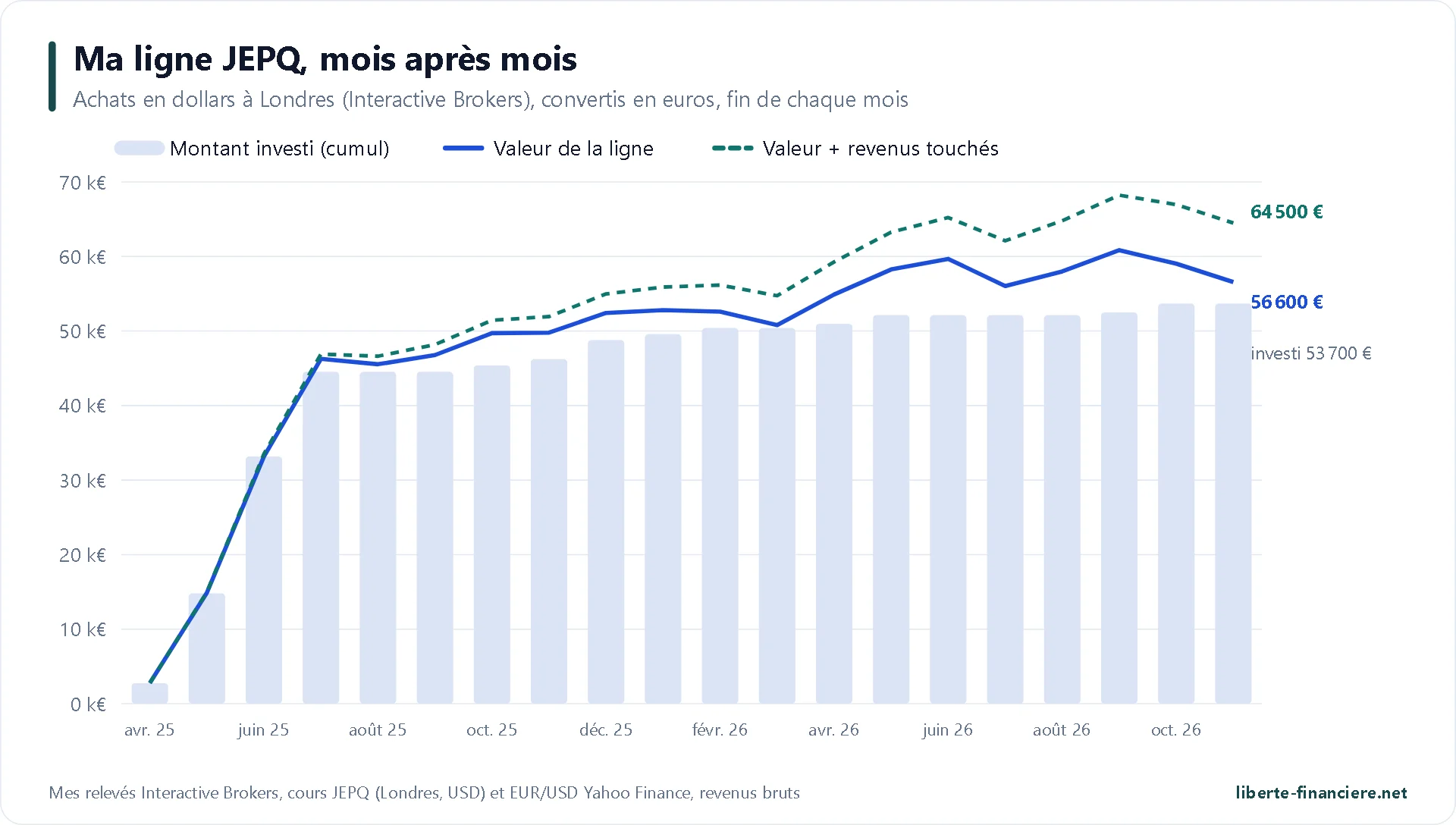
I bought my first JEPQ shares on April 23, 2025, in the middle of the tariff crisis, on the London Stock Exchange in dollars, with Interactive Brokers. I invested in stages: about 44,500 € between April and July 2025, then small regular purchases. As of November 6, 2026, I hold 2,519 shares, for 53,700 € invested ($61,600, order fees included), worth about 56,600 €.
My unrealized gain is about 2,900 € in euros. It was higher in the spring (about 12 % at my one-year review in May 2026): the Nasdaq-100 fell in early November 2026, and the dollar's decline in 2025 weighed on my purchases converted into euros.
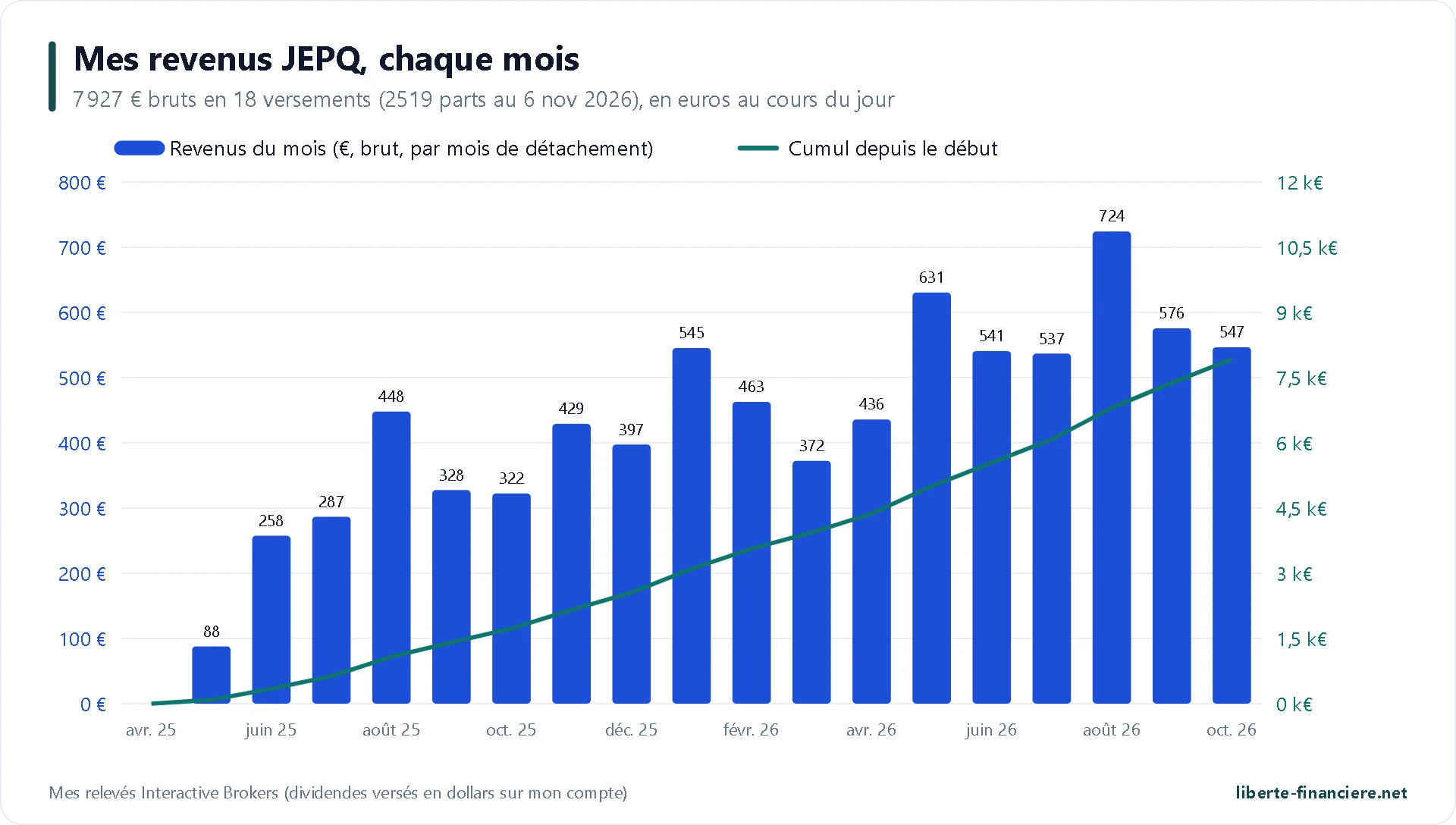
On the income side, I have received 18 payments, for $9,174 gross, i.e. about 7,927 € at the exchange rate of each payment day. The last few months have hovered around 550 € gross a month, and the November 2026 distribution ($0.2751 per share) should bring me about $693. Adding current value and income received, my position is worth about 64,500 € for 53,700 € invested, before tax.
On these payments, Interactive Brokers withheld no tax at source: an Irish ETF pays its distributions without Irish or US tax for a French resident. I then declare them in France (see the taxation section).
My JEPQ position is at Interactive Brokers London Stock Exchange in dollars, currency conversion at 0.002 % and up to $1,000 in IBKR shares offered when you open an account. |
 My time with the WINC
I bought 165 WINC shares on September 12, 2025, on Xetra in euros, at 4.7145 € (777.89 € plus 1.25 € in fees). I had first tried the dollar share class in Amsterdam, but the order would not go through, for lack of trading. The WINC paid me a single distribution, on October 29, 2025: $0.1195 per share, i.e. $19.72, in dollars despite my purchase in euros. I sold it on January 7, 2026 at 4.9045 € (809.24 €), one week before the January ex-date, i.e. about +6 % in four months including the distribution.
Why did I sell it? Three practical reasons: the distribution was quarterly, which complicated my tracking of monthly income; I had no dollar cash for the most attractive share class; and I preferred to focus my purchases on a single position. Two of these three reasons disappeared with the switch to monthly payouts.
 What I am doing now
This comparison changed my mind. I am going to gradually switch my JEPQ to the WINC, which I have not held since January 2026: at equal fees, it is far more diversified (countries, sectors, number of stocks), less volatile, it has protected its capital better and it now pays every month. In exchange, I accept slightly lower income (about 10.4 % against 12.1 % over 12 months).
I am taking the WINC's distributing share class, as with the JEPQ. The WINA accumulating share class only manages 28.6 million dollars and trades too little for my taste: I look for ETFs with more than 100 million in assets. The distributing share class keeps a subtle tax advantage: a larger part of the WINC's performance comes from the rise in its price, which is only taxed when you sell. So I receive income close to 10 % a year, while keeping part of the growth out of reach of the flat tax as long as I do not sell.
In practice, I will first reinvest in the WINC the dollar distributions the JEPQ pays me. I am going to try buying in Amsterdam, in dollars, with a limit order, after comparing at Interactive Brokers the order fees on that exchange with those in London; if the order goes through badly, I will convert into euros to buy on Xetra. Then I will quickly consider selling part of my JEPQ to speed up the switch. These are my choices, based on my profile and the rest of my wealth: I am not a financial adviser.
 Where and how to buy JEPQ and WINC
Both ETFs are listed on several European exchanges, but not in Paris: you need a broker that gives access to London, Frankfurt (Xetra) or Amsterdam, in an ordinary brokerage account (they are not PEA-eligible). The US JEPQ ETF, listed on the Nasdaq, cannot be bought by a European retail investor: you have to take the European version, with the ISIN starting with IE.
JEPQ | WINC | |
|---|---|---|
In dollars | London: JEPQ (the most traded), Switzerland | Amsterdam: WINC (little trading) |
In euros | Xetra: JEQP, Milan | Xetra: WINC |
In pounds | London: JEQP | London: WINC |
Accumulating | JEQA: London (USD), Xetra (EUR) | WINA: Amsterdam (USD), Milan (EUR) |
At Trade Republic | Yes, under the ticker JEQP | Depending on the app's list |
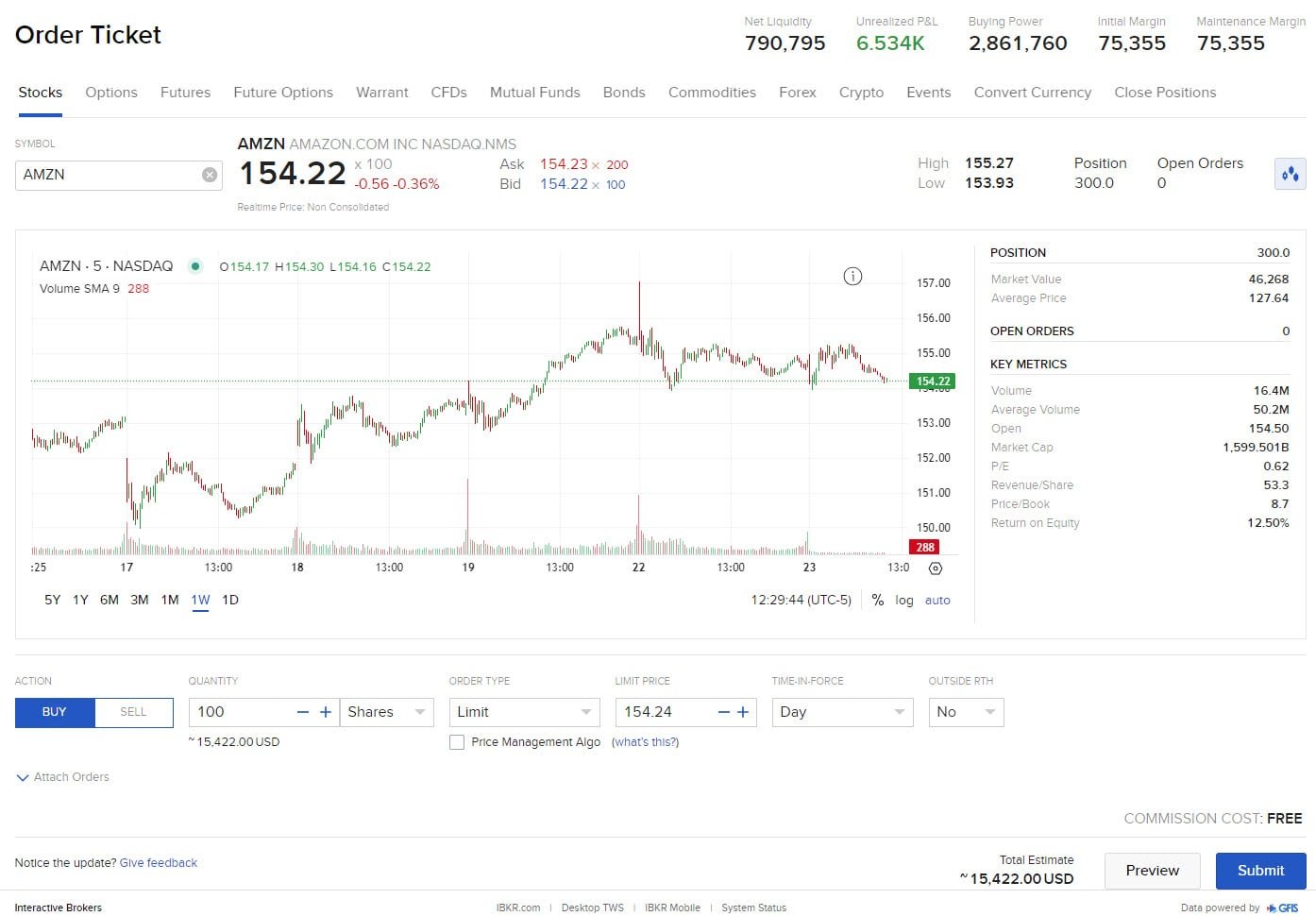
With Interactive Brokers, this is what I do: I buy the JEPQ in dollars in London, with dollars already in my account (currency conversion costs 0.002 % at IBKR), and I bought the WINC in euros on Xetra, because the dollar line in Amsterdam was barely trading that day. Order fees are a bit higher in London than in Frankfurt. The trading currency changes nothing about your exposure: with the dollars from my JEPQ distributions, I can buy the WINC in Amsterdam in dollars, provided I place a limit order and accept that it may take time to fill, or convert those dollars into euros for 0.002 % and buy on Xetra, where trading is much more active. At Trade Republic, the JEPQ is available under the ticker JEQP; tax is withheld automatically on distributions there (see the taxation section).
 Liquidity: where the shares really trade
Ticker | Type | Exchange | Currency | Share class assets | Traded per day |
|---|---|---|---|---|---|
JEPQ | Distributing | London | USD | $4.34 bn | ≈ $12 M |
JEQP | Distributing | Xetra | EUR | (same share class) | ≈ 2.7 M€ |
JEQA | Accumulating | London | USD | $153 M | ≈ $0.97 M |
JEQA | Accumulating | Xetra | EUR | (same share class) | ≈ 77 k€ |
WINC | Distributing | Amsterdam | USD | $1.01 bn | ≈ $0.49 M |
WINC | Distributing | Xetra | EUR | (same share class) | ≈ 2.5 M€ |
WINA | Accumulating | Amsterdam | USD | $28.6 M | ≈ $0.21 M (no trading on 8 days out of 66) |
WINA | Accumulating | Milan | EUR | (same share class) | ≈ 87 k€ |
Amount traded on the exchange per day: average of the last 3 months as of November 7, 2026 (Yahoo Finance volumes). Assets: JPMorgan AM (November 6) and iShares (November 5).
You often read that you should avoid an ETF with less than 100 million euros. That threshold applies to the fund: a small fund risks being closed by its issuer. Here, JEQA and WINA are share classes of funds worth several billion (JEPQ) or one billion (WINC): that risk is low. On the other hand, a thinly traded share class trades with a wider gap between the buy price and the sell price. The two lines that exceed one million a day are the JEPQ's distributing share class (London and Xetra) and the WINC's on Xetra. For JEQA in London, buying remains simple. For JEQA on Xetra and WINA everywhere, always place a limit order, during the hours when the US market is open: a market maker can create shares on demand, but it sets its own price.
 The steps on Interactive Brokers
Check your trading permissions: in the account settings, enable stocks and ETFs on the target exchange (United Kingdom, Germany or the Netherlands). Without this, the order is rejected with a "not permitted" message or a request for a key information document. These ETFs use options: Interactive Brokers also asks you to enable the corresponding permission in the trading settings, otherwise you will not be able to select them.
Search for the ETF by its ISIN (IE000U9J8HX9 or IE000KJPDY61) rather than by its name, then choose the exchange and the currency.
Get the currency ready: to buy in dollars, first convert your euros (or keep the dollars from your distributions).
Place a limit order, preferably in the afternoon, when the US market is open: the gap between the buy and sell prices is then at its narrowest.
Note the ex-dividend date: to receive the next distribution, you need to hold the shares the day before.
Open an Interactive Brokers account Up to $1,000 in IBKR shares offered when you open an account. My full review is here. |
Taxation in France

This is the topic that comes up most often in your comments. Here is what you need to know if you are a French tax resident holding JEPQ or WINC in a brokerage account, with the official texts. This section only applies to French tax residents.
No withholding tax for you
Both ETFs are Irish funds. The US dividends they collect are subject to 15 % withholding inside the fund, under the tax treaty between the United States and Ireland: this is already built into the price and the performance. Then, Ireland withholds nothing on what the fund pays you, since the shares are held through a recognized settlement system (iShares III plc prospectus, Irish taxation section). So you receive your distribution gross, with no tax credit to reclaim, and the listing exchange (London, Xetra, Amsterdam) changes nothing. What some people call "withholding" at their broker is actually French tax withheld at source by a broker that handles it for its clients.
 31.4 % or the progressive scale
Distributions are investment income. By default, they are subject to the single flat-rate levy of 31.4 %: 12.8 % income tax and 18.6 % social contributions, after the CSG increase passed by the 2026 social security financing act. For income received through a foreign broker, this 18.6 % rate already applies to 2025 income (impots.gouv.fr). You can opt for the progressive income tax scale if your tax bracket is low; since the 2026 finance act, this option is no longer irrevocable.
The 40 % allowance (reserved for the progressive scale option) only applies, for a fund, to the part of the distribution that comes from eligible dividends, and provided the fund publishes this breakdown (BOFiP). Neither JPMorgan nor iShares publishes it, and most of the payouts come from option premiums: in practice, count on no allowance.
With Interactive Brokers: you declare everything yourself

When | What | Form |
|---|---|---|
Each month with a payment, before the 15th of the following month | 12.8 % advance payment and 18.6 % social contributions, only if your reference tax income for the year before last reaches 50,000 € (single person) or 75,000 € (couple) | 2778-DIV, with your tax office |
In the spring | Distributions received abroad | 2047, then carried over to the 2042 (2026 tax brochure) |
In the spring | Advance payment already made and income already subject to social contributions | 2042: boxes 2CK and 2BH |
In the spring | Account held abroad (Interactive Brokers Ireland) | 3916 and box 8UU (1,500 € fine per account forgotten) |
The year of a sale | Capital gain or loss | 2074, boxes 3VG / 3VH (impots.gouv.fr) |
Below the 50,000 € and 75,000 € thresholds, you have no advance payment to make each month: the tax and social contributions are calculated on your tax notice. Amounts are declared in euros, at the exchange rate of the payment day. Capital losses can be carried forward against capital gains over the following 10 years.
With Trade Republic

Trade Republic states in its help center that it automatically withholds tax on its French clients' dividends and pays it to the tax authorities, then provides a single tax form (IFU) in the app. Capital gains are not withheld: they are declared in the spring. Since the account is opened with a German bank, form 3916 still has to be filled in. Check in the app the rate applied for 2026.
 The "Trump tax" of section 899
In spring 2025, a US bill provided for a surtax on income paid to investors from certain countries, "section 899". It was dropped after a G7 agreement (US Treasury), and the law signed on July 4, 2025 does not contain it (Congressional Research Service). So it does not apply.
PEA, life insurance, PER
The PEA only accepts funds invested at least 75 % in European stocks: JEPQ and WINC have no place in it. I found no French life insurance contract or PER (retirement savings plan) offering them as of November 8, 2026. So the brokerage account remains the only possible wrapper.
How much to invest to receive 500 or 1,000 € a month?
This is the question I get most often. The calculation is simple: capital needed = desired monthly income × 12 ÷ after-tax yield. With the 31.4 % flat-rate levy, a gross yield of 12 % gives 8.2 % net, and 10.45 % gives 7.2 % net. I add a cautious assumption at 8 % gross, in case option premiums fall (calm market): that is the level the JEPQ saw in some months of 2025.
Desired net income | JEPQ (12.1 % gross) | WINC (10.45 % gross) | Cautious assumption (8 % gross) |
|---|---|---|---|
100 € a month | 14,000 € | 17,000 € | 22,000 € |
300 € a month | 43,000 € | 50,000 € | 66,000 € |
500 € a month | 72,000 € | 84,000 € | 109,000 € |
1,000 € a month | 145,000 € | 167,000 € | 219,000 € |
2,000 € a month | 289,000 € | 335,000 € | 437,000 € |
Capital rounded to the nearest thousand euros, 31.4 % flat-rate levy, without taking currency or price changes into account. Distributions are not guaranteed.
To receive 1,000 € net a month, you therefore need about 145,000 € in the JEPQ or 167,000 € in the WINC, and rather 219,000 € if you want to keep a safety margin. These are large amounts: these ETFs are mainly used to turn capital you have already built up into income, or to top up other sources of income. With my current position of about 57,000 €, I receive around 550 € gross a month, i.e. about 380 € net.
Distributing or accumulating: JEQA and WINA
An accumulating share class (JEQA for the JEPQ, WINA for the WINC) applies exactly the same strategy, but keeps the premiums and dividends in the fund instead of paying them out. In a brokerage account, you are only taxed when you sell, on the capital gain: no 31.4 % levy every year, so the money that would have gone to the tax authorities keeps working. In return, you no longer see income landing in your account every month: to get some, you have to sell shares.
Switching from a distributing share class to an accumulating one is not a simple transfer: you have to sell the first, which triggers tax on any capital gain, then buy the second. For me, the unrealized gain is small today (about 2,900 €), so the operation would cost little in tax. On liquidity, JEQA trades properly in London in dollars (nearly one million a day), much less on Xetra; WINA (28.6 million, not on Xetra) trades little everywhere (see the liquidity table).
Reinvest or spend the income?
Reinvesting a distributing ETF's payouts every month means paying tax before reinvesting: in a brokerage account, 31.4 % of each payment goes to the tax authorities, whereas an accumulating ETF reinvests everything tax-free until you sell. If you do not need the income today, the accumulating share class (JEQA or WINA), or a classic accumulating ETF in a PEA, is more efficient. Distributing share classes make sense when the income is spent or used to diversify elsewhere.
 The risks to know

As a reminder: I am not a financial adviser. Any investment carries a risk of capital loss, and past performance is no guarantee of future performance.
Capital loss: these ETFs are still equity funds. In spring 2025, the JEPQ lost 23.8 % in euros in two months, the WINC 18.8 %. The option premium only cushions a small part of a decline.
Liquidity: both ETFs can be sold on the exchange at any time, but some lines trade little (the WINC in dollars in Amsterdam, for example). Use limit orders, during the hours when the US market is open if possible.
Geopolitical risk and concentration: the JEPQ is nearly 95 % American and 60 % technology. A crisis hitting the United States or the digital giants (tariffs, regulation, an artificial intelligence bubble bursting) would hit it head-on. The WINC is more spread out, but remains 71 % American.
Capped upside: in a strong recovery after a decline, these ETFs only recover part of the rebound. Over the long term, a classic accumulating ETF is very likely to do better.
Income not guaranteed: the amount paid out changes every month, and a distribution higher than the fund's real gains is paid for by a drop in the price.
Currency risk: a dollar fund, dollar income; a falling dollar reduces your performance in euros.
Short track record: two years of existence for the European JEPQ, two and a half years for the WINC, and a WINC strategy that is still recent. These funds have not yet been through a real, lasting bear market.
Pros and cons
|
| |
|---|---|---|
JEPQ |
|
|
WINC |
|
|
 JEPQ or WINC: for which profile?
Your profile | JEPQ | WINC |
|---|---|---|
You want a monthly income to spend (income phase) | Yes | Yes |
You want the maximum income, even if it means accepting more volatility | Yes | Rather not |
You want a single income ETF, as diversified as possible | Rather not | Yes |
You already have a lot of World, S&P 500 or Nasdaq ETFs | Rather not | Yes |
You are in the accumulation phase and reinvest everything | Rather not | Rather not |
You are new to the stock market | Rather not | Rather not |
You want to invest through a PEA | Not possible | Not possible |
If you are in the accumulation phase, an accumulating ETF in a PEA remains the simplest and most tax-efficient solution: I explain it in my guides to the best MSCI World ETF for a PEA and the best S&P 500 ETF for a PEA. Options ETFs find their place when you want to live off your income, or build a pocket of regular income alongside your capital.
 The alternatives to the JEPQ and the WINC
Alternative | What it brings | What it costs |
|---|---|---|
JEPG (JPMorgan Global) | Global stocks, active JPMorgan management, monthly payouts | Much lower yield (5.7 %) |
JEPI UCITS (JPMorgan US) | US stocks less volatile than the Nasdaq | Lower yield (7.2 %), 100 % United States |
INCU (iShares U.S.) | US version of the WINC, monthly | Small fund ($117 M), 100 % United States |
JEQA (accumulating JEPQ) | The strategy without payouts, tax only when you sell | No income: loses the main point |
An accumulating World or S&P 500 ETF in a PEA | The most tax-efficient way to accumulate | No income: you have to sell shares to get some |
Dividend stocks held directly | No management fees | Diversification and time spent monitoring |
An options ETF on emerging markets | Would complement the WINC | None in a European version as of November 9, 2026: the only one spotted (Global X EMCC) is American, not accessible |
If you are looking to build capital, my guides to the best MSCI World ETF for a PEA and the best S&P 500 ETF for a PEA remain the starting point. Options ETFs become interesting when the goal is to receive a regular income, without having to sell shares.
 My videos on JEPQ and WINC
I have devoted several videos to these two ETFs. My review after one year of JEPQ, in May 2026:
And my presentation of the WINC, in September 2025, when it still paid out every quarter:
 FAQ: JEPQ and WINC
Are JEPQ and JEQP the same ETF?
Yes. The European JEPQ has a single ISIN for its dollar distributing share class (IE000U9J8HX9), but its ticker changes depending on the exchange: JEPQ in London in dollars, JEQP on Xetra in euros and at Trade Republic. The holdings and distributions are identical. The US JEPQ ETF, on the other hand, is a different fund, not accessible to European retail investors.
Is there an accumulating version?
Yes for both: JEQA (IE000N6I8IU2) for the JEPQ and WINA (IE0000P0RPE6) for the WINC, both in dollars. They reinvest premiums and dividends instead of paying them out.
Is the 10 % yield per month or per year?
Per year. The JEPQ paid out about 12 % of its price over 12 months, in 12 payments of about 1 % each. The WINC about 10.45 % over 12 months. These amounts are gross, before the 31.4 % of tax and social contributions, and are not guaranteed.
Since when has the WINC paid out every month?
Since September 2026. iShares announced it in a letter to shareholders dated August 21, 2026; the first monthly payment was made on September 30, 2026, the next one on October 28, 2026.
How long do you wait before the first payment?
You need to hold the shares the day before the ex-dividend date. The payment then arrives about two weeks later for both funds (since October 2026 for the JEPQ, which used to pay about four weeks later). Depending on the purchase date, the first payment therefore comes between two and six weeks later.
Why does the JEPQ have only 110 holdings?
Because it follows the Nasdaq-100, which has about a hundred companies. Its 110 holdings as of November 6, 2026 are 94 stocks, 15 call options sold on the index and one cash line. The WINC, for its part, holds 551 stocks.
Is there any withholding tax?
Not for you. The 15 % withholding on US dividends is taken inside the fund, and Ireland withholds nothing on distributions. At Interactive Brokers, I receive the full amount. At Trade Republic, French tax is withheld at source by the broker: it is not a foreign withholding tax.
How do you declare distributions received at Interactive Brokers?
On form 2047, then on the 2042 return, in euros at the exchange rate of each payment day. If your reference tax income exceeds 50,000 € (75,000 € for a couple), you also have to make an advance payment every month with form 2778-DIV. The account is declared on form 3916.
Can you buy JEPQ or WINC in a PEA or a life insurance contract?
No for the PEA, which is reserved for funds invested 75 % in European stocks. I found no French life insurance contract or PER offering them. You need an ordinary brokerage account.
Does the capital erode over time?
Not so far. Over two years, in dollars, the price alone rose 1.9 % for the JEPQ and 8 % for the WINC. In euros, the dollar's decline brings the JEPQ to -1.8 % and the WINC to +4.1 %. A lasting bear market could change this picture.
Should you take a euro-hedged share class?
It is a choice. A hedged share class (JEQE, EDMC) protects against a falling dollar, but costs a bit of yield and gives up the gain if the dollar rises again. Be careful: the JEPQ's JQPD share class pays out in euros without being hedged.
JEPQ, JEPI or JEPG: what is the difference?
Same team, same principle, different universes: the JEPQ on the Nasdaq-100 (the biggest income, about 11-12 %), the JEPI on less volatile US stocks (about 7 %), the JEPG on global stocks (about 5.7 %). The WINC distributes almost as much as the JEPQ with a universe as broad as the JEPG's.
Should you sell to lock in your gain before a decline?
Nobody can predict a decline. These ETFs are designed to be held for a long time and produce income; selling creates a capital gain taxed at 31.4 %. For my part, I do not sell to anticipate a decline: if I reduce my JEPQ, it will be to diversify into the WINC.
 Conclusion: JEPQ or WINC?
Both ETFs keep their promise: an income paid every month, around 10 to 12 % a year, for 0.35 % in fees, with no withholding tax for a French investor. The JEPQ pays the most and suits anyone who accepts a heavy concentration on US technology. The WINC pays a little less, but it is far more diversified, less volatile, it has preserved its capital better over the last two years, and it now also pays every month.
For my part, my 2,519 JEPQ shares have earned me about 7,900 € gross in 18 months, but I am going to switch gradually to the WINC: first by reinvesting the JEPQ's distributions into it, then probably by selling part of my position, to diversify my income. Before investing, keep in mind that these funds are still equity funds, that their payouts are not guaranteed, and that an accumulating ETF remains more efficient for anyone who does not need income.
Invest in JEPQ and WINC Both ETFs, all their share classes and all their exchanges, with up to $1,000 in IBKR shares offered (see the offer). |
Add a comment
A question or your own experience to share? Leave a comment: I reply personally.