
Debitum is a Latvian platform for investing in real-economy businesses, and one of the few in the sector to hold a MiFID II licence issued by the Bank of Latvia. Since its launch, more than €237 million has been invested there by almost 36,000 investors, at rates of 8 to 15% a year, today mostly in Latvian forests and farmland. I made my first deposit on 25 November 2024: in two years, I put in €12,800, earned €2,587 in net gains, and my real return reaches 13.05% a year excluding bonuses, without a single late payment.
In this review, I first put Debitum under the microscope: its history, its owners, how the Notes and ABS work, its protections, and the accounts of its six financing partners, with a close-up on LFDF, which carries two thirds of the outstanding portfolio. I then cover everything that matters for investing: statistics, regulation, Auto Invest, Flow, fees, risks, taxation in France, a comparison with Lande Finance, Income Marketplace, Afranga and Nectaro, and my real figures after two years.
This article is not sponsored by Debitum. Some links are affiliate links: if you sign up with my link, you get 1% cashback on your investments during your first 30 days.
 Debitum at a glance
Criterion | Debitum |
|---|---|
Founded | Platform online since 2018; operating company registered on 9 April 2019 |
Company | SIA DN Operator, no. 42103092209 in the Latvian register |
Headquarters |
|
Owner and manager | Ingus Salmiņš, sole shareholder (via SIA ZIdea) and CEO since 31 March 2026 |
Regulation | MiFID II licence no. 06.06.08.728/537 from the Bank of Latvia since 21/09/2021 |
Type of investment | Notes (corporate bonds) and ABS (securities backed by loans to SMEs) |
Sectors | Forests and farmland in Latvia, loans to SMEs, video games |
Return | Rates of 7.5 to 15.5% a year; historical platform XIRR: 14.83% |
Volume | €237.5M invested since launch, €75.7M outstanding on 22/11/2026 |
Financing partners | 6 active, including LFDF, which carries 65% of the outstanding portfolio |
Minimum ticket | €10 |
Liquidity | No secondary market; Flow at 8% allows a capped early exit |
Fees | None for the investor (no deposit, withdrawal or management fees) |
Withholding tax | 5% for EU and EEA residents, recoverable in France |
Trustpilot | 4.1 / 5 from 139 reviews |
Bonus | 1% cashback on your investments during your first 30 days |
 Riga (Latvia)
Debitum is not a consumer credit marketplace like Mintos or PeerBerry: it is a broker of financial instruments, which places bonds and securities backed by business loans. This status imposes much stricter rules on it than on most lending platforms. Its size remains modest compared with the leaders, but it has grown sixfold in three years. You can compare it with other platforms, on regulation, withholding tax or the strength of their accounts, in my P2P comparison tool.
Open a Debitum account Sign up in less than 5 minutes, from €10, 1% cashback on your first 30 days with my link. |
 My video: my full review of Debitum
If you prefer video, here is my review filmed in November 2025, after one year on the platform: the history, the team, the Notes and ABS, the pros, the cons and my first figures. A lot has changed since then (new CEO, the weight of LFDF, Flow, 2025 accounts): this article goes further and takes stock of my two years.
 From 2015 to 2026: the history of Debitum
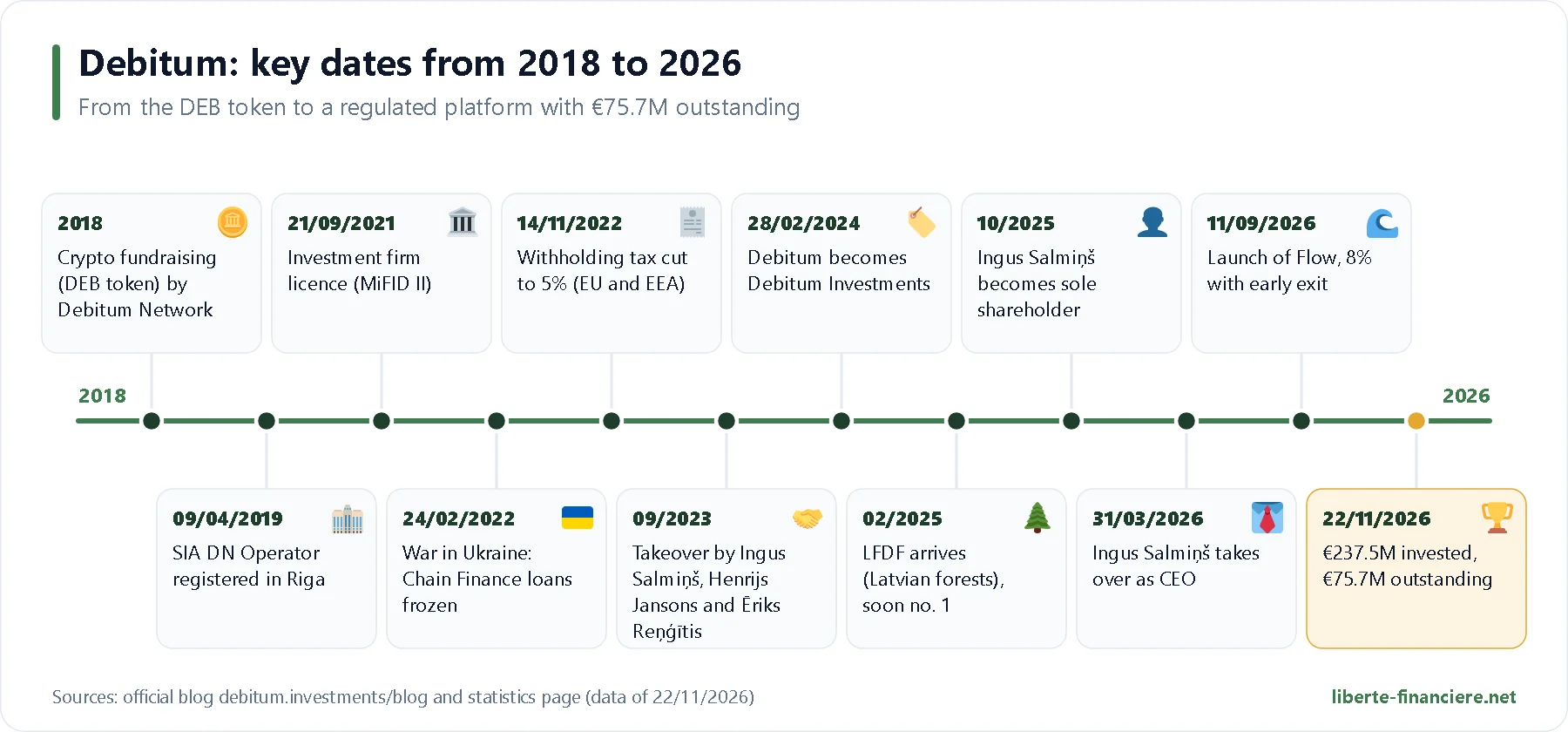
The history of Debitum falls into three eras: the founders and cryptocurrency (2015-2023), the takeover and regulation (2023-2024), then the Latvian forests (since 2025). The timeline below shows the key dates, which I then go through in detail.
 The early days: from factoring to the DEB token
It all starts in 2015 with a Baltic factoring company, Debifo, created by three founders, including Mārtiņš Liberts. In 2017-2018, they launch Debitum Network, a plan for an SME financing platform backed by a cryptocurrency, the DEB token, sold during a cryptocurrency fundraising in 2018. Like most projects of that wave, the token collapsed and its buyers lost most of their stake. This is the dark spot in Debitum's prehistory: it explains why its name still raises suspicion among some investors, even though today's platform is a different company, regulated since 2021 and profitable since 2024.
The platform you use today is operated by another company, SIA DN Operator, registered on 9 April 2019. At the time of the 2023 takeover, Debitum stated in an official announcement that DN Operator had never issued DEB tokens or carried any debt towards their holders, and that the Bank of Latvia had asked for any service unrelated to its regulated activity to be removed from the platform: the use of DEB tokens was therefore cut off there. Legally, the page has been turned; reputation-wise, it leaves a few marks.
 2021-2022: the licence, then the war in Ukraine

On 21 September 2021, DN Operator obtains an investment firm licence from the Latvian financial authority, which has since become the Bank of Latvia. It is a turning point: the platform gradually stops selling simple claims and starts offering financial instruments, first ABS from February 2022, then Notes in 2024. The investment robot has to be rebuilt, which slows growth for two years.
On 24 February 2022, war breaks out in Ukraine. One partner, Chain Finance, financed Ukrainian car loans through a local company, Motor Finance. Martial law blocks any money transfer out of the country: these loans are frozen. In July 2023, a Debitum subsidiary, DN Funding Alpha, takes over the commitments of Chain Finance towards investors, with a plan to repay the capital after the end of martial law and interest reduced to 3% a year. These assets now represent 0.84% of the amounts invested on the platform: they are not counted as lost, but they have not been recovered either.
 2023-2024: the takeover and the reset
On 7 July 2023, control of DN Operator changes hands: the CEO at the time, Henrijs Jansons, and businessman Ingus Salmiņš buy the platform, joined by Ēriks Reņģītis; the Bank of Latvia approves the deal in September 2023. Founder Mārtiņš Liberts leaves the management board. The new owners raise the share capital from €390,000 to €750,000, shorten the terms, add daily interest, relaunch Auto Invest and rename the platform Debitum Investments on 28 February 2024.
 2025-2026: the era of Latvian forests
In February 2025, a new bond issuer arrives: LFDF (Latvian Forest Development Fund), a buyer of Latvian forests. Within a few months, it becomes by far the platform's largest partner. The outstanding portfolio doubles in 2025, from €27.4M to €53.2M, then exceeds €75M in November 2026. At the same time, Debitum's ownership narrows: at the end of 2025, Ingus Salmiņš buys out Ēriks Reņģītis's shares and becomes the sole shareholder, then takes over management himself on 31 March 2026. 2026 also sees the birth of Flow, an 8% product with early withdrawal, and, on 12 November, a shorter new name, "Debitum", with a new logo.
 Who runs and who owns Debitum?
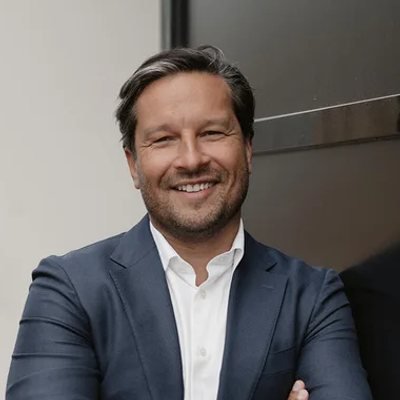 Ingus Salmiņš (LinkedIn) is both the owner and the boss of Debitum. A graduate of the Executive MBA of the Stockholm School of Economics in Riga, he spent more than eight years in corporate banking at Citadele (2005-2014), then was commercial director of the Latvian post office (2014-2016) and director of the energy efficiency programme at ALTUM, the Latvian public financing institution (2016-2019). A shareholder since 2023, he was chief risk officer before buying the last shares in October 2025. He now holds 100% of DN Operator via his holding company SIA ZIdea, and he took the position of CEO on 31 March 2026.
What stands out is the merry-go-round of bosses: four CEOs since 2023. Henrijs Jansons runs the platform until June 2024, then Ēriks Reņģītis succeeds him. In October 2025, Anatolijs Putna, until then chief operating officer, takes over, before leaving in spring 2026. Debitum presents these changes as a planned transition; above all, they show that the platform now rests on a single man, who is at once shareholder, manager and former head of risk.
The official team page shows a three-person management board and a small team:
Ingus Salmiņš, chairman of the management board and CEO;
Justīne Birkova (LinkedIn), board member, in charge of anti-money laundering;
Andis Rožkalns (LinkedIn), board member and chief risk officer since March 2026, coming from an international construction group;
Kalvis Bambals (LinkedIn), appointed head of compliance and legal in March 2026; yet his LinkedIn profile does not mention Debitum and presents him as a partner at Nordant since July 2026;
Sarmīte Dārziņa (LinkedIn), accounting;
Roman Shedlovskiy (LinkedIn), growth;
Dāvis Ziediņš (LinkedIn), business development;
Ieva Pastare (LinkedIn), brand and communication.
According to its 2025 annual report, the company had more than 15 employees at the end of 2025, with part of the IT development outsourced to contractors. It also owns eight subsidiaries: seven DN Funding companies (Alpha to Eta) that issue the ABS, and "DN Trustee", which holds the collateral on behalf of investors. The most important point for you is in the Latvian register: Sandbox Funding, the platform's second-largest lender, has also been 100% owned by SIA ZIdea since April 2026, and shares the same address as Debitum. The owner of the platform is therefore also the owner of one of the lenders it assesses and whose securities it sells. Debitum acknowledges this on the Sandbox page ("linked by governance arrangements"), and its conflict of interest prevention policy covers this case; I come back to this point in the partners section.
 How does Debitum work?
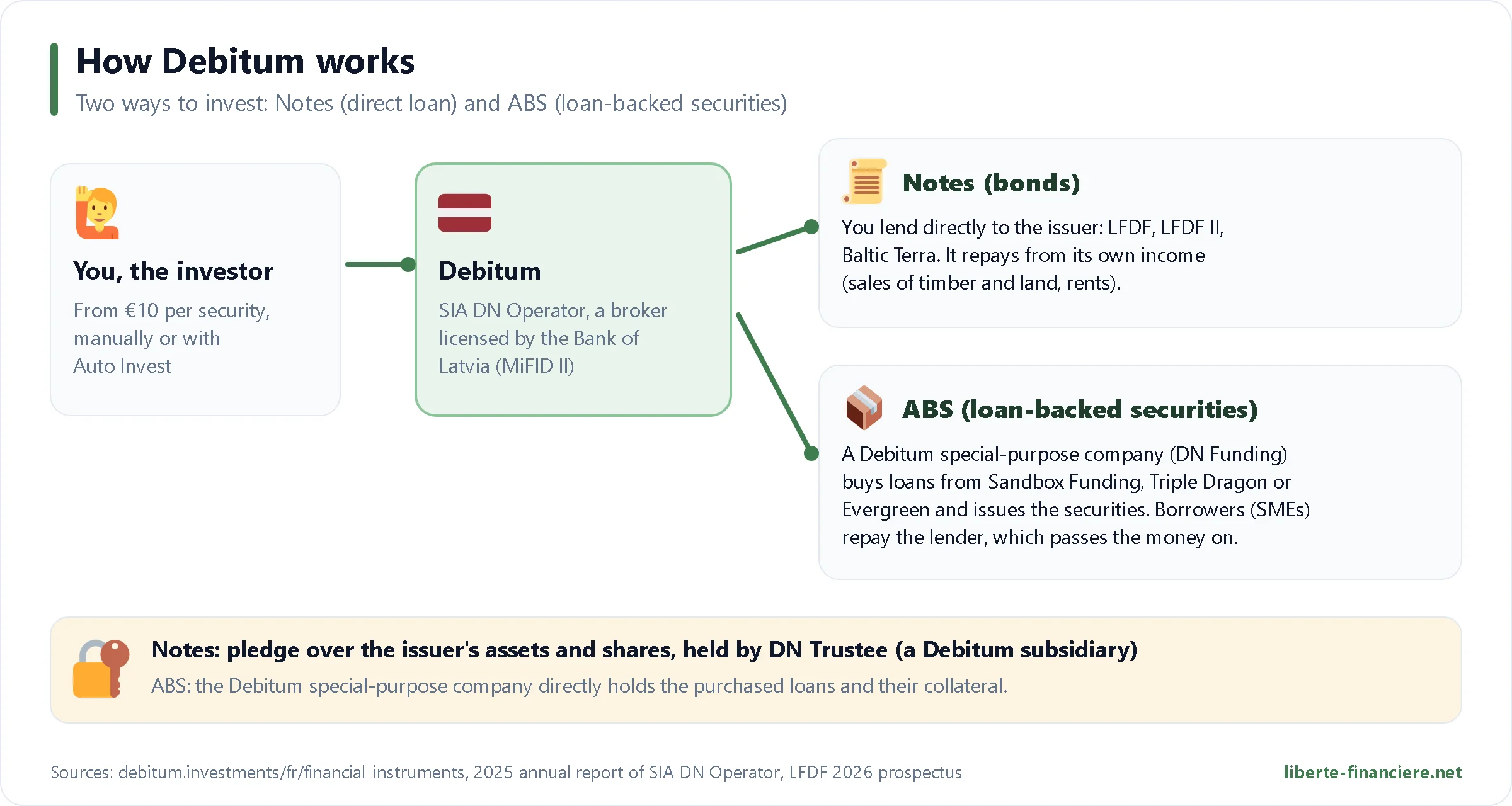
On Debitum, you don't buy a share of a loan as on a classic marketplace: you buy a financial instrument, with its own ISIN code, issued under a prospectus approved by the Bank of Latvia and registered with Nasdaq's Baltic central securities depository. Debitum acts as a broker: it selects the issuers, places their securities with investors and earns commissions paid by those issuers (€2.41M in 2025). You pay nothing. There are two families of securities, with very different risk logic.
Notes: you lend directly to a company
A Note is a bond: the company borrows directly from investors to finance its own business, and repays you from its own revenue. This is the case for LFDF and LFDF II (forests) and Baltic Terra (farmland), which together make up more than 82% of the outstanding portfolio. The risk is simple to understand: everything depends on the health of that single company and the value of the assets pledged as collateral. There are no borrowers behind it, and no buyback by a third party: if the issuer cannot pay, nobody else will pay in its place.
 ABS: securities backed by a bundle of loans
An ABS (asset-backed security) is issued by a dedicated company owned by Debitum, for example DN Funding Zeta for Sandbox Funding. This company buys a batch of at least five loans granted to SMEs by a partner lender, then issues securities that you buy. The borrowers repay the lender, who passes the money on to the dedicated company, which pays you. The lender keeps part of the risk and commits to buying back any loan more than 90 days late. This is the model of Sandbox Funding, Triple Dragon and Evergreen Capital.
 The trust score: A, B or C
Each partner receives an internal trust score, from A to C, meant to reflect its probability of insolvency over twelve months. It combines portfolio quality, financial ratios, structure and management, lending rules and recovery capacity. To date, LFDF and Baltic Terra are rated A, Sandbox Funding B+ and Triple Dragon C. It is a useful benchmark, but it is an in-house rating, calculated by a platform that is paid by those same partners: I prefer to look at their accounts myself, which I do further down.
 Monthly or daily interest, terms from 6 months to 3 years
Depending on the security, interest is paid every month or every day, and the capital is repaid at maturity (sometimes partly before). Terms range from six months (Triple Dragon) to three years (LFDF, Sandbox). Current offers are long: 23 to 35 months at LFDF, 18 to 36 months at Sandbox, 17 to 31 months at Baltic Terra. The longer the term, the higher the rate: count on 13 to 15.5% beyond two years, 10.5 to 12% around one year. Rates are fixed, and a loyalty bonus of 0.5 to 2% a year can be added (see below).
 Debitum's protections, and what they don't cover
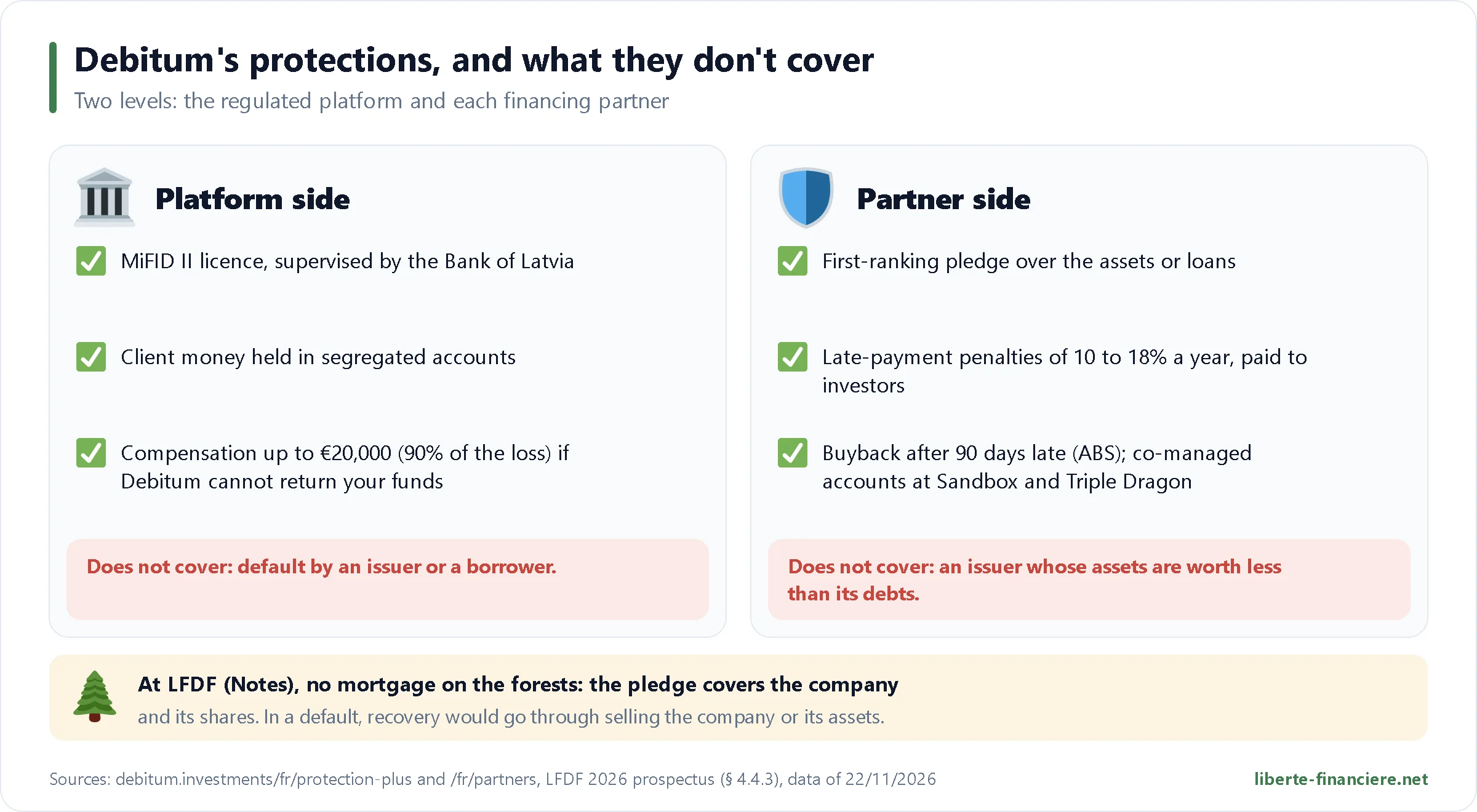
Debitum highlights several layers of protection. You need to clearly separate those that protect your money against a failure of the platform, which are solid, from those that protect you against a failure of an issuer, which depend entirely on the quality of each partner.
Platform side: regulation does the work
Like any licensed investment firm, Debitum must keep its clients' money in segregated accounts, separate from its own funds: in the event of bankruptcy, neither its creditors nor a liquidator can touch it. Your securities, for their part, are registered in your name. Debitum is also a member of the Latvian investor compensation scheme: if it were unable to return your money or your securities, for example after internal fraud, you would be compensated for 90% of your loss, up to €20,000. Be careful: this compensation only applies in the event of proven fault by the platform, never when an issuer or a borrower fails to repay.
 The first-ranking pledge
Each security comes with first-ranking collateral. For ABS, the dedicated company directly holds the loans purchased and their own collateral (commercial pledges, mortgages, guarantees). For Notes, a pledge covers all of the issuer's assets and its shares; it is held for investors by DN Trustee, a Debitum subsidiary. In the event of default, Debitum can have these assets sold, and investors are paid before the issuer and its shareholders.
There is a limit, written in black and white in the LFDF prospectus (§ 4.4.3): the forests are not mortgaged in favour of investors. The pledge covers the company and its shares, not the land directly. In the event of default, recovery would go through the sale of the company or its assets, which can take time and reduce the amounts recovered. The prospectus even states that, for unmortgaged land, investors could be treated as unsecured creditors.
 The 90-day buyback and late payment penalties
For ABS, the lender must buy back any loan that goes beyond 90 days late, with the remaining capital and interest, or replace it with a loan of the same risk. For Notes, the issuer is required to repay early if its security becomes non-performing; since it is the debtor, this clause only protects you if it still has money. During a delay, a penalty is added to the interest after a short grace period: 10% a year at LFDF, LFDF II, Baltic Terra and Sandbox, 15% at Triple Dragon and 18% at Evergreen, paid in full to investors. It is one of the rare cases where a delay can earn you more than expected.
 The share kept by the partner
Debitum asks each partner to keep 10 to 30% of the risk, so that it has an interest in choosing its borrowers carefully. In an ABS, this means it finances part of the loan batch itself. For a Notes issuer, this "share" shows up instead in its equity, and that is where the problem lies: at LFDF, equity represented about 8% of the balance sheet at the end of 2025. On Sandbox Funding and Triple Dragon, Debitum also monitors jointly managed bank accounts, which let it see every loan granted and every repayment.
Invest on a regulated platform MiFID II licence, segregated accounts and compensation up to €20,000 if the platform fails. |
 The financing partners and their accounts
Debitum has worked with 23 partners since 2018; sixteen have left, and the platform states that all of them repaid investors' capital and interest in full. There are six active ones left, plus DN Funding Alpha, which carries the Ukrainian assets. That is very few, and very concentrated: on 20 November 2026, Latvian land (forests and farmland) carried 82% of the €74.6M outstanding. All the balance sheets are in my balance sheet analysis tool, and the breakdown by country on my P2P map.
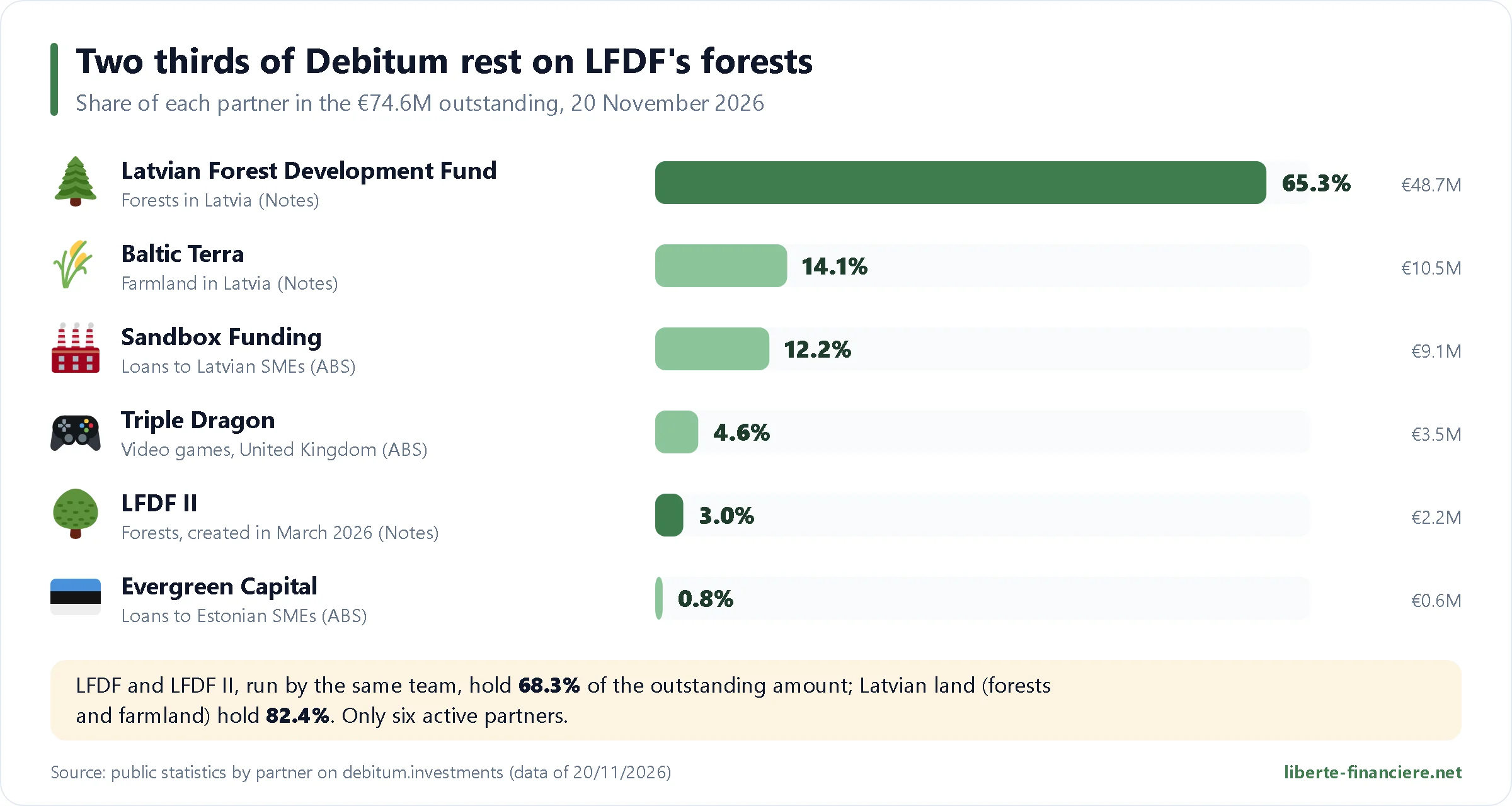
Latvian Forest Development Fund: 65% of the outstanding portfolio
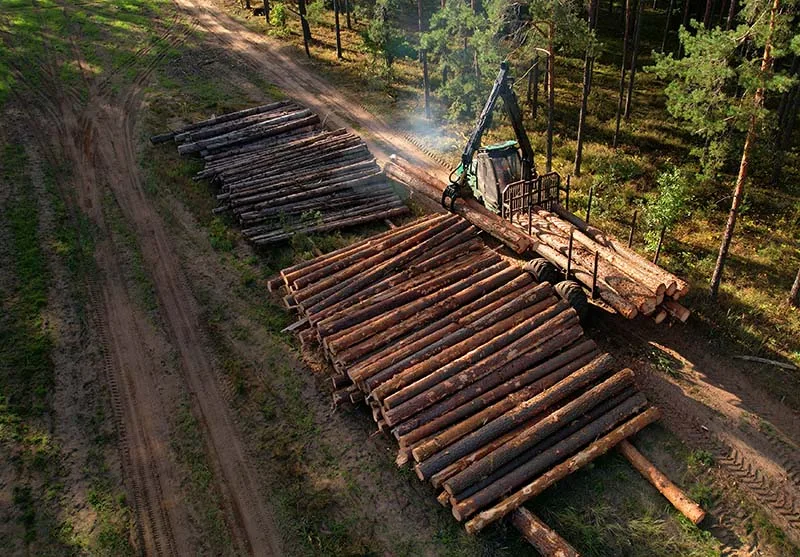
Behind the English name is SIA Latvijas Meža Attīstības Fonds (no. 40203475516), created on 6 April 2023 in Riga. It buys forests and farmland in Latvia, often small plots, to resell them at a higher price, operate them (selective felling, firewood) or split off the agricultural parts. In 2025 alone, it bought 659 properties for €33.3M, and its portfolio exceeded 7,000 hectares in August 2026. It has only four employees and two managers: Edgars Birks, CEO since August 2025, former head of forestry operations at SCA in Latvia, and Gatis Melderis, a forest valuation specialist. Its sole owner is Jānis Upenieks, via his company Intelligent Innovations; he was economic adviser to the Latvian Prime Minister and parliamentary secretary at the Ministry of Economics, according to Debitum.
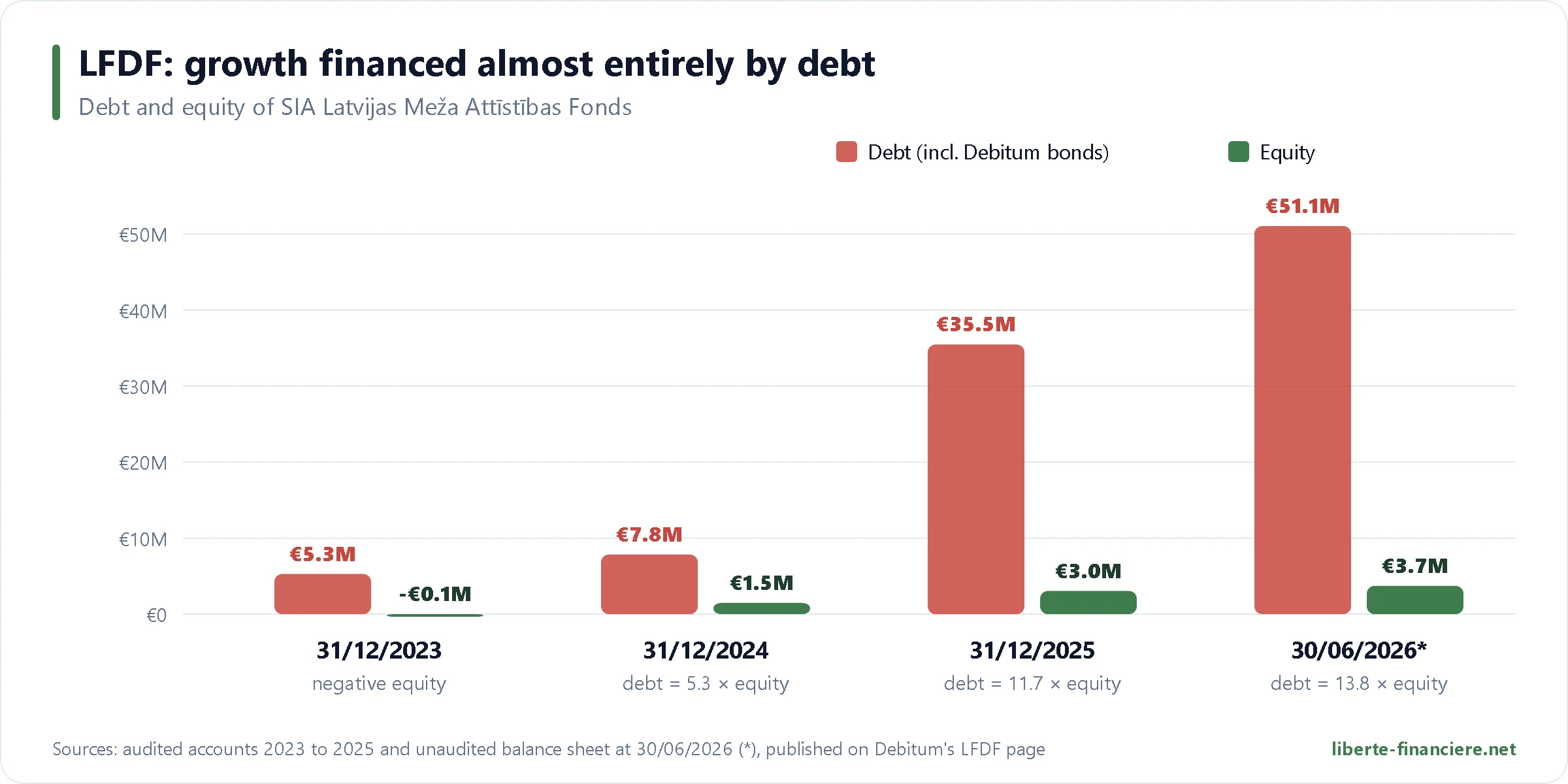
The figures show meteoric growth, financed by debt. In 2025, LFDF placed about €32.3M of bonds via Debitum. Its 2025 accounts, audited without qualification by S. Vilcānes audits, show €10.8M in revenue, €1.56M in profit, €38.5M in assets, but also €35.5M of debt for €3.0M of equity: 11.7 times more debt than equity, a ratio that the prospectus itself flags as a risk. Above all, at the end of 2025, the company had only €123,000 in cash against €22M of debt due within a year. As of 30 June 2026, its unaudited balance sheet shows €51M of debt for €3.7M of equity and €43M of land in stock.
In practice, LFDF repays its bonds by selling land and issuing new bonds: in the first half of 2026, it issued €24.6M and repaid €13.8M. As long as new investors keep arriving and the land keeps selling, the machine runs, and it has met all its commitments to date: €29.8M already repaid to Debitum investors, without a single day's delay. On my side, 54 of my LFDF positions that reached maturity returned €14,174 of capital to me, all on time. But if new subscriptions slowed sharply, or if the Latvian forest market turned, a company this indebted and with so little cash would have little room for manoeuvre.
Are LFDF's forests worth what they cost?
LFDF paid a little more than the Latvian average for its forests (about €5,700 per hectare, against €4,000 to €5,000 according to Debitum itself);
it bought at least €24M of forests from JUNO, its former parent company, which is also its largest customer;
Debitum published a clarification on these prices, backed by an independent valuation of one plot;
the forests are not mortgaged in favour of investors: the collateral goes through the shares of LFDF.
This is the real question, since the whole strength of LFDF rests on its land. In its audited 2025 accounts, LFDF records its forests at their purchase price (as inventory, at cost or at resale value if lower), with no revaluation. At the end of 2025, they were booked at €36.8M, for 6,430 hectares spread over 659 properties: about €5,700 per hectare. According to the prospectus, the portfolio reached €44M for more than 7,600 hectares in June 2026, still around €5,800 per hectare.
Yet, in a clarification published on 26 March 2026, Debitum itself estimates the average price of a Latvian forest at between €4,000 and €5,000 per hectare (about €2,500 for a clear-felled plot). LFDF therefore paid 15 to 45% more than this average for its forests. That is not necessarily abnormal: a forest rich in mature timber is worth more than a young plantation. But nobody can check it from the outside, because LFDF publishes neither the split of its purchases between land, standing timber and costs, nor an overall valuation of its portfolio.
The second point to know concerns where the forests come from. LFDF bought at least €24M of forests from the company JUNO, its former parent company: €14.7M between April 2024 and June 2025, then €9.26M in the first half of 2026, more than half of its portfolio. JUNO has not been a shareholder since 7 January 2025, but the same executive sat on the boards of LFDF, its shareholder and JUNO until 10 July 2026, and Debitum acknowledges this link. JUNO is also LFDF's largest customer: out of €11.4M in revenue in the first half of 2026, €8.54M of sales went to JUNO, three quarters of the total. LFDF's attractive margin (41% gross margin in 2025, 34% in the first half of 2026) is therefore made mostly with the company that sells it its forests. Nothing here is forbidden, and these links are disclosed; it's simply that sales between related companies don't tell you what the land would be worth to an independent buyer.

In that same clarification, Debitum explains why the prices paid by LFDF often exceed those shown in the Latvian land register: the register usually shows only the price of the land, while the standing timber is sold under a separate contract, which is not recorded there. To back this up, LFDF had one of its plots valued by the Latvian firm Latio: €30,000, of which €8,700 for the land and €21,300 for the timber, i.e. €6,976 per hectare, against €1,422 per hectare visible in the register. The explanation holds up, because in Latvia most of a forest's value is often in the timber. To date, Debitum has not published the timber purchase contracts or a valuation of all the forests. No irregularity has been demonstrated, and LFDF has always repaid on time.
One last point, useful to know if things go wrong: in its clarification, Debitum states that the Notes are secured by a first-ranking pledge over all of LFDF's assets, forests included. The prospectus is more cautious (§ 4.4.3 and 4.4.4): the collateral is a pledge over movable property and over the shares of LFDF, which creates no direct security over the real estate, and in the event of bankruptcy, investors "may be treated as unsecured creditors" for the land. To recover the value of the forests, you would have to go through seizing the company's shares, which can take time and reduce the amount recovered. LFDF's CEO argues that a forest gains about 7% in value a year, thanks to tree growth, which is plausible. As long as no overall valuation is published, you simply have to accept a degree of trust in these prices.
 LFDF II: the next step, with subordinated securities
Created on 26 March 2026 by the same team, LFDF II is a separate company that buys new forests while LFDF manages its existing portfolio. It carries 3% of the outstanding portfolio (€2.2M) and, together with Baltic Terra, serves as the underlying for Flow. Important point: its first Notes are "Junior Series", meaning subordinated. If senior securities are issued later, they will be repaid before you, including if the collateral is sold. The rates offered (10.5 to 11%) are lower than LFDF's, and the company has no track record yet.
 Baltic Terra: farmland
SIA Baltic Terra Capital (no. 40203653737), created on 4 June 2025 and owned by Jānis Lezdis, buys poorly farmed or fragmented agricultural land, restores it (drainage, access, legal regularisation) and leases it to local farmers, with a target of 10,000 hectares. It carries 14.1% of the outstanding portfolio (€10.5M). Its first accounts, audited by Forvis Mazars, cover only seven months of 2025, before most of its issues: there is therefore still little hindsight. The rate offered ranges from 12.5 to 14.5%.
 Sandbox Funding: the owner's lender
SIA Sandbox Funding (no. 40203473712), created on 30 March 2023, lends to Latvian SMEs against solid collateral: commercial pledges, receivables, mortgages on real estate and land. It is the only partner that combines a retained share, a 90-day buyback and co-managed accounts. It has financed €48.7M on Debitum, of which €39.2M has already been repaid, and carries 12.2% of the outstanding portfolio. Its accounts remain modest: €449,000 of equity at the end of 2024, €638,000 at the end of September 2025, for more than €4M of loans.
As mentioned above, Sandbox belongs to the same shareholder as Debitum. The 90-day buyback therefore relies on a company whose owner is also the owner of the platform that controls its enforcement. It is not illegal and it is disclosed, but it is exactly the kind of link that made me reduce my position, as I explain below.
 Triple Dragon: video games, in decline
Triple Dragon finances video game studios and advertisers based on their receivables from Apple, Google or ad networks, via a dedicated company created for Debitum investors. It is historically the largest partner (€37.6M financed since 2020, 91% already repaid), but it now carries only 4.6% of the outstanding portfolio and only offers 6-month securities at 11.5%. Its trust score has been lowered to C, and the group now mostly finances itself on its own platform, which I cover in detail in my Triple Dragon review.
 Evergreen Capital: Estonian SMEs
Evergreen Capital is an Estonian lender created in 2013 that finances small businesses against the personal guarantee of their managers. Profitable (€225,000 in profit in 2025 for €966,000 of equity), it now accounts for only 0.8% of the outstanding portfolio, with securities at 7.5% over ten months. Its 2023 and 2024 accounts were only subject to a limited review, not a full audit.
 The lender strength score: 1.88 out of 5
In my P2P comparison tool, each platform receives a strength score calculated from the balance sheets of its lenders, weighted by their share of the outstanding portfolio. Debitum scores 1.88 out of 5 for its lenders, against 2.66 for Income Marketplace or 2.42 for Lande Finance. LFDF is rated 1.91, Baltic Terra 2.65, Sandbox 1.49 and Triple Dragon 0.30. LFDF's score actually rests on a single representative balance sheet, the 2025 one: the 2023 and 2024 accounts concerned a company that was still borrowing very little via Debitum.
 Statistics, delays and defaults
Debitum's statistics page is one of the most complete on the market: amounts invested, outstanding portfolio by partner, status of securities, investors' countries. On 22 November 2026, it showed €237.48M invested since launch, €75.7M outstanding, €17.8M of interest paid, 35,788 registered investors and a historical XIRR of 14.83%.
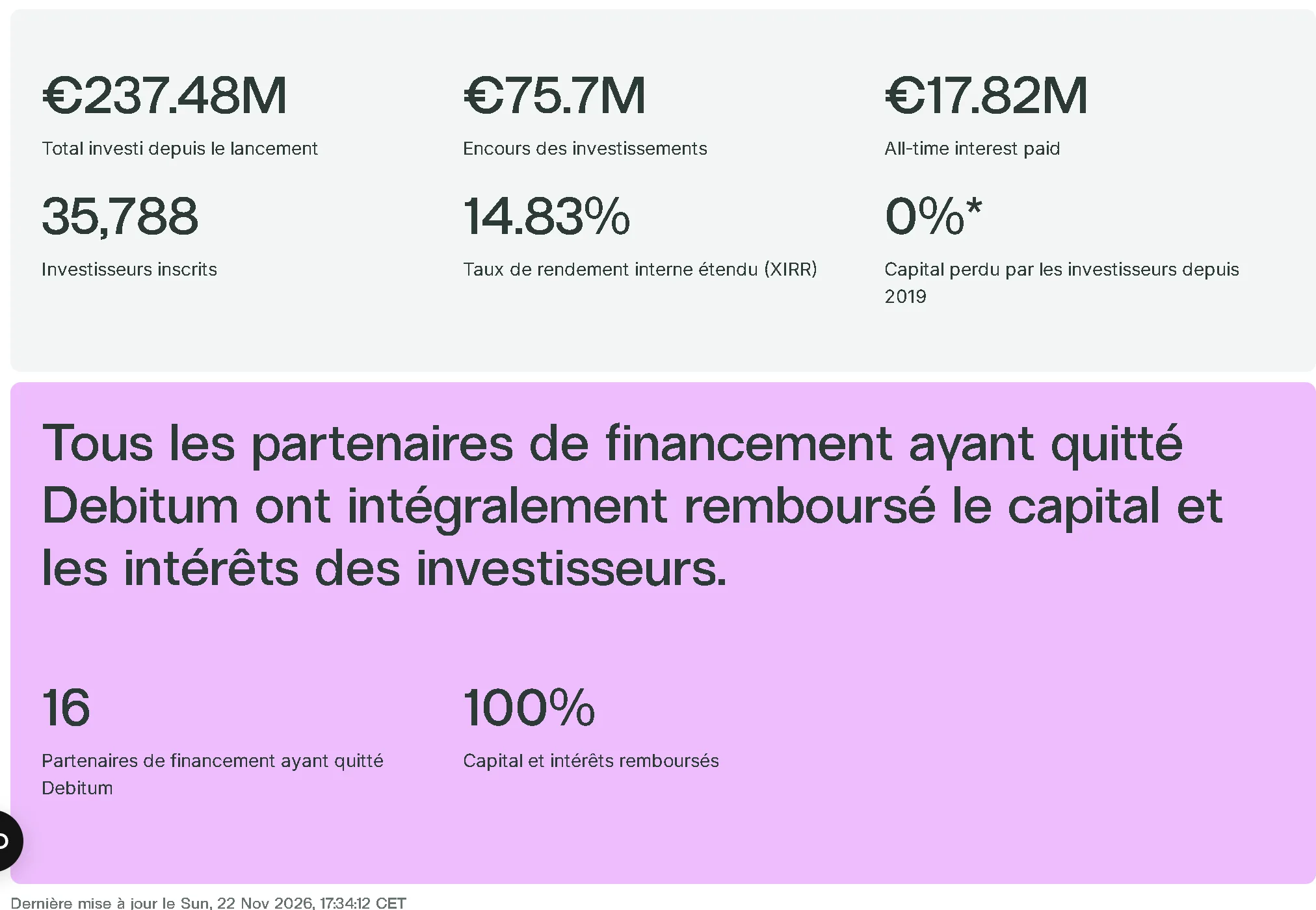
On quality, Debitum shows 0% of capital lost by investors since 2019 and €0 late on the current outstanding portfolio. Two nuances: the asterisk refers to the restructured Ukrainian assets (0.84% of the amounts invested), and the 2025 annual report states that 2.39% of repayments that year arrived late (7.10% in 2024), with penalties paid to investors. So delays do exist, and they are caught up. Growth, for its part, has accelerated since the takeover: the number of registered users has tripled since the end of 2023.
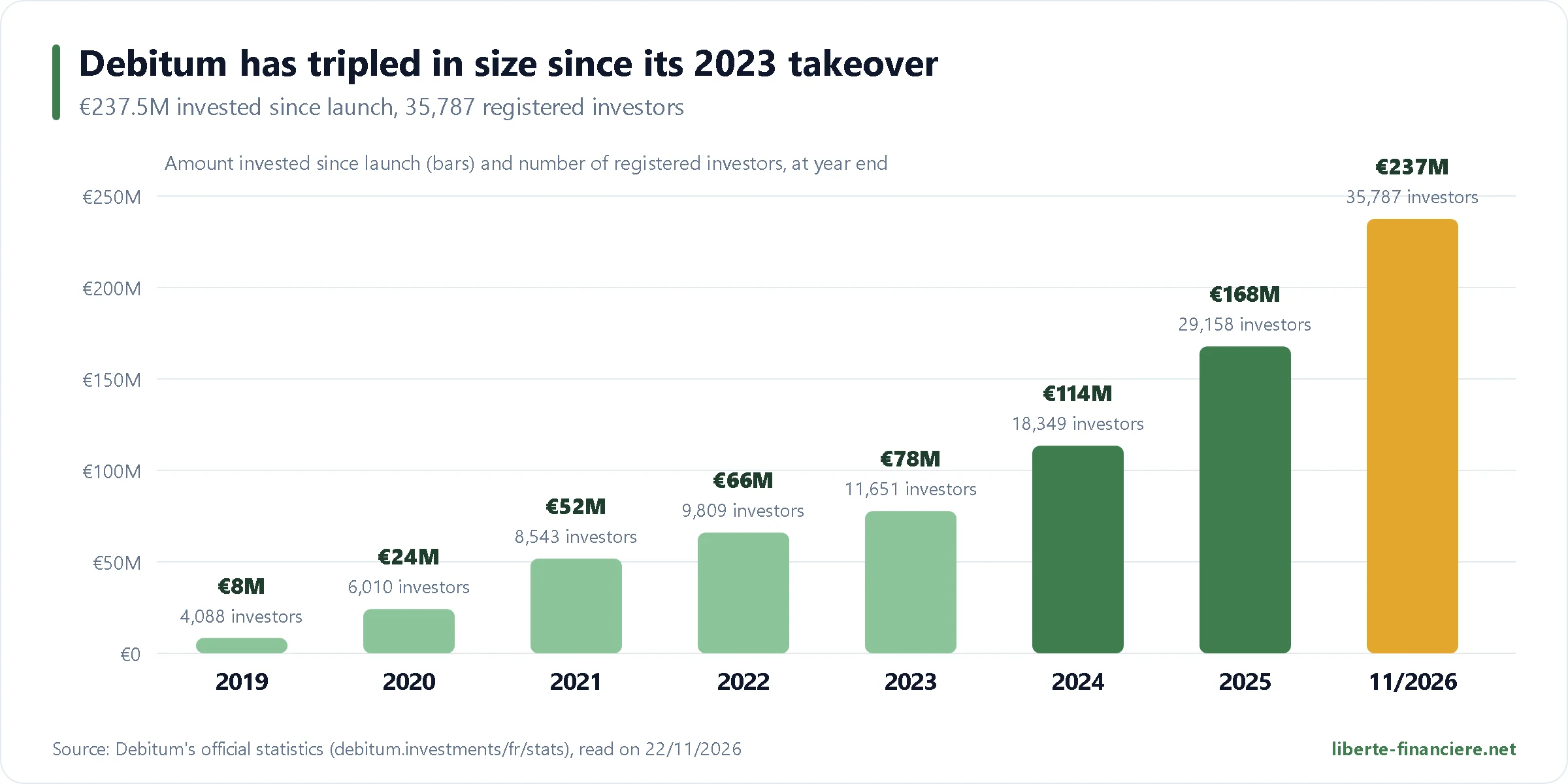
Investors come mainly from Germany (30.8%), Spain (12.6%), Portugal (10.5%) and Lithuania (9.7%); the French come fifth with 8.9%. In 2025, they deposited €31.8M on the platform and withdrew €10.0M. Debitum publishes a monthly update on its blog: in October 2026, €6.47M was invested and €828,000 of interest paid.
Regulation: what the MiFID II licence changes
SIA DN Operator is an investment firm licensed by the Bank of Latvia (licence no. 06.06.08.728/537) since 21 September 2021, extended to portfolio management in December 2024. It falls under the European MiFID II directive, the same framework as stockbrokers, and not under the European crowdfunding regulation (ECSP) like most lending platforms. Since 2025, it can offer its services in France, Germany, Spain, Italy, the Netherlands, Belgium and Austria.
For you, this changes several concrete things: capital requirements (share capital has reached €818,000 since September 2026), accounts audited every year, vetting of every new manager and shareholder by the regulator, segregation of client funds, compensation up to €20,000 and a suitability questionnaire before investing. Every issue of Notes or ABS goes through a prospectus filed with the Bank of Latvia. In 2024 and 2025, Debitum also obtained the best taxpayer rating (A) from the Latvian tax authority.
But the licence governs the platform, not the quality of the issuers: the regulator checks that the prospectus is complete, not that the investment is good. Nor does MiFID II prohibit a shareholder of the platform from owning an issuer, as long as the conflict of interest is disclosed and managed. To date, no sanction by the Bank of Latvia against Debitum has been published.
 Debitum's accounts: profitable since 2024
This is the platform's strong point. After losses from 2021 to 2023, SIA DN Operator has been profitable since 2024. In 2025, its commissions reached €2.41M (+85%) and its profit €507k, with €1.04M of equity, €378,000 in cash and accounts audited without qualification by BDO. Only the auditor's opinion on the 2022 financial year contained a qualification.
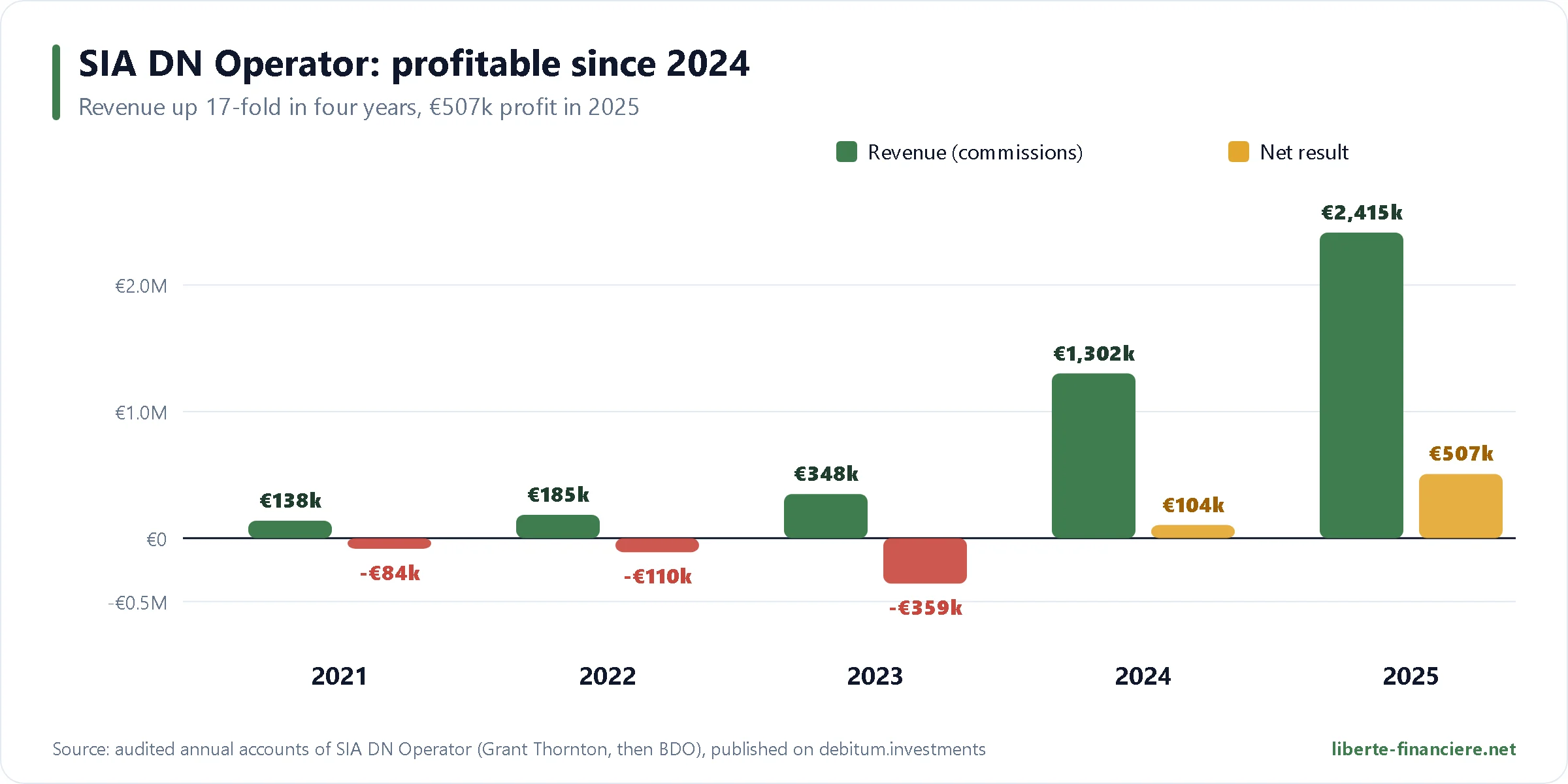
In my balance sheet analysis tool, Debitum gets a strength score of 2.89 out of 5 for the platform itself, one of the best in my comparison tool, ahead of Mintos or Swaper and far ahead of Income Marketplace, which is still loss-making. A profitable platform doesn't need to chase issuers at any cost to survive, which is reassuring. Its dependence on LFDF, which accounts for two thirds of the outstanding portfolio and therefore a large share of the commissions, is less so.
 Opening a Debitum account step by step

Signing up takes less than 5 minutes, then verification usually takes less than a day. You must be of legal age and have a bank account in your name; residents outside the European Union and companies are accepted.
Create your account with my link: email address, password, country of residence.
Verify your identity with an ID card, a passport or, since July 2026, a residence permit, then take a selfie.
Answer the suitability questionnaire, cut down to 19 questions in 2025: it is required by MiFID II to check that you understand the risks.
Make a first deposit. It is a standard SEPA transfer, from an account in your name, which registers that account for your future withdrawals; card, Apple Pay or Google Pay payments and online banking payments are credited faster, but do not validate the account.
Enable two-factor authentication in your settings, then invest manually or with Auto Invest.
A detail few people know: each account has a deposit limit set according to your answers (€12,000 in my case). To go beyond it, Debitum asks you to prove the source of your funds (payslips, statements, sale of an asset). It is an anti-money laundering obligation, not a trap, but it is better to know before sending a large sum.
 Investing manually or with Auto Invest
On the Invest page, each partner presents its available securities with the rate, remaining term, trust score, type (Note or ABS), late payment penalty and documents: prospectus, final terms, key information document. You can invest from €10 per security. Auto Invest, for its part, places your money on its own according to your rules.
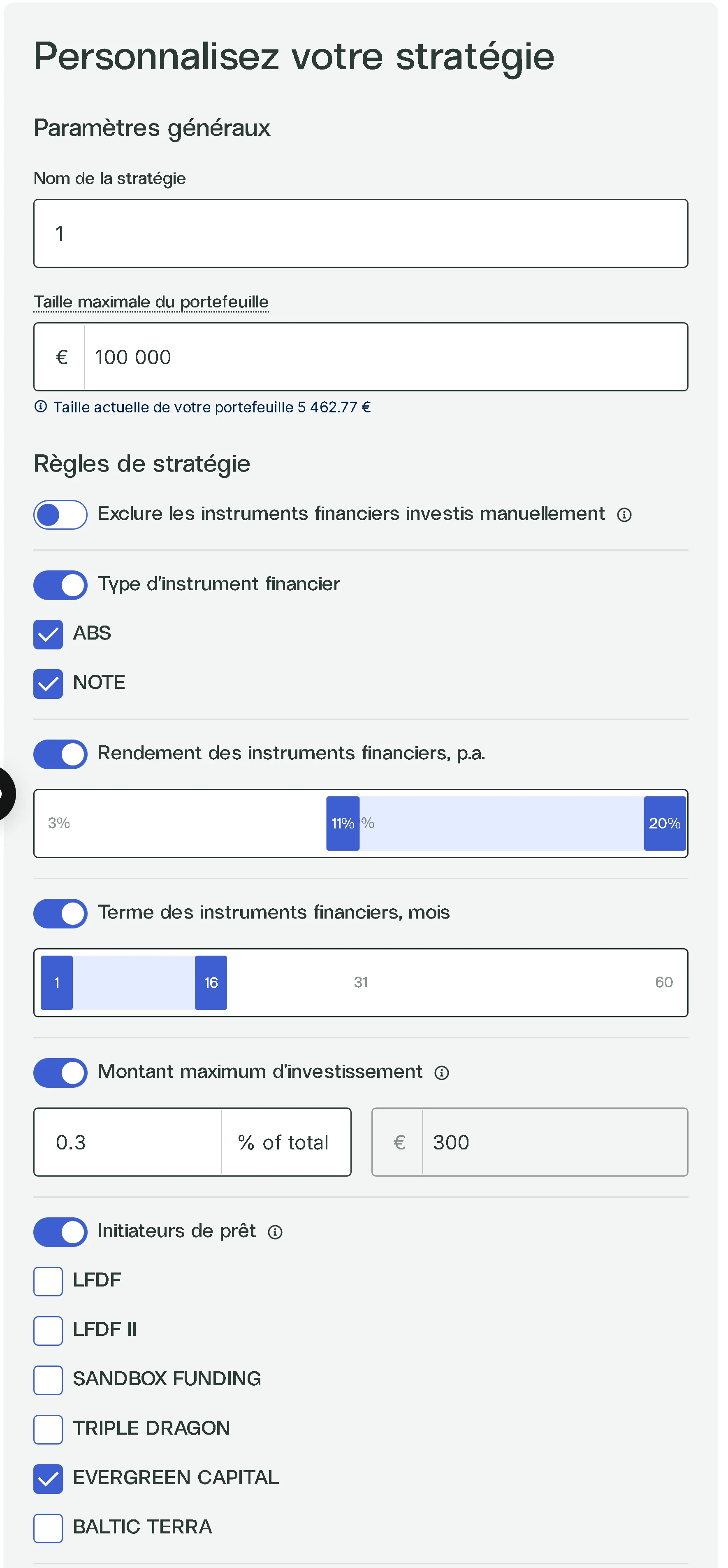
There you choose a maximum portfolio size, the type of security (ABS, Notes or both), a range of rates and terms, a maximum amount per security (in euros or as a percentage of the portfolio), the partners selected, a minimum balance to keep uninvested, and even an automatic withdrawal of repayments to your bank (reserved for accounts over €10,000). It is simple and effective. My approach: tick the partners one by one rather than accepting everything, because it is the only real diversification lever on Debitum.
 Debitum Flow: 8% with an exit door
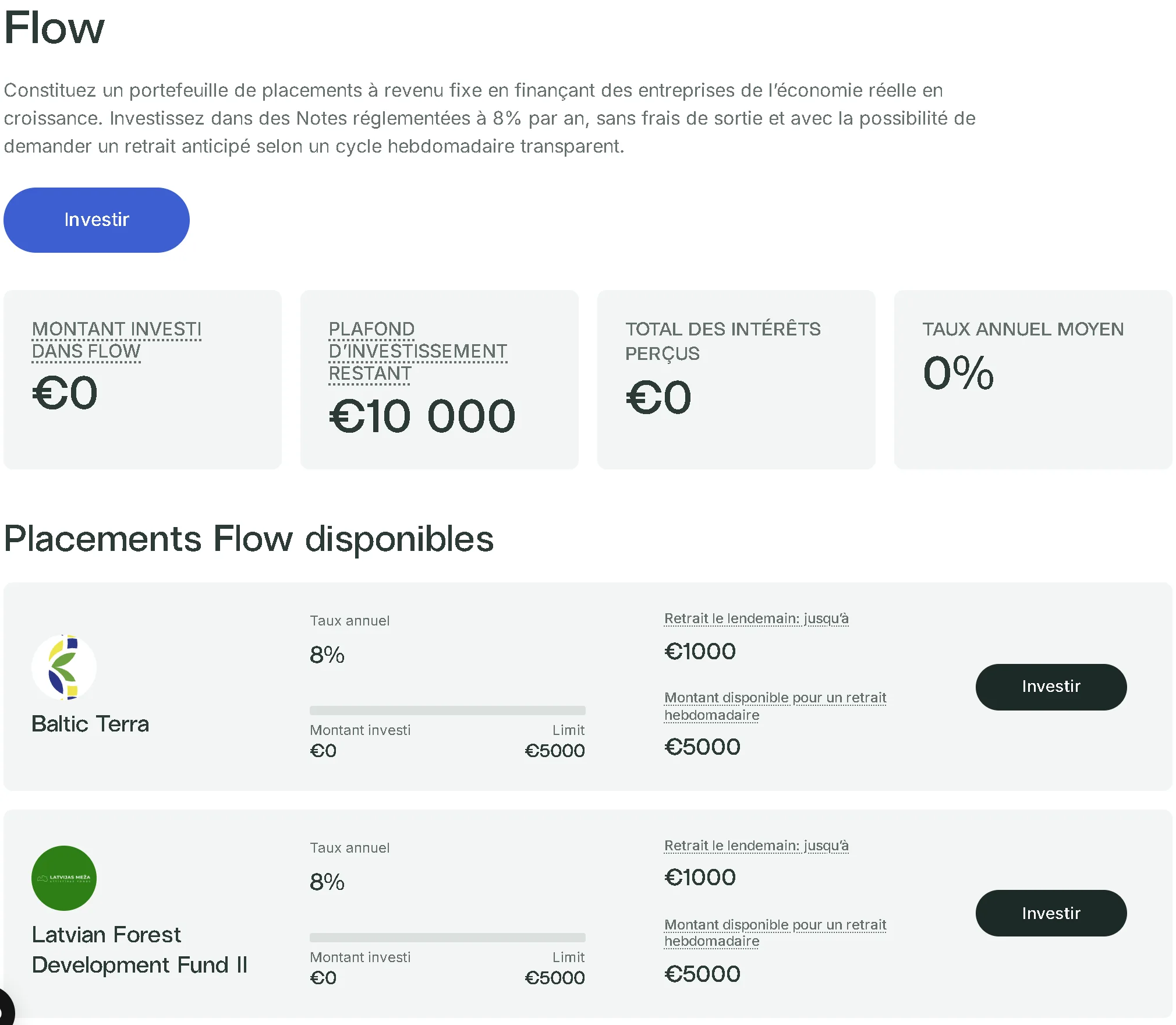
Launched on 11 September 2026, Flow answers the main criticism of Debitum: the lack of liquidity. You invest in five-year Notes from Baltic Terra and LFDF II, at 8% a year with interest paid every day, and you can ask to exit whenever you want, at no cost. The product passed €2M in a month and a half.
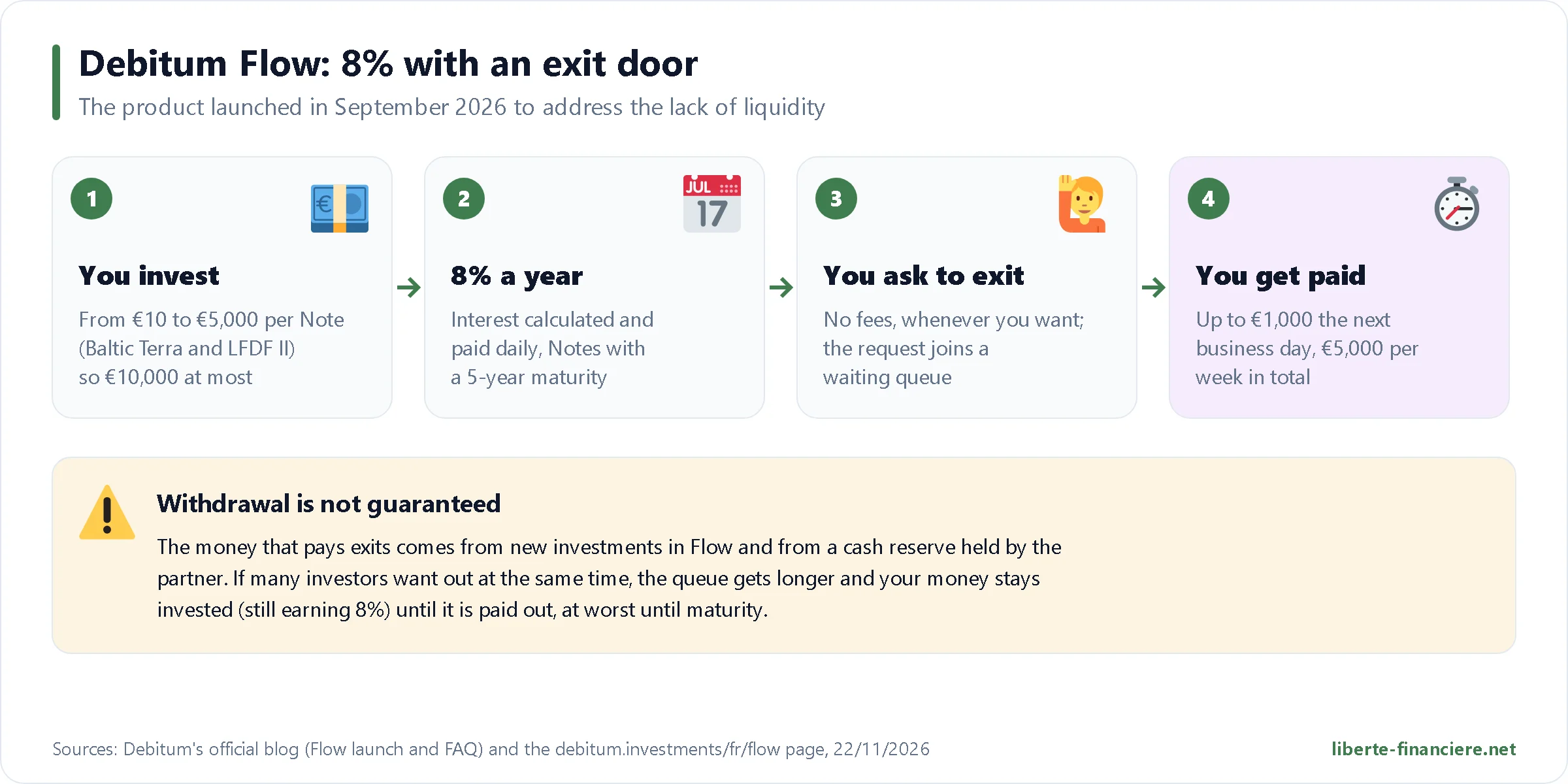
The rules are precise (official FAQ): from €10 to €5,000 per Note, so €10,000 at most; up to €1,000 paid out the next business day and €5,000 per week in total; requests handled in order of arrival. The money that pays for exits comes from new investments in Flow and from a liquidity reserve held by the issuer. The withdrawal is therefore not guaranteed: if many investors want to exit at the same time, the queue gets longer. Your money then keeps earning 8% while it waits, but it may remain locked until maturity, in five years.
My view: 8% for a product backed by Latvian land with a possible exit is attractive on paper, but you take on the risk of LFDF II (subordinated securities, a company only a few months old) and of Baltic Terra, for a lower rate than their classic Notes. Flow investments count towards reaching a loyalty level, but do not receive the loyalty bonus. I have not invested in it.
 The loyalty programme and referrals
Since October 2025, Debitum has rewarded large accounts and referrers with a four-level loyalty programme. Your level depends on your outstanding portfolio or on the number of friends referred over twelve months. The bonus is added to the rate of new investments made on the Invest page, until their maturity.
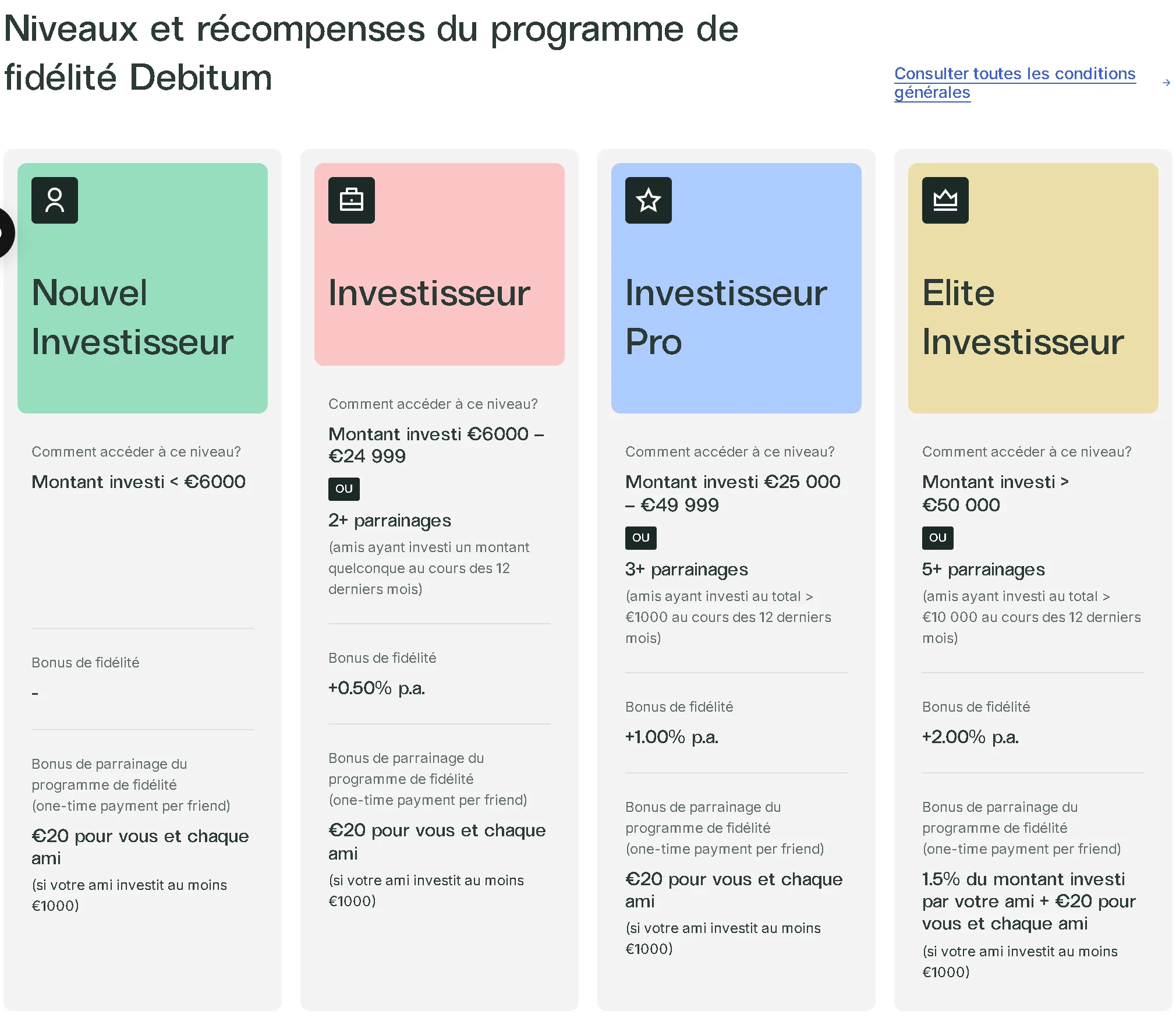
Level | Outstanding invested | or referrals | Loyalty bonus |
|---|---|---|---|
New investor | Less than €6,000 | - | - |
Investor | €6,000 to €24,999 | 2 friends | +0.5% a year |
Pro Investor | €25,000 to €49,999 | 3 friends (more than €1,000 invested) | +1% a year |
Elite | More than €50,000 | 5 friends (more than €10,000 invested) | +2% a year |
Referrals earn €20 for you and for your friend as soon as they invest at least €1,000 within their first 30 days, plus 1.5% of their investment at Elite level. Debitum also regularly runs cashback campaigns on certain securities, often on long terms; they are announced on the platform and on its blog. One last point: if your outstanding portfolio falls, you have ten days to reinvest before losing your level.
 Fees and liquidity
Debitum charges the investor no fees: none for opening an account, depositing (even by card), investing, withdrawing, or on an inactive account. Its price list only provides for fees on exceptional operations. Withdrawals of the available balance are processed within 3 business days, to a verified bank account.
The real constraint is liquidity. Debitum has no secondary market: you cannot sell a security to another investor before its maturity. With terms that now reach two to three years at LFDF and Sandbox, your money is locked up for a long time. The only early exit door is Flow, capped at €10,000 and with no guarantee. Debitum raised its capital in 2023 partly to launch a secondary market; three years later, it still doesn't exist.
Try Debitum from €10 No fees, monthly or daily interest, 1% cashback on your first 30 days with my link. |
 The risks you need to know

I am not a financial investment adviser; every investment carries a risk of capital loss, and past performance is no guarantee of future performance.
Capital loss. If an issuer goes bankrupt and its collateral is worth less than its debts, you can lose part or all of what you lent it. Neither Debitum nor the compensation scheme covers this case. Debitum details this in its risk document.
Illiquidity. With no secondary market, your money stays locked until maturity, up to three years. Flow offers a limited exit with no guarantee.
Geopolitical and concentration risk. 82% of the outstanding portfolio depends on Latvian land and 68% on the two LFDF companies. A downturn in the Baltic forest market or a regional crisis would hit almost the whole platform; the Ukrainian episode of 2022 showed that a war can freeze repayments for years.
LFDF risk. A heavily indebted company (11.7 times its equity at the end of 2025), with little cash, which repays partly thanks to new issues, with no mortgage on its forests, which buys and resells a large part of its land with its former parent company, and whose forest value has not been the subject of a published overall valuation.
Conflicts of interest. Debitum's owner also owns Sandbox Funding, and the platform, its dedicated companies and the security agent all belong to the same group. It is disclosed and regulated, but it reduces the independence of oversight.
Key person. A single shareholder, who became CEO, after four management changes in three years.
Tax and currency. No currency risk, everything is in euros; the 5% withholding is recoverable in France, but requires a correct tax return.
These risks don't mean Debitum is doing badly: the platform is profitable, regulated and no issuer is late. They mean that your real risk is not that of a diversified platform, but that of two or three Latvian companies. That is the basis on which I size my position.
 Debitum taxation in France
This section applies to French tax residents. Since 14 November 2022, Debitum has applied a 5% withholding tax on interest for residents of the European Union and the EEA (25.5% for Latvian and non-EU residents, according to Debitum). It is deducted automatically, with nothing to do on your side. Thanks to the tax treaty between France and Latvia, this 5% is creditable against your French tax: you don't pay twice. I explain the mechanism country by country in my guide to withholding tax in P2P.
In France, your interest is subject to the flat tax (PFU) of 31.4% (12.8% income tax and 18.6% social contributions), or to the progressive income tax scale if you opt for it. In practice: the 12.8% prepayment is declared every month with form 2778, unless you request the exemption (reference tax income below €25,000 for a single person, €50,000 for a couple). The following year, you report interest and withholding on form 2047, then on form 2042, and you declare your Debitum account on form 3916. Debitum provides an annual tax statement that you can download from "My balance". I went through every box in my video on form 2047 and in my guide to declaring your P2P income; if you want to save time, FlashFiscal fills in these forms for you.
To give you an idea, here is what €10,000 invested for three years at 12%, with interest reinvested, becomes before and after tax:
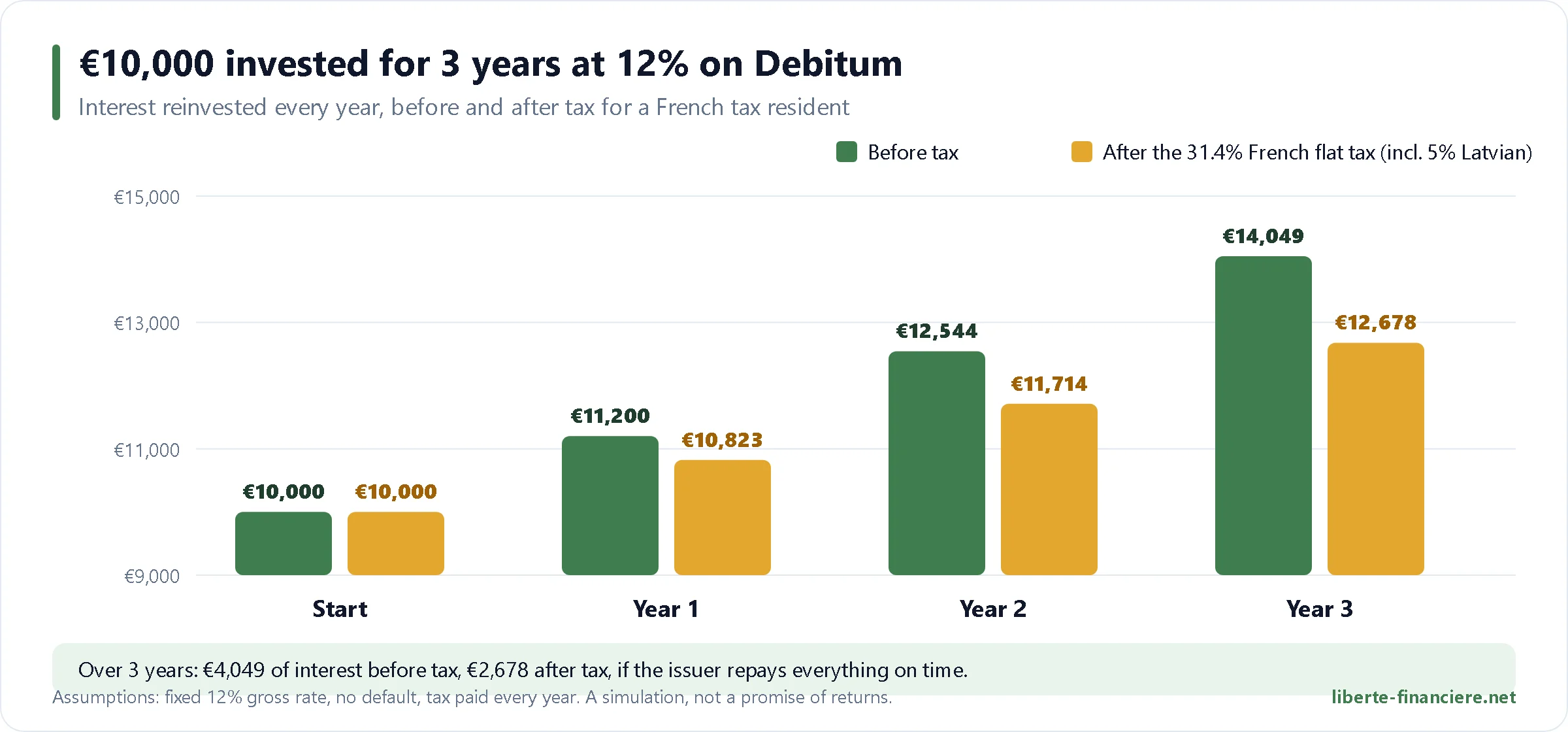
Over three years, €10,000 earns about €4,049 before tax and €2,680 after the flat tax, if the issuer repays everything on time. If you invest via a company, the 5% withholding does not apply and the interest is included in its taxable profit.
 Debitum vs Lande Finance, Income, Afranga and Nectaro
I compared Debitum with the platforms where I invest that also finance businesses or assets at 10-15%: Lande Finance, the other Latvian platform for farmland and forest land, Income Marketplace, Afranga and Nectaro. The returns are my real XIRRs excluding bonuses, calculated on all my transactions in November 2026.
Criterion |
|
|
|
|
|
|---|---|---|---|---|---|
Headquarters |
|
|
|
|
|
Regulation | MiFID II | ECSP | None | ECSP | MiFID II |
What you finance | Forests, farmland, SMEs | Loans secured by land or real estate | Loans from 14 lenders, Europe and Asia | Consumer loans | Loans from lending companies |
My XIRR excluding bonuses | |||||
Investment robot | Yes | Yes | Yes | No | Yes |
Withholding tax | 5% recoverable | 0% | 0% | 10% non-recoverable | 5% recoverable |
Strength score (balance sheets, out of 5) | 2.22 | 2.42 | 1.93 | 1.81 | 2.67 |
|

 Bulgaria
In this table, Debitum offers the second-best real return, behind Afranga, and ahead of Lande Finance, which finances similar assets at lower rates but with a secondary market. Its strength is the framework (MiFID II and profitable accounts); its weakness, the concentration on a single issuer. Income Marketplace, unregulated and still loss-making, offers in return real diversification across fourteen lenders; I cover it in detail in my Income Marketplace review. The strength score combines that of the lenders (two thirds) and that of the platform (one third): Debitum's is pulled down by LFDF and Sandbox, but supported by its own accounts.
 My experience after two years on Debitum
I opened my account and made my first deposit of €1,000 on 25 November 2024, then topped up in stages to €12,800 by August 2025. I first invested in Sandbox Funding, then mostly in LFDF from April 2025, always with Auto Invest and terms of about one year. Two years later, here are my figures, as of 22 November 2026:
Indicator | My Debitum account |
|---|---|
Money deposited | €12,800 (from November 2024 to August 2025) |
Money withdrawn | €4,243 (since February 2026) |
Account value | €11,144, fully invested |
Gross interest | €2,576 |
Latvian withholding tax | €136 |
Bonuses (cashback and loyalty) | €148 |
Net gain | €2,587 |
XIRR excluding bonuses | 13.05% (13.91% including bonuses) |
Current positions | 95: 58 at LFDF, 30 at Sandbox, 4 at Baltic Terra, 3 at Triple Dragon |
Delays and losses | None |
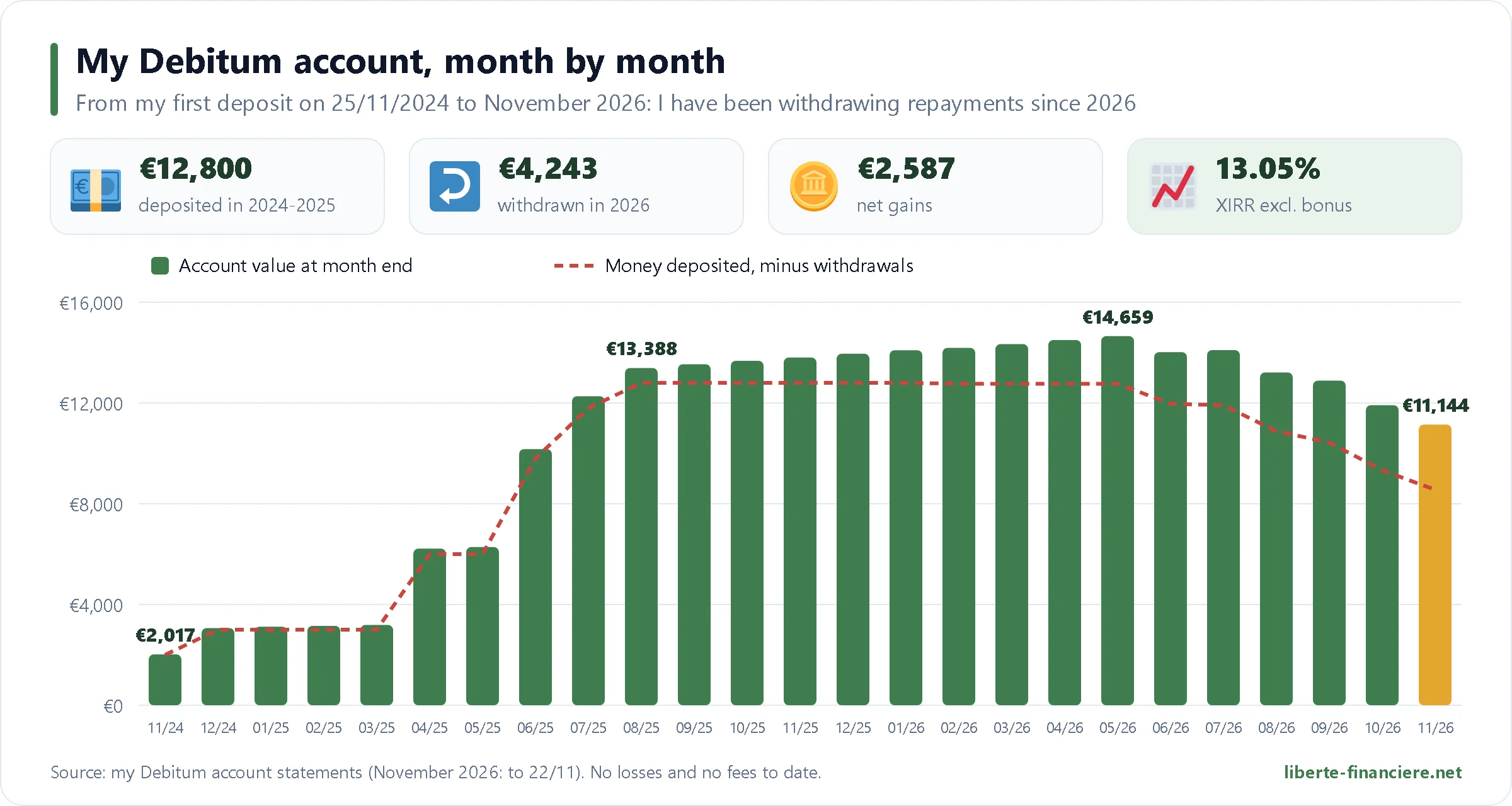
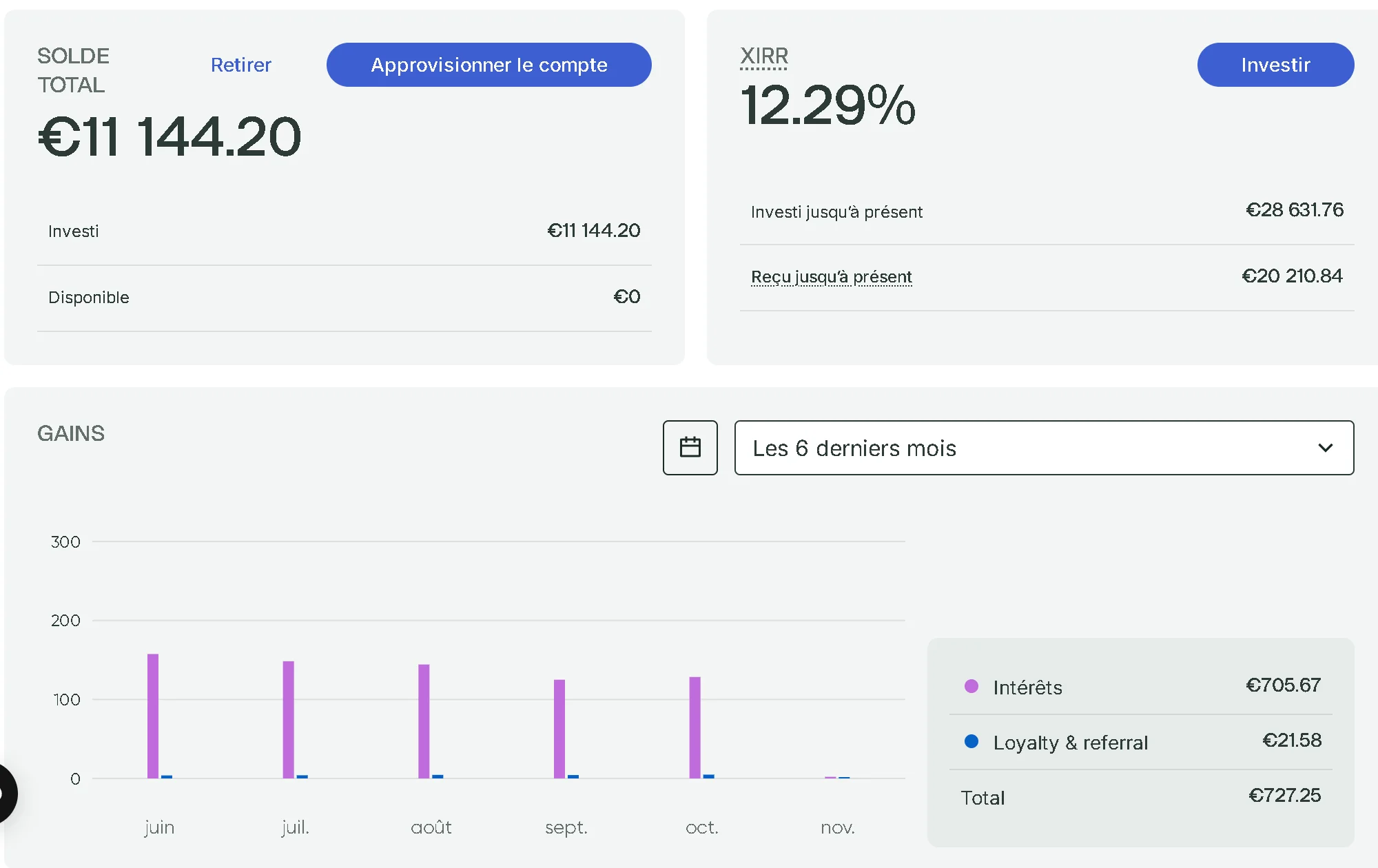
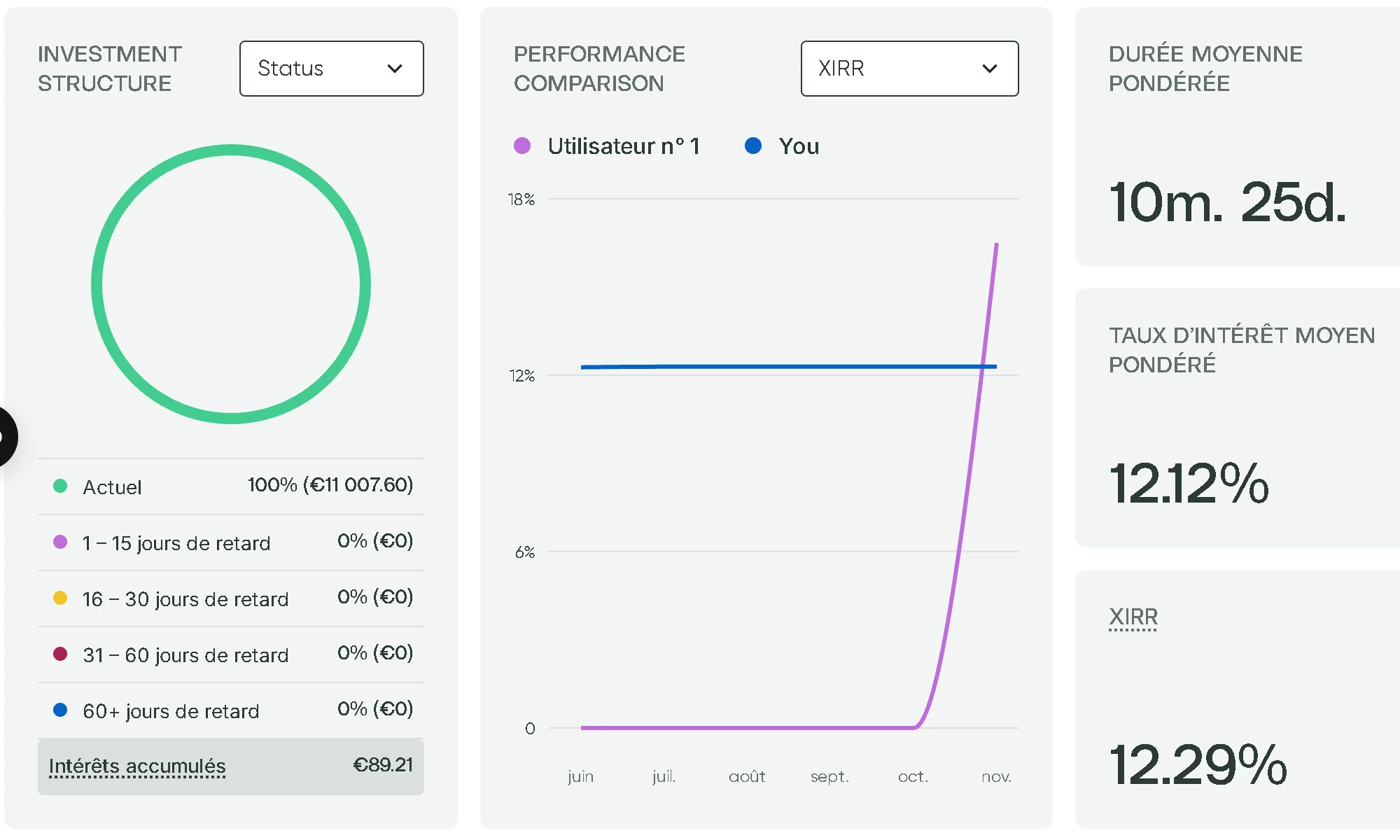
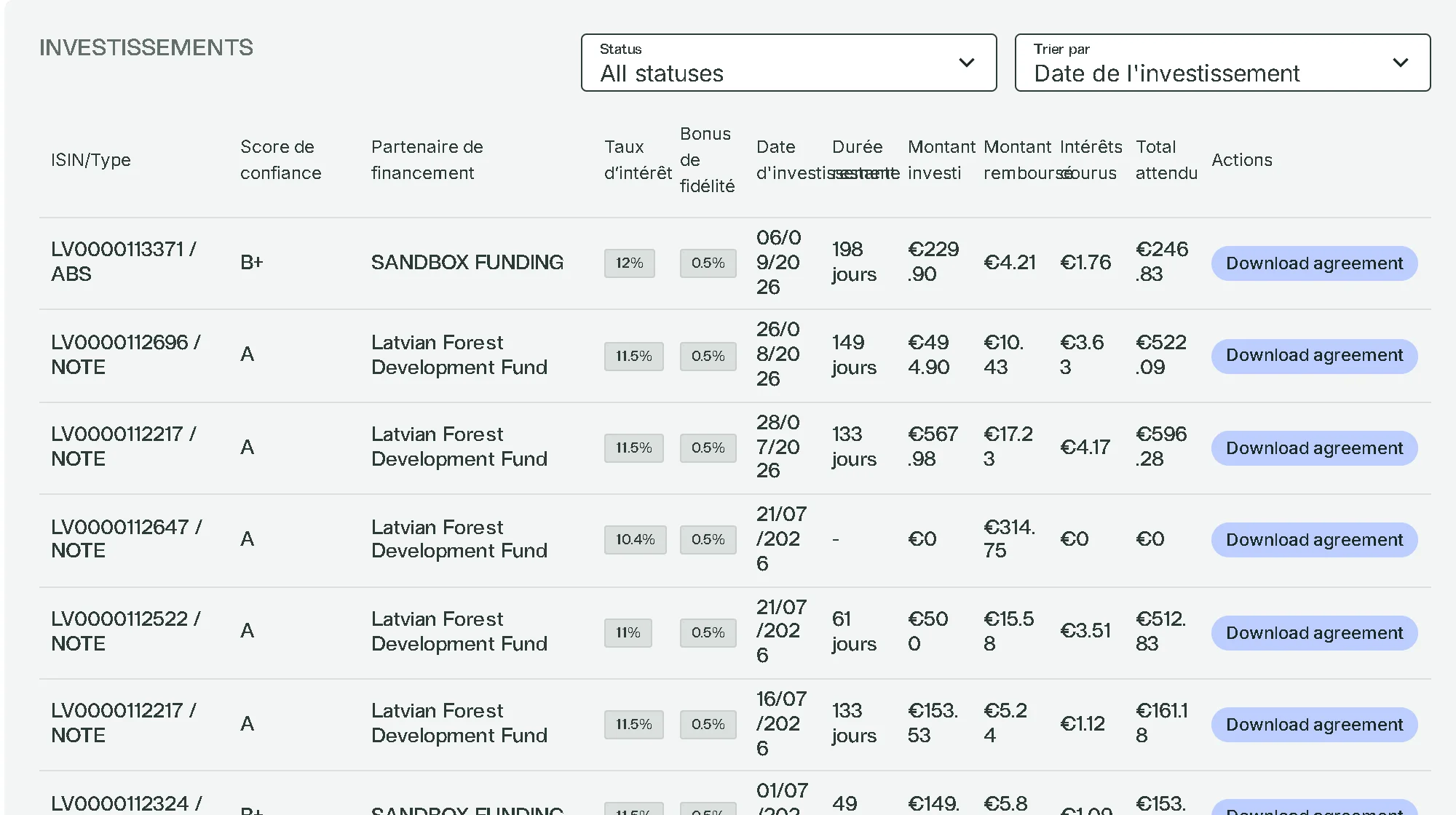
In two years, I have had no delays and no losses. 54 of my LFDF positions and 28 Sandbox positions reached maturity and returned €17,446 of capital to me, always on the scheduled date, and interest comes in every month, around €130 to €160 gross. Debitum's counter shows an XIRR of 12.29%, against 13.05% excluding bonuses in my calculation. The gap comes from the 5% Latvian withholding tax: Debitum deducts it from your return, whereas I neutralise it, as portfolio tracking tools do, because it is recovered in France as a tax credit (see the tax section). If I deduct it too, I drop to about 12.2%, almost Debitum's figure. My weighted average rate is 12.12% for an average term of eleven months.
And yet, since the end of summer 2026, I have been reducing my position: my last investment dates from 5 September 2026, my Auto Invest now only targets partners with no offer matching my criteria, and I withdraw repayments as they come in (€4,243 withdrawn in 2026). I explained it in my Q3 2026 review, for three reasons:
Conflicts of interest and resales between related companies. LFDF buys a large part of its forests from JUNO, its former parent company, and also sells some back to it: €9.26M bought and €8.54M sold in the first half of 2026 alone. Prices are set between related companies, with no published overall valuation (see the value of the forests). On top of that, Debitum's owner owns Sandbox Funding, the platform's second-largest lender. It is disclosed and regulated, but too intertwined for my taste.
Poorly rated lending companies. In my P2P comparison tool, the strength score of Debitum's lenders is only 1.88 out of 5, while the platform itself scores 2.89. LFDF has debt of 13.8 times its equity and almost no cash.
LFDF is a young company. It was created in April 2023 under the name JUNO ESTATE and only arrived on Debitum in February 2025. So it has never been through a crisis, even though it carries 65% of the platform's outstanding portfolio.
None of this has turned into a delay: it is a choice made out of caution, not a reaction to an incident.
In concrete terms, my portfolio is still 64% at LFDF, with maturities spread from January 2027 to April 2028. I'm not selling anything in a rush, since nothing in the figures justifies it: I let the maturities come in and reallocate the money to more diversified platforms. I will update this article as repayments come in.
Pros and cons of Debitum
|
|
|---|---|
MiFID II licence, segregated accounts and compensation up to €20,000 (see regulation) | Two thirds of the outstanding portfolio with LFDF, a heavily indebted company (see the partners) |
Platform profitable since 2024, accounts audited by BDO | Debitum's owner also owns Sandbox Funding |
13% real return in my case, no delays in two years | No secondary market, terms of up to 3 years |
No fees, free card deposits, from €10 | Only six active partners, mostly in Latvia |
Detailed statistics and public documents for each issuer | No mortgage on LFDF's forests |
Flow at 8% with early withdrawal, loyalty bonus up to 2% | Four CEOs since 2023, a past linked to the DEB token |
 Cons
 Who is Debitum for?
Profile | Is Debitum a good fit? |
|---|---|
You want a MiFID II regulated platform, with profitable accounts | Yes |
You accept locking up your money for one to three years for 12 to 15% | Yes |
You want exposure to real assets (forests, farmland) | Yes |
You invest via a company | Yes, companies are accepted, with no withholding tax |
You are looking for broad diversification across lenders | Rather not |
You may need your money in the coming months | Rather not, except via Flow and within its limits |
You reject any link between a platform and its issuers | Rather not |
 What users say
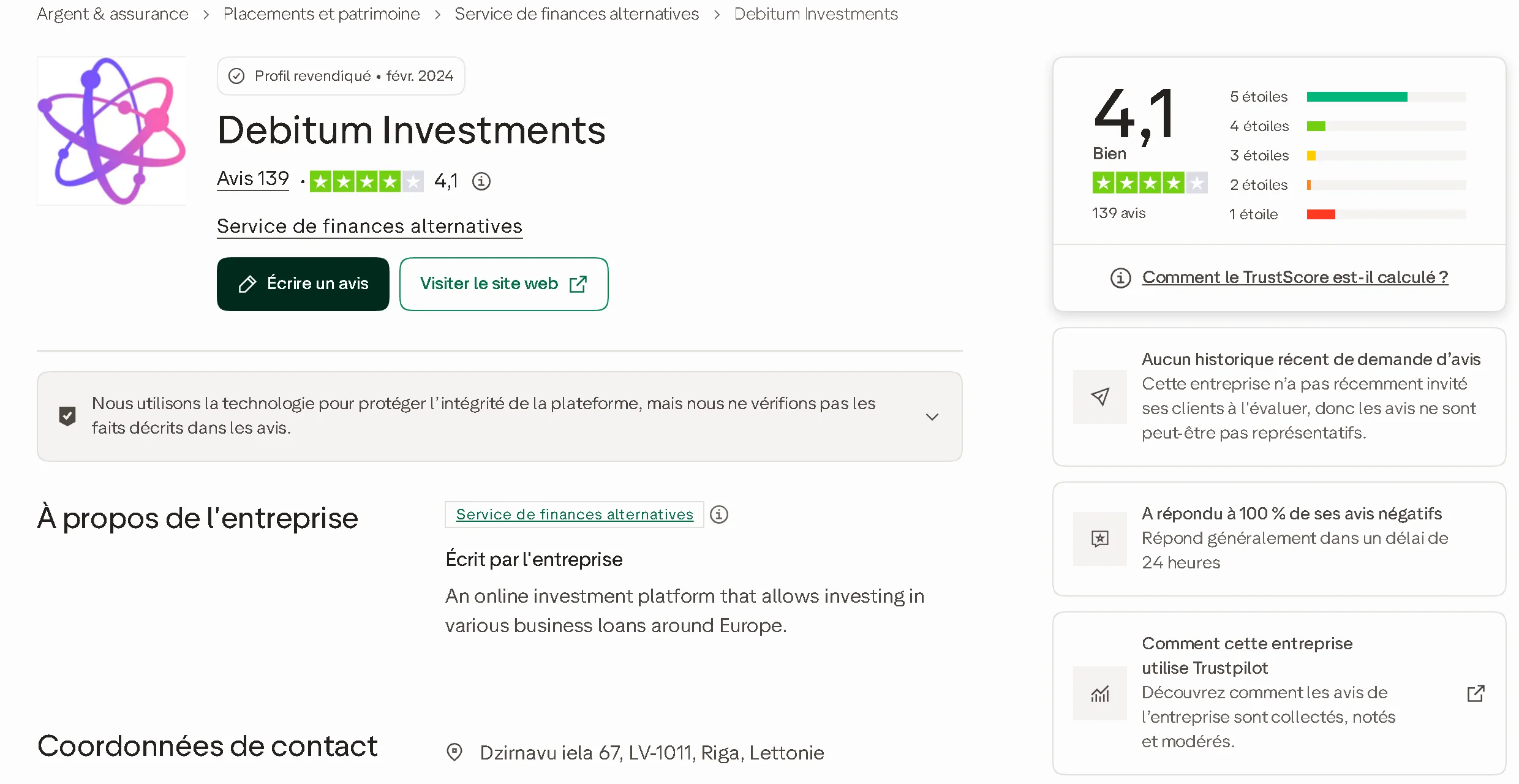
On Trustpilot, Debitum currently scores 4.1 / 5 from 139 reviews, with 63% five-star and 18% one-star reviews. The platform replies to every negative review, usually within 24 hours, but Trustpilot notes that it has not recently invited its customers to leave a review. Positive reviews mainly praise the simplicity of the site and the regularity of payments. The most visible negative reviews concern identity verification, seen as demanding (bank statements, proof of income), which Debitum justifies by its anti-money laundering obligations.
In my community on Telegram, the recurring questions are about LFDF, the length of the securities and Flow. Debitum also runs a Telegram group and a news channel, and its support team answers by email at support@debitum.investments or by phone; the site is translated into French.
 Debitum bonus code

There is no code to enter: by signing up with my link, you get 1% cashback on your investments during your first 30 days. To make the most of it, invest your deposit in the very first days. You can then combine it with the loyalty programme and Debitum's occasional cashback campaigns, which are announced on the platform.
Get the Debitum bonus 1% cashback on your investments during your first 30 days, no code needed. |
 FAQ: frequently asked questions about Debitum
Is Debitum a scam?
No. It is an investment firm licensed by the Bank of Latvia, with audited and profitable accounts, which has not caused its investors to lose any capital since 2019. Its past linked to the DEB token and the links between its owner and some issuers are, however, worth knowing about.
Is Debitum regulated?
Yes: MiFID II licence no. 06.06.08.728/537, granted by the Bank of Latvia in September 2021 and also valid in France.
What happens if Debitum goes bankrupt?
Your securities belong to you and your uninvested money is held in segregated accounts. If the platform could not return them to you, the Latvian compensation scheme would cover 90% of your loss, up to €20,000.
What happens if LFDF or another issuer defaults?
Debitum enforces the first-ranking pledge and sells the issuer's assets or shares for the benefit of investors. Repayment is not guaranteed and can take time; the €20,000 compensation does not apply in this case.
Why does LFDF weigh so much?
Because it has been issuing large volumes at 13-15% since 2025 and investors follow. It carried 65% of the outstanding portfolio in November 2026, 68% with LFDF II.
Can you withdraw your money at any time?
Only the uninvested balance, free of charge, within 3 business days. There is no secondary market: a security is held until maturity, except in Flow, which allows an early exit of €5,000 per week at most, depending on the available liquidity.
Are there any fees on Debitum?
No, no deposit, withdrawal, investment or management fees for the investor.
Does Debitum withhold tax at source?
Yes, 5% for EU and EEA residents, creditable against your French tax if you are a French tax resident. You then declare your interest (2778 if you are not exempt, 2047, 2042) and your account on form 3916.
Can you invest on Debitum via a company?
Yes, companies are accepted and are not subject to withholding tax.
What is the minimum amount to invest?
€10 per security. A deposit limit is set when the account is opened; to raise it, you have to prove the source of your funds.
What is the link between Debitum and the DEB token?
The DEB token was sold in 2018 by Debitum Network, before the creation of the company that operates the platform. DN Operator never issued or bought back these tokens, and their use was removed from the platform in 2023.
Which bonus code should you use on Debitum?
No code: go through my link to get 1% cashback on your investments during your first 30 days. The current offer, if there is one, is shown at the top of this article.
 Conclusion: my review of Debitum
Debitum is one of the best-regulated platforms in crowdlending: MiFID II licence, segregated accounts, audited and profitable accounts, detailed statistics, no fees and, in my case, 13% a year for two years without a single delay. On paper, it is one of the strongest offers on the market for anyone looking for returns on real assets.
But you are not buying a diversified platform: you are mostly lending to LFDF, a heavily indebted forestry company that grows thanks to investors' money, in a setup where the owner of the platform also owns one of the lenders. That is why I keep Debitum as a secondary holding and am gradually reducing it for now, without selling anything in a hurry. For my part, I see it as a platform to keep in the background of a portfolio, for diversification, choosing its partners one by one and closely following its news. If you open an account, my link gives you 1% cashback on your first 30 days.
Investing carries a risk of capital loss. This article reflects my personal experience: I am not a financial investment adviser.
Add a comment
A question or your own experience to share? Leave a comment: I reply personally.