LANDE (also known as Lande Finance) is a Latvian platform that lends to farmers, launched in 2020 in Riga and holding a European licence since 2024. There is no lending company in the middle here: you lend directly to farms in Latvia, Lithuania, Romania and Poland, and each loan is secured by a mortgage on their land or a pledge on their machinery. In six years, more than €68 million has been financed this way, at an average rate of about 11%. I made my first deposit on 24 December 2024: my account is now worth €13,669, for a real return of 11.33% a year, bonus included.
In this review, I go through LANDE's history and its founder, how a loan works, the collateral and what it is really worth, the four countries, the statistics, the real state of delays, defaults and recoveries, the European licence, the platform's accounts, sign-up, Auto Invest, the secondary market, fees, risks, French taxation, the comparison with Income Marketplace, Debitum, InSoil and Afranga, and my figures after almost two years.
This article is not sponsored by LANDE. Some links are affiliate links: if you sign up with my link, you get 3% cashback on your primary market investments during your first 30 days.
 LANDE at a glance
Criterion | LANDE |
|---|---|
Founded | Launched in July 2020 in Riga, under the name LendSecured |
Company | SIA LANDE Platform, no. 40203386735 in the Latvian commercial register |
Head office |
|
Management | Nikita Gončars, founder, CEO and majority shareholder |
Regulation | European ECSP licence from the Bank of Latvia since 7 February 2024 |
What you finance | Direct loans to farmers and agricultural businesses |
Borrowers' countries |
|
Return | Rates of 10 to 14% a year; 11.3% on average |
Collateral | Mortgage on the land or pledge on the machinery, LTV of 41 to 44% on average, personal guarantee |
Buyback | None: in case of default, recovery and sale of the collateral |
Volume | €68.5M financed and 2,458 projects since 2020, €31.6M of capital still owed at 31/10/2026 |
Minimum investment | €50 per loan |
Liquidity | Free secondary market, at the price of the remaining principal |
Fees | None, except an inactivity fee after 12 months without investing |
Withholding tax | None |
Trustpilot | 2.6 / 5 from 57 reviews |
Bonus | 3% cashback on your primary market investments for 30 days |
 Riga (Latvia)
 Lithuania,
 Romania,
 Poland
LANDE belongs to a small family of platforms: agricultural crowdfunding. Unlike marketplaces such as Mintos or Income Marketplace, where you buy a share of a loan already granted by a lending company that commits to buying it back, here you lend directly to a farm, for a specific project, with real collateral. It is closer to real estate crowdfunding than to consumer lending, with loans of one to five years. You can compare it with the other platforms, in particular on regulation and financial strength, in my P2P comparison tool.
Open a LANDE account Sign up in less than 5 minutes, from €50 per loan, 3% cashback on your first 30 days with my link. |
 My video: my LANDE review after 8 months
If you prefer video, here is my first review, filmed in August 2025 after eight months of investing: the principle of agricultural loans, the collateral, the interface and my first figures. This article goes much further, with almost a year more hindsight, my first two defaults, the platform's 2025 accounts and the new terms and conditions.
 From 2020 to 2026: the history of LANDE
LANDE was founded in 2020 in Riga by Nikita Gončars, with a simple idea: in Latvia, many small and medium-sized farms struggle to get a bank loan, even though they own land or equipment that can serve as collateral. The platform published its first information for investors on 17 July 2020 and financed its first project at the end of September. At the time it was called LendSecured: you can still find this name in every investor's transfer reference, which starts with "LENDSECURED".
In 2021, according to its official presentation, LANDE won the Fintech Abu Dhabi award for the Baltic countries. The platform then expanded to Lithuania, where its first loans date from 2022, and to Romania in 2023. Growth was fast: €1.3M financed in 2021, €5.4M in 2022, €11.3M in 2023.
On 7 February 2024, the Bank of Latvia granted SIA LANDE Platform the European crowdfunding service provider licence (ECSP), which allows it to operate throughout the European Union. The same year, the team learned from its first defaults: it stopped loans secured by crops or livestock, the riskiest ones, to focus on land and machinery, and the company returned to profit.
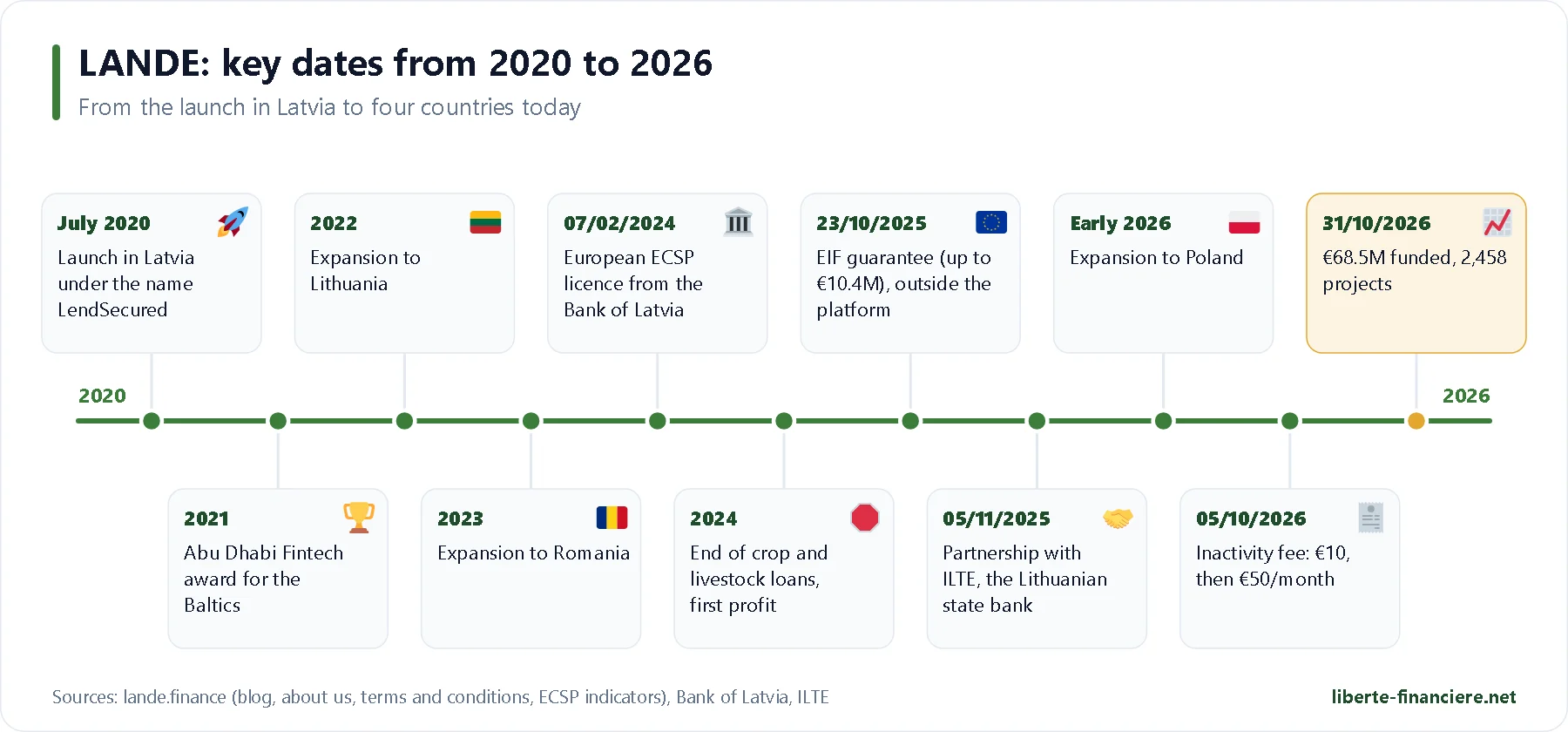
Since then, the milestones have followed one another: a few non-agricultural loans from June 2025 (a Romanian road haulage company, secured by real estate), a European Investment Fund guarantee in October 2025, a partnership with ILTE, the Lithuanian public development bank, in November 2025, then the launch in Poland in early 2026. At the end of October 2026, LANDE had financed €68.5M through 2,458 projects, and is aiming for €30M in 2026 alone.
 Who runs LANDE?
 Nikita Gončars (LinkedIn) founded LANDE in 2020 and still runs it as CEO and Chairman of the Management Board. A specialist in secured lending, he is the one who presents the platform's results on video every quarter, together with the head of investor relations. He is also LANDE's owner: according to the 2025 annual report, he holds 78.67% of the capital, the rest being split between shares held by the company itself (9.97%), an investor fund "LANDE INVESTORS" (4.56%), the company Vauban Nominees Limited (4.59%) and an Estonian holding company (2.21%). According to his LinkedIn profile, LANDE raised €550,000 from business angels and venture capital funds, which explains these small shareholders. For an investor, he is a very involved and very accessible founder: he answers personally on LinkedIn and on Telegram, where I have already chatted with him. But it is also a platform that depends heavily on a single person.
He was joined on the Management Board, on 2 April 2025, by Jānis Laiviņš-Laivenieks (LinkedIn), head of legal. Watch out for a common mix-up: the CTO is also called Nikita, but he is a different person, Nikita Grebnovs (LinkedIn), who led the response to the PHP vulnerability in October 2026. The official team page also lists:
Mārtiņš Vītols (LinkedIn), head of operations;
Haralds Neimanis (LinkedIn), head of business development, long in charge of the Baltic countries;
Ligita Dikšiene (LinkedIn), head of Lithuania, and Justyna Puczkowska (LinkedIn), head of Poland, who brought more than ten years of experience in bank and agricultural lending;
Malvīne Madžule (LinkedIn), head of legal and recovery in the Baltic countries;
Valērija Vorobjova (LinkedIn), loan portfolio manager.
The Romanian team, for its part, has changed head several times since 2025, and LANDE says it strengthened it in 2026 on risk management and recovery. The platform runs an official Telegram group, where the team answers investors and where, in October 2026, it put the next website improvements to a vote. My personal experience points the same way: when I wrote to the CEO at the end of August 2026 about the delays, the answer came quickly and in detail.
 How does a LANDE loan work?
A farmer submits a financing request: buying land, a new tractor, refinancing a bank loan, working capital before the harvest. The local team studies their creditworthiness, their accounts, their harvest history and their EU subsidies; according to LANDE, only about 5% of applications are accepted. The project is then published with its amount, rate, term, LTV and collateral, and investors fund it in slices of at least €50.
A direct loan, with no lending company in the middle
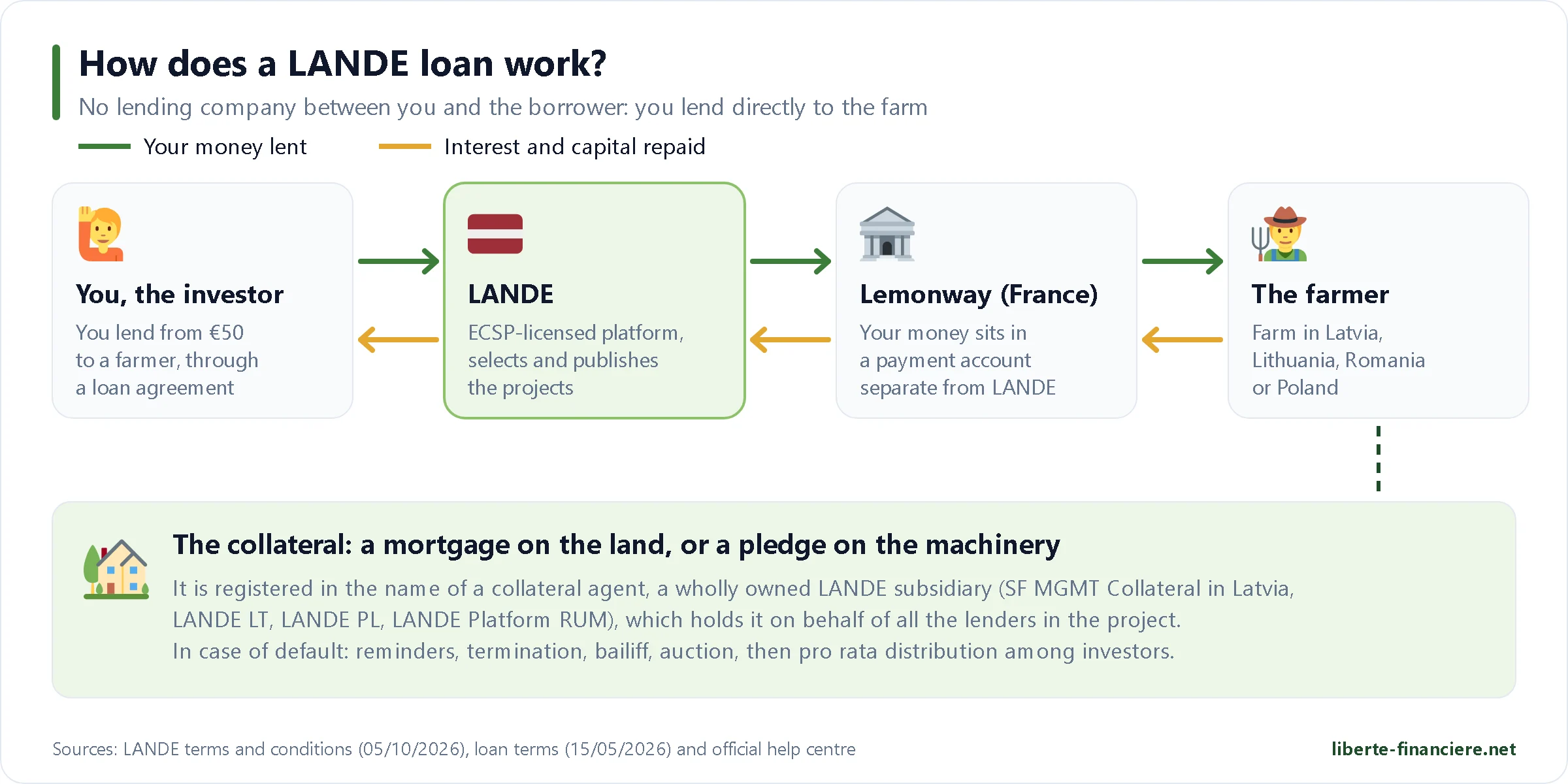
This is the big difference with most P2P platforms: there is no lending company between you and the borrower. When you invest, you sign a real loan agreement with the farm, and you can download it as a PDF. LANDE is an intermediary: it selects the projects, handles payments and recovery, but does not lend itself and does not guarantee your capital. It earns its money from fees charged to borrowers, which amounted to €2.38M of revenue in 2025.
The advantage is that your risk does not depend on the financial health of a lending company, as it does on Mintos or PeerBerry. The drawback is that there is nobody to buy back your loan if it goes wrong: you depend on the farmer, their collateral and LANDE's recovery work. This changes everything in the way you invest, and I go into it in the section on delays.
 Who holds the collateral? The collateral agent
With dozens of investors on the same loan, the mortgage cannot be registered in each of their names. The terms and conditions therefore provide for a collateral agent: a company that holds the mortgage or pledge in its own name, on behalf of all the lenders of the project, and shares out the amounts recovered in proportion to each investment. These are wholly owned subsidiaries of LANDE: SIA SF MGMT Collateral in Latvia, UAB LANDE LT in Lithuania, LANDE Platform RUM in Romania and LANDE PL in Poland.
This set-up is common in secured crowdfunding, but it has a consequence: in case of default, you cannot act alone against the borrower. The loan terms even forbid it: everything goes through LANDE and its agent, who decide on reminders, termination, seizure and sale.
 Everything in euros, with five types of repayment schedule
All loans are in euros, even in Romania or Poland: you have no currency risk. Interest is calculated daily and paid according to the schedule chosen by the farmer, adapted to the rhythm of their business:
Annuity: principal and interest repaid every month, in equal instalments;
Bullet: interest every month, principal in one go at the end. This is the most common schedule, especially for land loans;
Balloon: reduced monthly payments, then a large final repayment;
Full Bullet: principal and interest in a single payment at the end;
Periodic payments: repayments timed to the seasons, for example after the harvest.
One detail that matters: while a project is being funded, your money is "reserved" and earns nothing until the loan is paid out to the farmer. As I write, €819 of my account is waiting like this. It is the improvement investors ask for most, and LANDE announces that its development is finished, with no go-live date.
 Where is your money? At Lemonway, in France
Your uninvested money is not in a LANDE account. It is held in a payment account opened in your name at Lemonway, a French payment institution licensed by the ACPR (the French banking supervisor), separate from LANDE's own cash. Even the money of a project still being funded stays at Lemonway, in a borrower account that they cannot use before the payout. If LANDE went bankrupt, these funds would not be part of its assets.
 Projects are always funded, thanks to an anchor investor
On LANDE, a project is never cancelled for lack of investors. According to the official help centre, the part not funded by the deadline is provided by an "anchor investor", and LANDE itself tops up remainders of less than €50. For you, this is comfortable: your money is not tied up for weeks for nothing. But the identity of this anchor investor is not disclosed publicly, and the LANDE group also finances loans on its own balance sheet, in particular those guaranteed by the EIF. This is a possible conflict of interest, governed by a conflict of interest policy required by the ECSP licence.
 The collateral: mortgage, pledge and LTV
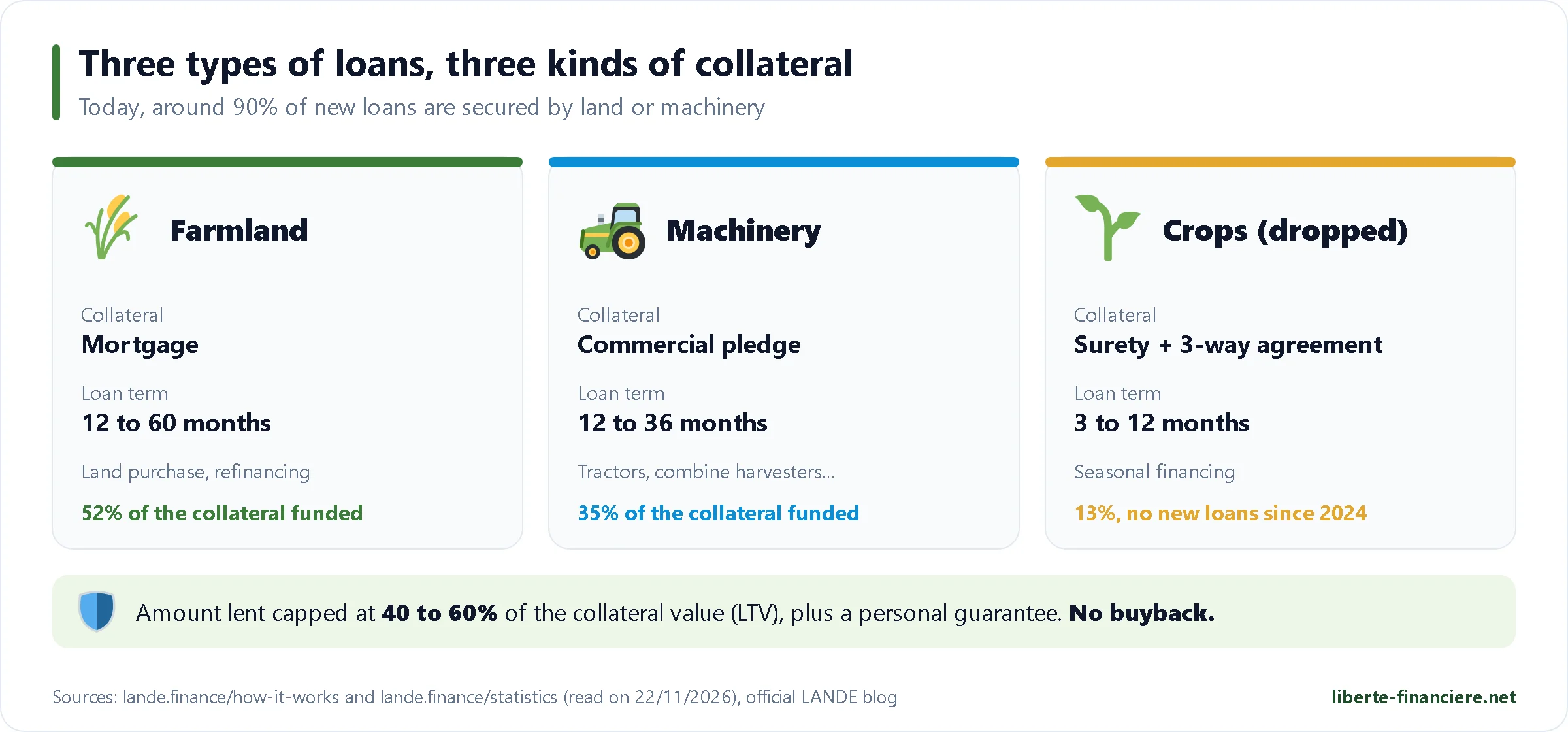
This is LANDE's central argument: every loan is backed by a real asset. There are three families of loans, each with its own collateral and term, and the platform caps the amount lent at 40 to 60% of the value of the collateral, usually adding the farmer's personal guarantee.
 Farmland, the king of collateral
Loans secured by a mortgage on farmland, sometimes on a house or a building, now make up the majority of volumes: €36.7M financed since the start, with a historical default rate of 2.56%, and even 1.09% in Latvia and 0.53% in Lithuania. They run from one to five years. Farmland has two qualities for a lender: it does not lose value over time like a tractor, and its price has risen sharply in the Baltic countries since they joined the European Union, because it started from a very low level.
 Machinery, a collateral that has improved
Loans secured by a commercial pledge on tractors, combine harvesters or seed drills run from one to three years. They were LANDE's weak point: 13.45% defaults on machinery loans granted in 2023, and up to 30.5% in Romania that year. Since then, the platform has tightened its selection, values equipment using the Mascus price database and favours recent machines: the default rate fell to 6.53% for 2024, then 2.89% for 2025, and Lithuania has had no default over three years of machinery loans. A machine loses value every year and is harder to resell than land: that is why I now stick to land.
 Crops and livestock: discontinued since 2024
The first seasonal loans were secured by the future harvest, with a three-way agreement between the farmer, LANDE and the grain buyer, or by livestock. These are the loans that today show the highest share of delays of more than 90 days, and LANDE no longer grants them: about 90% of new loans are now secured by land or machinery. There are still a few loans backed by agricultural subsidies, which the platform calls "Financial".
 The LTV, to check on every loan
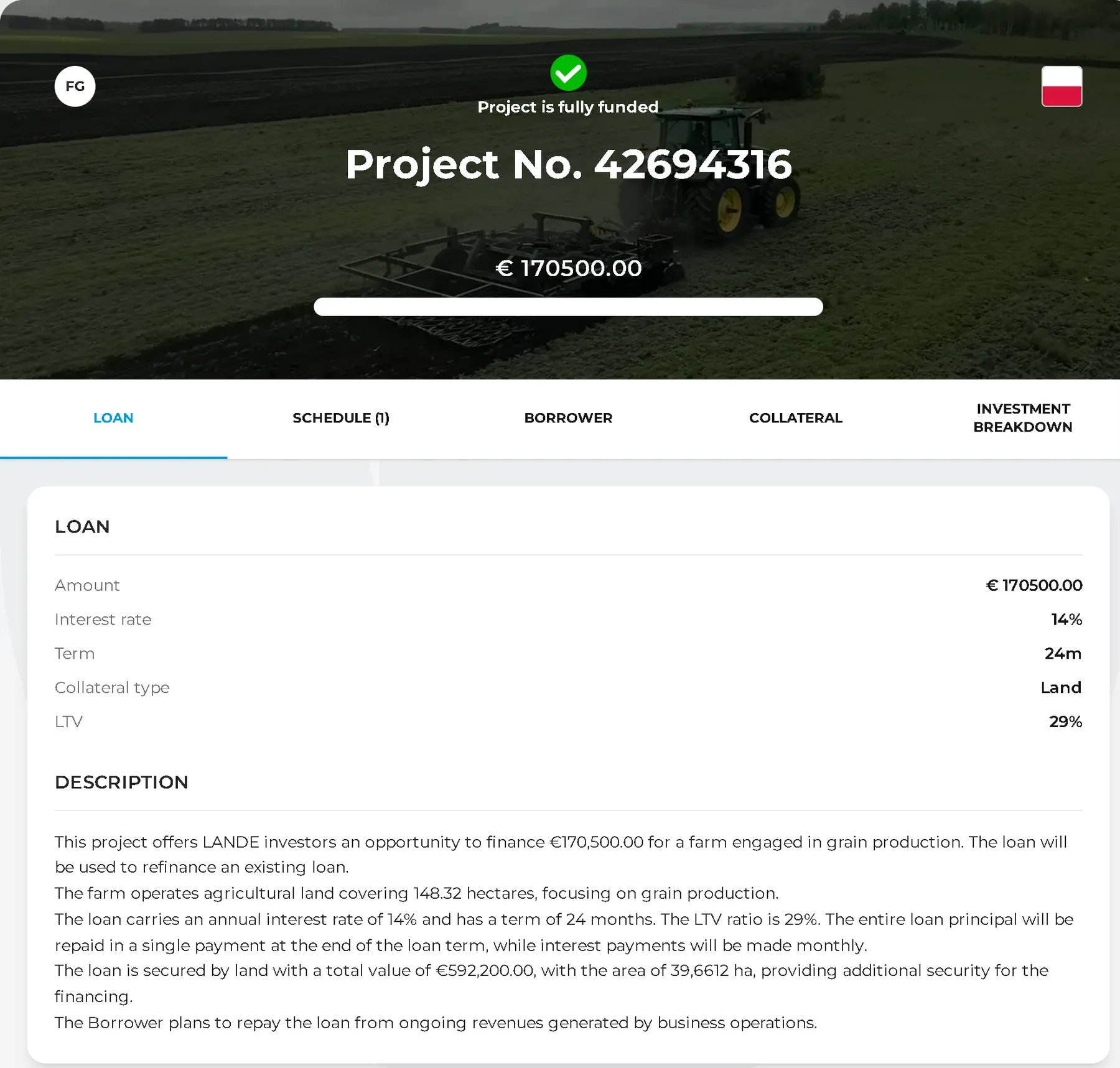
The LTV ("loan to value") is the ratio between the amount lent and the estimated value of the collateral. The lower it is, the more comfortably the collateral covers your claim. The platform average is 41%, and 44.2% on loans from the third quarter of 2026. On this Polish loan I invested in, for example, the land is worth 3.5 times the amount borrowed:
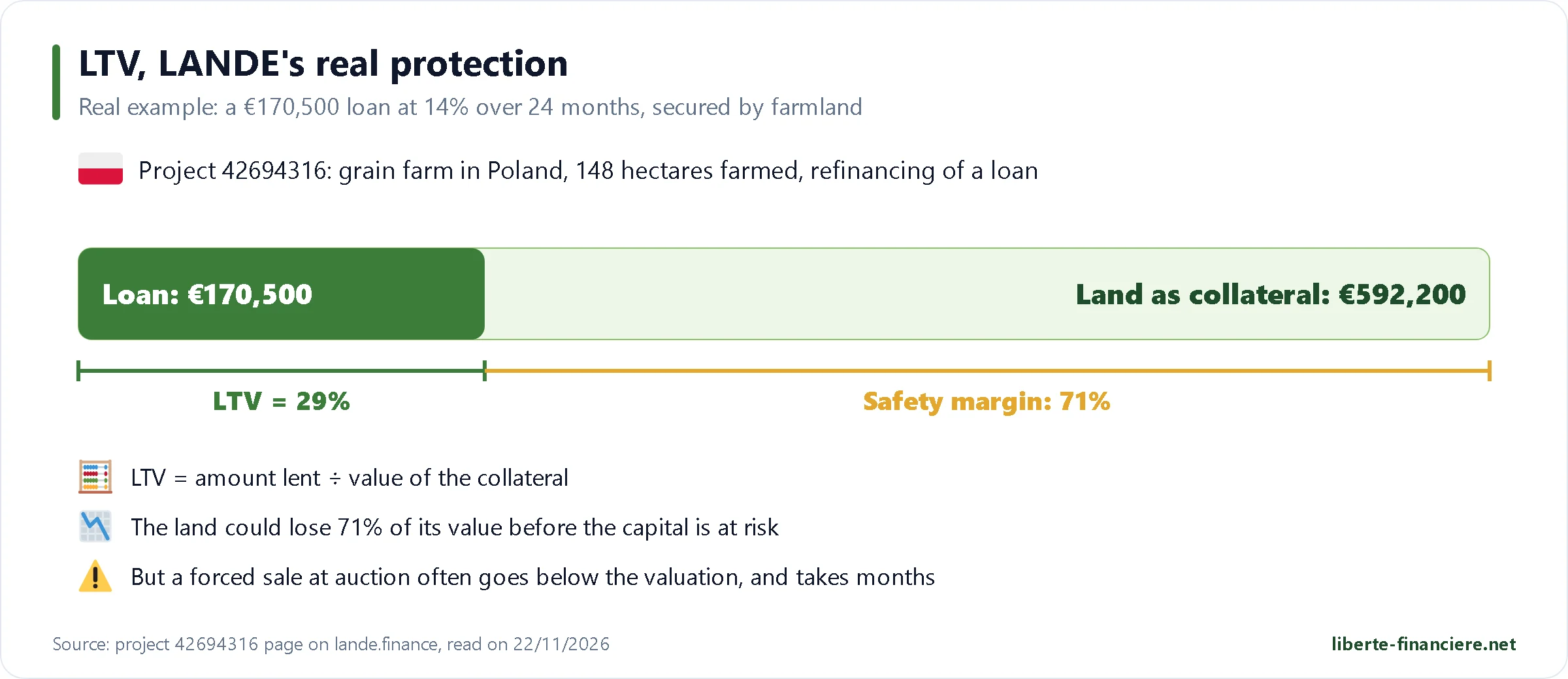
Two limits to keep in mind. First, the value is set by an appraiser chosen for the project: LANDE publishes its valuation method for Poland and its credit policies, but it is an estimate, not a sale price. Second, a forced sale at auction often goes below the estimate and takes months, or even years. An LTV of 30% protects the capital very well; it does not protect you from lost time.
 No buyback guarantee, and that is deliberate
LANDE says it clearly in its help centre: there is no buyback guarantee. When a farmer pays late, nobody pays you back after 60 days as on Income Marketplace or Mintos. In return, interest keeps running throughout the delay, plus late interest and penalties charged to the borrower. It is the choice of a "real estate" model rather than a "consumer credit" one: less liquidity, but a risk that does not depend on a lending company.
 The EIF guarantee does not cover your loans
In October 2025, LANDE signed a guarantee with the European Investment Fund, under the InvestEU programme, covering up to 80% of the risk on a loan portfolio of up to €10.4M. It is a fine sign of confidence from a European institution. But watch out for what many investors have misunderstood: LANDE itself makes it clear that these loans, without real collateral and of up to €50,000, are not offered to the platform's investors. They are financed separately, on the balance sheet of the group's companies and by a dedicated fund. The loans you buy on LANDE do not benefit from any EIF guarantee.
 In Lithuania, a public bank lends alongside you
The partnership signed with ILTE, the Lithuanian national development bank, works differently: on some Lithuanian loans, ILTE finances up to 40% of the amount, and LANDE's investors the rest. These projects carry the label "Co-financed by ILTE" on the platform. Having a public bank lending on the same terms as you is a good sign of the quality of the selection.
 The borrowers' four countries
LANDE lends in four European Union countries, each with its own local team, rates and track record. You can see the platform's exposure on my P2P map.
Country | Since | Collateral | Rate | What you need to know |
|---|---|---|---|---|
| 2020 | Land, machinery | 10 to 13% | Historical market, nearly €30M financed, 3.6% defaults across all collateral types, 1.09% on land |
| 2022 | Land, machinery | 10 to 12% | Difficult start, then 0% defaults on recent loans, ILTE co-financing |
| 2023 | Land, machinery, real estate | 11 to 14% | Rates 1 to 2 points higher, more defaults on the first machinery loans |
| 2026 | Land only | 12 to 14% | LTV below 60%, notarial deed of submission to enforcement on every loan |
Poland deserves a word. For its launch in early 2026, LANDE chose to finance only loans secured by real estate, with a so-called "Article 777" notarial deed, by which the borrower agrees in advance to enforcement: in case of non-payment, recovery can start without a long trial. It is the country where I invested the most in 2026, because rates there reached 13 to 14% on land. That is no guarantee of success, though: three of my Polish loans are already more than 30 days late, one of them more than 90.
Romania is the most rewarding and the riskiest market. LANDE had a high default rate there on its first machinery loans in 2023, and says it has strengthened its local team, brought recovery in-house and restarted auctions of mortgaged assets in autumn 2026. My two defaulted loans are Romanian. Finally, in Latvia, an agricultural state of emergency was declared on 29 September 2026, until 10 January 2027, after rains that disrupted the harvests: LANDE says it has not seen a surge of difficulties, but is monitoring the affected farms case by case. Be careful, this is not a freeze on repayments: nothing is frozen automatically. The order published in the Latvian Official Journal only opens a possibility: according to the Latvian Ministry of Agriculture, lenders may agree to defer principal repayments, review interest or change repayment schedules without penalty, and a contract breached because of the bad weather may be recognised as a case of force majeure. This deferral is not automatic, it is negotiated farm by farm, but until 10 January 2027, you should expect slower repayments on some of the Latvian loans.
 LANDE's statistics
LANDE is one of the most transparent platforms on the market: a real-time statistics page, a monthly report (example: the September 2026 one) that details all its statistics every month (financing, delays by bracket, defaults, recovery stages, news from each country), a quarterly video from the CEO and the performance indicators required by European regulation, updated every month. To date, the platform shows an average LTV of 41%, an average rate of 11.3%, an average term of 21 months and an average loan of €28,295.
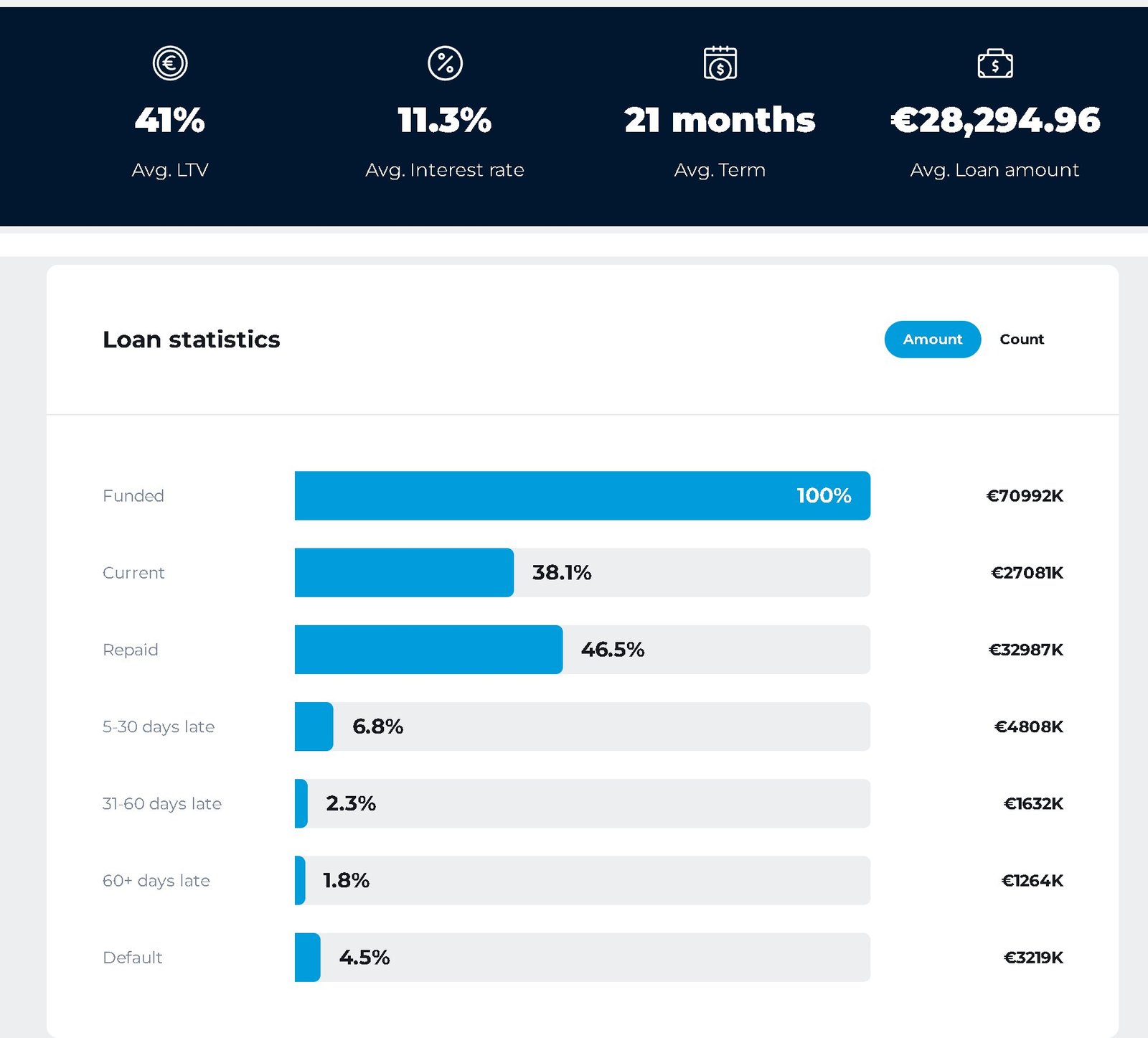
Investors have earned a total of €6.46M in interest, including about €660,000 in the third quarter of 2026 alone, against €500,000 in the first. More than 10,000 investors are registered, with an average portfolio of €7,384, and the newcomers of 2025 came mainly from Germany, France and Spain. In August and September 2026, 191 then 137 new investors signed up. Volumes almost doubled every year until 2023, and keep climbing:
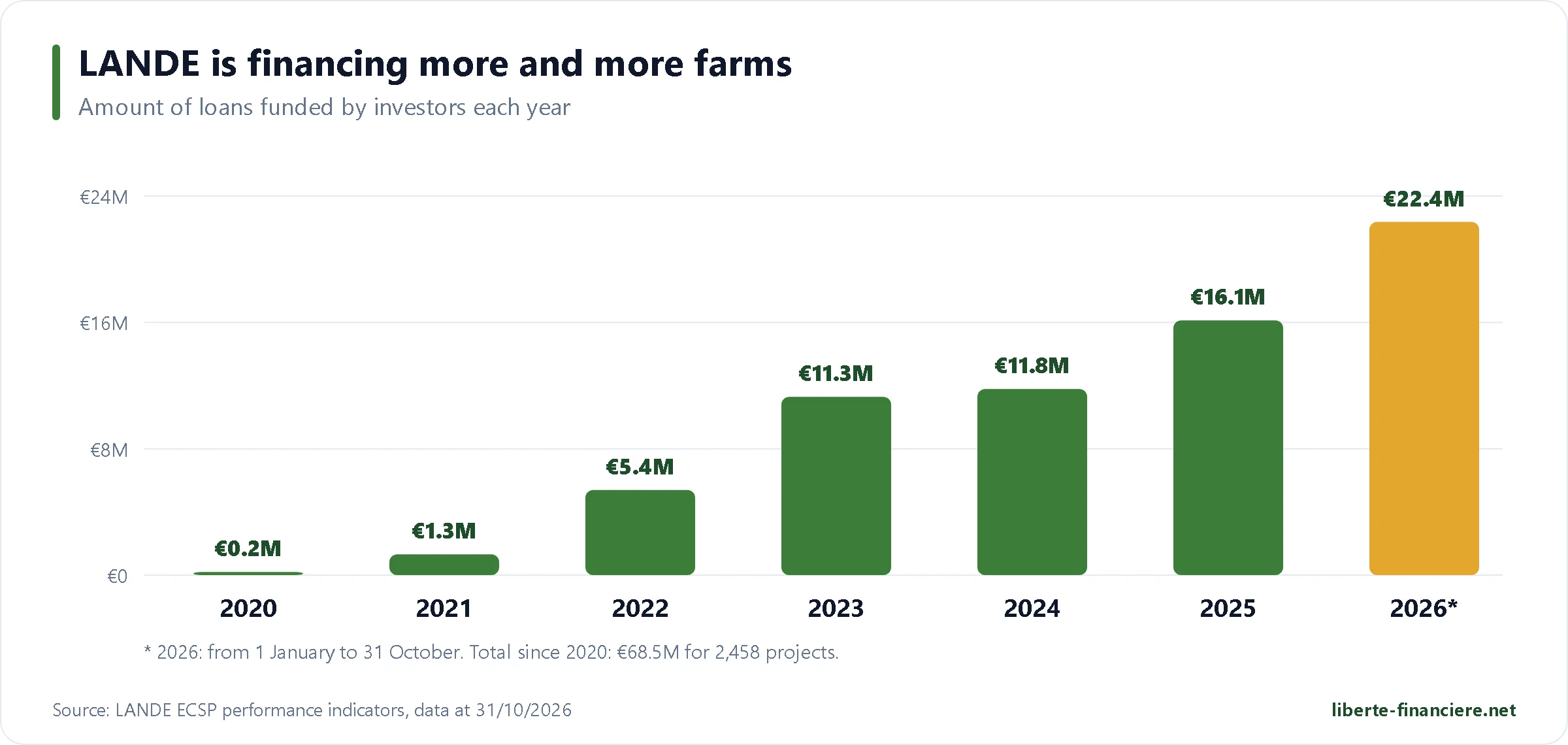
These volumes follow the farming calendar: demand for financing is strong in spring and autumn, when farms buy seed, fertiliser and fuel, and weaker during the harvest. In the second quarter of 2026, the average rate, cashback included, reached 13.5%, against 11.8% in the first. For the last quarter of 2026, LANDE expects about €10M of new loans and rates close to 13%.
 More than 40% of outstanding capital has a problem
This is the figure you have to face. According to LANDE's statistics page, of the €38M of outstanding loans, about 71% are current, 20% are late and 8.5% are in default. This level surprises new investors, and it is the criticism that comes up most often in the community.
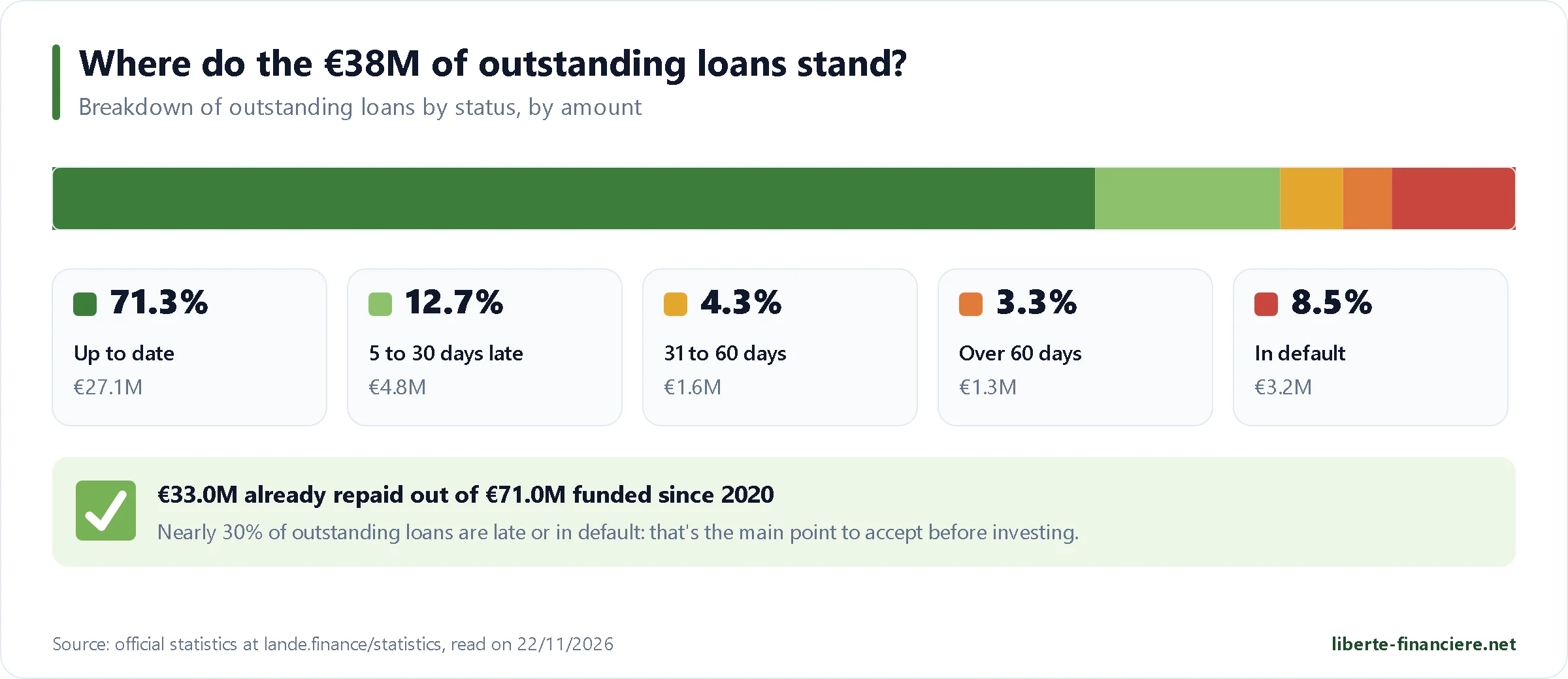
It is partly explained by the model: a farmer gets paid when they sell their harvest or receive their EU subsidies, not on a fixed date, and delays of a few weeks are common. LANDE takes this into account by increasingly timing the instalments to the harvest. But a delay here is never bought back after 60 days: it lasts until the borrower has paid or the collateral has been sold. This is what makes the real return less regular than the advertised rate.
These percentages, from LANDE's statistics page, still understate the problem. I saw it by comparing them with the regulatory performance indicators, published every month in the same format as those of the French platforms. First, the €38M counts each outstanding loan at its original amount: on 31 October 2026, the capital actually still owed is only €31.6M, because €4.75M has already been repaid on these loans. Second, and above all, loans whose repayment schedule has been changed are classed as "current" on the statistics page: 154 loans and €4.64M of capital, which are no longer being repaid according to the original contract.
Of the €31.6M still owed, the official indicators therefore paint a different picture: 55.9% performing loans, 14.7% rescheduled, 22.2% delays of less than six months and 7.3% in recovery proceedings (€2.29M across 109 loans). In other words, 44% of the capital still owed is not being repaid as originally planned. On my performance indicators page, which compares all platforms with the same method (rescheduled loans, delays, proceedings and losses relative to the total financed), LANDE has a delay rate of 20.4%, 18th out of 35 platforms. This is not a loss rate: it is the share of the amounts financed that are rescheduled, late or in recovery.
 Delays, defaults and recoveries: the real picture
On a platform without buyback, the real question is not "are there defaults?", but "how much do you get back, and how long does it take?". Here is what the official figures and my own portfolio say.
 A “default rate” of 3.59%: in fact, loans in recovery
The performance indicators required by the European licence give a “default rate” of 3.59% at 31 October 2026. Mind the word: this is not a loss, it is the share of loans that have gone into recovery. LANDE calculates it year by year, dividing the outstanding principal of loans in proceedings by the amount lent that year, then takes the simple average of the seven years, as provided for by the European Delegated Regulation 2022/2115. Result: 2020 and its €0.2M of loans weighs as much as 2026 and its €22M. Measured against amounts, the capital in recovery represents 3.35% of all loans granted, and nearly 5% excluding the 2026 loans, too recent to have defaulted. The regulation also requires counting loans rather than euros, and classifying as defaulted any loan more than 90 days late. LANDE, however, only counts loans in proceedings: one of my Polish loans is more than 90 days late without being classified as defaulted. The figure varies widely depending on the year of the loan, with a peak on the 2023 loans, those of the first Romanian machinery loans:
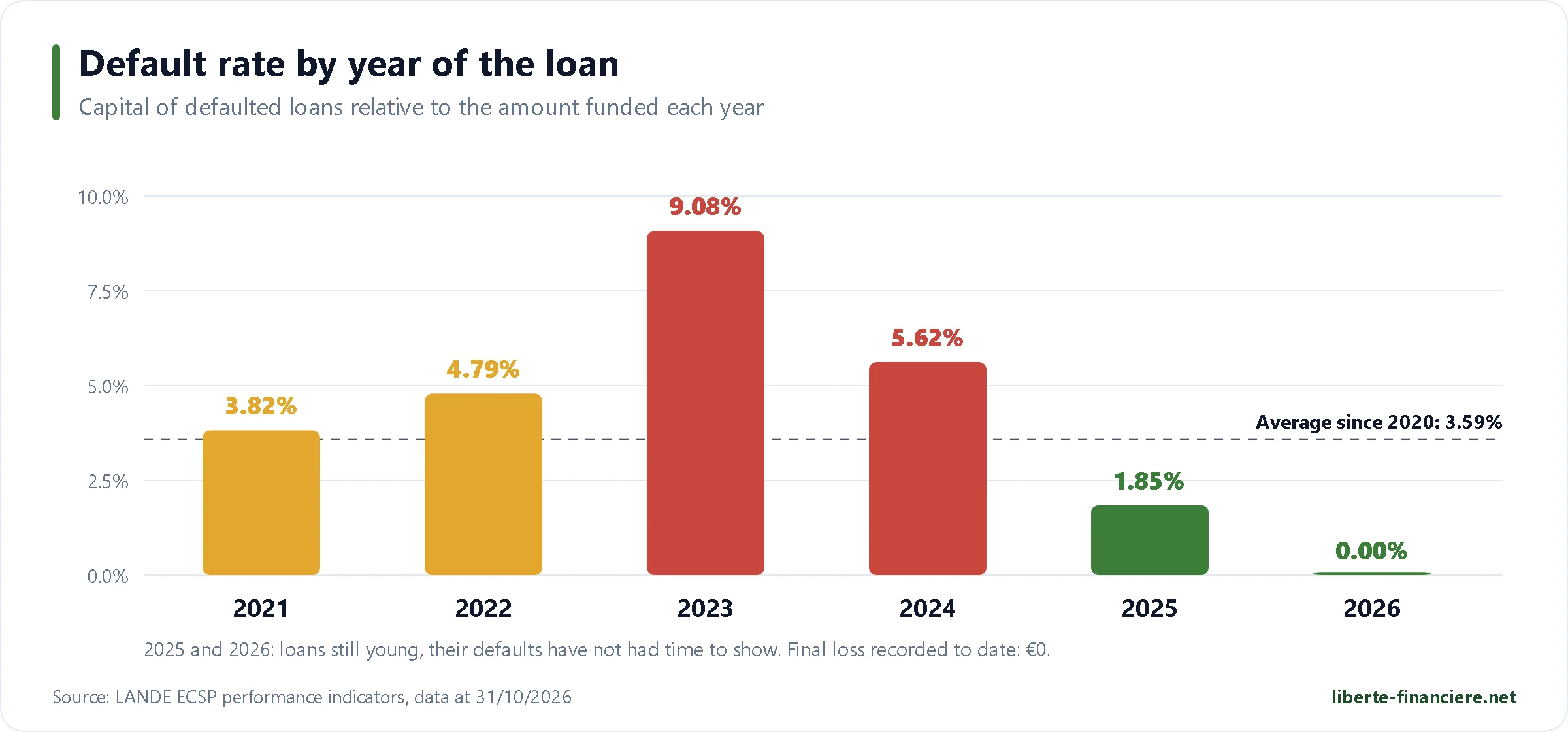
The years 2025 and 2026 look excellent, but caution is needed: a two- or three-year loan has not yet had time to default. LANDE acknowledges this itself in its October 2026 update. The real test will come in 2027 and 2028, when the 2025 loans reach maturity. Note also: LANDE publishes other rates, calculated differently: 4.08% in that same October update, and 4.5% on its statistics page (€3.2M of defaulted loans, counted at their original amount, out of €71M financed). Hence the different figures depending on the page you look at: to track changes from one month to the next, I stick to the regulatory rate.
 No final loss reported to date
This is the most reassuring point: in its regulatory indicators, LANDE reports €0 of final losses since 2020. A defaulted loan is not a loss: it is a loan in recovery, whose collateral has not yet been sold. Cases do get resolved, sometimes after years. LANDE published the example of a €23,000 Lithuanian loan, secured by a harvest that was worth nothing anymore, whose borrower owed more than €100,000 to their creditors: after an appeal that blocked the bailiff for six months and a refusal of any haircut, all the capital was recovered, with interest up to February 2024. In September 2026, the Romanian team also obtained €45,000 from a defaulted borrower and a €27,500 settlement with another.
This zero should not make you forget the rest: a default is still a nuisance. Throughout the recovery, often two years or more, your capital is locked up and pays you nothing. The interest is not lost for all that: it generally keeps running and is recovered at the end if the recovery succeeds, as in the Lithuanian example above. But in the meantime, your return goes down, and the final amount recovered will only be known when the collateral is sold. With €2.3M of capital in proceedings and 44% of the capital still owed rescheduled, late or in default, this zero is a good sign of the quality of the collateral, not a promise for the future.
This "zero" should still be read with some distance. Some of the defaulted loans have been in proceedings since 2023 or 2024, and the amount that will come out of them is not known. Until the Romanian auctions are over, nobody can say whether all the collateral will cover all the capital. As for the interest accrued during those years, it will only be recovered if the sale price is high enough.
 How a recovery works
LANDE's procedure starts with reminders from the first days of delay. After that, the borrower receives a formal notice by registered letter, then via a notary if they do not collect it within 30 days. If nothing happens, LANDE terminates the contract, which makes the whole loan due, and goes to court or to the bailiff to have the collateral sold.
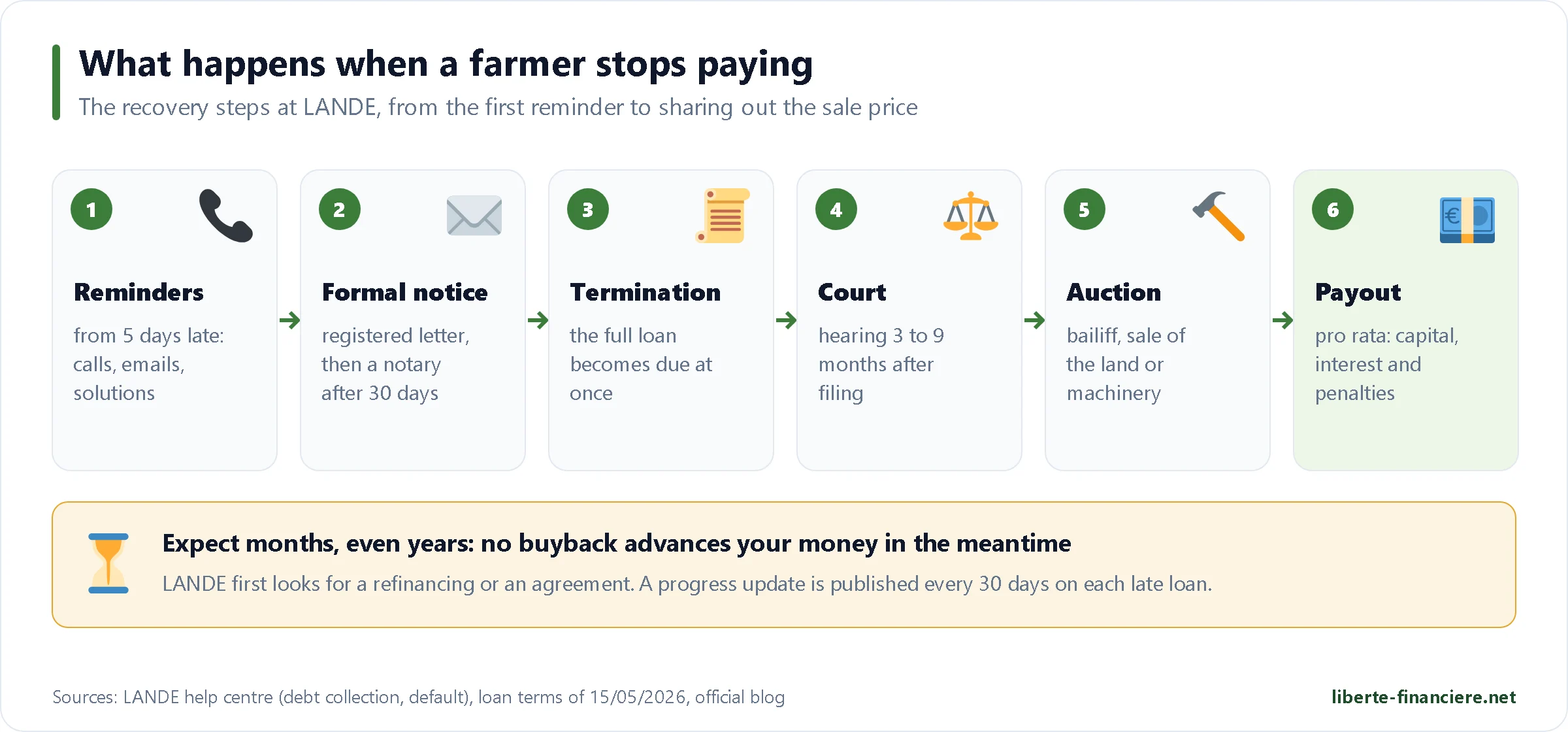
What this diagram does not show is the time it takes. A hearing is set three to nine months after the claim is filed, a borrower can challenge each stage, and an auction can fail for lack of a buyer. That is why LANDE first looks for a settlement or a refinancing: it lets the farmer sell an asset themselves, find a bank or get a new loan on the platform, rather than going to court.
 A progress update every 30 days
For each loan more than 30 days late, LANDE publishes an update at least every 30 days, visible to the loan's investors. Here are the ones I received over the last few weeks: an objection by the borrower that suspends enforcement, a termination notice, an unreachable client who will receive a final formal notice, a refinancing negotiation with additional collateral.
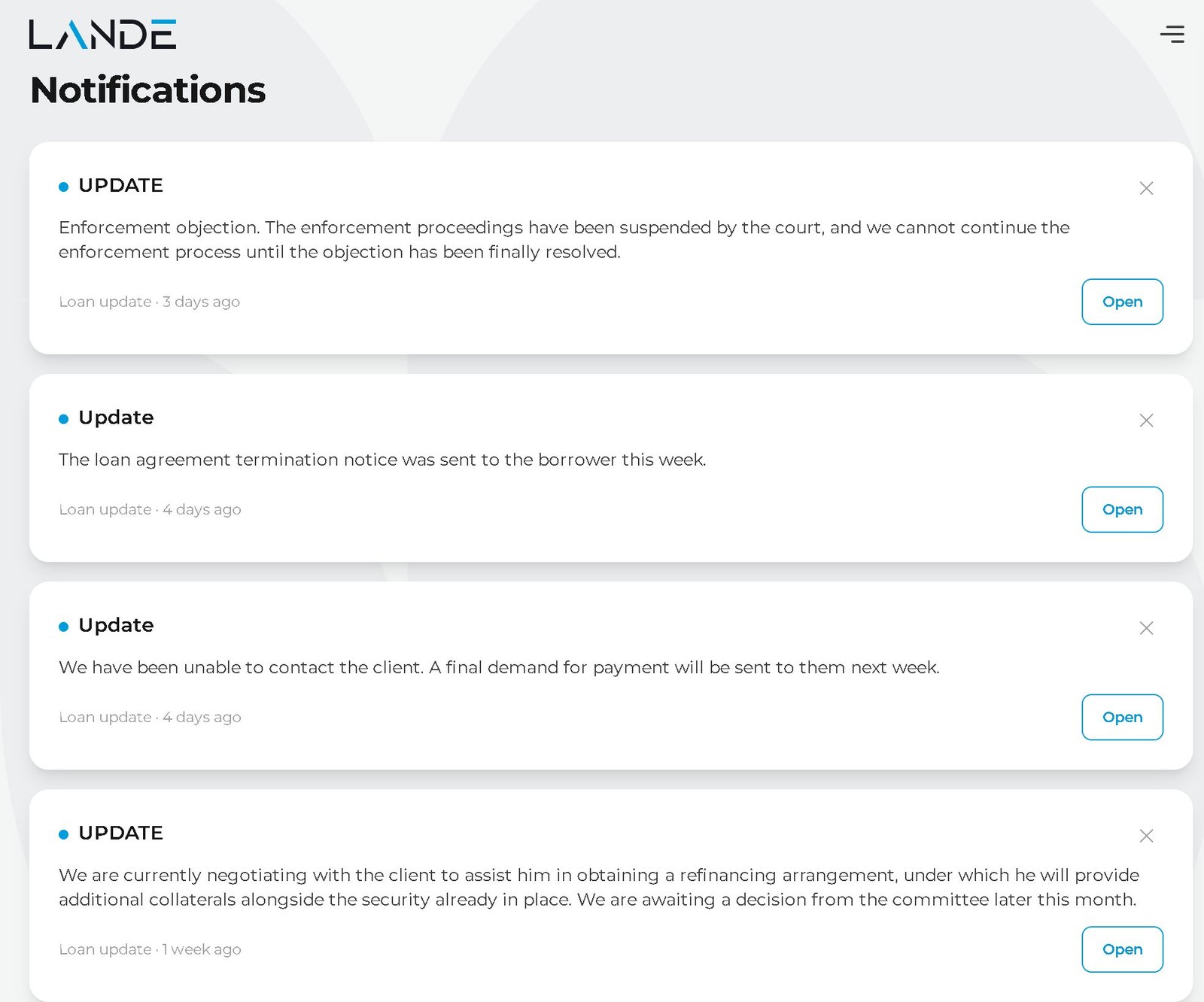
These updates are more detailed than on most platforms. You learn, for example, that insolvency proceedings were opened against a borrower by another creditor, but that LANDE is not moving the loan to default because the farmer keeps paying and is selling assets to repay. My only regret: LANDE does not publish an update when a borrower keeps making false promises, which sometimes leaves a loan without news for several weeks.
 Refinancings, to keep an eye on
A farmer who cannot repay their principal at maturity can ask for a refinancing: LANDE then publishes a new project, funded by new investors, which repays the old one. The contracts do not provide for a direct extension, everything goes through this mechanism. For the investors in the old loan, it is good news: they get their principal and interest back. For those in the new one, you have to read the loan page: a loan whose purpose is to "refinance an existing loan" can be healthy (the farm is investing elsewhere) or hide a difficulty. LANDE says it asks for additional collateral or a lower LTV on these occasions.
Is LANDE regulated?
Yes. SIA LANDE Platform is a European crowdfunding service provider (ECSP), licensed by the Bank of Latvia by a decision of 7 February 2024, and listed in the ESMA European register. This licence allows it to offer its loans throughout the European Union, to manage portfolios on behalf of investors (Auto Invest), to run a bulletin board (the secondary market) and to set the rates of the projects. It is the same status as La Première Brique in France or InSoil in Lithuania. To understand the differences with the MiFID II licence of Mintos or Nectaro, I have detailed the different statuses in my guide to P2P regulation.

In practice, the ECSP licence gives you:
a key investment information sheet (KIIS) for each project, which you can download before investing;
a knowledge test and a simulation of your ability to bear a loss if you are a non-sophisticated investor, with a warning if you invest more than €1,000 or 5% of your net worth in a single project;
a 4-day reflection period during which you can cancel an investment free of charge, with a simple email;
segregated client funds, a conflict of interest policy, a business continuity plan and supervision by the Bank of Latvia.
What it does not give you: there is no investor compensation fund and no deposit guarantee, as the website footer reminds you. The licence does not protect you against a farmer's default. To date, no regulatory sanction against LANDE is known. On the IT security side, the platform fixed the critical PHP vulnerability of October 2026 overnight, with no sign of intrusion.
 LANDE's accounts: profitable, but worth watching
A platform without buyback above all has to outlive the loans it manages: if it closed, recovering the outstanding loans would become much more complicated. So I read the annual reports of SIA LANDE Platform, all audited without qualification by the Latvian firm Orients Audit & Finance.
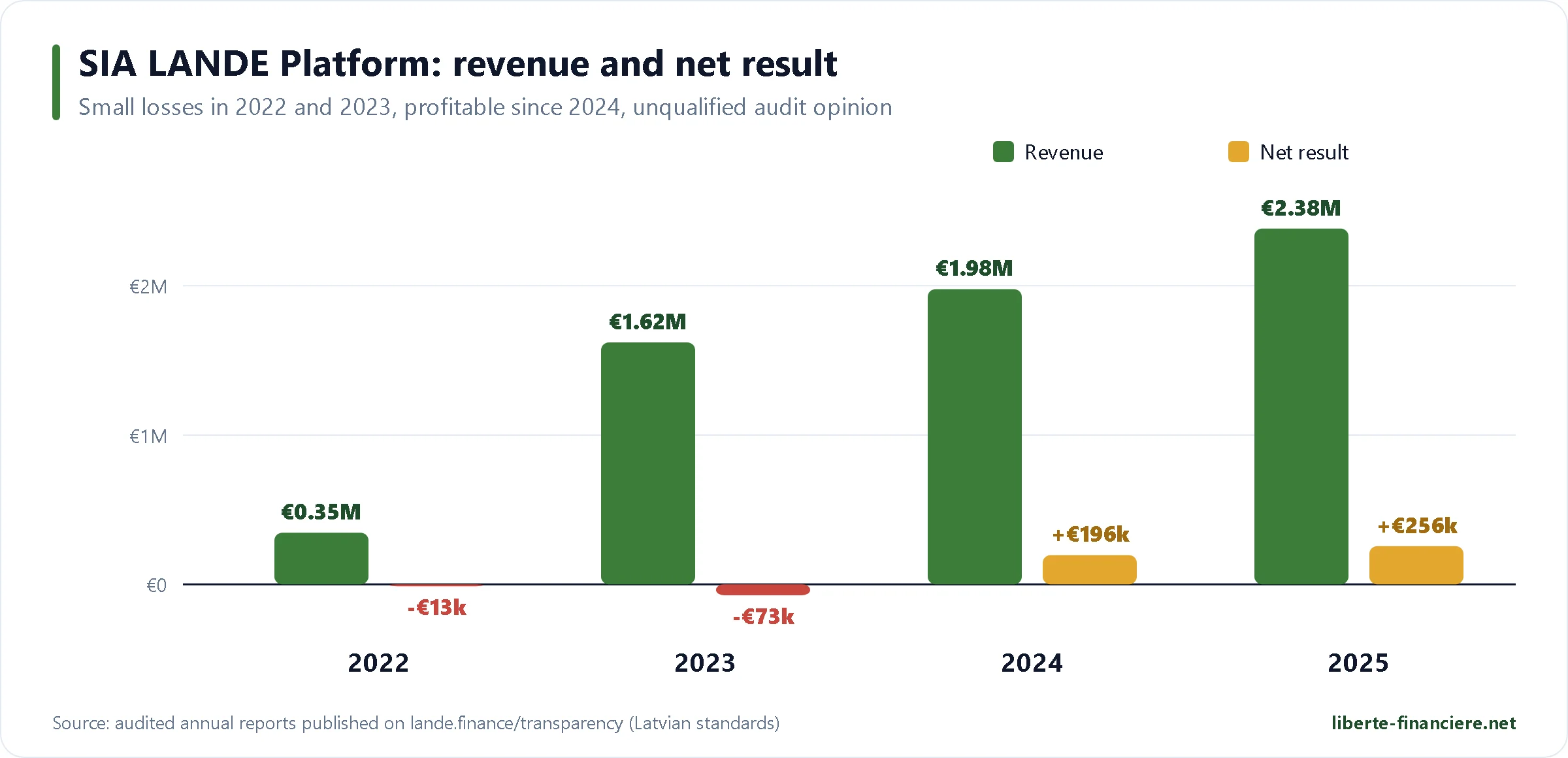
Revenue grew from €346,087 in 2022 to €2.38M in 2025 (+20% year on year). After two small losses (-€12,981 in 2022, -€73,129 in 2023), the company has been profitable since 2024: €196,086, then €256,335 in 2025, a net margin of 11%. At the end of 2025, its equity stood at €722,593 and its cash at €522,950, about three months of expenses. At group level, including the subsidiaries, LANDE reports €2.9M of revenue and €360,600 of profit, figures that are not audited. You can find the detailed analysis and the rating of these accounts in my financial statements of the LANDE platform.
Three points deserve your attention:
Unsecured loans to related companies: in 2025, LANDE lent €418,650 to its subsidiary SF MGMT Collateral, the Latvian collateral agent, repayable on 14 April 2030, and €51,609 to a member of the Management Board, at 5% until the end of 2026. None of these loans is secured, and together they represent 65% of equity.
Modest cash for a platform that manages €31.6M of outstanding loans, even if it remains above the regulatory minimum.
Dividends: €50,000 of exceptional dividends were paid for the 2025 financial year, and the report plans to distribute part of the profit again.
Nothing alarming for a small, profitable and audited company, but this is not a bank's balance sheet. That is why the platform's financial strength rating, in my financial statements analysis, remains average (2.42 out of 5) despite its profitability.
How do you open a LANDE account?

Signing up takes less than 5 minutes. LANDE accepts any adult or any company with a bank account in the SEPA area, and the website is available in English.
Click on my sign-up link to get 3% cashback on your first 30 days, then create your account with your email and a password.
Verify your identity with an ID document and a selfie, then take the knowledge test required by European regulation.
Fund your account. Two options: a standard SEPA transfer, quoting your personal reference "LENDSECURED-…", credited in one to three business days; or Pay by Bank, an instant payment from your online banking, credited in one minute, free from €500 and charged €0.50 below that.
Invest manually from €50 per loan, or create an Auto Invest strategy (see below).
To withdraw, add your IBAN with a bank statement: Lemonway checks it manually the first time.
If your traditional bank blocks the first transfer to a foreign IBAN, which does happen, call your bank adviser or use Pay by Bank. Company accounts are accepted, with the company's documents.
Create my LANDE account Less than 5 minutes, from €50 per loan. 3% cashback on your first 30 days with my link. |
 Investing on LANDE: manually or with Auto Invest
The primary market lists new projects with their country, collateral, repayment schedule, rate, LTV and term. Each loan page describes the farm, the purpose of the loan, the collateral and its value, with the key information sheet to download. A "Borrower" tab gives the name of the farm and, for a company, its registration number.
Auto Invest: two options and a queue
There are two automatic strategies. The simple version invests from €50 in every new project, with no criteria at all. The advanced version, from €100 per project, lets you filter by rate, LTV, term, collateral, repayment schedule and country. Two drawbacks: a strategy can no longer be edited after its first investment (you have to create a new one), and investments are served on a first-come, first-served basis. When there are many investors and few projects, your robot waits its turn. In my case, it never really worked: I invest manually.
 My criteria for choosing a loan
Land as collateral rather than machinery: this has been my choice since spring 2026, after my first default on a machinery loan.
An LTV of 60% at most, ideally below 50%. Above that, the safety margin becomes too thin in a forced sale.
A rate of at least 11%: below that, the return does not make up for the delays and the lack of buyback.
A term of 36 months at most, to keep some turnover.
Read the purpose of the loan: a refinancing is not necessarily bad, but I look at why.
These criteria reflect the way I invest and are not a universal rule: depending on your profile, you may prefer Romania for its higher rates, or annuity loans to get some capital back every month.
 The secondary market: free, but at par
To exit before maturity, LANDE offers a secondary market, called a "bulletin board" in the terms and conditions. You put all or part of a loan up for sale, with no fees at all, and you keep earning the interest as long as it is not sold. On sale, the month's interest is split between seller and buyer in proportion to the days.
The official rules are strict:
the price is always equal to the remaining principal: no discount to sell faster, no premium;
a loan of less than €100 is sold in full, above that in slices of at least €50;
loans in default, loans repaid in one go at maturity ("Full Bullet") and those with periodic payments cannot be sold;
a loan bought on the secondary market can only be resold after a new instalment has been paid.
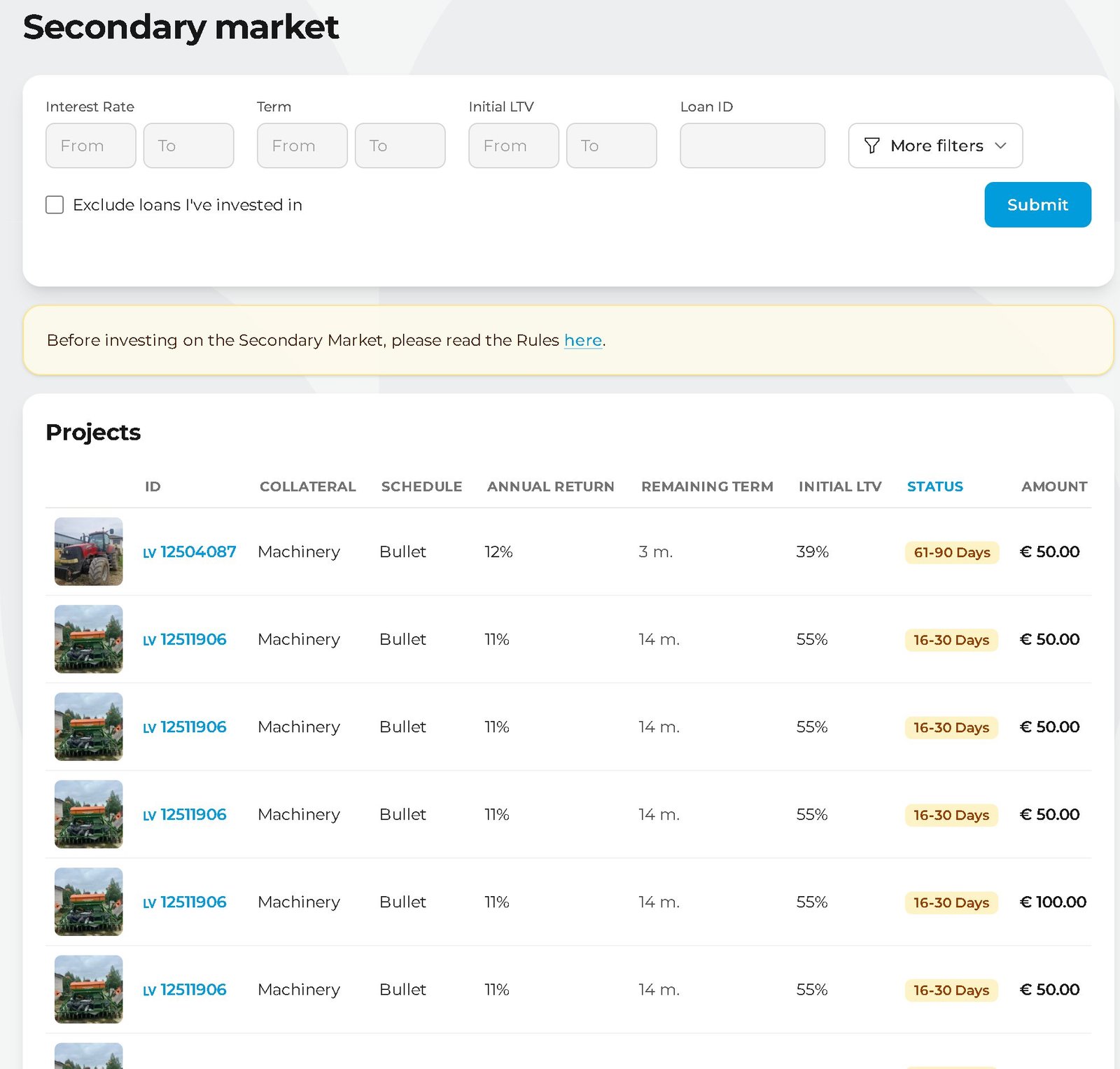
In practice, a current loan can usually be resold without too much difficulty, but nothing guarantees a buyer. As I write, 538 offers are for sale, and a good share of them are late loans that their holders are trying to sell before the situation gets worse. This is the trap I fell into in December 2024: I bought on the secondary market a share of a loan that was already late, without filtering on its status. It all ended well, but always filter on "current". The ability to sell at a discount or a premium is the first improvement investors are asking for, and LANDE has put it on its roadmap, with no date.
 Fees: free, unless you stop investing
LANDE does not charge you for signing up, investing, management, the secondary market or withdrawals. There are only two fees: €0.50 for a Pay by Bank deposit of less than €500, and above all, since the terms and conditions of 5 October 2026, an inactivity fee.
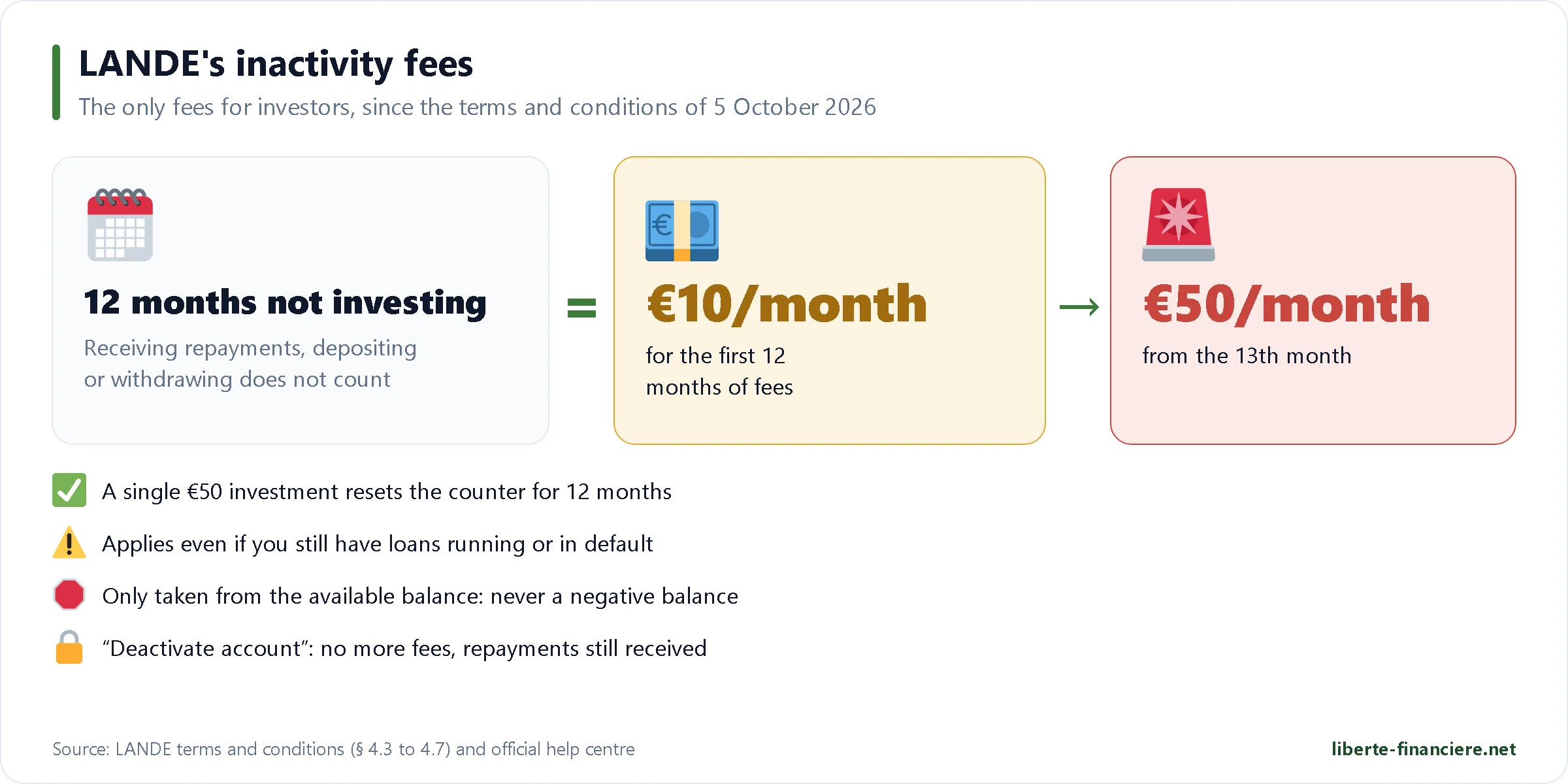
It applies if you have made no new investment for 12 months, on the primary or secondary market: €10 a month the first year, then €50 a month. Receiving repayments, depositing or withdrawing does not count as activity, and the fee applies even if you still have loans outstanding or in default, which upset some investors who are waiting for an old loan to be recovered. It is only taken from your available balance and never makes it negative.
To avoid it, LANDE gives two options: invest at least €50 once a year, or click "Deactivate account" in your settings. A deactivated account pays no fees, keeps receiving its repayments and lets you withdraw the money, but can no longer invest. The account can only be closed permanently once all loans have been repaid or settled, defaults included.
 The risks you need to know

I am not a financial investment adviser: every investment carries a risk of capital loss, and past performance is no guide to future performance. Here are the risks I see on LANDE, from the most general to the most specific. The platform also details its own in its official risk warnings.
Capital loss: if a farmer defaults and the sale of their collateral does not cover everything, you can lose part of your capital or of the accrued interest. No final loss has been reported to date, but several million euros are in proceedings.
Illiquidity: loans often run for two to five years, delays stretch the real term further, and the secondary market does not let you sell a defaulted loan. Only put money on LANDE that you will not need in the medium term.
Geopolitical and concentration risk: the whole portfolio is in four Eastern European countries, all neighbours of Russia, Belarus or Ukraine, and in a single sector, agriculture, which is exposed to the weather, to fertiliser and fuel prices and to EU subsidies.
Long recoveries: without buyback, a late loan can tie up your money for months or years, with different court procedures in each country.
Dependence on the platform: LANDE alone manages the collateral, through its subsidiaries, and the recovery. If it closed, the loans would still be yours, but following them up would be harder. It is still a small company and depends heavily on its founder.
Loans to related companies: 65% of LANDE's equity is lent without collateral to a subsidiary and to a director.
A return less regular than advertised: between delays, money sitting idle during funding and early repayments, the real return is often one point below the loan rate.
 LANDE taxation in France

LANDE does not withhold any tax at source: your interest is paid to you gross, and it is up to you to declare it. This is an advantage over some Lithuanian platforms that withhold 15%. In France, it is subject to the 31.4% flat tax (12.8% income tax and 18.6% social charges), or to the progressive income tax scale if that suits you better.
Annual return: report your interest on forms 2047 and 2042, and declare your LANDE account as a foreign account on form 3916 (SIA LANDE Platform, Roberta Hirša iela 1, LV-1045 Riga, Latvia).
Document to use: in the "Balance" tab, choose the year, then click "Income Statement" to download the annual statement as a PDF. There is no IFU (the French annual tax summary).
Monthly return (2778-SD): since nothing is withheld at source, you may have to declare the interest every month and pay the tax instalment as you go, depending on your reference taxable income.
Through a company: the interest is included in taxable profit, subject to corporation tax.
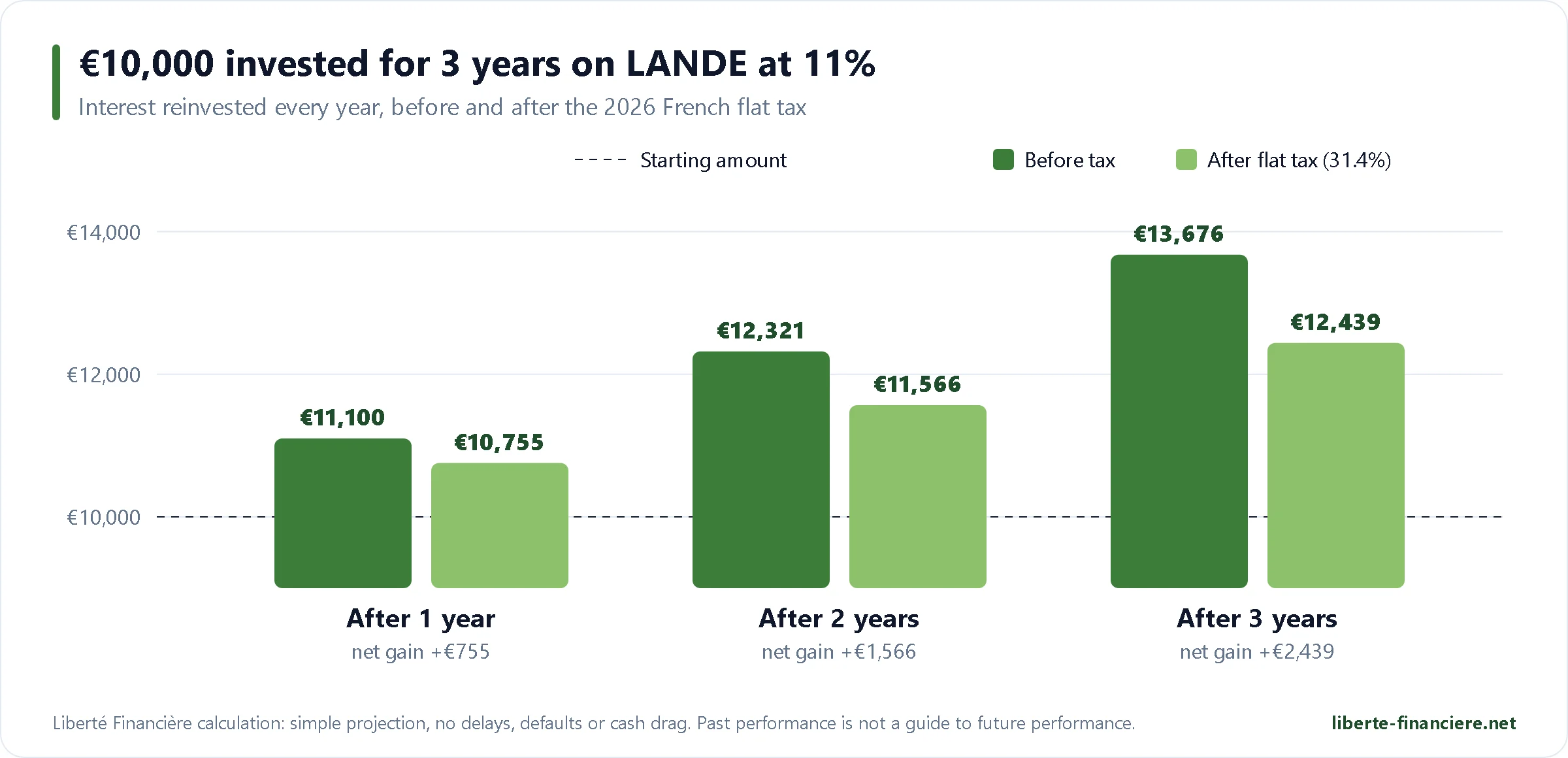
To get a sense of the effect of tax, here is a simple simulation: €10,000 invested for three years at 11% gross, with interest reinvested. Before tax, you end up with €13,676; paying the flat tax every year, with €12,439, a net return of about 7.5% a year. This is an order of magnitude, with no delays or defaults.
All the steps are detailed in my guide how to declare your P2P income for tax and in my article on withholding tax in P2P.
LANDE versus its competitors
I first compare LANDE with platforms offering loans secured by real assets or by a company, which often sit in the same portfolios. The returns are my real XIRRs excluding bonuses, calculated on all my cash flows on each platform.
Criterion |
|
|
|
|
|---|---|---|---|---|
Platform | LANDE | InSoil | Debitum | Income Marketplace |
Head office |
|
|
|
|
What you finance | Farms, directly | Farms, directly | Businesses, through lending companies | Loans from 14 lending companies |
Protection | Mortgage or pledge | Mortgage or pledge | Buyback by the lending company | Buyback at 60 days and junior share |
Regulation | ECSP | ECSP | MiFID II | None |
Withholding tax | None | 15% | 5%, reclaimable in France | None |
My XIRR excluding bonuses | I don't invest there | |||
|


 Estonia
Compared with InSoil, its direct Lithuanian competitor, and with Debitum, LANDE has the advantage of withholding nothing at source on your interest. Compared with Debitum and Income Marketplace, it earns me less, by two to three points, because its loans have no buyback and delays weigh on the return. In exchange, your risk rests on real land and not on the strength of a lending company: it is a useful diversification, not a replacement.
To widen the picture, here is LANDE against platforms with shorter, higher-yielding loans, where I also invest:
Criterion |
|
|
|
|
|
|---|---|---|---|---|---|
Platform | LANDE | Afranga | Nectaro | Swaper | Mintos |
Head office |
|
|
|
|
|
Regulation | ECSP | ECSP | MiFID II | None | MiFID II |
Typical term | 1 to 5 years | A few months to 3 years | A few months | A few months | A few months to 2 years |
My XIRR excluding bonuses | |||||
|


 Bulgaria
On return alone, Afranga, Swaper and Nectaro do better, with shorter loans and a buyback by the lending company. LANDE is on a par with Mintos. Its appeal lies elsewhere: a different risk, backed by real assets, in a sector that does not depend on consumer credit. I see it as a diversification pocket, in the same way as fractional real estate.
 My experience: €13,669 and 11.33% a year
I made my first deposit on LANDE on 24 December 2024, €1,000 in total that month, invested straight away. I added to it in stages in 2025 (€2,000 in February, €2,850 in March, €4,000 in August, €2,000 in September), then more slowly in 2026. In total, I have deposited €15,850 and withdrawn €4,132, mainly in summer 2026, when a wave of early repayments left me with cash I could not reinvest at a good rate. My account is now worth €13,669.
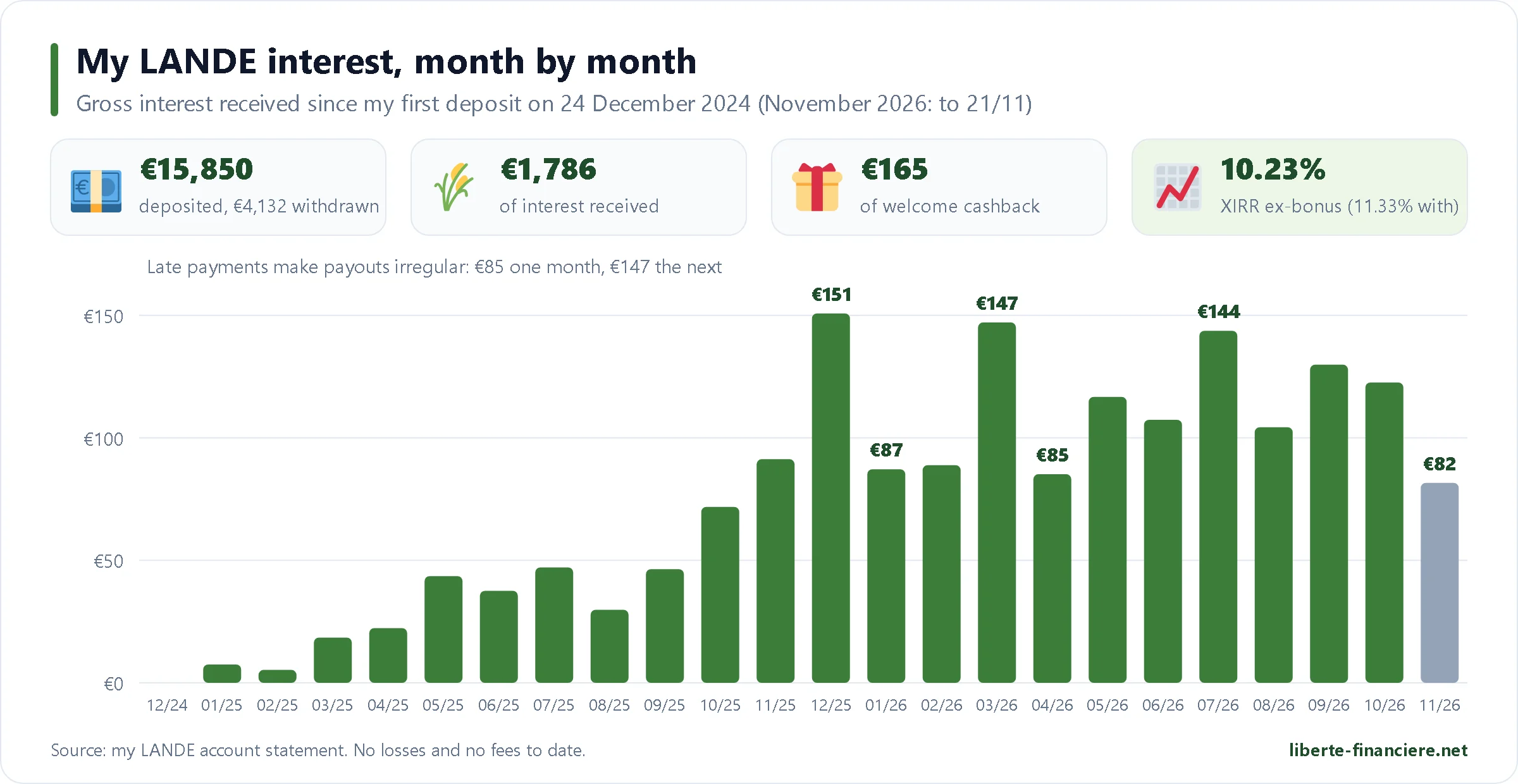
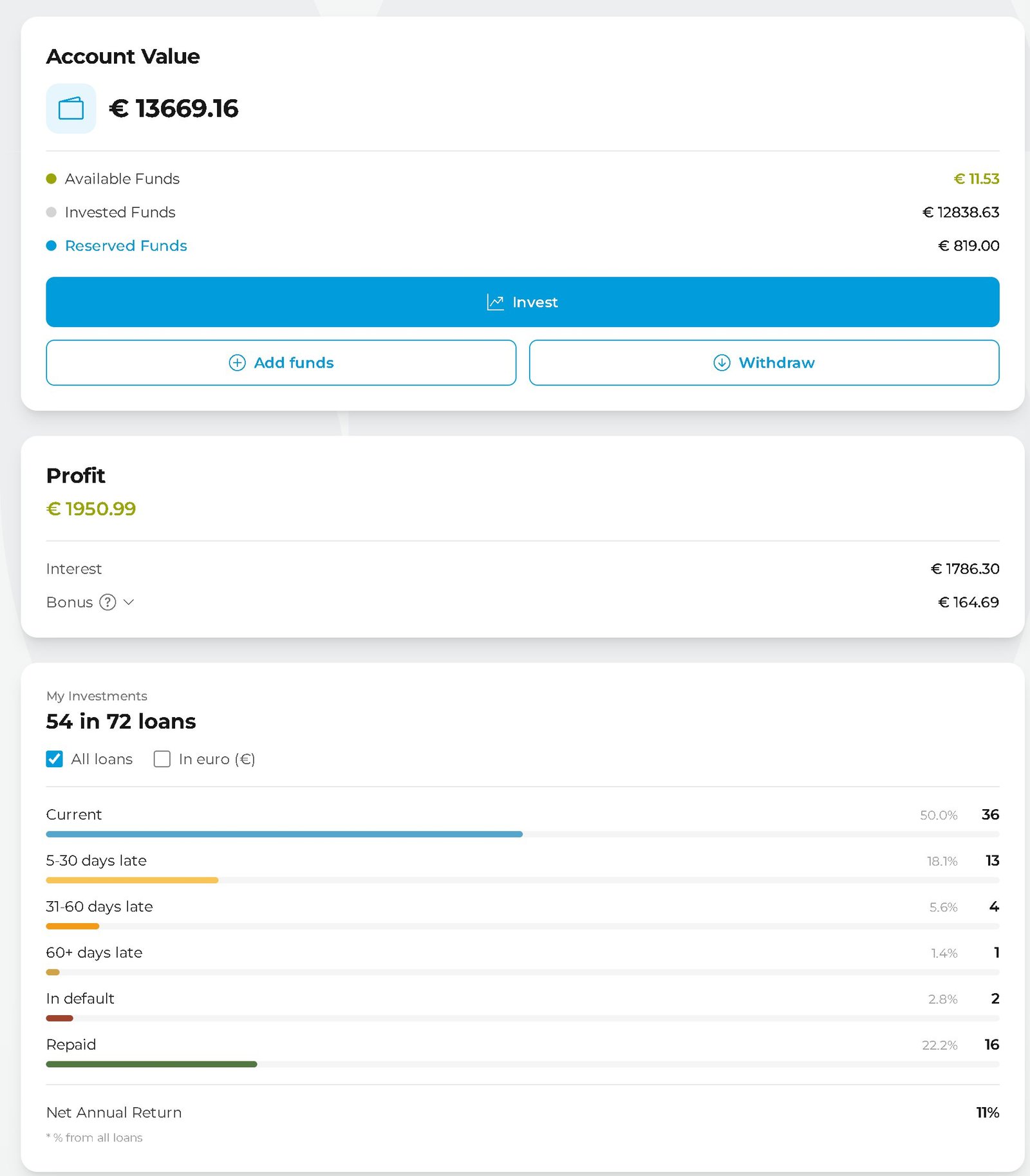
In almost two years, LANDE has paid me €1,786 in interest and €165 in welcome and campaign cashback, with no losses and no fees. My real return, measured by the XIRR, which takes into account the date of each cash flow, is 11.33% a year including bonuses, and 10.23% excluding bonuses. That is below the 11 to 12% of the loans I chose, and it makes sense. Be aware: a late loan stops paying interest until it is brought up to date. You generally get it back later, but this lag lowers the XIRR. On top of that, money reserved during funding earns nothing, and some loans were repaid early. The 11% "net annual return" shown by LANDE is an XIRR calculated by the platform, close to mine.
These same delays make the payments irregular: €85 one month, €147 the next. At 23 November 2026, I have 72 investments spread over 61 loans: 16 are repaid, 37 are current (including 3 still in funding), 17 are late (12 by 5 to 30 days, 3 by 31 to 60 days and 2 by more than 60 days), i.e. 13 different loans, and 2 are in default. By amount, 38% of my invested capital is late (€4,870 out of €12,839), and €937 is in default.
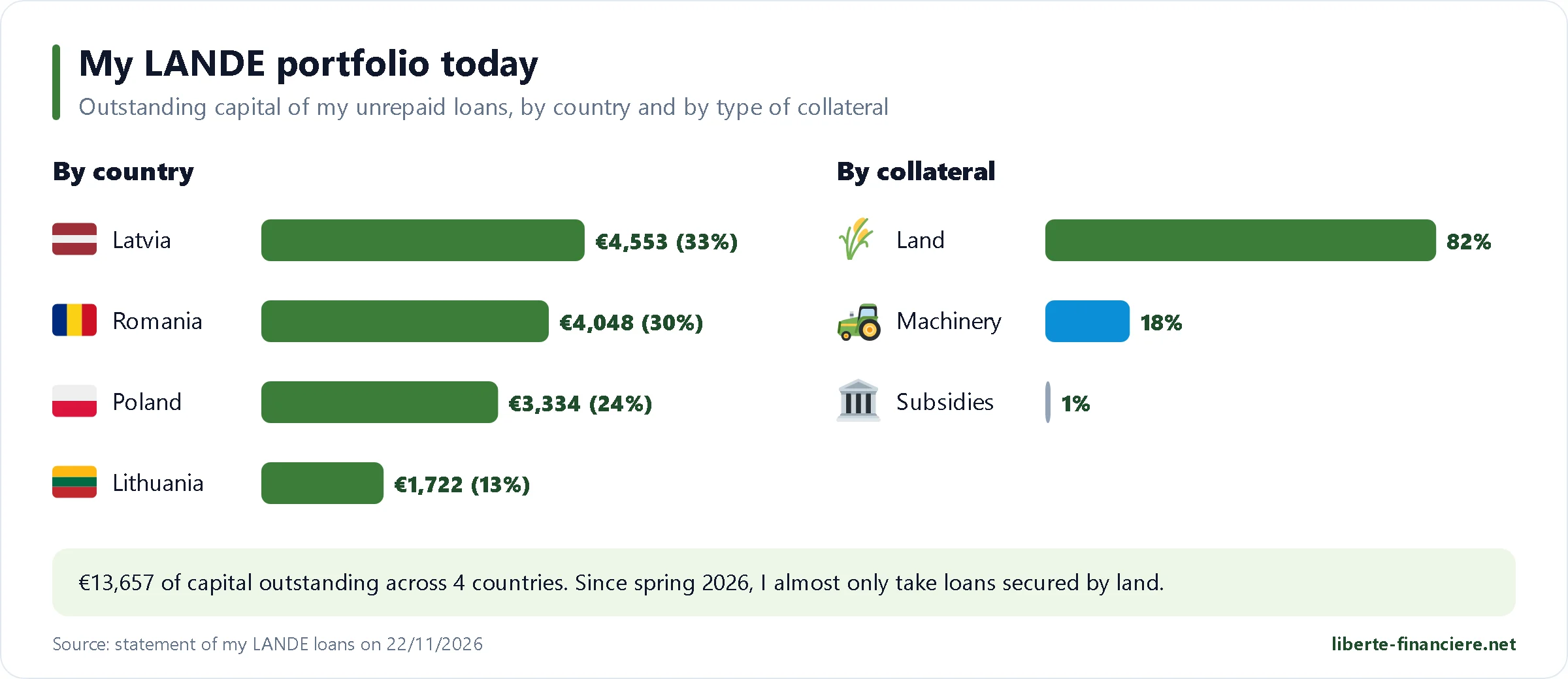
My two defaults are Romanian: an €18,000 machinery loan and a €33,500 loan secured by a plot of land, both granted in summer 2025 at 11%. They are in recovery, and I have not lost a single euro yet, but it was the first machinery loan that made me decide to only take land from then on. Since then, 82% of my portfolio has been secured by land, spread across the four countries:
So my feeling is mixed. On the one hand, the platform is serious, regulated, profitable and transparent, its CEO is very responsive, and the land collateral really reassures me: it is the only platform in my portfolio where, if something goes wrong, there is a field behind my loan. On the other hand, the level of delays is too high for my taste, recovery takes time and the real return remains a little below the other P2P platforms. I reinvest my interest, but I am not adding fresh money until I have seen the next repayments, in particular those of my late Polish loans and the outcome of my two defaulted Romanian loans. I will update this article as things develop.
Pros and cons
|
|
|---|---|
Real collateral: mortgage on land or pledge, average LTV of 41% (see the collateral section) | Lots of delays: 44% of the capital still owed is rescheduled, late or in default (see the statistics) |
European ECSP licence, audited accounts, profitable since 2024 | No buyback: a default is settled through a recovery that can take years |
Returns of 10 to 14%, with no withholding tax | Real return a little below the advertised rate (10.23% excluding bonuses for me) |
Direct loans to farms: no risk linked to a lending company | Inactivity fee after 12 months without investing, even with loans outstanding |
Rare transparency: monthly reports, defaults by year and by country, follow-up of every late loan | Unsecured loans from LANDE to its subsidiary and to a director (65% of equity) |
Free secondary market, responsive team, website in English |
 Cons
 Who is LANDE for?
Profile | Is LANDE a good fit? |
|---|---|
You want to diversify your P2P with loans backed by land | Yes |
You want a platform regulated at European level | Yes |
You accept frequent delays and long recoveries in exchange for real collateral | Yes |
You like choosing your loans one by one | Yes |
You invest through a company | Yes, companies are accepted |
You want perfectly regular interest every month | Not really |
You may need your money within the year | Not really |
You are a beginner and want a simple product with fast withdrawals | Not really: look at Monefit or Bondora |
 What users say
On Trustpilot, LANDE scores only 2.6 / 5 from 57 reviews to date, a rating the site describes as "poor". The distribution is very polarised: lots of five-star reviews and lots of one-star reviews, few in between. LANDE does not invite its customers to leave a review, which often drags the rating down.
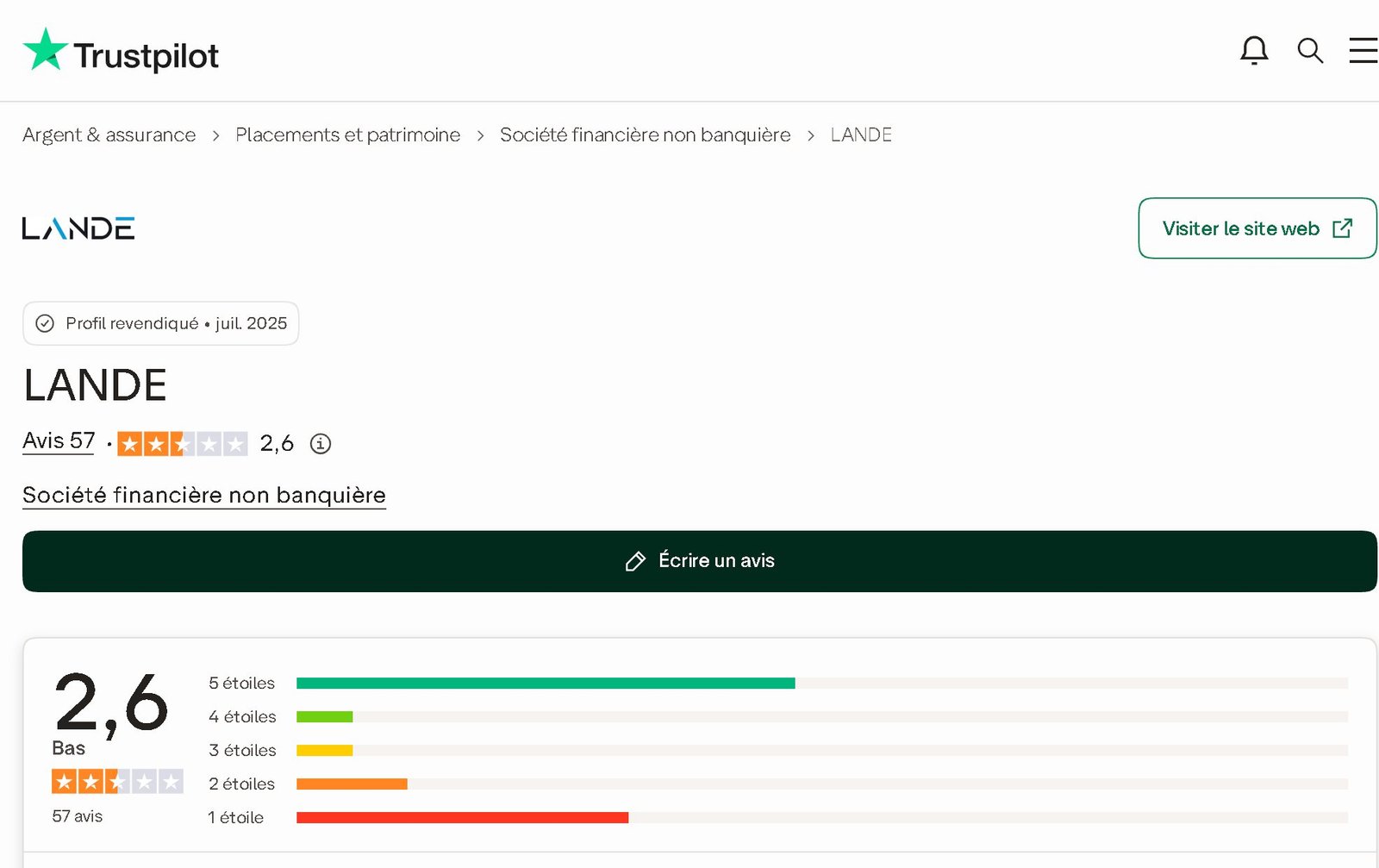
Positive reviews praise the transparency, the returns, the secondary market and the quality of support. Negative reviews are almost all about the same issues: loans that have been late for months, recoveries under way since 2023, and, since October 2026, the inactivity fee charged to investors who are precisely waiting for a recovery to end. In my community on Telegram, the recurring questions are about the level of delays, the difference between a default and a loss, and how to choose your loans.
 Lande Finance bonus code

There is no code to enter: by signing up with my link, you get 3% cashback on your primary market investments during your first 30 days. Secondary market purchases do not count: to make the most of it, invest your first deposit in new projects in the very first days. LANDE also regularly runs cashback campaigns in spring and autumn. All the conditions are on my Lande Finance bonus code page.
Get the LANDE bonus 3% cashback on your primary market investments during your first 30 days, no code needed. |
 Frequently asked questions about LANDE
Is LANDE a scam?
No. It is a Latvian company licensed by the Bank of Latvia since 2024, whose accounts are audited without qualification and published, and which has been financing real farms since 2020. Its loans are still risky: frequent delays and no buyback.
Is LANDE regulated?
Yes, under the European ECSP licence granted on 7 February 2024 by the Bank of Latvia. It does not include an investor compensation fund.
Does LANDE have a buyback guarantee?
No. Each loan is secured by a mortgage on land or a pledge on machinery; in case of default, LANDE recovers the debt and has the collateral sold.
What happens if a farmer does not repay?
LANDE sends reminders, a formal notice, terminates the loan and then has the collateral sold, through the courts or a bailiff. The amounts recovered are shared among the investors in proportion to their investment. This can take months, or even years.
Have investors ever lost money on LANDE?
No final loss has been reported to date in the regulatory indicators. 109 loans are in default, meaning in recovery, for €2.3M of capital still owed (€3.2M at their original amount). Their outcome is not yet known.
What happens if LANDE goes bankrupt?
Your loans belong to you and your uninvested money is ring-fenced at Lemonway. The collateral is held by dedicated subsidiaries, and the ECSP licence requires a business continuity plan, but recovery would be slower and less certain.
How do I get my money back before maturity?
Through the secondary market, free of charge, at the price of the remaining principal. Defaulted loans and loans repaid in one go at maturity cannot be sold.
Are there any fees on LANDE?
No, except an inactivity fee since 5 October 2026: €10 a month, then €50, after 12 months without a new investment. Deactivating your account removes it.
Does LANDE withhold tax at source?
No. Your interest is paid gross; in France, you declare it (forms 2047, 2042 and 3916) and pay the 31.4% flat tax.
How much do you need to start?
€50 per loan, €100 per project with the advanced Auto Invest. To spread the risk over about twenty loans, allow at least €1,000.
Which bonus code should you use on Lande Finance?
No code: go through my link to get 3% cashback on your primary market investments during your first 30 days. The current offer, if there is one, is shown at the top of this article.
Conclusion: my opinion on LANDE
LANDE is a platform apart in P2P: direct loans to European farmers, secured by their land or their machinery, with a European licence, audited and profitable accounts, and rare transparency about its defaults and recoveries. The advertised 11% is real on paper; for me, it translates into 10.2% a year excluding bonuses, with no losses to date.
The trade-off is patience: lots of delays, no buyback, recoveries counted in months or years, and a return less regular than elsewhere. So I keep LANDE as a diversification pocket of about €13,600, invested first and foremost in land-backed loans, and I am watching three things: the outcome of my defaulted loans, the auctions in Romania and how the loans granted in 2025 and 2026 hold up. If you want to get started, go through my link to get 3% cashback on your first 30 days.
Investing involves a risk of capital loss. This article reflects my personal experience: I am not a financial investment adviser.
Add a comment
A question or your own experience to share? Leave a comment: I reply personally.