Indemo, a Latvian investment firm licensed by the Bank of Latvia, is one of the few European platforms that let you invest in unpaid Spanish mortgage debts, bought from banks at a steep discount. Launched in 2023, it already claims €40.1M invested, more than 25,100 clients and 28 cases repaid without a single loss to date.
In this review, I go through Indemo's history, its team and shareholders, the full legal structure (from the Spanish bank to your Note), the 24 steps of a property foreclosure in Spain, the six ways the money is recovered, what the advertised 20.5% return really measures, why your account will show a much lower return for the first two years, the delayed cases, the company's accounts, regulation, the 2026 Spanish decree, fees, French taxation and how it compares with La Première Brique and the other platforms I use.
This article is not sponsored by Indemo. Some links are affiliate links: if you sign up with my link, you get +0.5% cashback on top of Indemo's cashback campaigns, as a new user who signed up through my link.

 Current offer : Black Friday
- 5% cashback for everyone on every investment
- No tiers: from €10 invested, cashback paid straight away
This offer comes on top of the usual offer.
Get the offer →Until 30 November 2026
 Indemo at a glance
Criterion | Indemo |
|---|---|
Founded | Company registered on 20 May 2022, platform opened to the public in 2023 |
Company | Indemo SIA (Latvian limited liability company), no. 40203401432 (Latvian register entry, Lursoft) |
Head office |
|
Management | Sergejs Viskovskis, CEO and Chairman of the Board |
Regulation | MiFID II investment firm licensed by the Bank of Latvia (licence no. 06.06.08.824/547) |
Investment type | Notes (debt securities), each backed by a single unpaid mortgage debt |
Property location |
|
Return | 15.1% a year targeted (middle scenario), 20.5% on average on the cases already repaid only |
Payout | Capital and gains in one go, at the end of the case: no monthly interest |
Term | Estimated maturity of 2 years in general, which can be brought forward or extended |
Liquidity | No exit before the end of the case: secondary market announced, not yet open |
Minimum investment | €10 per Note |
Fees | None to invest, deposit or withdraw; €2.90 a month on an inactive account |
Withholding tax | 5% in Latvia for a European Union tax resident |
Volume | €40.1M invested, €35.9M outstanding, €4.9M repaid |
Losses | No case closed at a loss to date, according to Indemo |
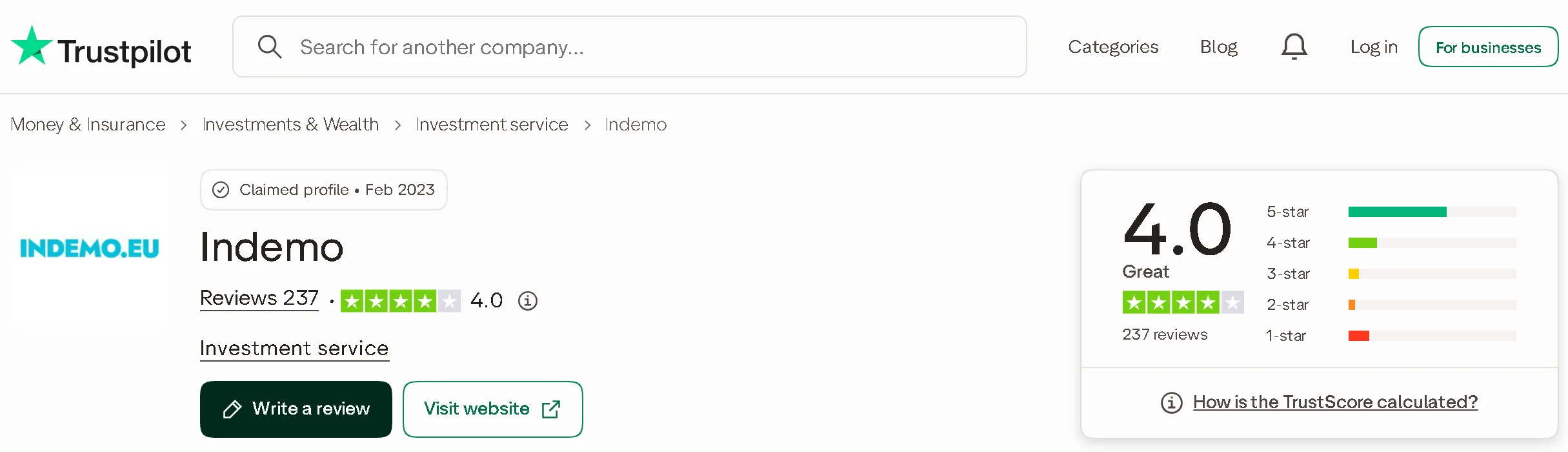
Trustpilot | 4.0 / 5 from 237 reviews |
Bonus | +0.5% cashback on top of Indemo's cashback campaigns, for a new user who signed up through my link |
Indemo is unlike any other platform you may know. It is not consumer lending like on Mintos or PeerBerry, nor developer financing like on La Première Brique: you finance the purchase of a debt that is already in default, and your gain depends on what is recovered from the mortgaged property. No buyback guarantee, no monthly interest, but a safety margin that comes from the discount at purchase. On the site, Indemo is listed under real estate crowdfunding: you can see how its regulation compares with the others in my P2P comparison tool.
Discover Indemo From €10 per Note, +0.5% cashback on top of the campaigns for a new user who signed up through my link. |
 From 2022 to 2026: the story of Indemo
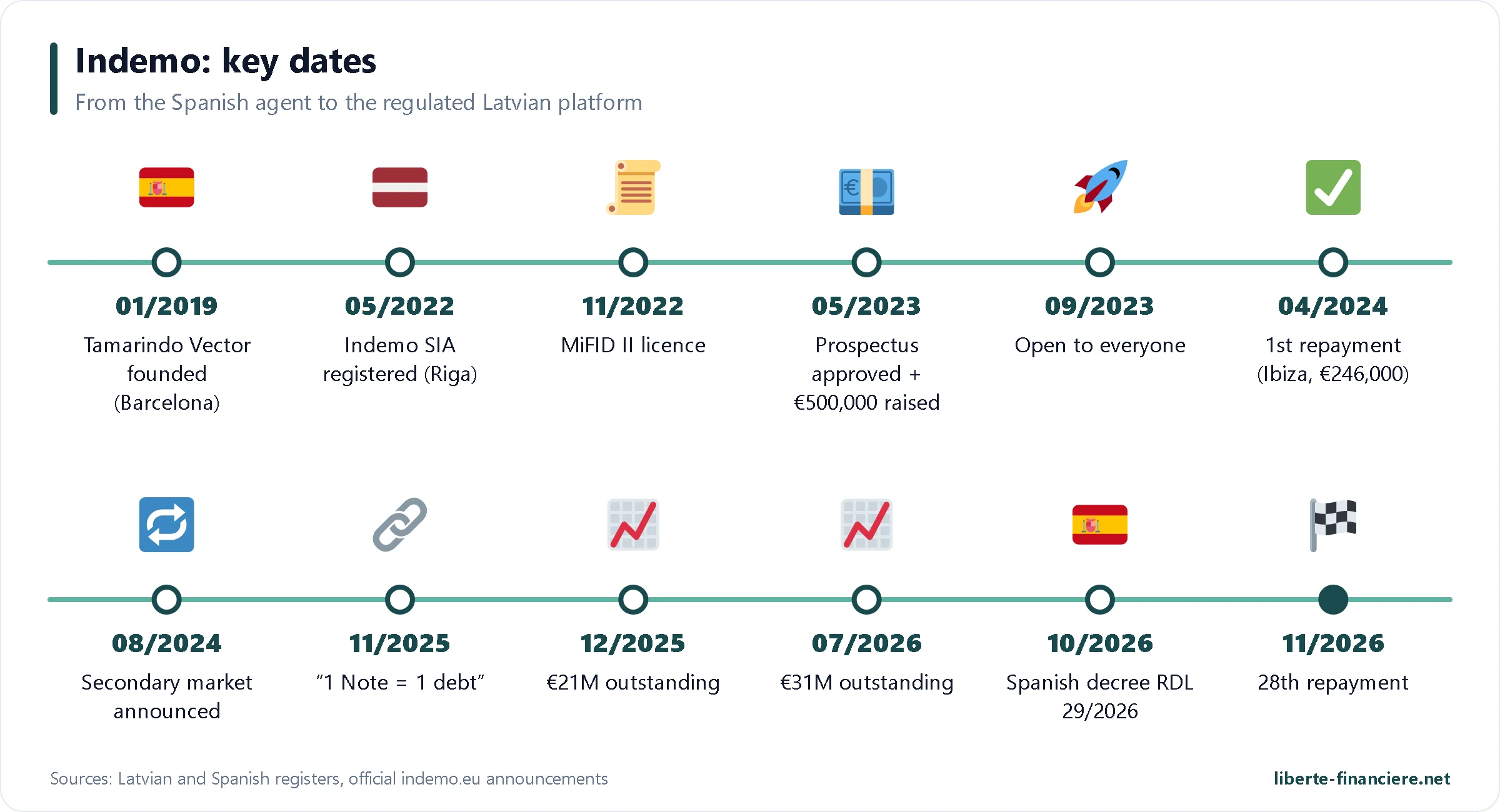
The story begins in Spain, before Indemo. On 16 January 2019, the company Tamarindo Vector S.L. was set up in Barcelona to buy unpaid mortgage debts; it was registered with the Bank of Spain as a real estate lender in June 2020 (key information document). It lacked one thing: money to buy more cases. That is the role Indemo would play.
Indemo SIA was registered in Riga on 20 May 2022. It applied for its licence in June and on 15 November 2022 obtained its investment firm authorisation, issued by the former Latvian regulator and taken over since 1 January 2023 by the Bank of Latvia. In 2023, everything sped up: a €437,500 capital increase in January, creation of the vehicle issuing the Notes in February, approval of the first prospectus (a €25M programme) in May, then a €500,000 fundraising round at a €2.5M valuation.
The platform ran in test mode from June 2023, opened sign-ups to everyone in September, then announced its official launch on 7 November 2023. At the end of 2023, it had 405 users and €1.16M of Notes funded. At the time, a Note grouped several debts: eight properties in the same basket.
On 8 April 2024 came the first repayment: a 119 m² flat in Ibiza, €246,000 recovered by selling the debt on to a specialised buyer, even before taking possession of the property (official announcement). In October 2024, Indemo passed €5M funded and 3,000 investors, then raised €556,000 at the end of the year at a €7.5M valuation. It was also in 2024 that it first announced a secondary market (post of 13 August 2024): we will see below that it is still not open.
2025 was the year it took off: €10M outstanding in May, €15M in September, €21M in December. On 3 November 2025, Indemo changed its model: one Note = one single debt, with new terms and conditions and new documents (official post). Two new Spanish partners arrived, Real Magna 1 and Aveine Invest, with their own prospectuses.
In 2026, Indemo delivered AutoInvest 2.0 in March, a dynamic portfolio revaluation and a mobile app in June, then published a new €50M prospectus for Tamarindo Vector in July. It passed €31M outstanding in July. The autumn was more turbulent: security maintenance completed on 22 October with all services restored (official news), then a debate over the Spanish housing decree, which I cover in its own section. The 28th case was repaid on 3 November 2026.
 Indemo's management team and shareholders
 Sergejs Viskovskis (LinkedIn) has run Indemo since it was founded: he has been CEO and Chairman of the Board since 20 May 2022, and the press release for the first fundraising round presents him as co-founder. He is also the one who signs the letters to investors, including the two clarifications of October and November 2026 on the Spanish decree. He personally owned 5.24% of the capital at the end of 2025, according to the annual report.
The team page on the official site is short: four people, with no detailed biography, who also make up the board of Indemo and its two subsidiaries:
 Jeļena Kibale, Chief Risk Officer (CRO), board member since 22 September 2025.
 Daniels Zirjakovs, Chief Technology Officer (CTO), board member and shareholder from the start.
 Vladimirs Slapakovs, Chief Financial Officer (CFO), board member since 13 November 2024.
Be careful if you read other presentations of Indemo: many still name Aleksandrs Volosins and Pāvels Počtarenko as CFO and CRO. The 2024 and 2025 annual reports show that they left the board, the first on 13 November 2024, the second on 22 September 2025. They remain among the small shareholders. The company employed 12 people on average in 2024 and in 2025, and since June 2025 has outsourced part of its administration and marketing.
 Ilja Hagins, on both sides
The most important name is not on the team page. Ilja Hagins, who presents himself as co-founder, is Indemo's largest shareholder: 34.23% of the capital at the end of 2022, then 28.09%, 24.74% and 20.92% at the end of 2025 as fundraising rounds went by. The prospectuses present him as a former head of wealth management at the Latvian bank Rietumu Bank, active in Spain since 2019, with more than 500 mortgage loans handled.
Above all, he runs Tamarindo Vector and Aveine Invest on his own, and co-runs Real Magna 1: the three Spanish companies that buy the debts and on which all the Notes depend (prospectuses for Tamarindo Vector, Real Magna 1 and Aveine Invest). He does not own their capital: the sole shareholder of Tamarindo Vector is Alexander Nazarov, that of Real Magna 1 is Viral Jashbhai Patel, and the beneficial owner of Aveine Invest is Magameds Ismailovs.
This is a point you need to understand properly. On the one hand, it is reassuring: the person who selects and manages the cases in Spain has a stake in the platform, and knows the business. On the other, it is a conflict of interest that the prospectus itself acknowledges: the seller of the cases and the largest shareholder of the company that offers them to you are linked, and the three Spanish partners rely on the same person. For an investor, all recovery therefore depends on a single network. I come back to this risk in the section on risks.
 Who owns Indemo?
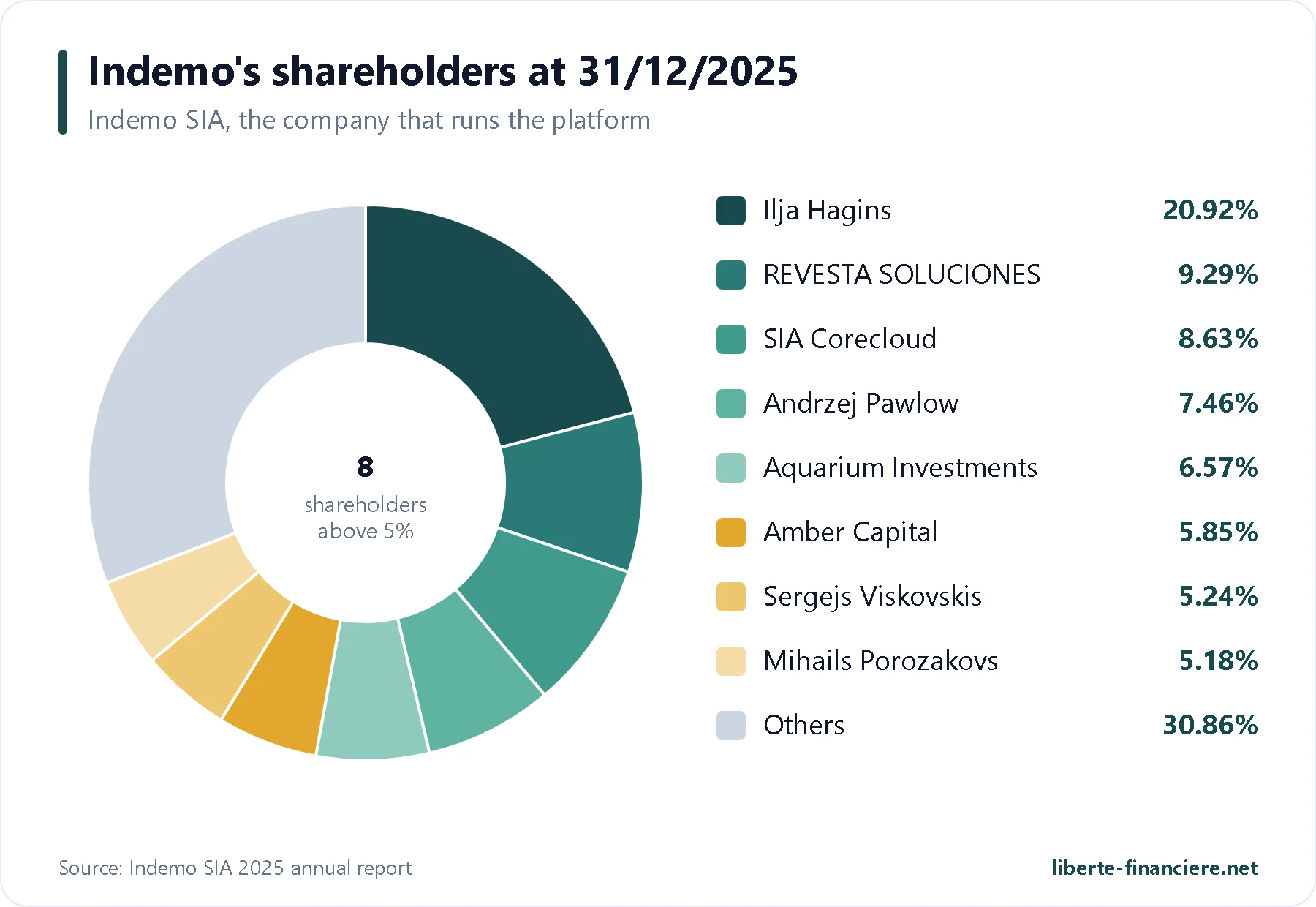
Indemo does not belong to any financial group. Its capital is spread among around twenty shareholders, mostly private Baltic and Spanish investors, who have contributed €2.19M in total since 2022 (capital and share premium, according to the 2025 report). Here are the main ones at 31 December 2025:
Shareholder | Stake at end of 2025 |
|---|---|
Ilja Hagins | 20.92% |
REVESTA SOLUCIONES S.L. ( | 9.29% |
SIA Corecloud ( | 8.63% |
Andrzej Pawlow | 7.46% |
AS "Aquarium Investments" IPS ( | 6.57% |
Amber Capital Investment Ltd ( | 5.85% |
Sergejs Viskovskis (CEO) | 5.24% |
Mihails Porozakovs | 5.18% |
Other shareholders (less than 5% each) | 30.86% |
 Cyprus)
The breakdown is still changing. The Latvian register now shows 21 shareholders, and SIA Corecloud appears there with 26.42% of the capital, against 8.63% a year earlier; the names of individuals are not shown. The same register notes that it was not possible to identify a single beneficial owner, which makes sense for such a widely held company. Finally, the 2025 report mentions a possible capital raise from the platform's clients: if it happens, you could one day become an Indemo shareholder, which is a completely different risk from buying Notes.
Indemo's auditor was Crowe DNW from 2022 to 2025, with unqualified opinions. The legal notice on the site now names BDO Assurance for the group's three Latvian companies: a change of auditor, with no date announced.
 How does Indemo work?
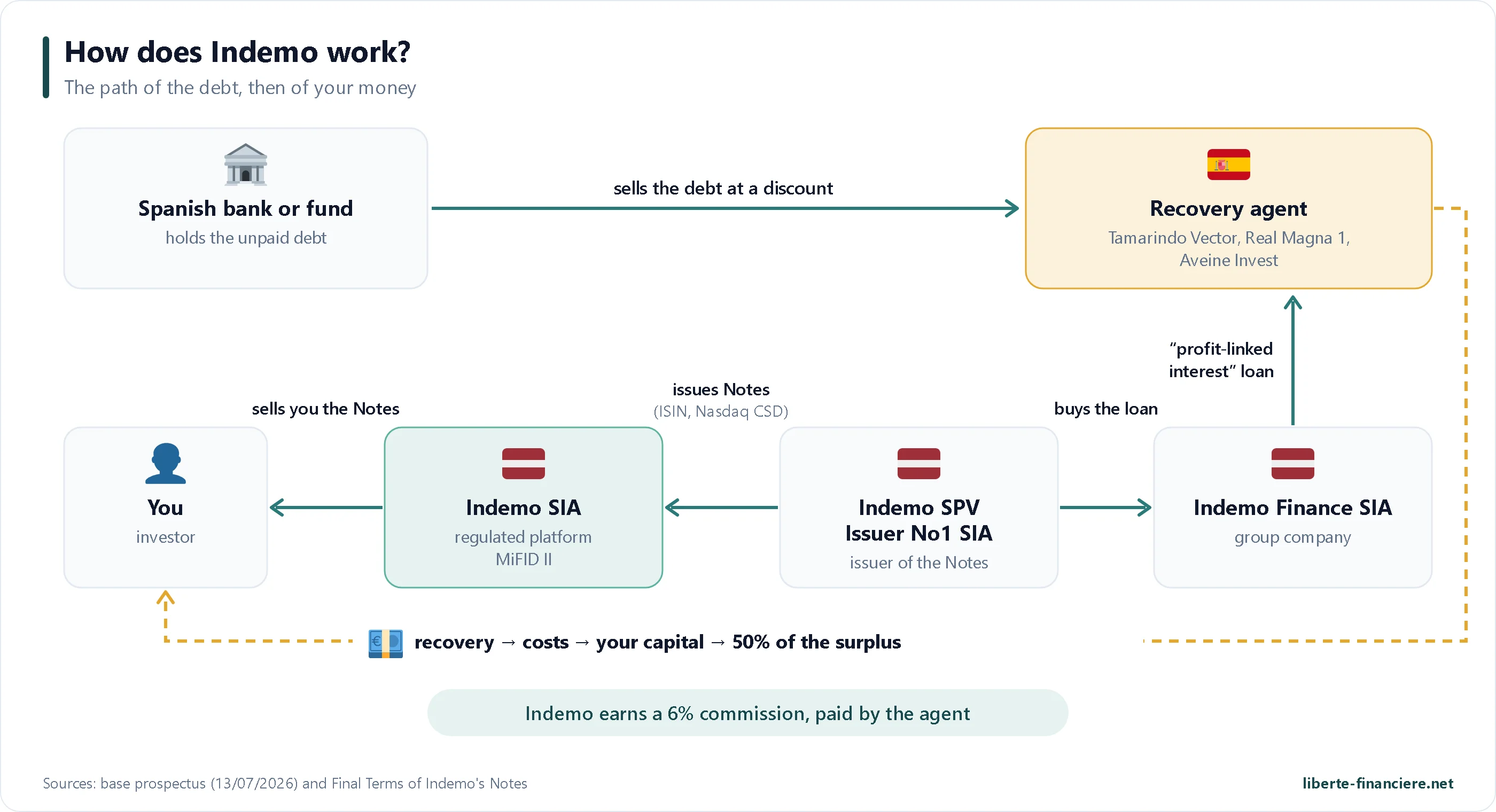
On Indemo, you buy neither a property nor a share of a traditional loan. You buy a Note, a financial security that entitles you to a share of what will be recovered on a single unpaid Spanish mortgage debt. To understand where your return comes from, and where the risks lie, you have to follow the money from start to finish.
 What is a discounted mortgage debt?
In Spain as elsewhere, when an owner stops repaying their home loan, the bank keeps a mortgage on the property. It can start a foreclosure, but it is slow, expensive in legal fees, and not its core business. Banks and funds therefore prefer to sell these unpaid loans in bulk, at a steep discount, to lighten their balance sheet and capital requirements. Specialised companies buy them, then take care of recovery.
According to the current prospectus, the cases offered on Indemo have things in common: 90% individuals and 10% companies, a default that occurred on average five or more years ago, a median price of around €150,000 per debt (from €75,000 to €500,000), and an average discount of 50 to 65% on the amount of the debt. They are often second homes, in large cities, tourist areas and university towns. The official product page states that fewer than 10% of the cases reviewed are selected, after legal analysis, internal rating, external valuation and approval by a committee.
The legal chain, from the Spanish bank to your Note
Here are the four links, as described in the key information document and the prospectus:
The Spanish foreclosure agent (the "Foreclosure Agent") buys the debt from a bank or a fund. There are three of them: Tamarindo Vector S.L. (
 Barcelona, B67360305), Real Magna 1 S.L. (B42797282) and Aveine Invest S.L. (B01936145), all registered with the Bank of Spain as real estate lenders.
Indemo Finance SIA, Indemo's Latvian subsidiary set up in July 2025, lends this agent the money that finances the purchase. The interest on this loan is not fixed: it depends on the outcome of the recovery.
Indemo SPV Issuer No1 SIA, the issuing vehicle (SPV, for "special purpose vehicle", a company created solely for this operation), buys this loan and issues a series of Notes against it, with an ISIN code and safekeeping at the central securities depository Nasdaq CSD.
Indemo SIA, the regulated company, sells you these Notes on its platform and holds your securities and your money.
The recovery itself (lawyers, court, negotiation, auctions) is entrusted by the agent to a Spanish case manager. The current prospectus does not name it; the former 2023 prospectus named ATLAN ADVANCE MANAGEMENT S.L., in Barcelona, and Tamarindo Vector's 2025 accounts still mention amounts owed to this group company.
This structure has a key consequence: you own neither the debt, nor the mortgage, nor the property. The mortgage is in the name of the Spanish agent. Your Note is a "limited recourse" bond: the issuer only pays you what it receives from the agent on that specific case, and the prospectus states that you have no direct recourse against the agent, the debtor or the manager.
 Profit sharing: 50% of the surplus
When the case is resolved, the money recovered follows a precise order, set by the prospectus. First the recovery costs, then the repayment of your capital, then the surplus, shared between the Noteholders and the Spanish agent. The share that goes to you is written in the final terms ("Final Terms") of each series: on a Note's page, it appears under the line "Interest 50%".
The prospectus's official example speaks for itself. The agent buys a debt for €100,000, the recovery costs €20,000 and brings in €170,000. First the €20,000 of costs are repaid, then the €100,000 of capital. €50,000 remains: the Noteholders receive half of it, i.e. €25,000, and the agent keeps the other half. If the case lasts two years, your gain is 25% over the period, i.e. 12.5% a year.
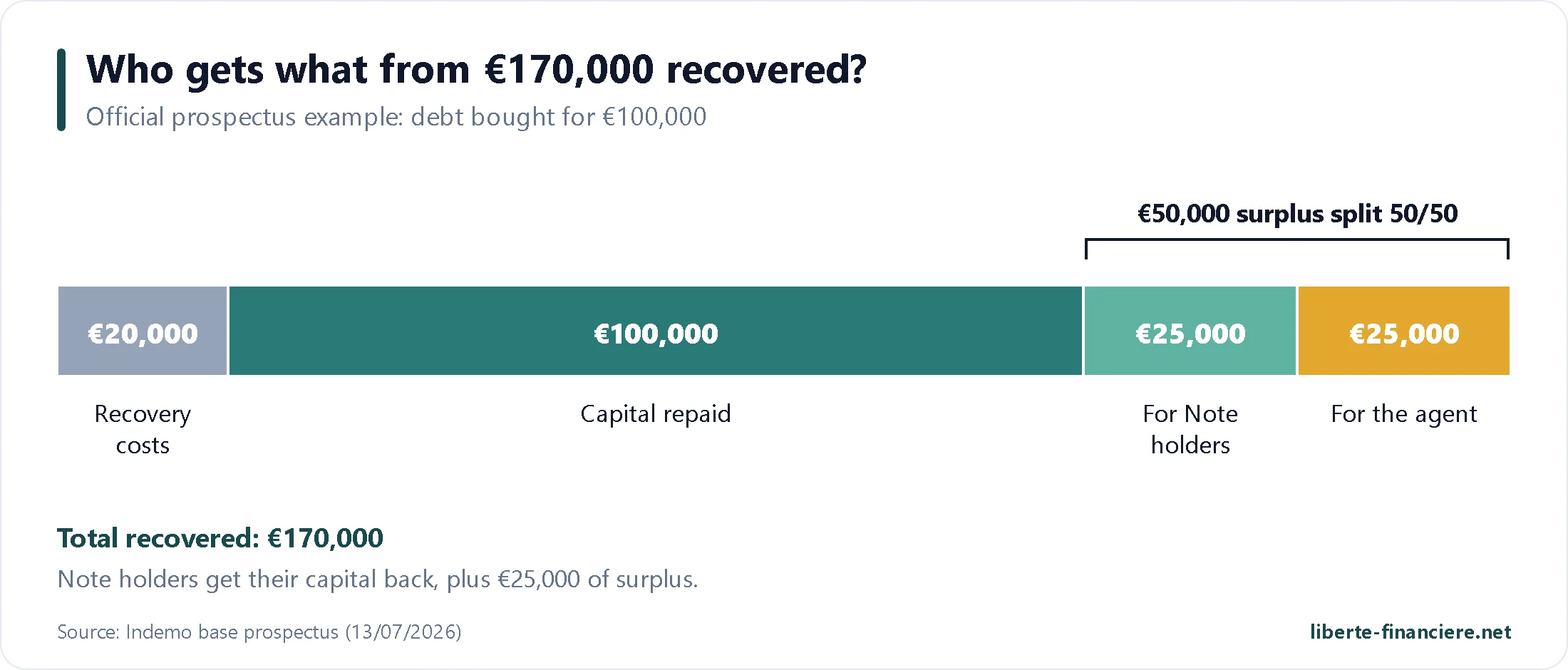
Two remarks. This sharing motivates the agent to recover as much as possible, since it earns along with you. But it also receives half of the surplus without having put up the purchase money: that is the price of its selection and recovery work. And Indemo's return calculation is a simple return, spread over the duration, with no compounding: a case that lasts longer for the same gain therefore yields less per year.
 PTV and PTD: the two ratios to read
Each Note shows two ratios that measure the discount:
PTV ("price to value"): price paid for the debt, relative to the estimated value of the property. A PTV of 60% means the property would have to lose 40% of its value for the sale to no longer cover the purchase price. That is your safety margin.
PTD ("price to debt"): price paid divided by the amount the debtor owes. A PTD of 50% means the debt was bought at half price. The lower it is, the more an amicable settlement can bring in, because the debtor owes much more than the agent paid.
The key information document assumes an average PTV and PTD of 62%. Indemo's home page shows an average discount of 57.3%. On the Notes open to date, the PTV ranges from 50.8% to 74.8%: the gap between two cases is large, and it is the first criterion I would look at before buying.
 What Indemo earns: a 6% commission
Indemo does not touch the recovery gains. It lives on a placement commission of 6% of the amount invested, paid by the Spanish agent once the series is fully subscribed: €600 for €10,000 invested, according to the costs and charges document ("Inducements" section). You do not see it on your account, and the key information document shows 0% fees. But it weighs on the economics of the case, since the agent has to recoup it somewhere.
This commission creates a classic bias: Indemo makes money when you invest, not when the case ends well. It is the same logic as most crowdfunding platforms, and the prospectus itself lists it among the conflicts of interest. The counterweight is reputation: a platform whose cases go wrong no longer raises anything.
 The 24 steps of a case, from court to sale

A Spanish property foreclosure does not happen overnight. Indemo breaks it down into 24 steps spread over 5 phases, shown on each Note as a progress bar and updated every month from the Spanish manager's reports (official description of the steps). Knowing them saves you from panicking over a case "stuck" at step 10 for six months: it is often normal.
Pre-litigation phase (steps 1 and 2): preparing the case, gathering documents, then filing the claim with the court.
Judicial phase (steps 3 to 9): the court accepts the claim, obtains from the land registry the certificate listing all charges on the property (step 4), notifies the debtor and demands payment. The debtor can object (steps 6 to 8), then appeal (step 9), which opens a new procedure before a higher court and can add many months.
Auction phase (steps 10 to 17): auction request, publication of the notice, payment of the fee, opening and closing of the online judicial auction, payment of the price by the court if a third party wins, or award of the property.
Adjudication phase (steps 18 and 19): the court awards the property to the creditor, who is registered as the new owner in the land registry.
Possession phase (steps 20 to 24): request for possession, notification of any occupants, hearing, eviction if necessary, then sale of the property on the market.
A Note does not necessarily come in at the beginning: you can buy a case at step 2 as well as at step 15. Cases at the start of the process generally have a bigger discount and higher potential, but their duration is more uncertain. Those reaching auction offer better visibility, with a smaller discount. Among the eight Notes open when I looked at the market, the steps ranged from 2 to 15.
Good news: most cases do not go all the way to step 24. Judicial pressure often pushes the debtor to negotiate well before. And the most recent case repaid, a house in Viladecavalls near Barcelona, ended with an amicable settlement as early as step 2, after 17 months (repayment announcement).
 The six ways out of a debt
This is the heart of the model: the Spanish agent does not need to recover the home for you to be repaid. Indemo describes six possible exits, from the fastest to the longest:
Early amicable settlement: the debtor, facing foreclosure, pays all or part of the debt. As they often owe much more than the price paid by the agent, even a settlement with a discount can be very profitable.
Later settlement, when the procedure moves forward and the auction becomes likely: the debtor then has more to lose.
Sale of the property by the debtor themselves, who obtains the release of the mortgage in exchange for part of the price.
Resale of the debt to another professional investor: its value rises as the procedure moves forward. That is what happened with the first case repaid, in Ibiza.
Online judicial auction, where a third party buys the property: the court pays the price over to the creditor.
Resale of the right to acquire the property won at auction (the "cesión de remate" under Spanish law), without ever becoming the owner. The 27th case, a flat in Parla, in the Madrid region, ended this way after 20 months, at 15.31% a year (official announcement).
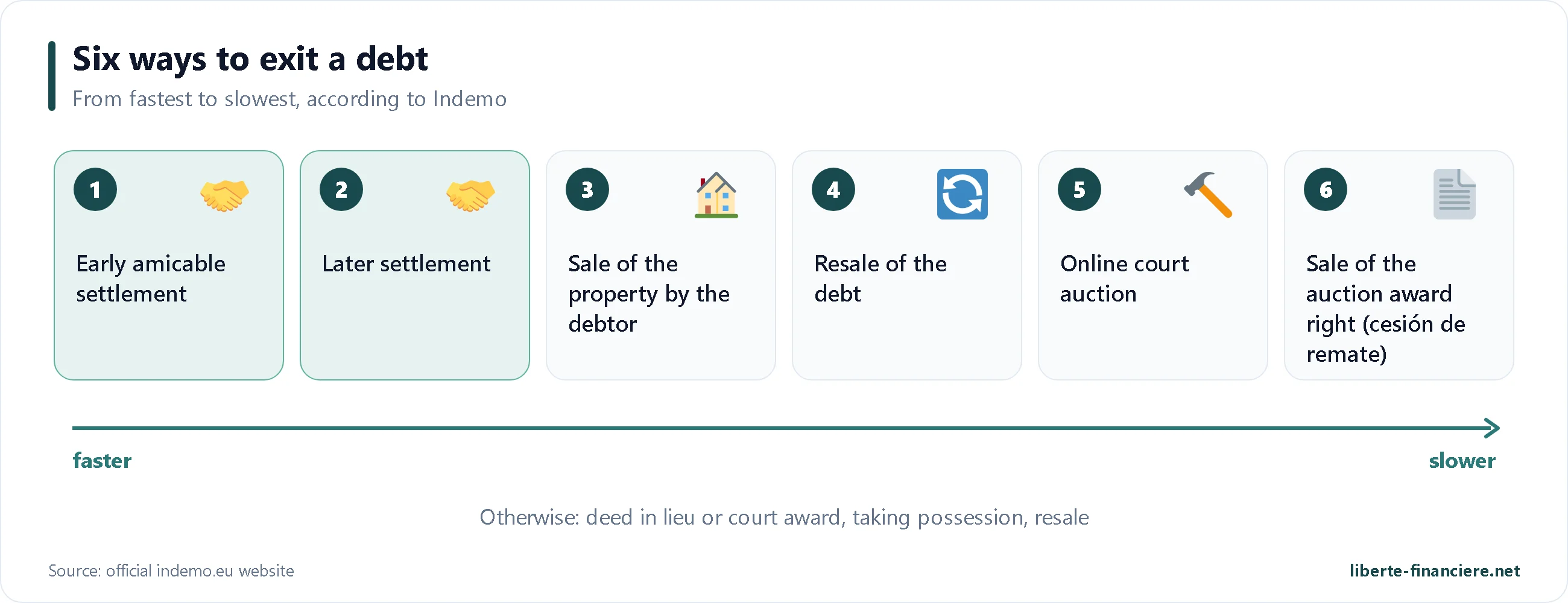
If none of these exits works, there is still the deed in lieu of foreclosure (the debtor hands over the property to settle the debt) or the award of the property to the agent, followed by taking possession, through the courts or amicably, and resale. This is the longest scenario, and the one where the value of the home and the presence of occupants matter most. Indemo does not publish the share of each type of exit among its 28 repayments: it is a figure I would like to see, as it would show how many cases are settled quickly and amicably and how many go through the whole procedure.
An ethical question often comes up in the comments: is this a "vulture fund"? The debtor has stopped paying for years on average, the debt has already been sold by their bank, and Spanish procedure protects vulnerable people (I come back to this with the 2026 decree). The agent even has an interest in a quick settlement rather than a long and costly eviction. Everyone will judge for themselves, but you should know that your return comes from recovering a debt from an individual in difficulty.
See the Notes open on Indemo Legal step, PTV, PTD and property map visible before you invest, from €10. |
 What return can you expect on Indemo?
This is the question that causes the most misunderstandings. You will come across at least three figures: 15.1% shown on each Note, 20.5% at the top of the statistics page, and a return of just a few percent on the account of most investors who started a year or two ago. All three are true, but they do not measure the same thing. I take them one by one.
 The 4 scenarios in the key information document
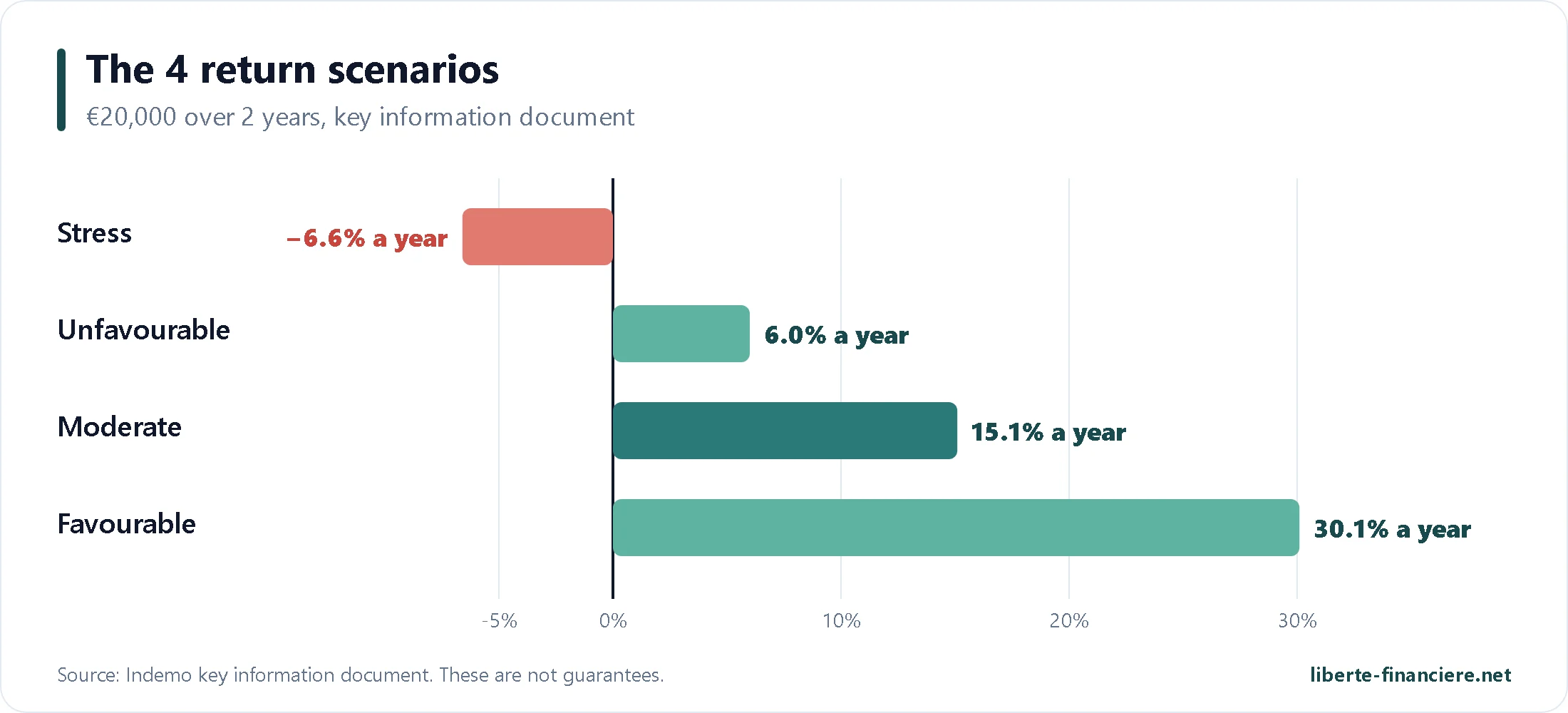
The 15.1% comes from the key information document (KID), the regulatory document every Note must provide. It simulates a €20,000 investment over two years, with an average discount of 62%, and gives four scenarios, the same for the three Spanish agents:
Scenario | What happens | Recovered on €20,000 | Per year |
|---|---|---|---|
Stress | No settlement, auction with no buyer, property taken over after 24 months and resold 18 months later with a 44.3% price drop (the worst Spanish fall between 2008 and 2014) | €17,342 | −6.6% |
Unfavourable | Sale at auction after 2 years, 15% below the appraised value | €22,400 | 6.0% |
Moderate | Amicable settlement: the debtor pays 90% of the debt within 18 months | €26,022 | 15.1% |
Favourable | Same settlement, but within 9 months | €32,043 | 30.1% |
So the 15.1% is not a promise: it is the "everything goes more or less well" scenario. The same document rates the product 6 out of 7 on the European risk scale and reserves it for investors "able to bear a total loss". The stress scenario, which assumes a property crisis as violent as the 2008 one, loses money. You sometimes read that even the worst scenario yields more than 7% a year: that is wrong, the official document says −6.6%.
 The advertised 20.5%: what it really measures
The Insights page shows an average return of 20.5%, with an asterisk but no calculation method. I asked Indemo directly. Ilja Hagins's reply by email, on 15 November 2026: it is the average annual net return on assets already recovered, i.e. the 28 cases repaid. Alongside them, 249 cases are still in progress, according to a further reply from Ilja Hagins on 18 November 2026.
This figure has a built-in bias: the cases that end first are those that were settled quickly, often through an amicable settlement, and therefore with the highest annual return. The long cases, which pull the average down, are not in it yet. You can already see it in the trend: Indemo announced 21.6% a year (weighted average) on 22 cases in July 2026, then 20.5% on 28 cases in November. The six cases repaid in the meantime pulled the average down. The home page, for its part, speaks of a "realised weighted return above 15% a year": that is probably the more cautious of the two figures.
 The latest repayments, one by one
Rather than an average, here is what the repayments published on the official blog say:
Case | Amount recovered | Duration | Annual return | Exit |
|---|---|---|---|---|
A81, | €246,000 | Not specified | 22 to 118% depending on the basket | Resale of the debt |
€233,000 | Just over 24 months | 15.3% | Not specified | |
€52,444 | 20 months | 15.31% | Assignment of the auction award right | |
€147,977 | 17 months | 11.58% | Amicable settlement at step 2 |
The first case, a spectacular one, set expectations at a level the following ones no longer reach. The latest repayments are rather between 11 and 16% a year, with durations of 17 to 24 months. That is still a very good return, with no losses to date, but it is the figure to keep in mind rather than the 20% on the home page. The return also varies depending on when you entered the case: on case R097, it ranges from 11.35% to 11.85% depending on the date the Note was bought. Finally, the 2025 report states that the ten cases repaid in 2025 yielded between 15.1% and 38% a year.
 Why your account shows a low return for the first two years
This is the point that disappoints new investors the most, and it is easy to explain: a Note pays nothing before the end of the case. No monthly interest, no accrued interest: as long as the foreclosure is not settled, your capital earns zero on your account. The return calculation for your portfolio (the XIRR, or internal rate of return, which takes into account the dates of each cash flow) therefore counts all the ongoing Notes with no gain at all.
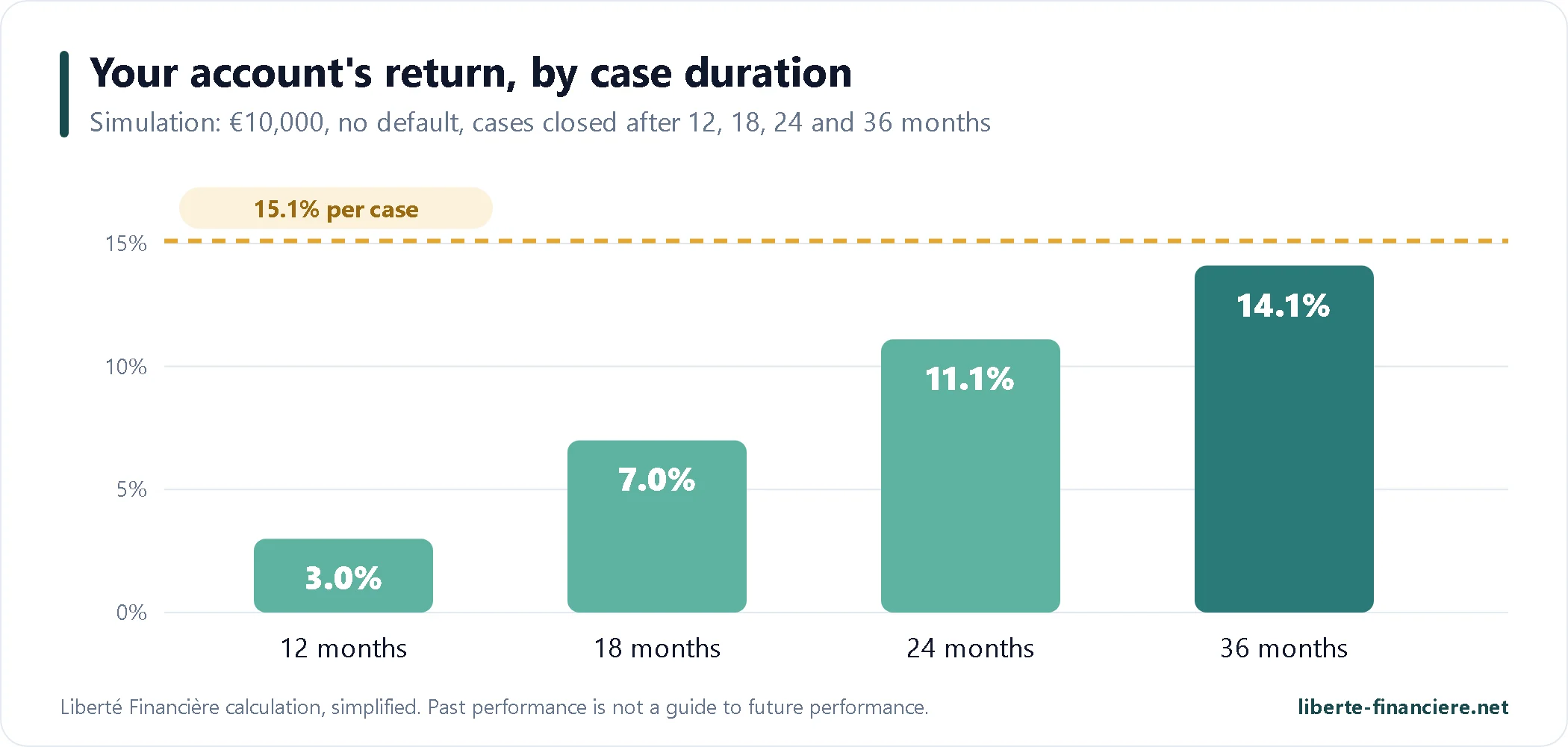
I ran a simple simulation. You invest €10,000 in one go, spread across many Notes. Each case yields exactly 15.1% a year, the moderate scenario, and none loses money. Only the duration varies: 20% of cases end at 12 months, 30% at 18 months, 30% at 24 months and 20% at 36 months.
After | Gains received | Capital still tied up | Return on your account |
|---|---|---|---|
12 months | €302 | €8,000 | 3.0% |
18 months | €982 | €5,000 | 7.0% |
24 months | €1,888 | €2,000 | 11.1% |
36 months | €2,794 | €0 | 14.1% |
Even in this scenario with no losses at all, your account shows only 3% after one year and 11% after two years, while each case yields 15.1%. The final return stays slightly below 15.1% because Indemo's calculation is a simple return, with no compounding, and the money paid back along the way is not reinvested in the simulation. If you reinvest each repayment in new Notes, the effect lasts even longer: part of your capital is always at the start of its journey.
This is exactly what many investors describe on Trustpilot or in the comments: a few dozen euros in gains after a year or a year and a half, and the feeling that "nothing is happening". It is not necessarily a sign of a problem: it is how the product works. The real test is the return after three or four years, when most of the cases bought at the start are closed. And that is when the actual duration of the cases becomes the most important figure.
 Delayed cases: 40 beyond 18 months
Indemo publishes no delay statistics on its site. So I asked for them. Ilja Hagins's reply by email, on 15 November 2026: out of the 243 cases then in progress, 18 have gone beyond 24 months and 22 are between 18 and 24 months. That is 40 cases, around 16%, beyond the 18 months of the moderate scenario. He adds that no case has been closed at a loss, even among those that needed more than 30 months of recovery.
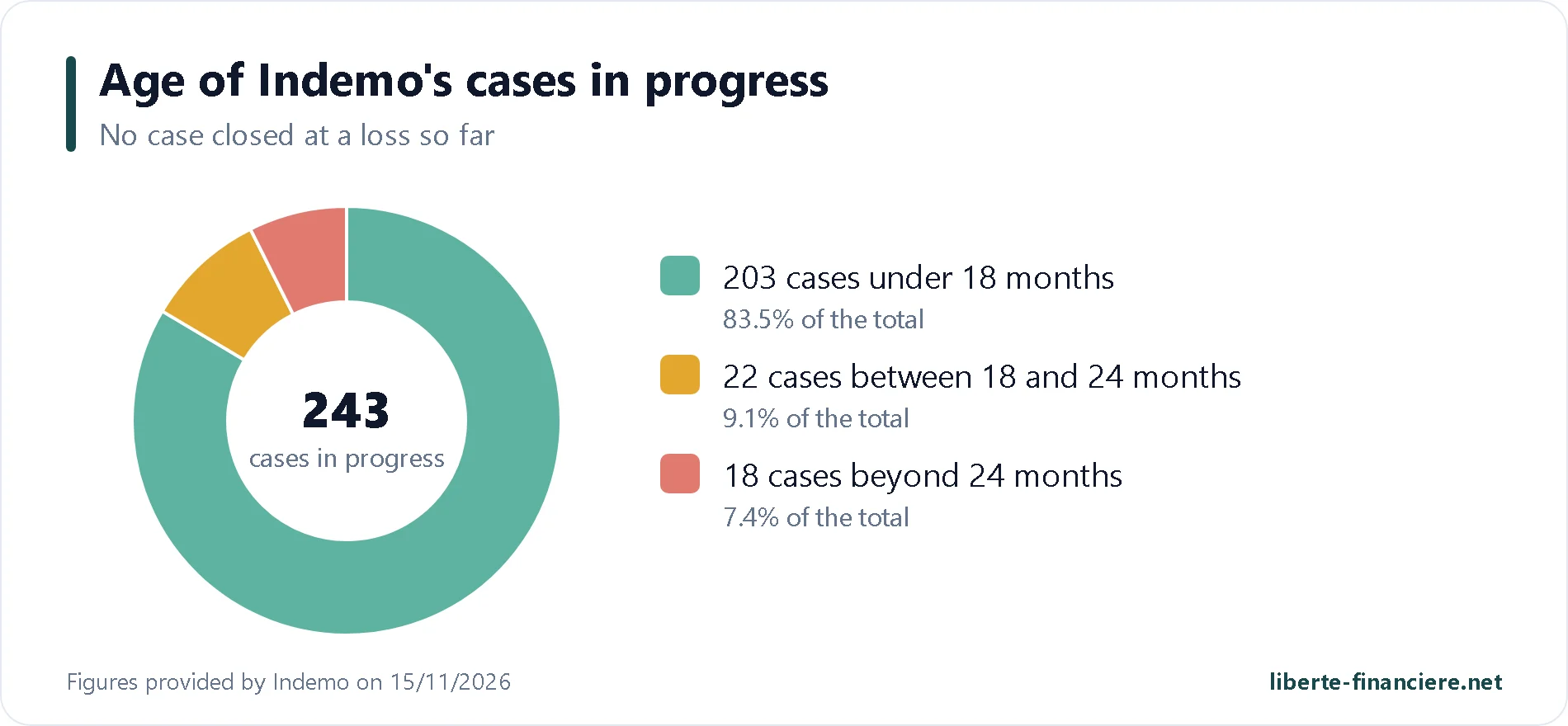
There are two possible readings. The reassuring one: the vast majority of cases are not yet 18 months old, since the outstanding portfolio exploded in 2025 and 2026, and no case has lost money. The cautious one: many cases are too young to be judged, and the share of long cases will mechanically increase in the coming months. Indemo told me on 18 November that this total only counts cases in progress, excluding repaid ones: there are already 249 of them. A case that lasts 36 months instead of 18 does not necessarily lose money, since late-payment interest keeps increasing the amount owed, but it divides your annual return.
Another point to know: a Note's maturity date is only an estimate. The prospectus says so in black and white: repayment may come earlier or "significantly later". It also allows Indemo Finance to extend the maturity with the issuer's agreement, but without yours, within the limits set by the final terms of each series, or without limit if a new law requires it. You are only informed of it on the platform. Finally, any claim on a Note becomes time-barred ten years after the date on which the payment becomes due.
Compare the open cases Legal step, PTV and estimated maturity of each Note, to pick cases at different stages. |
 Indemo's statistics
Indemo publishes its main figures on its Insights page, updated on an ongoing basis but without a date. Here is what it shows to date:
€40.1M invested since launch;
€35.9M still ongoing (the outstanding portfolio);
€4.9M repaid to investors, on 28 cases;
more than 25,100 clients registered;
an average duration of 14 months for the cases repaid.
The balance between these figures says it all: nearly 90% of the money invested is still in ongoing procedures. Indemo is a platform growing very fast, most of whose cases have not yet reached the age at which their outcome can be judged. The average duration of 14 months, like the 20.5% return, only covers cases already closed, and therefore the fastest ones.
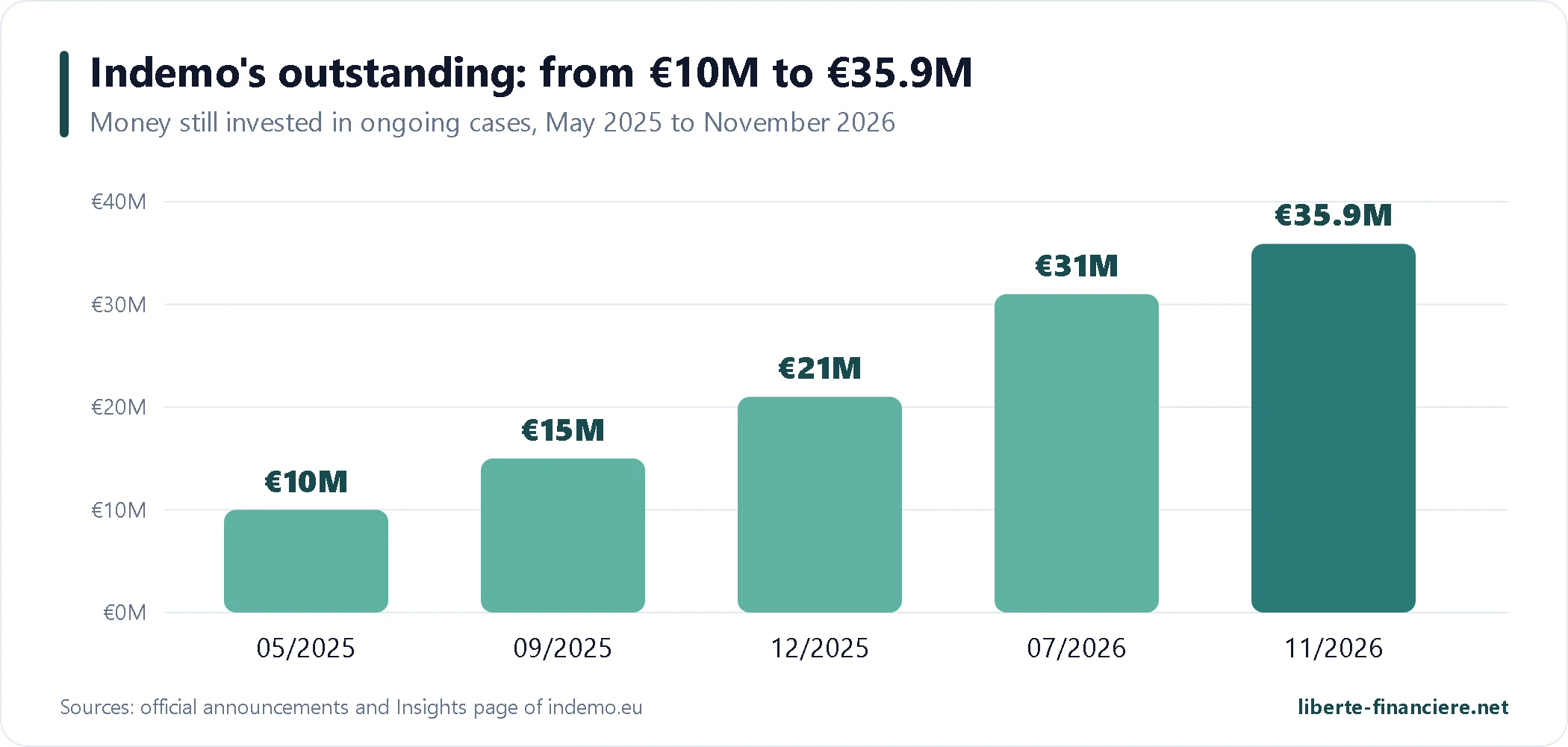
Growth, on the other hand, is impressive. According to successive official announcements, the outstanding portfolio went from €10M in May 2025 to €15M in September, €21M in December, €31M in July 2026, then nearly €36M today. The 2025 annual report gives a more precise snapshot at 31 December 2025: 16,834 registered clients, €24.9M invested cumulatively, €22.8M under administration, an average portfolio of €3,244 and 111 cases offered during the year.
Two remarks on these figures. The number of clients counts registered users, not active investors: the site says "25,000+" on some pages and "20,000+" on others. In terms of choice, when I looked at the market, eight Notes were open at the same time, all shown at 15.10%: plenty to spread your money across several properties and several cities. Indemo also publishes the progress of ongoing cases every month, for example 23 assets updated in November 2026, half of them at the auction stage (November update).
 The company's accounts: still loss-making
Indemo SIA's accounts are published in full on the site's Financial reports page, audited without qualification by Crowe DNW for 2022 to 2025. You can also find them, summarised and compared with the other platforms, in my P2P financial statements (Indemo view). Here are the accounts of the company alone:
2023 | 2024 | 2025 | |
|---|---|---|---|
Commissions (revenue) | €58,644 | €385,989 | €1,019,364 |
Net result | −€333,193 | −€682,100 | −€691,063 |
Shareholder contributions during the year | €437,500 | €756,000 | €799,103 |
Equity at year end | €300,126 | €374,197 | €482,237 |
Cumulative losses since 2022 | €337,509 | €1,019,609 | €1,710,672 |
Sources: 2023, 2024 and 2025 accounts. The group's consolidated accounts give very similar figures (a loss of €692,665 in 2025).
Revenue was multiplied by 2.6 in 2025, but costs followed: €1.7M of expenses, including €890,000 of sales costs. The largest item is the cashback paid to clients: €547,762 in 2025, against €133,399 in 2024, i.e. more than half of the commissions received. The almost permanent cashback campaigns that attract investors therefore cost the platform a lot. Since January 2026, according to the same report, the Spanish case management companies reimburse part of these expenses every month, which should lighten the accounts.
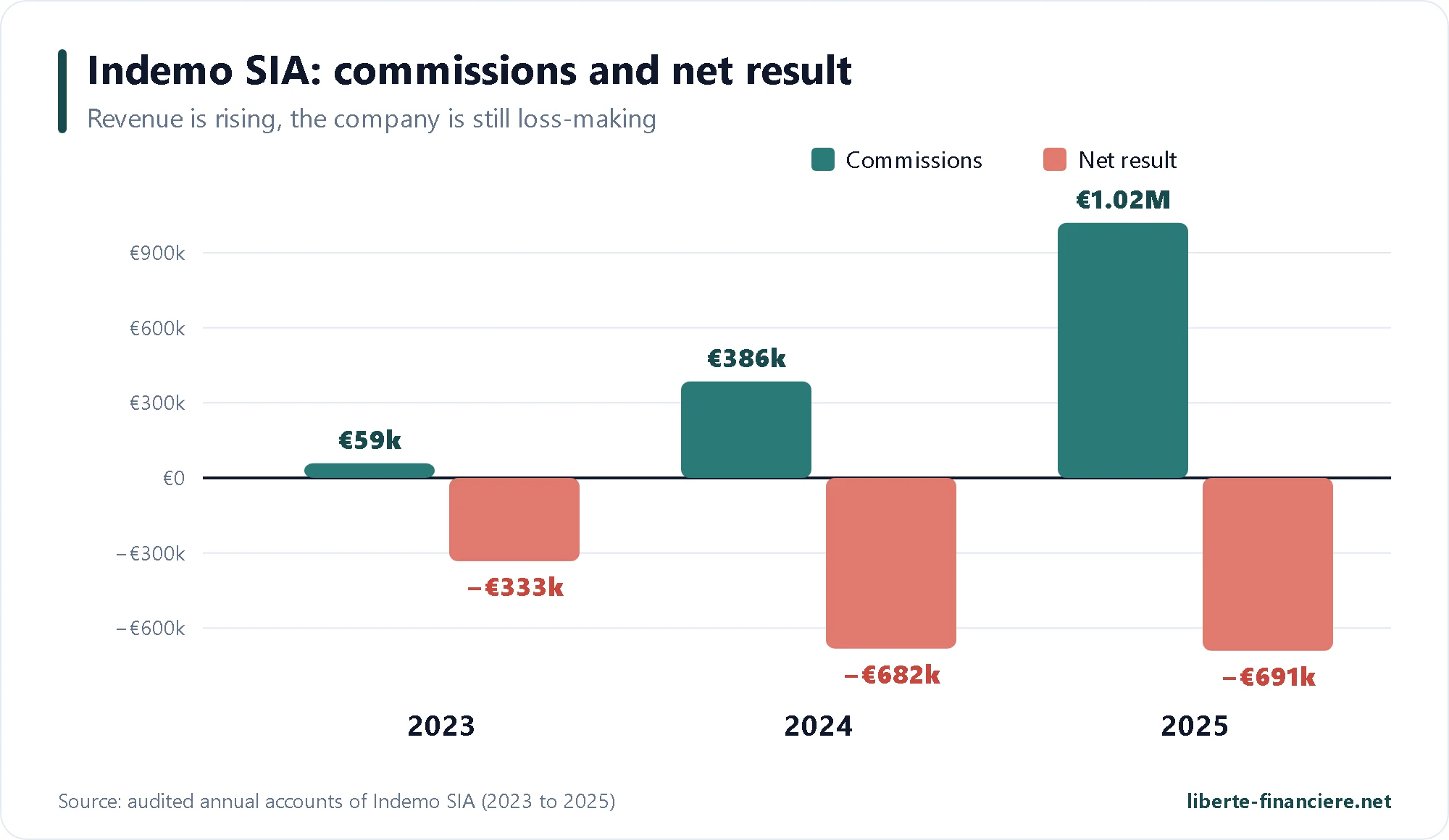
The 2025 report announces a small profit of €16,329 for January and February 2026, unaudited, and aims to break even in 2026. The going concern relies on the 2026 budget, on the shareholders' commitment to put money back in "if necessary" and on a possible capital raise from clients. On the regulatory side, regulatory capital stands at €340,393, i.e. 160% of the required minimum: the margin is there, but it has shrunk (179% a year earlier).
For you as an investor, what does a loss-making platform mean? Your Notes and your money are kept separate from Indemo's accounts (I explain this in the regulation section). An Indemo bankruptcy would therefore not make your Notes disappear, but it would seriously complicate the monitoring of cases, the distribution of repayments and access to your account. Four loss-making years in a row is common for a young, fast-growing platform; it is also a signal to watch until profits are confirmed over a full year.
What about the Spanish agent's accounts?
Since your return depends on the foreclosure agent, its accounts matter as much as Indemo's. Indemo publishes those of Tamarindo Vector, the historical agent, audited by Forvis Mazars (2025 accounts). In 2025, the company generated €1.11M in revenue and a profit of €178,249, on a €9M balance sheet, 87% of which is loans. Its equity is only €195,110, i.e. around 2% of its balance sheet: the company carries millions of euros of cases with very little capital of its own. It has no employees, only its sole director is paid, and its accounts mention a credit line granted to this director as well as a €400,000 loan to Real Magna 1, one of the two other agents.
These cross-links are not hidden, since they appear in audited accounts published by Indemo itself. But they show that the three agents form a single whole, and that none of them has a large financial cushion.
 Regulation and protection of your money

This is one of Indemo's real strengths. The platform does not have crowdfunding service provider (ECSP) status, like La Première Brique or business lending platforms: it has a more demanding status, that of an investment firm under the MiFID II directive, the same framework as stockbrokers. Its licence no. 06.06.08.824/547 has been valid since 15 November 2022 and appears in the Bank of Latvia register, which authorises it to execute orders, manage portfolios, provide investment advice, place securities and hold them in custody.
The Notes themselves are transferable securities issued under a prospectus approved by the Bank of Latvia, with an ISIN code and safekeeping at Nasdaq CSD, the central securities depository of the Baltic countries. So you are not buying a private contract with a platform, but a regulated financial security, with a key information document, a suitability test and disclosure obligations. To see how this status compares with other platforms, I have detailed the differences between MiFID II and ECSP in my article on P2P regulation.
A detail worth knowing: the regulator's entry only lists 12 countries where Indemo can offer its services on a cross-border basis: Germany and Spain since June 2023, then Austria, Belgium, Estonia, France, Italy, Lithuania, Luxembourg, the Netherlands, Portugal and Czechia since December 2023. Indemo, for its part, announces 29 Member States, and its 2024 accounts mention an application for 16 additional countries. For a French resident, the situation is clear:  France is one of the notified countries.
 If Indemo goes bankrupt
The terms and conditions and the note on investor protection provide for two protections:
Segregation of assets: your uninvested money and your Notes are not mixed with Indemo's accounts. They are held in separate accounts opened with authorised institutions in the European Union. Indemo's creditors cannot touch them.
The Latvian investor compensation scheme, provided for by European directive 97/9/EC: if Indemo cannot return your money or your securities (as established by the Bank of Latvia or a bankruptcy ruling), you can be compensated up to €20,000. The claim must be made within two years, and payment comes from three months onwards.
Be careful about what this scheme covers: it only applies in the event of misconduct or failure by Indemo to return what belongs to you. It never covers an investment loss, a case that goes wrong, or the default of the issuer or the Spanish agent. It is not a guarantee of your capital.
If the Spanish agent defaults
This is the scenario people talk about least, and the most important one. Your Note is repaid only from what the agent pays over on your case. If the agent goes bankrupt, the subsidiary Indemo Finance is just an ordinary creditor among others, and the prospectus states that the holders of one series could end up on an equal footing with those of other series. You have no direct recourse against the agent, the debtor or the manager.
The only protection provided is a contract dated 29 August 2023: Indemo's issuing vehicle holds an option to buy the 3,000 shares of Tamarindo Vector at €1 each, and thus take control of it to continue the recovery. Indemo considers the probability of having to exercise it "close to zero" and records it at zero in its 2025 accounts. I found no equivalent published contract for Real Magna 1 and Aveine Invest. And the prospectus provides for a backup servicer only "where applicable": none has been appointed to date.
In practice, taking over the company would make it possible to keep control of the debts and mortgages. But that assumes the company is still sound, with no hidden debts, and that the recovery work can continue without its current director. That is why I consider the dependence on a single Spanish network to be Indemo's most important specific risk, ahead even of the platform's financial health.
The Spanish decree RDL 29/2026: what changes, or not
In October 2026, the Spanish government adopted a series of emergency housing measures that worried many investors. The timeline is confusing, so I go through it in order, based on the two letters from Indemo's CEO (13 October and 13 November 2026):
the first versions of the decrees were rejected by Parliament on 2 October, which was dissolved on 5 October; elections were set for 29 November 2026;
the government adopted new versions, including Royal Decree-Law 29/2026 of 6 October, in force on 8 October;
its article 2 makes it possible to suspend certain evictions until 31 December 2030 for vulnerable people;
another rule, known as the "70% rule", regulates the purchase of homes; according to Indemo, it targets the price of a property, not the purchase price of a debt.
The question that matters for you: does the eviction freeze apply to mortgage foreclosures, which are the basis of the product? Indemo says no, and it is not just its opinion. I read the source: the agreement unifying the criteria of the civil judges of the Barcelona court, adopted on 29 October 2026, signed on 3 November and circulated by the Barcelona Bar Association. Its point 1 explicitly excludes from the moratorium incidents involving third-party occupants and mortgage foreclosures, because these have their own rules (Law 1/2013 on the protection of mortgage debtors), which the decree does not change. Its point 5 limits the regime until 2030 to certain procedures under article 441.5 of the Civil Procedure Act.
The nuance to keep in mind: this is a common position of the Barcelona judges, not a rule binding on the whole of Spain. Indemo also cites rulings along the same lines in Málaga, Torremolinos and Cerdanyola del Vallès, reported by a law firm, which I was unable to read. Vulnerable people had in any case been protected since 2013, and the existing moratorium ran until May 2028. Indemo has revised neither its timelines nor its assumptions, and has not suspended investments.
My view: the direct impact seems limited to date, but the Spanish legal risk does not go away. A new government after 29 November, a different final text, or judges in other regions reading the decree differently could lengthen some procedures. And a longer case means a lower annual return, even without a loss. It is a risk to keep in mind as long as 100% of the cases are in Spain.
A MiFID II regulated platform Notes with an ISIN, approved prospectus, compensation scheme up to €20,000 if Indemo fails. |
 Signing up on Indemo, step by step

To open an account, you must be 18 or over and be a citizen of the European Union or hold a valid residence permit in the Union (official FAQ). One account per person; companies can open an account in their name, joint accounts are not offered. Here is the process:
Create your account with my link: email address, password, country of residence.
Verify your identity with the Veriff service: passport or ID card, then a short video of your face using your phone or computer camera.
Fill in the regulatory questionnaire: tax residence, tax number, source of your funds and wealth.
Take the MiFID II suitability test (see below), required in order to invest.
Deposit euros by SEPA transfer from a bank account in your name in the European Union or the European Economic Area, with your investor ID as the reference. Allow one to three business days.
Invest from €10 per Note, manually or with AutoInvest.
The form itself takes a few minutes to fill in. Validation can take longer if Indemo asks you additional questions, which often happens.
 Source of funds: users' number one complaint
Because it is a regulated investment firm, Indemo applies more thorough anti-money laundering checks than most lending platforms. Its terms and conditions allow it to ask for the source of your funds and wealth, to decide on its own whether the supporting documents are sufficient, and to block access to your account if in doubt. This is the main source of negative reviews on Trustpilot: tax returns requested, accounts suspended during a check, sign-ups refused.
To avoid being blocked, prepare as you would for a broker: a recent proof of address, your tax number, and something to justify the money you deposit (payslips, tax assessment, savings statement or deed of sale). Deposit from a bank account in your name, always the same one, because withdrawals only go to an account already used for a deposit. And if you are asked a question, answer precisely: a check is in no way an accusation, it is a legal obligation for a regulated company.
 The MiFID II suitability test
Before your first purchase, Indemo requires a questionnaire on your knowledge and experience of financial products. To activate AutoInvest, you also have to answer questions about your financial situation, your objectives, your risk tolerance and your sustainability preferences. Without this test, everything is locked: on my account, the markets show the label "LOCKED" until it is done. If your answers show that the product does not suit you, you can still invest manually, with a warning, but not with AutoInvest. Indemo also sends reminder emails to its clients asking them to take or update it: I received a request of this kind, with 30 days to do it.
 Investing: the market, a Note's page and AutoInvest
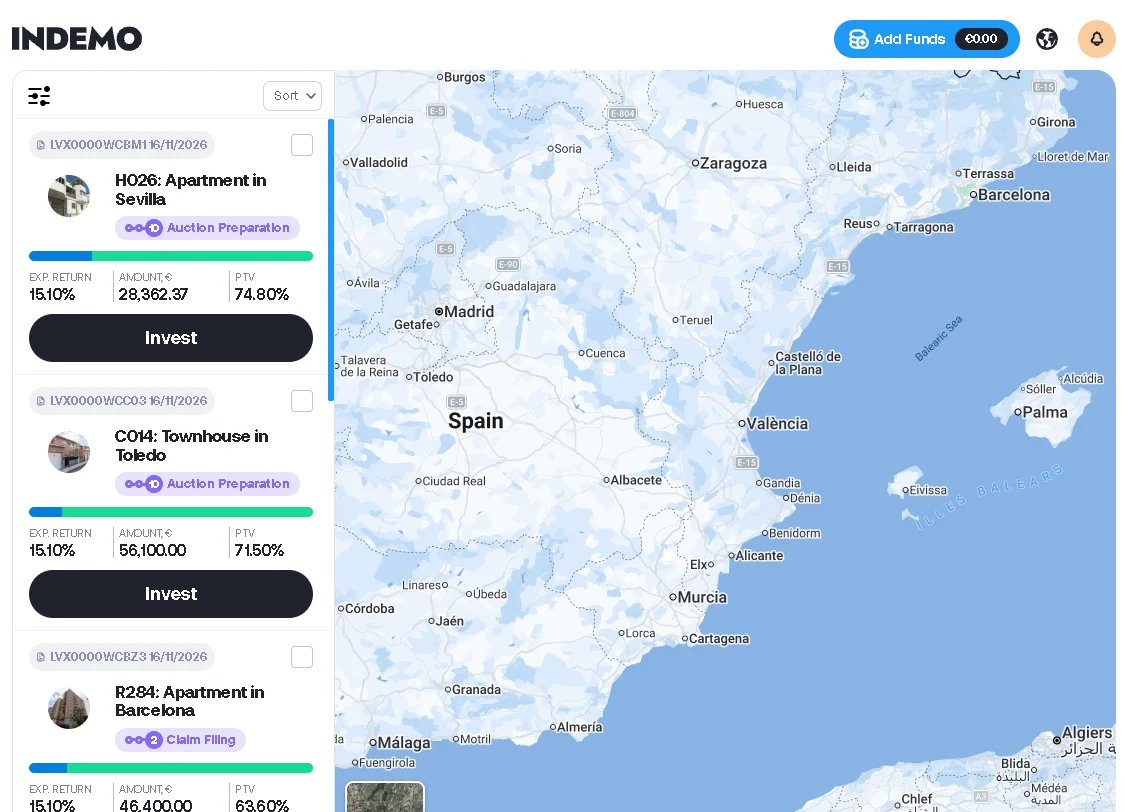
Indemo's market looks more like a real estate crowdfunding platform than a loan marketplace: few cases at a time, each with its detailed page and its location on a map of Spain. When I looked, eight Notes were open, from a commercial unit in Córdoba to three terraced houses near Málaga, with amounts from €21,000 to €64,500 per case and PTVs from 50.8% to 74.8%. You can filter by legal step, using the 24 steps described above.
 What a Note's page contains
Let's take a real example, Note H026, a flat in Seville:
amount to be funded: €28,362.37, of which 22% already subscribed;
expected return: 15.10% a year, the moderate scenario;
PTV of 74.80% (price paid relative to the property's value) and PTD of 49.90% (price paid relative to the debt);
issued on 24 November 2026, estimated maturity on 24 November 2028, i.e. two years;
share of the surplus for Noteholders: 50%; repayment in one go at maturity ("Bullet");
issuer: Indemo SPV Issuer No1 SIA; foreclosure agent: Tamarindo Vector S.L.; case at step 10, preparation of the auction.
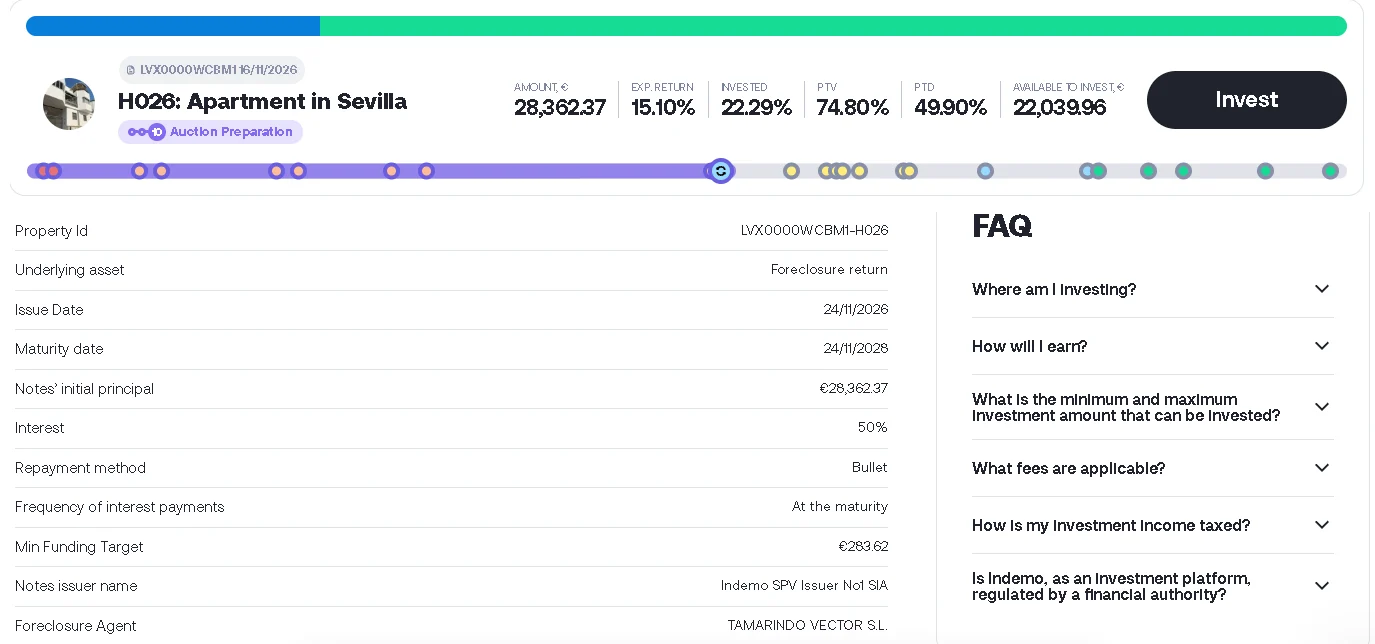
Each page also gives the independent valuation of the property ("Objects" tab), its exact location, and three documents: the final terms of the series, the base prospectus and the key information document. The page itself reminds you: the return and the repayment date depend entirely on the outcome of the foreclosure and are not guaranteed. In this example, the PTV of nearly 75% leaves a smaller safety margin than average: if the property had to be sold at auction 25% below its appraised value, the purchase price would no longer be covered.
 AutoInvest 2.0
Automatic investing can be started from a €10 balance. You set a cap, and you can stop it at any time, according to the FAQ; version 2.0 was delivered in March 2026. It stays locked until the full suitability test has been taken: that is what my account below shows: before activating AutoInvest, Indemo asks for a deposit of at least €10 and the suitability test. With so few cases open at a time, AutoInvest is mostly useful so you do not miss new Notes, which sometimes fill up quickly, and to reinvest repayments without thinking about it.
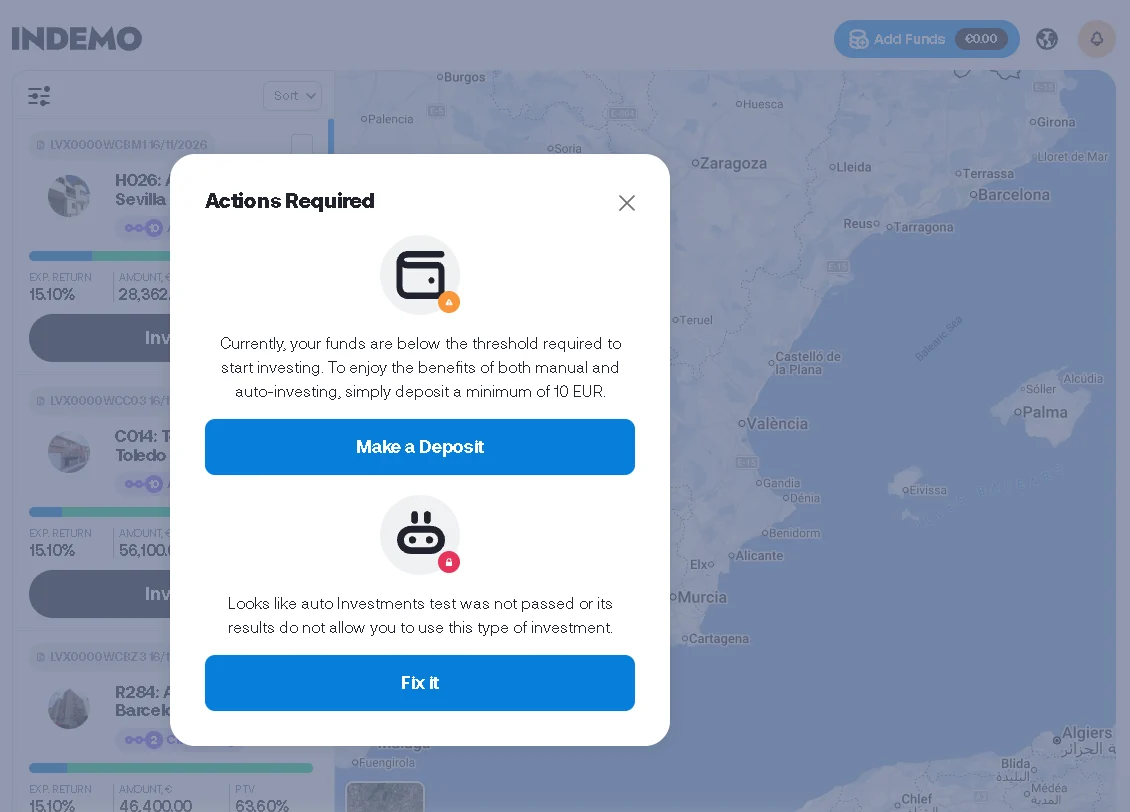
My view on the settings: a low cap per Note to spread across many cases, and a limited total budget, since the money invested will be tied up for a long time. If the safety margin matters to you, look at the PTV of each new Note, even if it means investing manually.
 Diversifying: how many Notes?
Since the switch to the "one Note = one debt" model, each Note depends on a single property, a single debtor and a single procedure (the prospectus actually lists this among the risks). A case that gets bogged down therefore weighs heavily if you only have three or four. The €10 ticket lets you spread a few hundred euros across dozens of cases, at different steps and in different cities. It is also the best way to smooth out duration: some cases will be settled in a few months, others in three years or more. Keep in mind that they all remain in Spain and go through the same network of agents: diversification reduces the risk of a single case, not that of the platform.
 Liquidity: no secondary market, for now
On Indemo, the money placed in a Note stays there until the end of the case. There is no way to sell a Note to another investor, nor to request an early exit. Only uninvested money can be withdrawn, from €10, to a bank account already used for a deposit: one to two business days of processing, then up to two days for the SEPA transfer (FAQ).
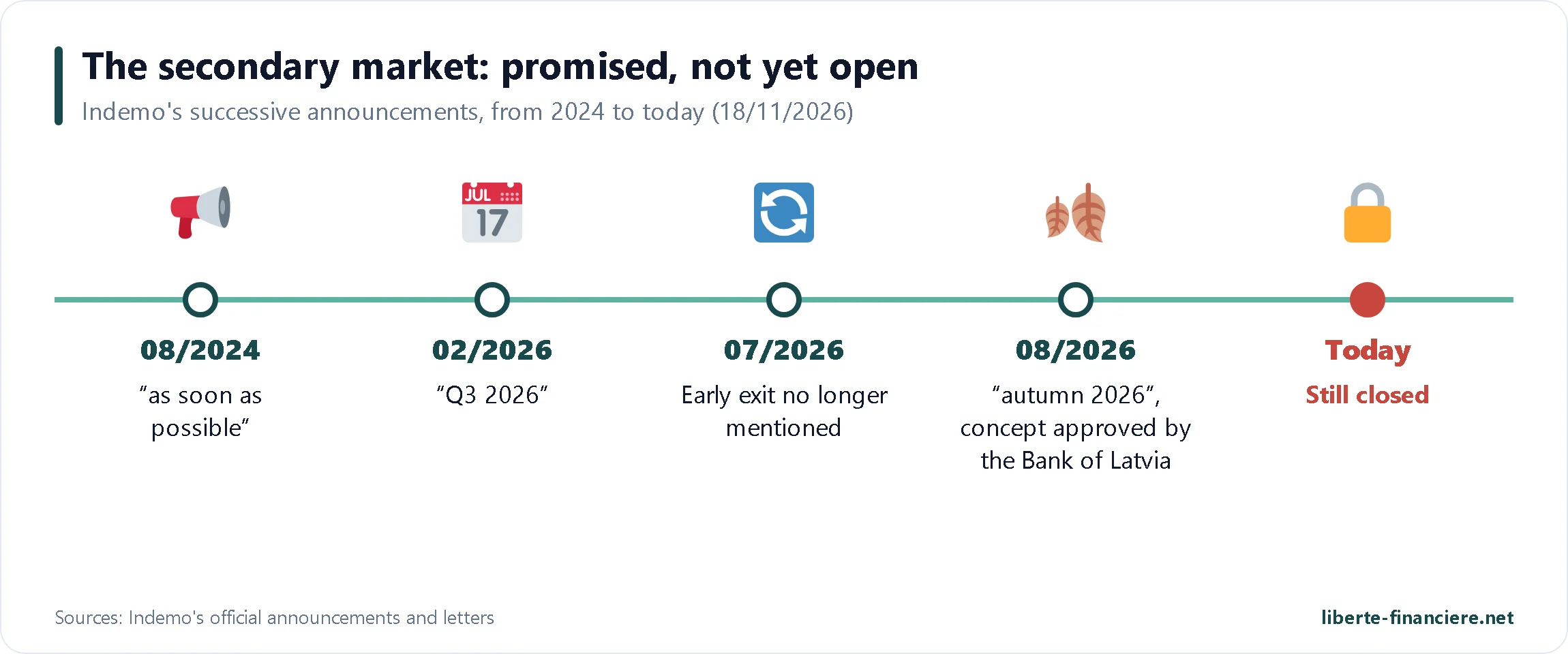
Yet the secondary market has been promised for a long time. Here is the history of the official announcements:
13 August 2024: secondary market concept announced, to be set up "as soon as possible" (post);
11 February 2026: 2026 roadmap, with an "Early Exit" in the second quarter and the secondary market in the third quarter of 2026 (roadmap);
29 July 2026: second-quarter review, portfolio revaluation delivered, the early exit is no longer mentioned (review);
11 August 2026: the concept is approved by the Bank of Latvia, a first version is targeted for autumn 2026, and the early exit is merged into it (update).
To date, the secondary market is still not open. I have no doubt it will eventually arrive, since the regulator has approved the principle. But do not count on it when deciding to invest: even once open, nothing guarantees there will be buyers for a Note stuck at step 9 of an appeal, nor at what price. The only reliable horizon is the end of the case.
The dynamic revaluation of the portfolio, delivered in June 2026, shows an estimated value for each Note depending on how far its procedure has progressed. It is useful information, but purely indicative: as long as there is no market to sell at that price, it is not money available, and it is not a return earned.
In practice, only put money into Indemo that you will not need for at least three years, keeping in mind that some cases already exceed 30 months. And do not count on repayments to pay for an expense on a fixed date: you never know which case will end, or when.
 Indemo's fees
For an active investor, Indemo is free: sign-up, deposits, investing, AutoInvest, account maintenance and withdrawals cost nothing. But the official fee schedule contains three fees that few people read:
Operation | Fee |
|---|---|
Sign-up, deposit, investing, AutoInvest, withdrawal (from €10) | Free |
Inactive account (no transaction for 6 months and no ongoing product) | €2.90 a month |
Detailed statement on request | €50 |
Transfer of securities or money between investors (inheritance, gift) | €300 |
The inactivity fee only affects an account that has been empty and without any Note for six months: if you stop investing, remember to withdraw your balance down to the last euro. The €300 transfer fee mainly concerns inheritance: when the account holder dies, Notes still ongoing cannot be sold, and will have to be transferred to the heirs, with this fee and the documents to provide. It is something to plan for if you invest a large amount in cases that can last several years: your loved ones should at least know that the account exists.
The real cost of the product lies elsewhere, and you do not pay it directly: the 6% placement commission paid to Indemo by the Spanish agent, and the half of the surplus the agent keeps on each case, both explained in the section on how it works. They are already deducted from the advertised returns.
 Cashback: how it works
Indemo is known for its very frequent cashback campaigns: a percentage of the amount invested, credited to your account, often with tiers depending on the amount invested in the month. We saw it in the accounts: the platform spent €547,762 on it in 2025, and the Spanish companies have been reimbursing part of it since 2026. For a new investor, this cashback partly offsets the lack of gains during the first months.
Two precautions. First, cashback boosts your starting return, but it says nothing about the quality of the cases: a two- or three-year investment is not chosen for a bonus of a few percent. Second, each campaign has its own conditions (minimum amount, period, whether it can be combined with other offers): read them on Indemo's blog before investing.
Current offer : Black Friday- 5% cashback for everyone on every investment
- No tiers: from €10 invested, cashback paid straight away
This offer comes on top of the usual offer.
Get the offer →Until 30 November 2026
 The risks you need to know

First of all, a reminder: I am not a financial investment adviser. Any investment carries a risk of capital loss, and past performance is no guide to future performance. The fact that no case has closed at a loss to date does not guarantee there never will be one.
Capital loss: your Note is only repaid from what the foreclosure brings in. If the property is worth less than expected, if the auction fails, or if the Spanish agent does not pay over the sums, you can lose part or all of your capital. The key information document rates the product 6 out of 7 and puts its stress scenario at −6.6% a year. There is no buyback guarantee, nor any protection fund to cover a losing case.
Illiquidity: your money is tied up until the end of each case, with no secondary market to date. The maturity is only an estimate, which the issuer can extend without your agreement. Allow three years, sometimes more.
Geopolitical and concentration risk: 100% of the cases are in
Spain, subject to the law, courts and housing policy of a single country, as the 2026 decree showed. The Spanish property market already lost 44.3% between 2008 and 2014. The platform and its subsidiaries are in  Latvia, a eurozone and NATO country bordering Russia.
On top of these come the risks specific to Indemo:
Dependence on a single Spanish network: three foreclosure agents, all run or co-run by Indemo's largest shareholder, with very little equity and no designated backup servicer. In my view, this is the main risk (see the section on regulation).
Conflict of interest: the same person is the platform's largest shareholder and the director of the companies that sell it the cases, and Indemo earns 6% on every euro invested, whatever the outcome.
The platform's financial health: four loss-making years, funded by the shareholders. Your Notes are kept separate from Indemo's accounts, but a failure would complicate the monitoring of cases.
Duration and actual return: 40 cases already exceed 18 months, and a long case divides your annual return even without a loss. The 20.5% return only covers the fastest closed cases.
Occupants and vulnerable people: an occupied home, by the former owner or by third parties, can add months of hearings and eviction. Spanish law protects vulnerable households, which can suspend a procedure.
Checks and account blocking: as a regulated company, Indemo can suspend your access while it checks the source of your funds.
My rule of caution for this kind of investment: do not put more than a small part of your wealth into it, only money you do not need for several years, and spread it across many cases.
 Indemo taxation in France

This section is for French tax residents. Indemo's taxation has two levels: a withholding in Latvia, then normal taxation in France. Nothing is automatic on the French side, and it is the question that comes up most in the comments.
The 5% withholding tax in Latvia
According to the prospectus (taxation section), Indemo withholds Latvian tax at source on your gains before paying them to you. For a non-resident individual, the rate is 5% for a tax resident of the European Union or the European Economic Area who meets the criteria of Latvian law, and 25.5% otherwise. To get the 5% rate, enter your tax residence and your French tax number correctly when you sign up. The prospectus states that this tax can generally be deducted from the tax due in your country of residence, and refers to the list of Latvian tax treaties, which includes the one with France.
What you declare in France
The gains on your Notes are investment income. They are subject to the 31.4% flat tax (12.8% income tax and 18.6% social contributions), or to the progressive scale if you choose it for all your investment income. In practice:
Form 2047: you declare the income received abroad there, at its gross amount, before the Latvian withholding. You then carry the total over to the 2042 return, along with the interest.
Tax credit: the 5% Latvian withholding is offset against French tax thanks to the tax treaty, up to the French tax due on this income. It is generally entered in box 8VL of the 2042. It does not reduce the social contributions, which remain due in full.
Form 3916: your Indemo account, which holds money and securities, is an account opened abroad. You must declare it every year, even if it is empty or you received nothing. Forgetting costs a €1,500 fine per undeclared account.
Monthly advance payment (form 2778-SD): as nothing is withheld in France, you may be required to declare and pay the 12.8% advance payment and the social contributions in the month following each payment received, depending on your reference tax income. Practice varies between tax offices: ask your tax office in writing.
Indemo provides downloadable tax statements in your account ("Tax statements and reports") with the year's amounts. A feature of the product: since gains only come at the end of the case, they can be concentrated in a single tax year, several years of return in one go. With the flat tax, this does not change the rate, but if you opt for the progressive scale, the year of repayment can push you into a higher bracket.
Two questions come up often. Cashback: no text clearly addresses this case, and I found no rule published by Indemo on the Latvian withholding applied to cashback; ask your tax office in writing. The real estate wealth tax (IFI): Notes are debt securities, not shares in a property company that you would own, so they should not fall within the IFI. All the declaration steps are detailed in my guide how to declare your P2P income for tax, and the withholding rates of each country in my article on withholding tax in P2P.
 Indemo compared with other platforms
Indemo has no real equivalent in France. The closest product I use is real estate crowdfunding: a debt backed by a property, repaid in one go at maturity, with a duration that depends on the success of the project. So I first compare Indemo with La Première Brique, on which I have funded 144 projects.
|
| |
|---|---|---|
Head office |
|
|
Regulation | MiFID II (Bank of Latvia) | ECSP, crowdfunding service provider |
What you finance | The purchase of a mortgage debt that is already unpaid | A loan to a developer or property dealer for an ongoing project |
Property location |
|
|
Where the return comes from | Discount at purchase, 50% of the surplus recovered | Fixed interest rate, penalties in case of delay |
Payout | In one go, at the end of the case | Generally in one go, at maturity |
Exit before maturity | Impossible to date | Resale market opened in November 2026 |
Minimum investment | €10 | €1 |
Tax withheld at source | 5% in Latvia, then declaration in France | Flat-rate withholding in France |
Advertised return | 15.1% per case (moderate scenario) | 11 to 13% gross per project |
| +0.5% cashback on top of the campaigns |
 La Première Brique
This head-to-head is instructive. On La Première Brique, projects show 11 to 13%, but the actual return drops as soon as a project is delayed, because the capital stays tied up longer than planned, as I explain in my La Première Brique review. Indemo has exactly the same mechanism, only more pronounced: a high return per case, but an actual return that depends entirely on duration. The fundamental difference lies in the starting point. On La Première Brique, you lend to a project that must succeed to repay you. On Indemo, the operation has already failed once, and your safety margin comes from the price at which the debt was bought.
To broaden the picture, here is Indemo compared with the other platforms I invest in today, with different products: business loans, consumer loans, agricultural loans backed by land.
|
|
|
|
| |
|---|---|---|---|---|---|
Head office |
|
|
|
|
|
What you finance | Discounted Spanish mortgage debts | Consumer loans and business loans | Consumer loans | Invoices and orders of French SMEs | Agricultural loans backed by land |
Interest | |||||
|
 PeerBerry
 Swaper
 Bienprêter
 Lande Finance
 Croatia
 Estonia
These platforms have something in common that Indemo does not: they pay interest as they go, every month or with each loan repayment, and my capital turns over quickly. Their risks are different (lending companies, borrowing businesses, countries), and each has its own review or bonus code page on the site. To compare the status, guarantees and countries of all the platforms, the easiest way is my P2P comparison tool, and to see where the head offices and lending companies are, the P2P map.
Try Indemo with a few Notes From €10 per case, +0.5% cashback on top of the campaigns for a new user who signed up through my link. |
 Why I don't invest with Indemo
People have been asking me on my channel since early 2025: "What do you think of Indemo?", "Why don't you invest in it?". Here is my honest answer. I opened an account and had my identity verified, and I was tempted to go ahead several times, but I have never deposited a single euro: my balance is zero, no Notes, and I have not even finished the suitability test.
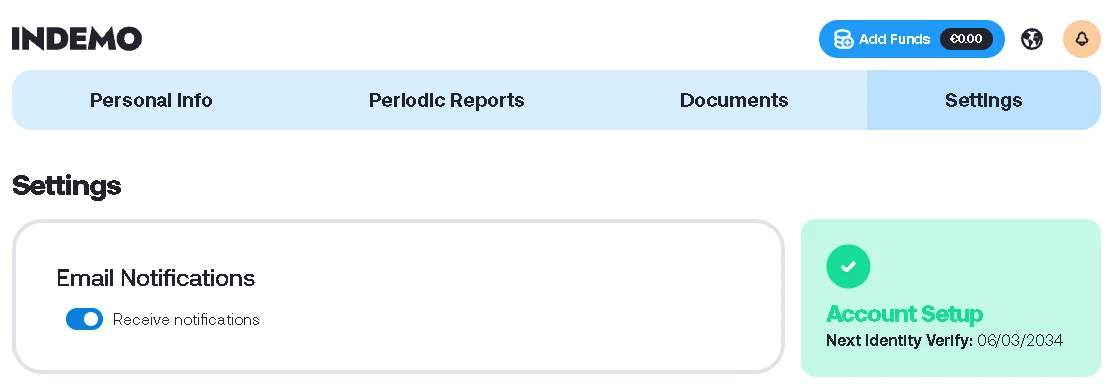
It is not because I think the product is bad. It is that it does not fit my personal strategy today, for three reasons.
 1. I want monthly interest
My lending investments are there to produce regular interest, every month, which I reinvest or withdraw. On Indemo, a Note pays nothing for the whole duration of its case, then everything at once, on a date nobody knows in advance. One to three years with no income at all is completely outside that logic.
 2. I want to be able to get out
I am increasingly looking for liquid investments, from which I can withdraw my money if I need it or if the situation changes. On Indemo, there is no secondary market (see the liquidity section): every euro invested is tied up until the end of its case, with no way out.
3. I already have enough real estate
Real estate crowdfunding is going through a difficult period in France. I have invested a lot in it, my real estate portfolio is already large, and I am waiting for it to slim down before adding more. And I am careful with real estate in general, because durations are often long.
What could change my mind: a secondary market that really works, public statistics on duration and delays by funding year, one or two more years of repayments on the cases funded in 2025, and accounts that break even over a full year. For an investor who is willing to forget their money for three years and wants a source of return uncorrelated with consumer loans, Indemo has real arguments, which I detail right below.
Indemo's pros and cons
 The pros
- Real regulation: MiFID II investment firm, Notes issued under an approved prospectus, segregated safekeeping and a compensation scheme up to €20,000 if the platform fails (see regulation).
 A safety margin from the moment of purchase: debts bought at an average discount of 50 to 65%, backed by a real property.
- Profitable closed cases: 28 repayments, none at a loss to date, from 11 to more than 20% a year.
 An investment uncorrelated with consumer loans and the stock market: the return depends on court procedures, not on the credit cycle.
- Plenty of transparency per case: property valuation, PTV, PTD, map, 24 steps tracked every month, regulatory documents.
- Small ticket and no fees: €10 per Note, no fees to invest or withdraw.
- Frequent cashback campaigns, which partly offset the wait for the first repayments.
 The cons
- No regular income: nothing is paid before the end of the case, and the account's return stays low for the first two years (see the simulation).
 No secondary market, promised since 2024, and maturities that can be extended without your agreement.
- A single Spanish network behind all the cases, linked to the largest shareholder, with no backup servicer.
- A platform still making losses, funded by its shareholders.
 Incomplete statistics: an average return calculated on closed cases only, no public figures on delays.
- Heavier taxation to manage: 5% Latvian withholding, forms 2047 and 3916, strict source-of-funds checks.
Who is Indemo for?
Your profile | Is Indemo right for you? |
|---|---|
You can forget about your money for three years or more, without needing it on a fixed date | Yes |
You want to diversify an already well-stocked loan portfolio with an uncorrelated product | Yes |
You care about a regulated platform, with securities held separately | Yes |
You like following concrete cases, step by step | Yes |
You want interest every month to supplement your income | No |
You might need this money within two years | No |
You want a high account return from the first year | Rather not |
You are a beginner and this is your first investment beyond a savings account | Rather not |
Indemo is rather aimed at patient, already diversified investors who want a small pocket of discounted real estate debt alongside more liquid investments. If you are looking for regular income, the lending platforms with monthly interest in the comparison suit that need better.
 Indemo bonus code and referral

No code to enter: sign up with my link, and you automatically get +0.5% cashback on top of Indemo's cashback campaigns, as a new user who signed up through my link. In practice, when Indemo launches a cashback campaign, your rate is raised by 0.5 percentage points. And this 0.5% always applies, with or without a running campaign: Ilja Hagins confirmed it to me by email on 18 November 2026. When Indemo launches a temporary offer, it is shown right here:
Current offer : Black Friday- 5% cashback for everyone on every investment
- No tiers: from €10 invested, cashback paid straight away
This offer comes on top of the usual offer.
Get the offer →Until 30 November 2026
Indemo also has a client referral programme, revamped in October 2026 (official terms):
Standard plan: your referee receives €25 if they invest at least €1,000 within 60 days and keep it invested for 30 days. You receive a total of €25, €75, €150, €250, €350 and then €500 for 1 to 6 referees, then €150 per additional referee.
VIP plan: if your referee invests €20,000 or more within 30 days of their first investment, you each receive 1% of that amount, with no cap.
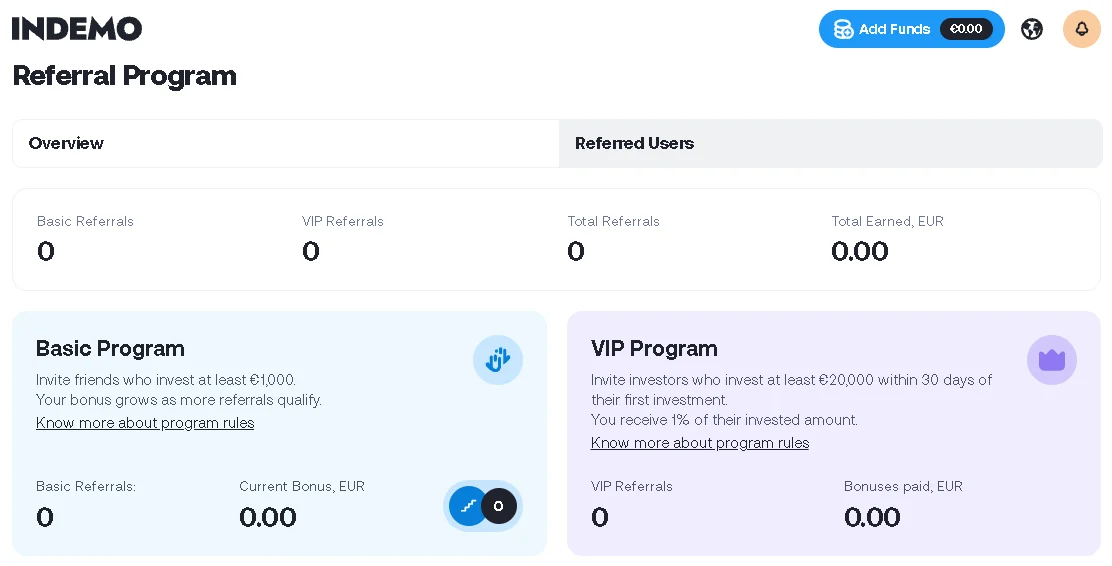
The two plans cannot be combined, bonuses are credited as money to reinvest and cannot be withdrawn directly, and a promo code takes precedence over a referral link. Find all the offers from other platforms on my bonuses and referrals page.
+0.5% cashback on Indemo On top of Indemo's campaigns, for a new user who signed up through my link, no code to enter. |
 FAQ: frequently asked questions about Indemo
Is Indemo a scam?
No. Indemo SIA is an investment firm licensed by the Bank of Latvia, its Notes are issued under an approved prospectus, its accounts are published and audited, and 28 cases have already been repaid. Being legitimate does not mean being risk-free: the platform is young, loss-making, and depends on a single Spanish network (see the risks).
Is Indemo regulated?
Yes, with MiFID II investment firm status, licence no. 06.06.08.824/547, with a passport for France. It is a more demanding status than that of crowdfunding platforms.
Do I own the debt or the property?
Neither. You own a Note, a debt security issued by an Indemo subsidiary, repaid only from what the Spanish agent recovers on a specific case. The mortgage is in the agent's name, and you have no direct recourse against it or against the debtor.
Does Indemo pay interest every month?
No. Capital and gains are paid in one go, at the end of the case. In the meantime, your account receives nothing, apart from any cashback.
How long do you have to wait for the first repayment?
Closed cases lasted 14 months on average, but the most recent ones took 17 to 24 months, and 40 cases already exceed 18 months. In a portfolio of many Notes, some cases may be settled in a few months, but expect a year and a half to three years for the majority.
Why is my return so low when Indemo shows more than 20%?
Because the 20.5% only covers the 28 cases already closed, whereas your ongoing Notes earn nothing until they are repaid. Even with 15.1% per case and no losses, an account shows around 3% after one year (see the simulation).
Can you lose money on Indemo?
Yes. No case has closed at a loss to date, but the key information document projects −6.6% a year in its stress scenario, and a total loss is possible if the Spanish agent defaults.
What happens if Indemo goes bankrupt?
Your Notes and your money are held separately from Indemo's accounts. If the platform could not return them to you, the Latvian compensation scheme covers you up to €20,000. This scheme never covers an investment loss.
Can you sell your Notes before the end?
Not to date. The secondary market, approved in principle by the Bank of Latvia, is announced for autumn 2026 but is not yet open.
Does the 2026 Spanish decree threaten my investments?
According to the agreement of the Barcelona civil judges of November 2026, the eviction moratorium does not apply to mortgage foreclosures. It is a local position, not a national rule, and the political context remains uncertain (see the section on the decree).
What is the minimum amount?
€10 per Note, and €10 for a withdrawal.
How do you declare Indemo for tax in France?
For French tax residents: gross gains go on form 2047, then on the 2042 return at the 31.4% flat tax; the 5% Latvian withholding gives entitlement to a tax credit, and the account must be declared every year on form 3916 (see taxation).
Can you avoid the 5% withholding tax in Latvia?
For an individual who is a French tax resident, 5% is the reduced rate for residents of the European Union; without the right tax information, the rate rises to 25.5%. This withholding is not lost: it is offset against your French tax.
What happens to the Notes in the event of death?
They do not disappear: they are transferred to the heirs, for a €300 fee set out in the fee schedule and the usual supporting documents. As they can last several years, it is better that your loved ones know the account exists.
Can you invest in Indemo through a company?
Yes, Indemo opens accounts for companies, one per entity, with verification of its representatives and beneficial owners. The gains then form part of the company's taxable profit.
Does Indemo have a mobile app?
Yes, Indemo launched its mobile app in June 2026, in addition to the website.
What bonus is there for signing up on Indemo?
With my link, you get +0.5% cashback on top of Indemo's cashback campaigns, as a new user, with no code to enter (see the bonus section).
 What users say
On Trustpilot, Indemo currently scores 4.0 out of 5 from 237 reviews, 13% of which are one-star reviews. Indemo publicly replies to many reviews, both positive and negative.
Positive reviews praise returns that deliver on repaid cases, cashback paid immediately, a clear interface, the app, and the ability to get into real estate without managing tenants or renovation work. Negative reviews, for their part, cluster around four themes:
Money that doesn't move: investors who have received only a few dozen euros after a year or a year and a half, with cases stuck at the early steps. This is the mechanism described in the section on returns.
Actual returns far from 20%: accounts at a few percent a year, cashback included.
Identity and source-of-funds checks: documents requested, accounts suspended, sign-ups refused.
Communication: updates considered too rare or hard to understand, and one inheritance case that remained blocked for several months.
In the comments on my channel and in the Telegram groups I follow, the remarks are the same: a lot of interest in the model, good feedback on closed cases, and real frustration over the duration and the lack of a secondary market. Community members have also shared some very good individual cases, around 20% a year over a few months, but no comparable overall account return.
Conclusion: my Indemo review
Indemo brings something rare to individual investors: access to discounted mortgage debt, a business so far reserved for specialised funds, within a MiFID II regulated framework, with a €10 ticket and case-by-case transparency. The first 28 cases all ended without a loss, with very decent returns, and the model has solid logic: when the debt is bought at half price, there is a margin before you lose money.
But you have to take it for what it is: a long, illiquid investment with no regular income, whose actual return depends above all on the duration of Spanish procedures. The advertised 20.5% only covers the fastest cases, your account will show little for the first two years, and everything rests on a single network of agents linked to the largest shareholder of the platform, which is itself still loss-making. It is these points, more than the Spanish decree, that I would keep an eye on.
As for me, I am staying out, because I want monthly interest and money that is not tied up for years. If you are patient, already diversified, and looking for a small pocket uncorrelated with your traditional loans, Indemo deserves a close look, spreading small amounts across many cases. You can start with my link, which gives you +0.5% cashback on top of Indemo's campaigns.
Add a comment
A question or your own experience to share? Leave a comment: I reply personally.