Income Marketplace is an Estonian loan marketplace launched in January 2021 in Tallinn. It stands out for three stacked protections, including a share of each loan kept by the lending company and repaid after you. In five years, it has funded €287 million of loans, at an average rate of 13.05%, for more than 11,700 investors. I made my first deposit on 31 December 2024 with €2,000, then built up my position step by step: about €11,400 is working there today, for a real return of 11.95% a year.
In this review, I go through the platform's history and shareholders, its team, how the loans work, the three protections and what they don't cover, the 14 lending companies and their accounts, the statistics and delays, regulation, the provider that holds your money, Income's own accounts, Auto Invest, fees, liquidity, risks, taxation in France, the comparison with PeerBerry, Afranga, Swaper, Nectaro or Mintos, and my real figures after almost two years.
This article is not sponsored by Income Marketplace. Some links are affiliate links: if you sign up with my link, you get a 3% bonus on the average amount you invest during your first 30 days.

 Current offer
- 3% of your average invested balance over your first 30 days, instead of 1%
- Example: €5,000 invested on average = €150 bonus
During the campaign, this offer replaces the usual offer.
Get the offer →Until 19 January 2027
 Income Marketplace at a glance
Criterion | Income Marketplace |
|---|---|
Founded | Company registered on 22 July 2020, marketplace opened on 12 January 2021 |
Company | Income Company OÜ, no. 16014116 in the Estonian register |
Head office |
|
Management | Lavrenti Tsudakov, CEO since October 2023; founder: Kimmo Rytkönen |
Regulation | No regulation (neither ECSP nor MiFID II): a simple marketplace for loan claims |
Type of investment | Purchase of loan claims: consumer loans, car loans, leasing, business loans, litigation funding |
Return | Rates of 7% to 15% a year depending on the lending company; 13.05% average rate since 2021 |
Protections | Mandatory buyback after 60 days of delay, lender's junior share repaid after you, Cashflow Buffer if the lender goes bankrupt |
Volume | €287m funded since 2021, €34.4m outstanding in mid-November 2026 |
Lending companies | 14 active (13 open to retail investors), in 9 countries, 5 of which carry 78.5% of the outstanding portfolio |
Minimum ticket | €10 deposit; €10 per loan suggested |
Liquidity | No secondary market: you wait for maturity or the buyback |
Fees | None, except €10 a month on a dormant account (no active loan and no activity for 60 days) |
Withholding tax | None |
Trustpilot | 3.9 / 5 from 63 reviews |
Bonus | 3% bonus on the average amount invested during your first 30 days |
 Tallinn (Estonia)
Income belongs to the family of loan marketplaces, like Mintos, Swaper or Afranga: you don't lend to an individual, you buy part of a loan already granted by a lending company, which commits to buying it back if it falls more than 60 days behind. It is still a small platform compared with the leaders (€34m outstanding, against several hundred million for the biggest ones), but it is growing fast and it is one of the most transparent on the market about its lending companies. You can compare it with the other platforms, especially on regulation, in my P2P comparison tool.
Open an Income Marketplace account Sign up in less than 5 minutes, from €10, with a 3% bonus on your first 30 days through my link. |
 My video: my full review of Income Marketplace
If you prefer video, here is my review recorded in April 2026: the platform's strengths, its three protections, the lending companies I favour, the ClickCash case and the weak points. At the time I had a little under €4,000 invested; this article goes further, with the new terms and conditions, Income's 2025 accounts and my updated figures on nearly €11,400.
 From 2020 to 2026: the history of Income Marketplace
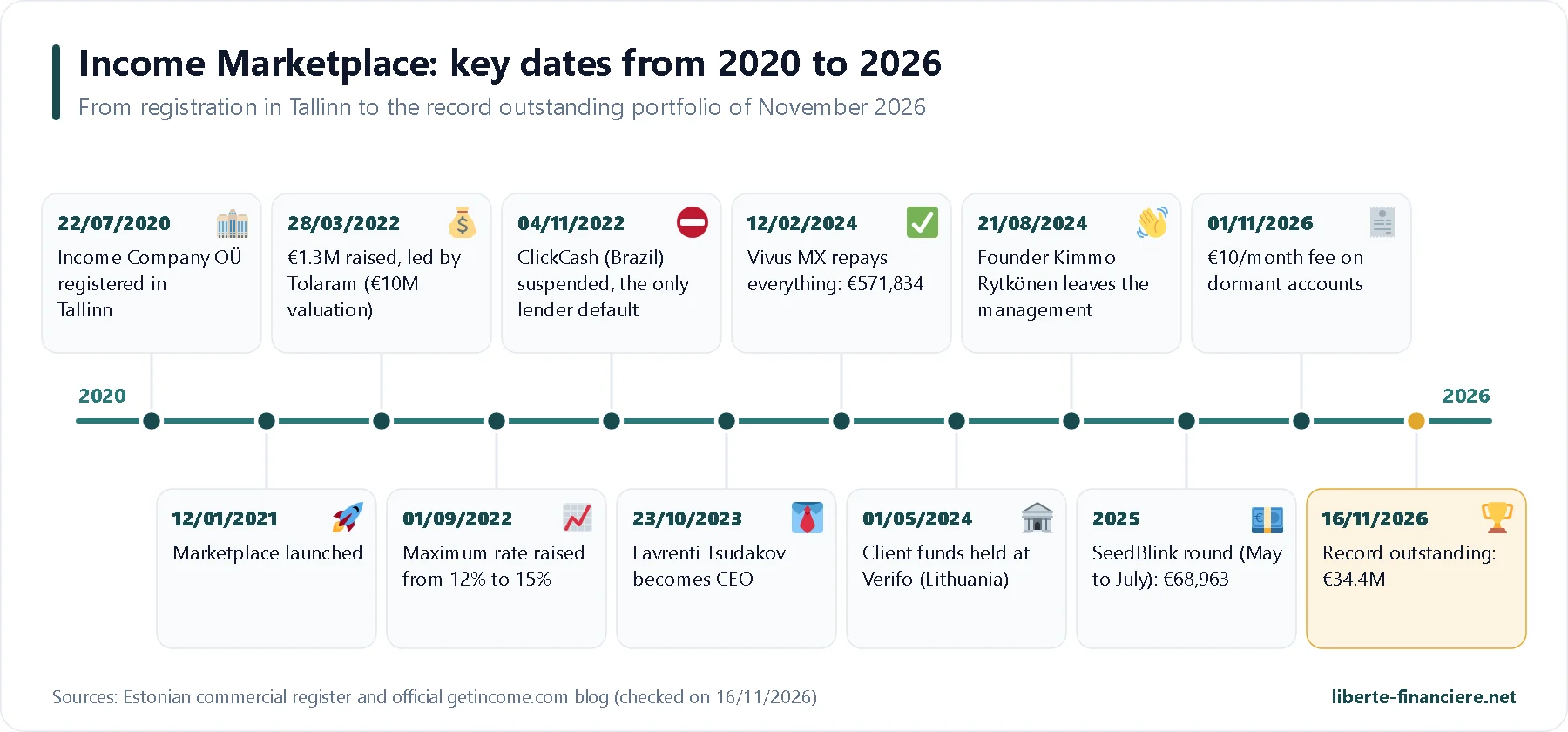
Income Company OÜ was registered in Tallinn on 22 July 2020 by Kimmo Rytkönen, a Finn who spent twenty years in consumer credit. The website went live in October 2020 and the marketplace actually opened on 12 January 2021, with a first Brazilian lender, ClickCash. Lending companies then joined over the months: Danabijak in Indonesia, FIN Yritysrahoitus in Finland, Finto Capital in Latvia, DanaRupiah in Indonesia. A mobile app came out as early as August 2021.
To fund itself, the young company raised about €1m from its founders and business angels in 2020, then €1.3m in March 2022 at a €10m valuation, with the Singapore group Tolaram as lead investor and two equity crowdfunding campaigns. The same year, Income raised its maximum rate from 12% to 15% to follow rising interest rates, and welcomed Hoovi (Estonia) and ITF Group (Bulgaria), today its largest lender.
The first blow came at the end of 2022: ClickCash was suspended for failing to carry out its buybacks. To date, it is the only lender default in the platform's history, and I go into it in detail below. In October 2023, Lavrenti Tsudakov became CEO; the founder focused on strategy, then left management in August 2024. In the meantime, Income went through the blocked transfers of Vivus Mexico, fully repaid in February 2024, and switched its payment provider to Verifo in May 2024.
Since then, growth has been steady: €100m invested in May 2024, €200m in November 2025, and an outstanding portfolio that went from €19.1m at the end of 2024 to €24.8m at the end of 2025, then to €34.4m in mid-November 2026. 2026 saw the arrival of Mocasa (Philippines), Pinjam Yuk (Indonesia) and One Leasing (North Macedonia), two-factor authentication in August, and new terms and conditions on 1 November, with fees on dormant accounts.
 Who runs Income Marketplace?
 Lavrenti Tsudakov (LinkedIn) has run Income since 23 October 2023. He joined as head of product, then chief operating officer, and has more than ten years of experience in product and team management in banking, fintech and logistics. He hosts the platform's quarterly podcast, answers investors and, since September 2026, publishes a detailed monthly report. He is also the director listed in the register for the group's companies, including the SPVs that hold the loan claims.
 Kimmo Rytkönen (LinkedIn) is the founder. According to his official profile, he has twenty years of experience in lending and banking and took part in two IPOs in the sector. CEO from 2020 to 2023, he left the management board on 21 August 2024 but remains a shareholder, with 9.47% through his holding company. In 2022, he was nominated at the Estonian Startup Awards in the foreign founders category.
Around them, the official team page shows a tight team of eight people:
Jüri Pruulmann (LinkedIn), chief technology officer, with a background in fintech and lending in Europe and Latin America;
Roger Timberg (LinkedIn), in charge of the company's finances;
Maciej Wenerski (LinkedIn), head of lending company analysis and a former auditor, who decides each lender's junior share;
Jegor Karasjov (LinkedIn), in charge of relations with the lending companies;
Anastasia Mesova, investor relations and product manager, whom you often come across on support and in the official Telegram group;
Steffi Künnapu (LinkedIn), marketing and communication.
On the capital side, the Estonian register is clear: the majority shareholder is Karlheinz Hauptmann, an investor living in Monaco, who holds 62.59% of the shares and is the only declared beneficial owner. He came in in 2021 and increased his stake at each funding round (17.8% in 2021, 39.9% in 2023, over 60% since 2025). Next come the founder's holding company (9.47%), several Estonian holding companies, Tolaram Fintech (2.78%) and the investors from the crowdfunding campaigns. Alexander Hauptmann has sat on the management board since 2020 alongside the CEO.
For you, this structure has a concrete meaning: Income is still losing money (I go through its accounts below) and it is these shareholders, led by Karlheinz Hauptmann, who have covered the losses for five years by converting their loans into equity. Their support is one of the conditions for the platform's survival as long as it is not profitable.
 How does Income Marketplace work?
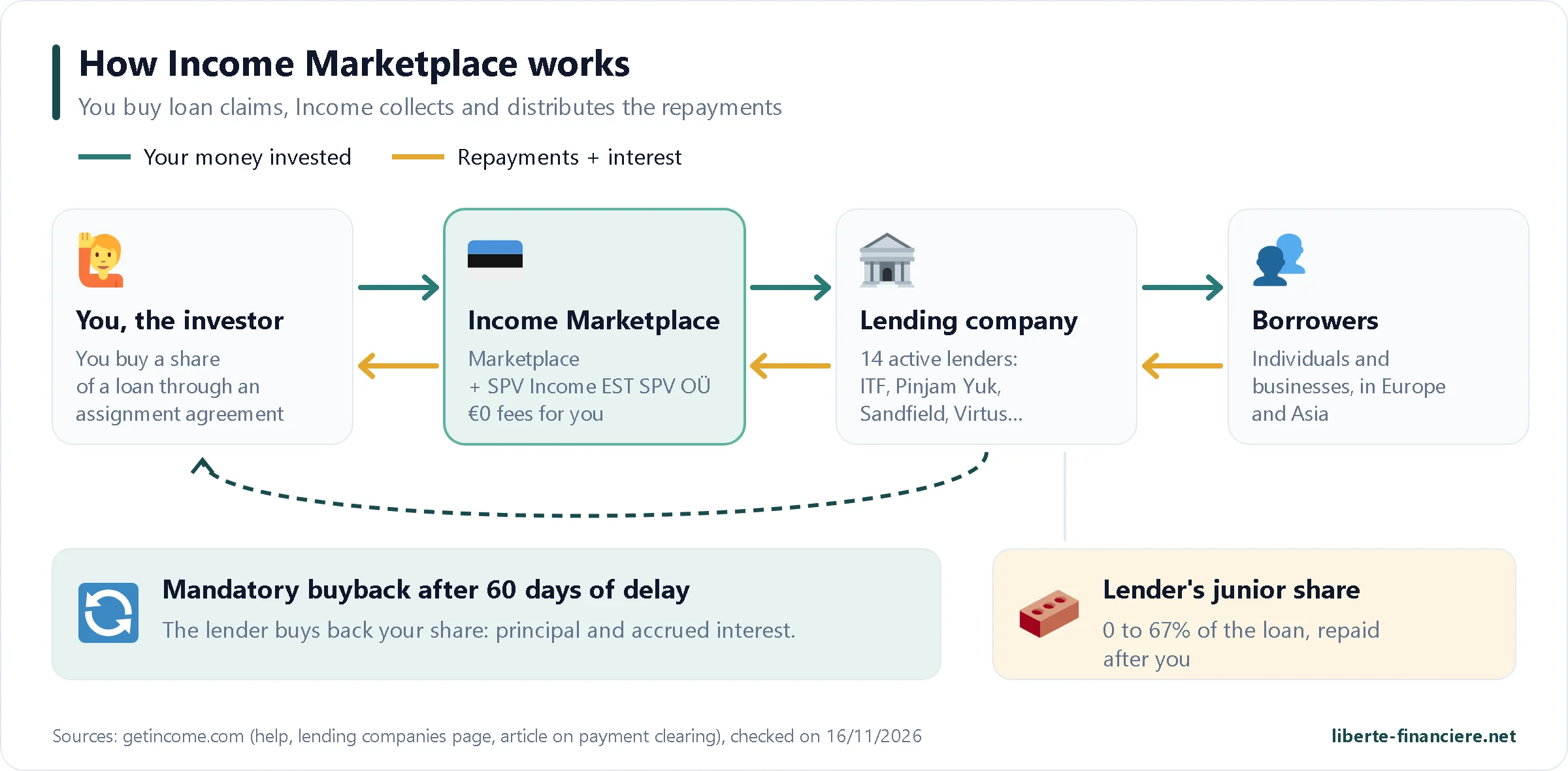
A lending company, for example ITF Group in Bulgaria or Ibancar in Spain, grants a loan to a borrower. It then lists that loan on Income to refinance itself. When you invest, you buy part of the loan claim, that is, the right to be repaid the principal and interest. The borrower keeps repaying the lending company, which passes your share on to Income, which credits it to your account. Income never lends itself and doesn't earn anything from you: it charges fees to the lending companies, which amounted to €693,261 of revenue in 2025.
An assignment agreement and an Estonian SPV
Legally, each investment is an assignment agreement for a loan claim signed online, which you can download as a PDF for each loan. For most lenders, the claim passes through a dedicated Income company, Income EST SPV OÜ (no. 16117827), which acts on behalf of investors: at Pinjam Yuk, Mocasa or Sandfield, the loan is first assigned 100% to this SPV, which then assigns fractions of it to investors. At Virtus Lending, the loans are pledged in favour of the SPV and the list is updated every quarter. A second company, Income UK SPV OÜ, was set up in August 2025 for British lenders.
The terms and conditions say it plainly: Income is an intermediary, it is not responsible for payments by borrowers or lenders, and you bear the credit risk on both. That is what makes the protections described below so important.
 Everything is in euros, even the Indonesian loans
All loans are offered in euros, including those granted in Indonesian rupiah, pounds sterling, Philippine pesos or Macedonian denars. The lending company bears the currency risk: if the rupiah falls, it pays the difference, not you. So you have no conversion fees, and you deposit by simple SEPA transfer.
 Why a loan can look late for a few days
Repayments come in through a direct connection to each lender's software, but the money doesn't always follow at the same pace. Income explains two settlement methods: either it receives 100% of the repayments and sends the lender back what is due to it, or the lender only transfers the investors' share, usually twice a week. In the community, people quickly noticed that many settlements land on a Tuesday. As a result, a loan can show "1 to 15 days late" even though the borrower has paid and the money is in transit. That is not a problem in itself, and interest keeps accruing throughout the delay.
 Income's 3 protections, and what they don't cover
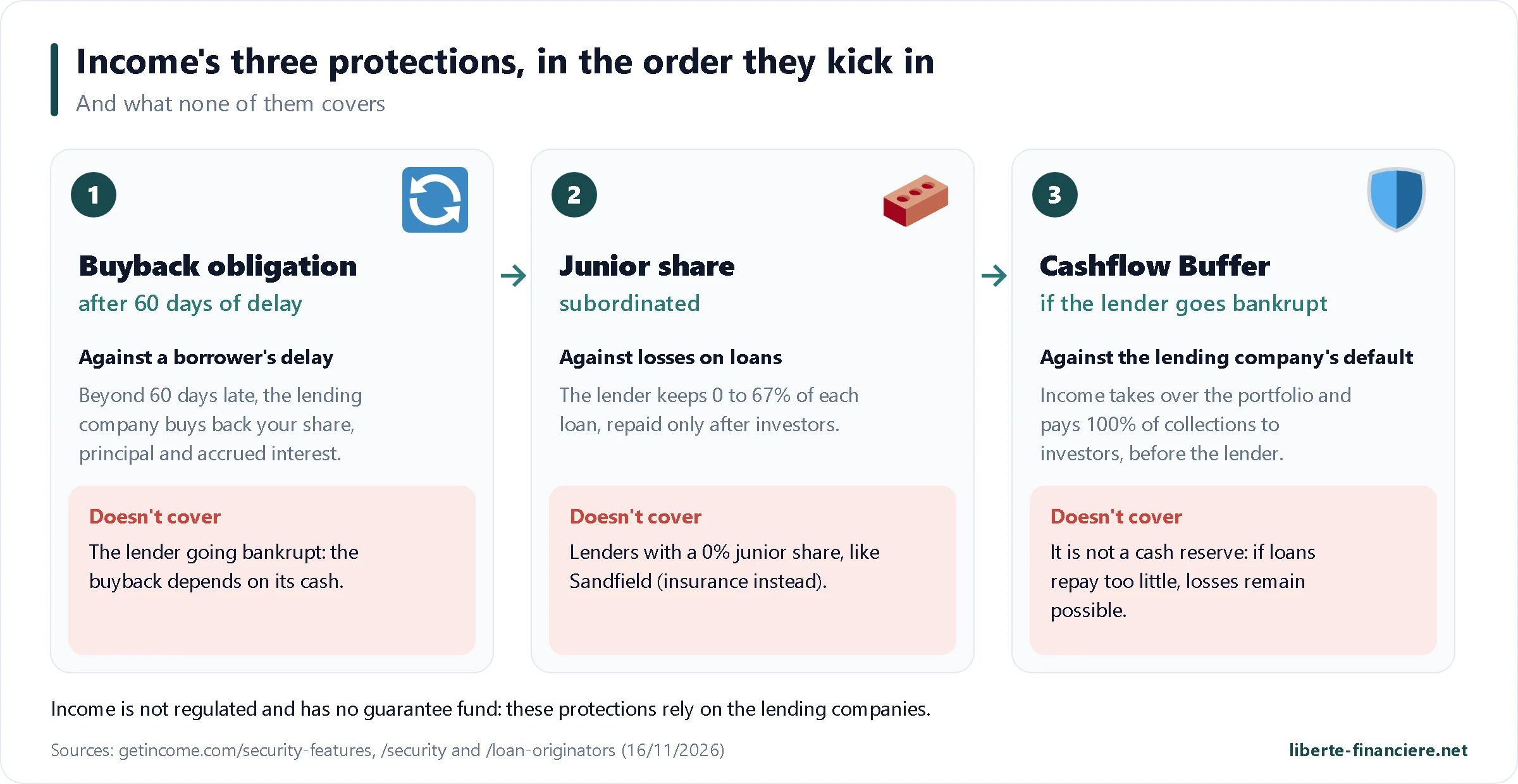
This is Income's real selling point. Where most platforms settle for a buyback guarantee, it stacks three layers of protection that don't kick in at the same time: the first protects against a borrower's default, the other two against a default by the lending company itself.
 1. Mandatory buyback after 60 days of delay
As soon as a loan goes beyond 60 days late, the lending company must buy it back, with all the remaining principal and accrued interest, whether the borrower has paid or not. Interest keeps accruing during the delay, including when the loan moves to the "buyback initiated" status. Income describes it as a contractual obligation of the lender, not a guarantee from Income: if the lender no longer has the money to buy back, this mechanism is no longer enough, and that is where the next two come in.
In my case, this mechanism runs all the time: 38% of the principal repaid to me came from a buyback, i.e. more than €10,000 out of €26,500. That is normal with lenders like Pinjam Yuk, where many borrowers pay late, and it is precisely what keeps the capital turning over.
 2. The junior share: the lender is repaid after you
On each loan, the lending company keeps part of the amount, called the junior share. This is not the classic "skin in the game" where the lender and you lose in equal proportion: here, its share is contractually subordinated to yours. As long as investors have not been repaid, the lender gets nothing on its share, and it is that share that absorbs the first losses. On the ITF Group loan below, for example, the lender keeps 10% (€316) and investors hold 90% (€2,844); the borrower pays 50% a year, the investor earns 12%.
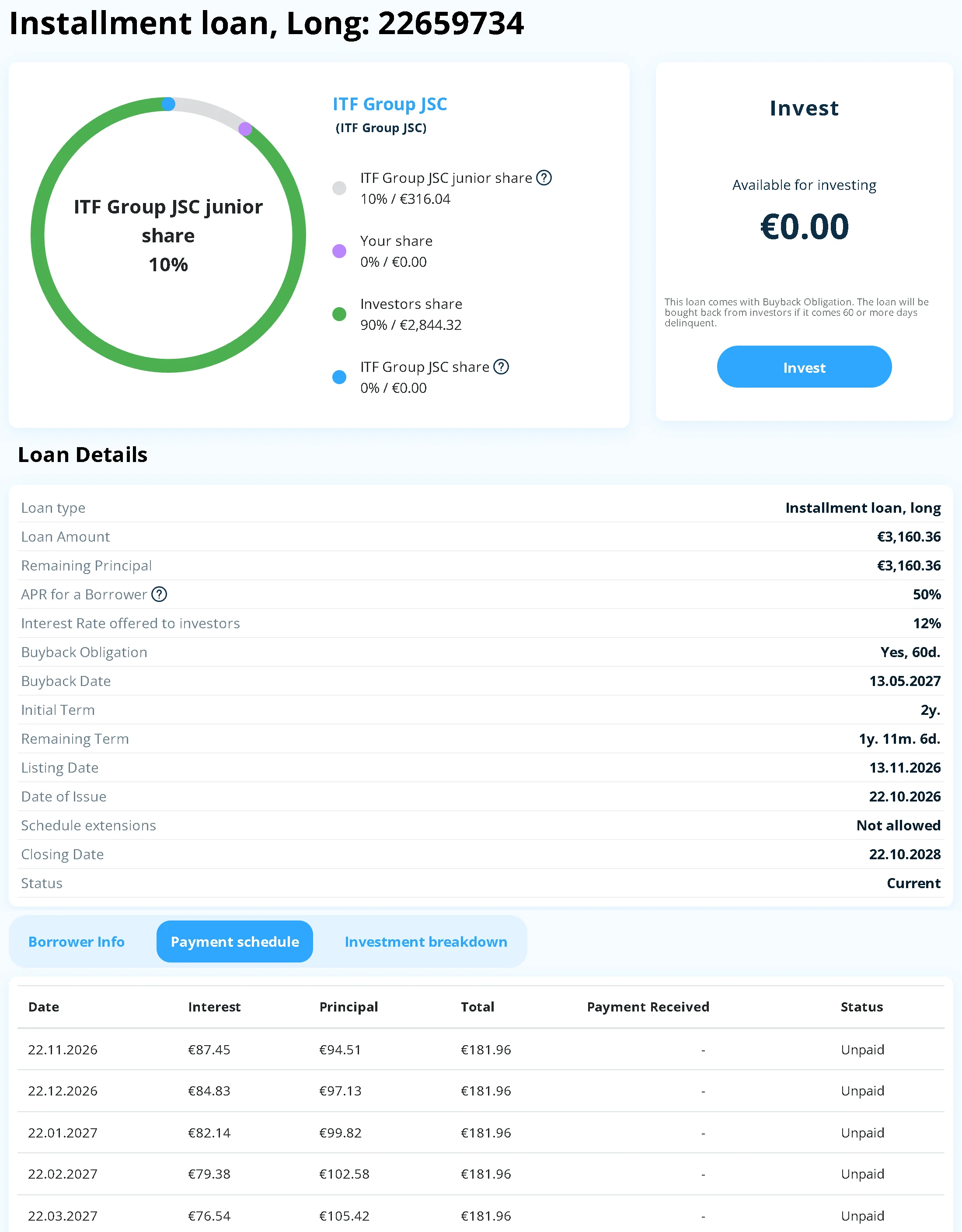
The junior share is set by the analysis team after studying the lender's repayment history: from 0% at Sandfield, which has insurance instead, to more than 30% at Pinjam Yuk for new borrowers, Mocasa or Danabijak. The riskier the portfolio, the higher the junior share. It is shown on the list of lending companies and on each loan's page.
 3. The Cashflow Buffer, if the lender goes bankrupt
The name is misleading: the Cashflow Buffer is not a pot of money set aside by Income. It is a calculation that adds up the portfolio margin (the lender lends at 30, 50 or 100% and pays you 12%), a risk adjustment and the junior share. It only applies if the lending company defaults: Income then takes over the whole listed portfolio, has it collected by local companies, and allocates 100% of the collections to investors' principal and interest before the lender gets anything.
The official example speaks for itself: out of 1,000 loans, if the lender disappears and 200 loans are never repaid, the high interest and the junior share of the other 800 are enough to cover investors. Income itself acknowledges the limit: if the buyback fails and the buffer is used up, there can be losses. And some lenders work differently: ITF Group, Simpleros and Pinjam Yuk are settled on a net basis or with partial netting, with an adapted protection, and Sandfield has neither a junior share nor a Cashflow Buffer.
 Protections specific to certain lenders
Sandfield Capital (United Kingdom): non-payment insurance taken out with Accelerant Insurance Europe. Be careful, its beneficiary is Sandfield's SPV, not you: it protects the lender, which can then honour its buybacks. This SPV, SFC4, is ring-fenced from Sandfield and structured to be bankruptcy-remote: it holds the claims and receives both the repayments from the law firms and the insurance payouts, then the money goes to Income's SPV and on to you. This flow is therefore designed to continue even if Sandfield, the operating company, runs into financial difficulty.
One Leasing (North Macedonia): since August 2026, its obligations have been guaranteed by its parent company, Virtus Invesco Partners, which is also a shareholder of Virtus Lending.
Hoovi (Estonia): loans secured by a mortgage or a car, but Hoovi keeps the collateral; you have no direct right over the asset.
Autofino and Current Auto (Lithuania): leases with a purchase option, where the car is not pledged in favour of investors (only a commitment not to pledge it to another creditor).
 What happened when things went wrong: ClickCash and Vivus
The protections have been put to the test once. On 4 November 2022, ClickCash, a Brazilian lender, stopped carrying out its buybacks: €246,878 was at stake. The pledged portfolio turned out to be much weaker than expected, because ClickCash had not maintained the agreed level of collateral. Legal action would have cost more than it would have recovered: Income gave up on it and, from the end of 2023, advanced out of its own pocket about €5,000 at each instalment to repay investors, principal first. The payments paused at times when its cash was tight; in mid-November 2026, €86,037 still remains to be repaid, out of €748,153 invested with ClickCash since the beginning.
The case also revealed a conflict of interest that Income disclosed itself: its management held about 12% of ClickCash's parent company, and Tolaram, a shareholder of Income, was its largest investor. The lesson the platform drew: only accept lenders with a portfolio of at least about €5m, and stricter collateral commitments.
The second incident ended better. At the end of 2023, Vivus Mexico's bank blocked its transfers. On 12 February 2024, Vivus repaid everything it owed, interest included, i.e. €571,834, then left the platform. Finto Capital (Latvia) had already exited cleanly in January 2023, buying back all its loans with 60 days of extra interest, and Current Auto LV closed its Latvian business in 2026 with no loss for investors.
 The 14 lending companies of Income Marketplace
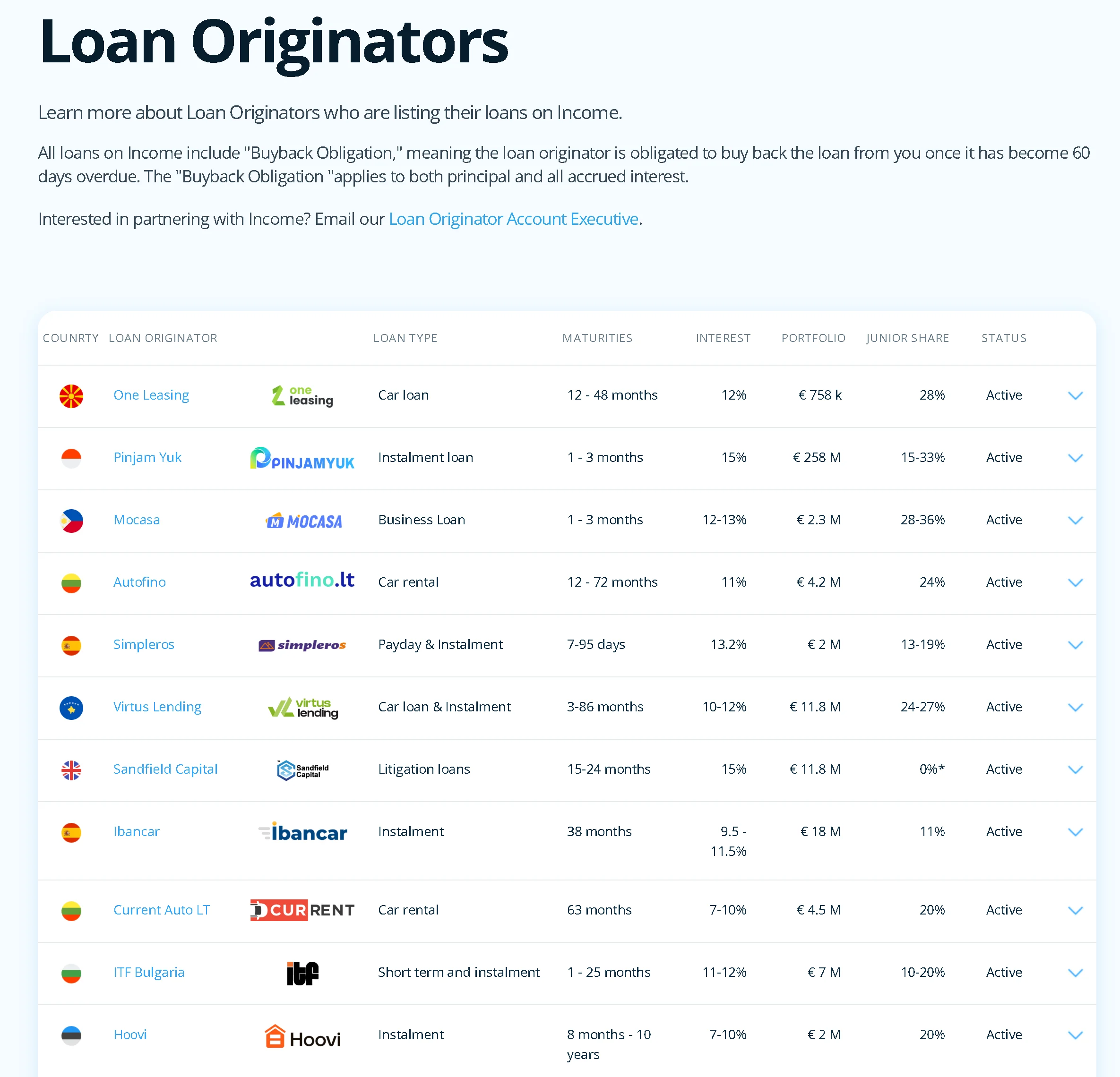
In mid-November 2026, Income works with 14 lending companies, 13 of them open to retail investors, in 9 countries, from Indonesian consumer loans to British litigation funding loans. Here is the full list, with each one's share of the outstanding portfolio. You can find the countries where they operate on my P2P map.
Lending company | Country | Type of loans | Rate | Junior share | Share of outstanding portfolio |
|---|---|---|---|---|---|
| Consumer loans | 11 to 12% | 10 to 20% | 17.9% | |
| Short instalment loans | 15% | 15 to 33% | 15.4% | |
| Litigation funding | 15% | 0% (insurance) | 15.3% | |
| Car and instalment loans | 10 to 12% | 24 to 27% | 14.1% | |
| Car-secured loans | 9.5 to 11.5% | 11% | 13.1% | |
| Secured loans, claims in collection | 7 to 13.5% | 10 to 37% | 6.6% | |
| Short-term loans | 13% | 19 to 35% | 5.1% | |
| Car leases with a purchase option | 7 to 10% | 20% | 3.9% | |
| Car leases with a purchase option | 11% | 24% | 3.3% | |
| Business loan backed by loans | 12 to 13% | 28 to 36% | 2.7% | |
| Very short-term loans | 13.2% | 13 to 19% | 1.1% | |
| Used car leasing | 12% | 28% + parent guarantee | 0.5% | |
Mammoth Finance |
| Private lender, professional investors only | n/a | n/a | 0.4% |
| Short-term loans | 10 to 12% | 19 to 67% | 0.3% |
 Bulgaria
 Indonesia
 United Kingdom
 Kosovo
 Spain
 Lithuania
 Philippines
 North Macedonia
The rates and junior shares are those of the official list to date; some vary depending on the type of loan or how long the borrower has been a customer. Two rows worth noting: Mammoth Finance is a "private" lender, whose loans are only offered to professional investors and which has no public page, so retail investors can choose from 13 lending companies, and ClickCash, suspended, no longer appears in the list.
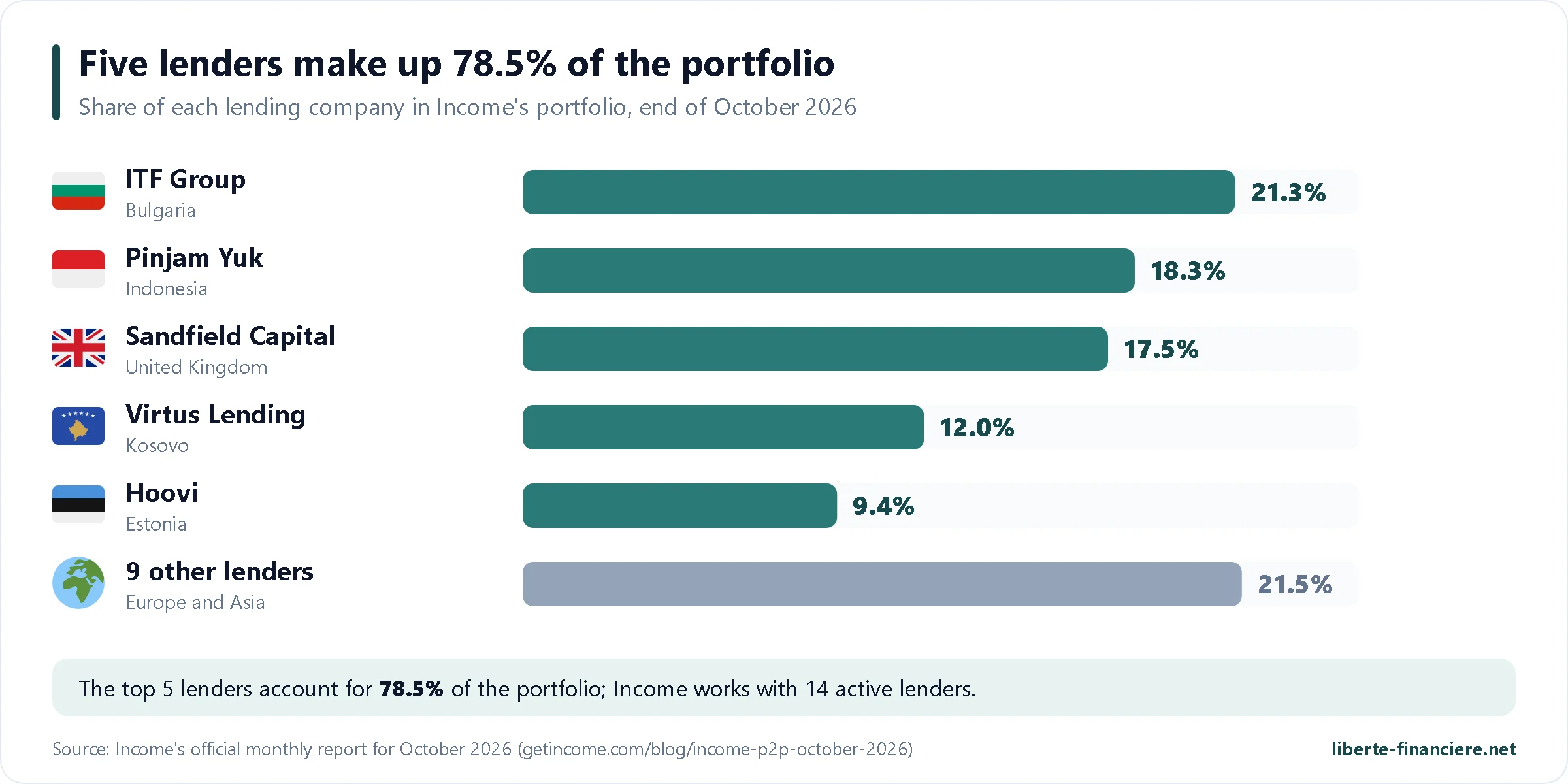
 Five lenders carry 78.5% of the outstanding portfolio
The diversification on display hides a strong concentration: at the end of October 2026, ITF Group, Pinjam Yuk, Sandfield, Virtus and Hoovi together accounted for 78.5% of the portfolio. In October, Pinjam Yuk even took 36.7% of new investments, driven by its 15% rate and its very short loans. By country, Indonesia alone weighs more than 20% of the outstanding portfolio. If you want real diversification, you therefore need to set up your Auto Invest to cap each lender's share; I come back to this below.
 What the lenders' accounts say
This is one of Income's strengths: the platform publishes the accounts of almost all its lenders, often audited, with a summary article on its blog. I went through them and rated them in my financial statements of Income's lending companies. In short:
The strongest: ITF Group, profitable with €3.1m of profit in 2025 and accounts certified without qualification; Virtus Lending (€372,000 of profit, audited accounts); Ibancar (€12.3m of revenue, €730,000 of profit); Hoovi (€867,000 of profit in 2025, audited accounts); DanaKredi, very profitable but sharply down in 2025 after the Indonesian regulator capped interest rates.
The most fragile: One Leasing, whose auditor expresses doubt about its ability to continue as a going concern (hence the parent company guarantee); Sandfield, with almost no equity, and unaudited September 2026 accounts; Current Auto LT, whose equity only turned positive again in 2026; Mocasa and Danabijak, which are loss-making.
I remain cautious on one point: several results articles published by Income contain drafting errors (a fall presented as a rise, a Bulgarian currency in the accounts of an Indonesian lender). The figures in the official PDFs are what count, not the summaries.
 High delays at some lenders
The statistics page gives, lender by lender, the share of the outstanding portfolio that is late. It varies enormously: less than 4% at Ibancar or Sandfield, around 30% at ITF or Autofino, more than 40% at Pinjam Yuk, Virtus and DanaKredi, and up to 82% at Current Auto LT. A delay is not a default: the 60-day buyback comes into play afterwards. But a lender with many loans in buyback initiated ties up a lot of cash, and that is the amount I keep an eye on: Pinjam Yuk had €437,749 in buyback initiated in mid-November, the largest amount on the platform.
 Income Marketplace statistics
Since its launch, Income has funded €287 million of loans, of which €261 million have already been repaid, at an average rate of 13.05%. Investors have earned about €8.7m in interest. The platform has 11,717 verified investors, but far fewer active ones: about 5,000 at the end of 2025, with an average portfolio of €6,141 at the end of October 2026. Its new customers come mainly from Germany and Spain, with France just behind.
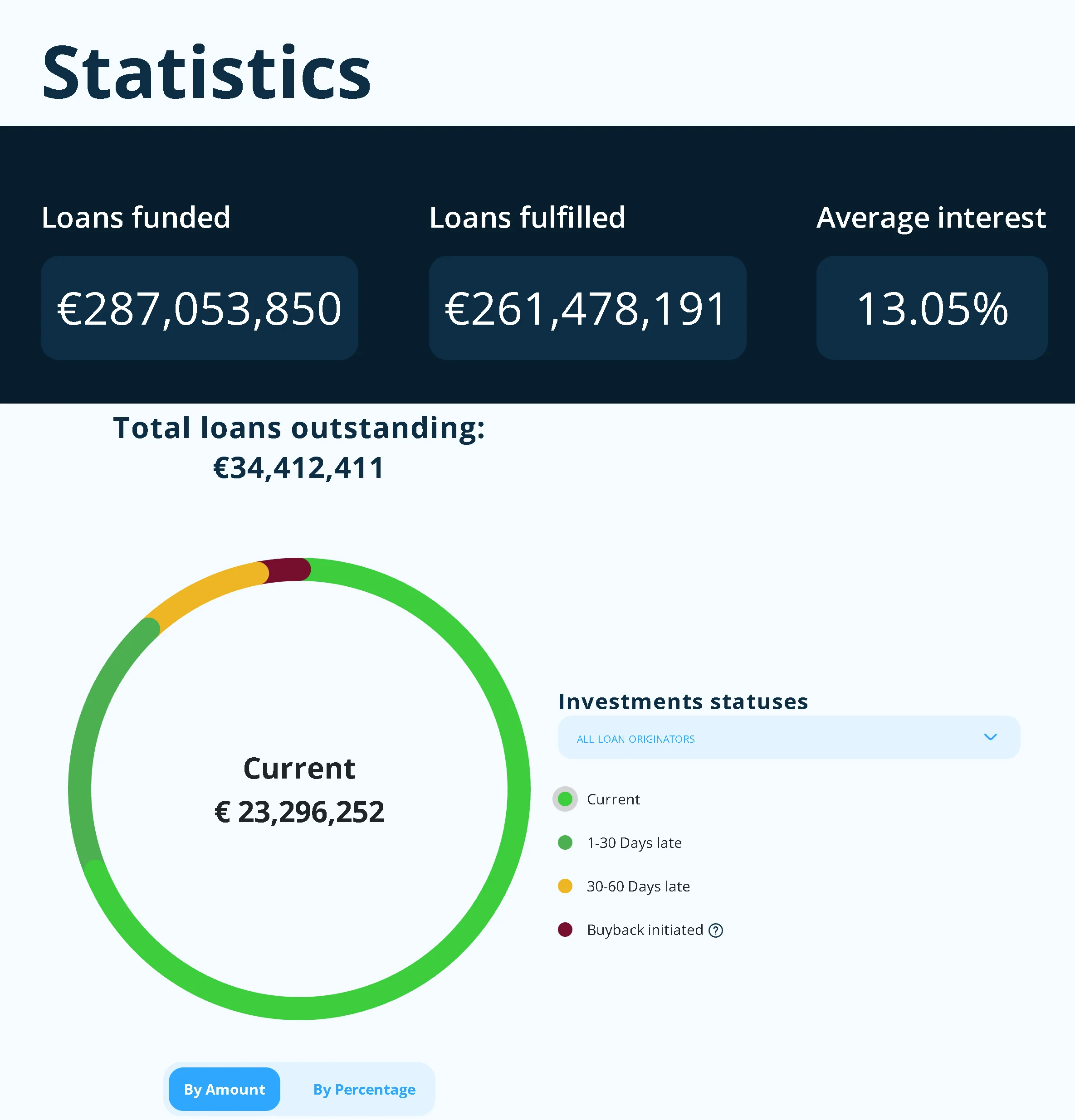
The outstanding portfolio, that is the investors' money currently on loan, grew from €1.2m at the end of 2021 to €7m at the end of 2022, €10.8m at the end of 2023, €19.1m at the end of 2024, €24.8m at the end of 2025 and €34.4m in mid-November 2026. Growth clearly accelerated in 2026, with more than €11m of loans funded every month since September and €333,880 of interest paid to investors in October alone, a record.
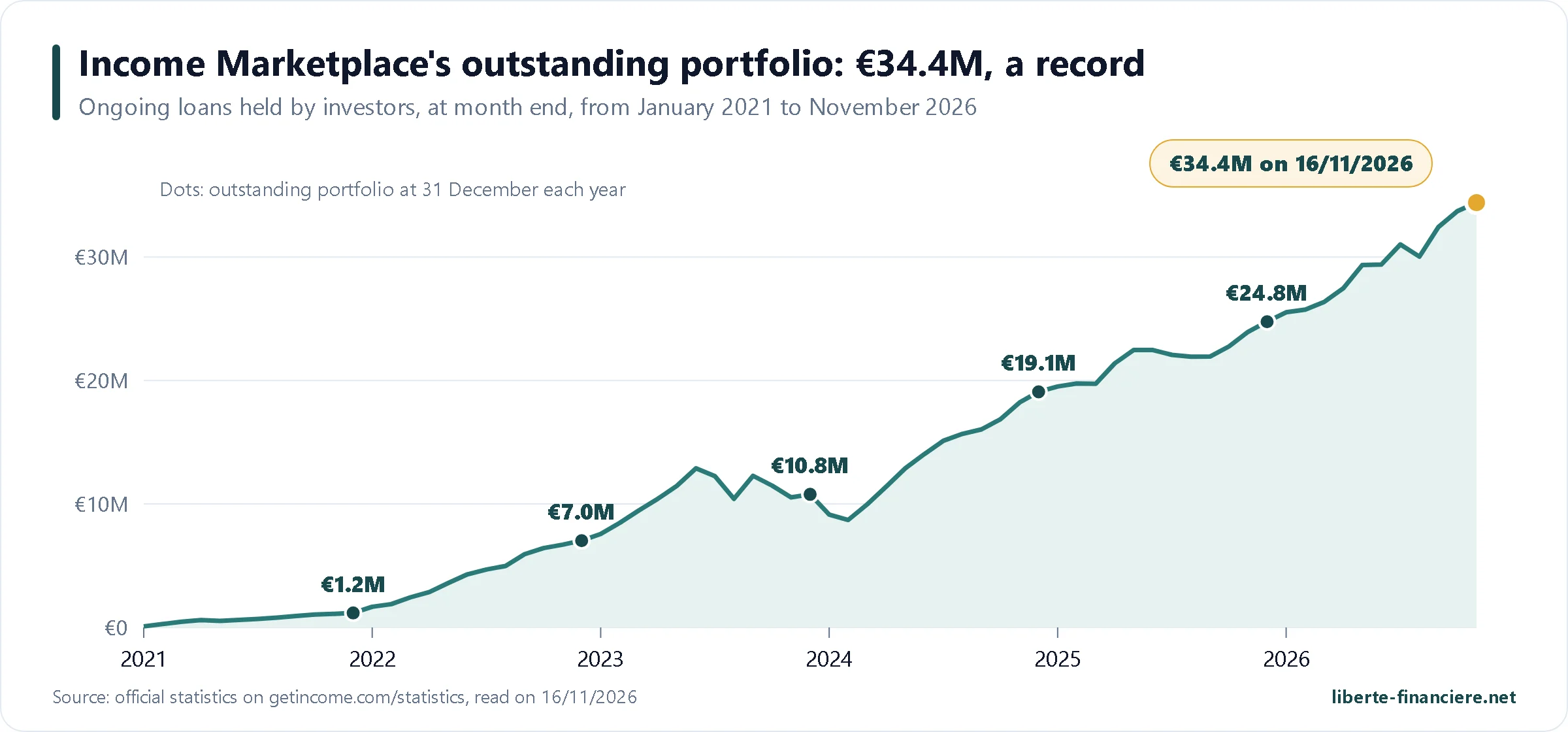
 A third of the portfolio is late: should you worry?
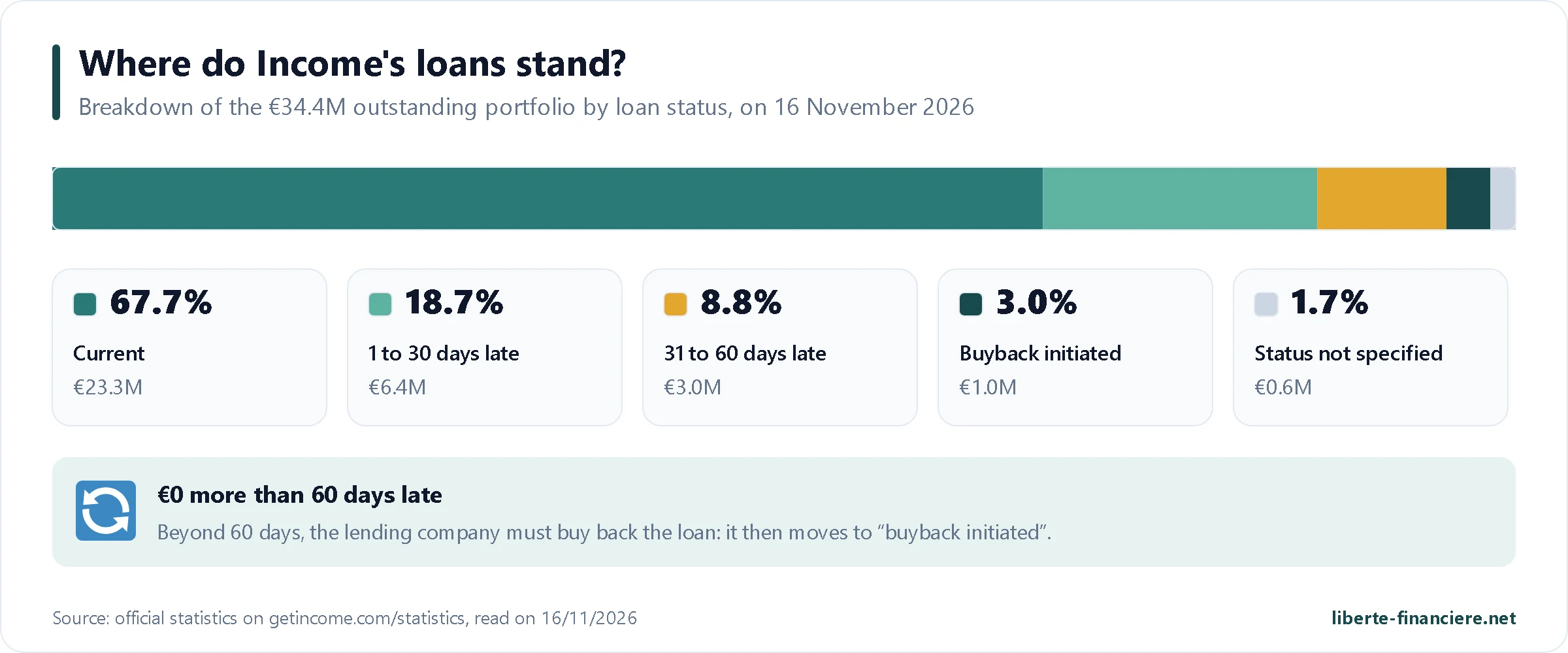
In mid-November 2026, 67.7% of the outstanding portfolio is current, 18.7% is 1 to 30 days late, 8.8% is 31 to 60 days late, and 3% is in buyback initiated. No loan is shown beyond 60 days, since the buyback takes over. This level of delay often surprises new investors, and it is the question that comes up most in the community. It comes from the lenders' model, which grants short loans to borrowers who often pay a few days or weeks late, and from settlement times. As long as buybacks are honoured, it costs nothing: interest accrues during the delay. The real warning sign would be a lasting rise in buybacks initiated at a lender.
 Is Income Marketplace regulated?
The answer is no, and Income says so itself in its FAQ: it is not regulated by a financial authority, because its activity does not fall within the scope of regulated financial services in Estonia. The European crowdfunding regulation (ECSP) does not apply to its model of buying consumer loan claims, and Estonia has never adopted the specific law expected since 2022. So there is no licence, no supervisory authority and no investor compensation scheme. To understand what this changes, I have detailed the different statuses in my guide to P2P regulation.

A direct consequence: the Bank of Latvia has put Income Company OÜ on its list of companies offering financial services without a licence, updated on 21 September 2026. This is not a sanction for fraud: the Bank of Latvia considers that, in its jurisdiction, a licence is required for this activity, and points out that the sums invested are not covered by Latvian investor protection. I found no sanction by any regulator against Income.
I asked Income directly where its licence stood. Lavrenti Tsudakov's answer, in November 2026: "Regulatory licensing is something we're actively working on in the background. We're not ready to share a public timeline yet, as we want to choose the right path rather than the fastest one." And on a possible move: "We're evaluating several regulatory routes, and jurisdiction is one of the factors in that analysis. We expect to have more clarity next year." Lithuania is the option mentioned publicly since 2025. For me, a licence is still the main step Income is missing to move into the category of platforms I consider the safest.
In the meantime, a few safeguards exist: identity verification is handled by Veriff, the platform passed a penetration test in June 2024 with no critical flaw, and two-factor authentication has been available since 18 August 2026: it remains optional, so turn it on in your settings.
 Where is your money? The Verifo case
Your uninvested money is not in an Income account. Since May 2024, it has been held at Verifo (Verified Payments, UAB), an electronic money institution licensed by the Bank of Lithuania, in client accounts kept separate from Income's own cash. If Income went bankrupt, this money would not be part of its assets. It earns no interest as long as it is not invested.
This point deserves an update. On 5 August 2026, the Bank of Lithuania took measures against Verifo after an inspection: the institution failed to meet its capital requirements for a good part of the period reviewed and lent large amounts to its sole shareholder for personal needs. The central bank ordered it to restore its capital before 1 October 2026 and prohibited it, until further notice, from taking on new clients, lending its funds or pledging them as collateral.
For you, the direct effect is limited: Income is an existing client, deposits and withdrawals continue, and client funds are protected by safeguarding rules, which keep them separate from the institution's own funds. But Income depends on a single payment provider, and a problem there could delay money movements. The platform has told its community it is looking for a second provider. So I keep little idle cash on Income, which is easy since Auto Invest reinvests everything.
 Does Income make money?
Not yet. The annual reports published by Income show it: the company has lost money every year since it was founded. Its revenue is growing fast (€222,400 in 2022, €431,913 in 2023, €507,147 in 2024, €693,261 in 2025), but losses remain high: €955,506 in 2022, €590,252 in 2023, €613,381 in 2024 and €437,981 in 2025. In total, nearly €3.8m of losses since 2020, covered by the shareholders.
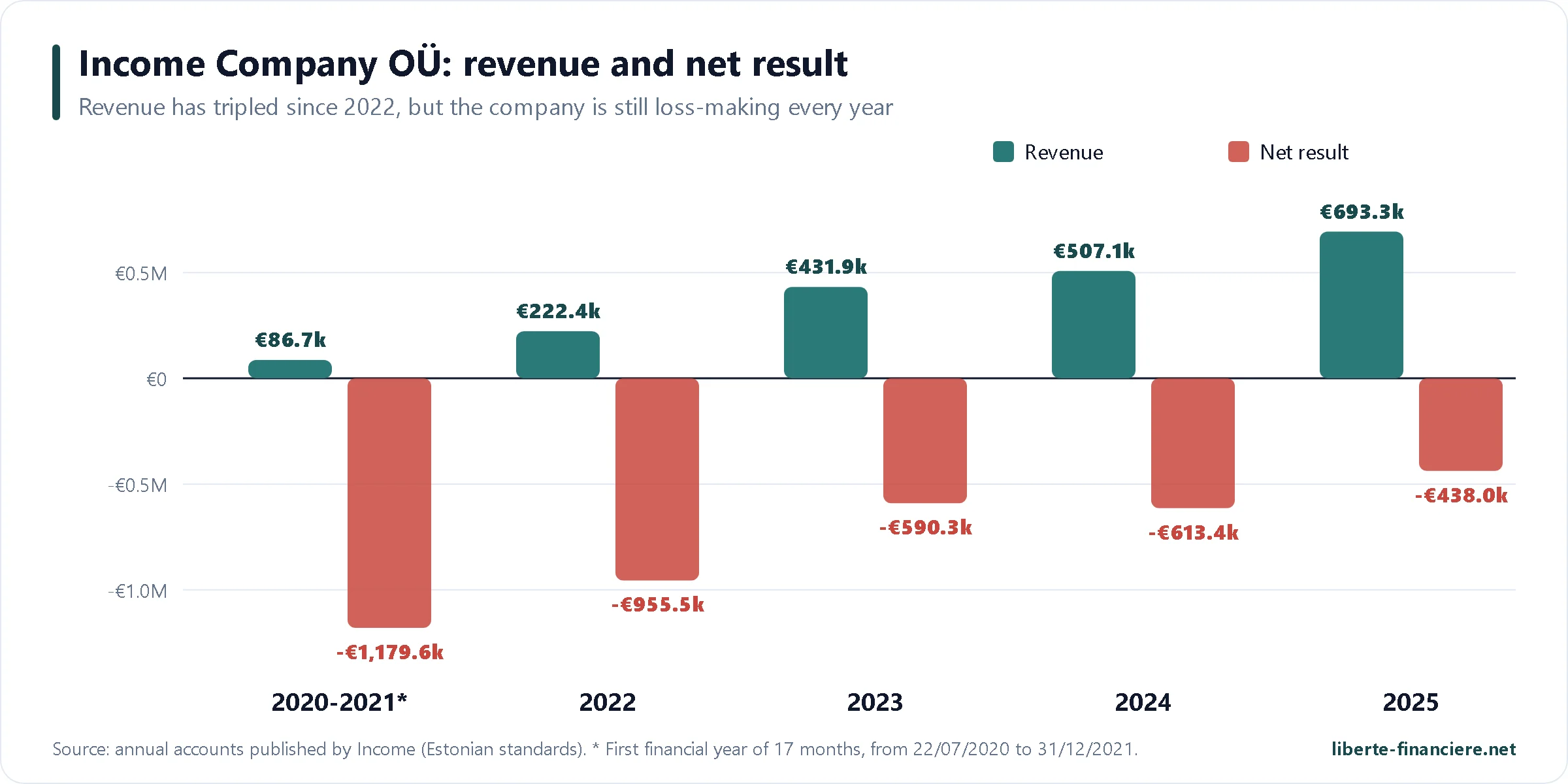
At the end of 2025, equity turned positive again (€94,175) thanks to the conversion of shareholder loans into equity, with €64,320 of cash. The Estonian register also shows a VAT debt of €11,138, fully covered by a payment plan ending on 25 December 2026. The reports contain no auditor's opinion. You can find the analysis of these accounts in my financial statements of the Income platform.
The good news is the trajectory. Income earns a commission on the outstanding portfolio: the bigger it gets, the more it earns. According to its CEO, December 2025 was already profitable on a one-off basis, and regular monthly profitability is expected at around €30 to 35m of outstanding portfolio; in October 2026, the platform told its community the threshold was rather around €35 to 37m. With €34.4m in mid-November and record revenue in October, it has never been so close. A new funding round has also been announced for 2026.
Should you worry about it? Income going bankrupt would not make you lose your loan claims, which belong to you, nor your uninvested money, safeguarded at Verifo. The terms and conditions provide that, if the platform closes, Income or a third party organises the collection of outstanding loans. But no successor is designated in advance, and a bankruptcy would certainly make recovery slower and more uncertain. That is why I invest on Income, but also diversify elsewhere so as not to put all my eggs in one basket.
 How do you open an Income Marketplace account?

Signing up takes less than 5 minutes. Income accepts adult individuals resident in the European Economic Area, Switzerland or the United Kingdom, as well as companies registered in those countries. Only one account is allowed per person.
Click on my sign-up link to get the 3% bonus on your first 30 days, then create your account with your email, or an Apple or Google account.
Verify your identity with Veriff: a photo of your ID card or passport, then a selfie. A driving licence is not accepted. Approval usually takes a few minutes.
Make a SEPA transfer in euros from a bank account in your name, making sure you include the reference number shown in your dashboard: without it, the transfer is sent back. The money arrives within one to two business days. The minimum first deposit is €10.
Invest manually or create an Auto Invest strategy (see below). Interest is paid at each instalment, usually every month.
Turn on two-factor authentication in your settings.
For a company, the process is the same, with the company's documents and an authorised representative. The iOS and Android apps let you follow your portfolio; the interface, on the website and in the app, is only available in English.
Create my Income account Less than 5 minutes, SEPA transfer, from €10. 3% bonus on your first 30 days with my link. |
 Investing on Income: Auto Invest and manual investing
Income's Auto Invest is one of the most complete on the market. You can create several strategies and filter by lending company, country, type of loan, minimum rate, remaining term, loan status, amount per loan, presence of an early buyback or extensions, and choose to reinvest repayments automatically. One option spreads your money equally across the selected lenders.
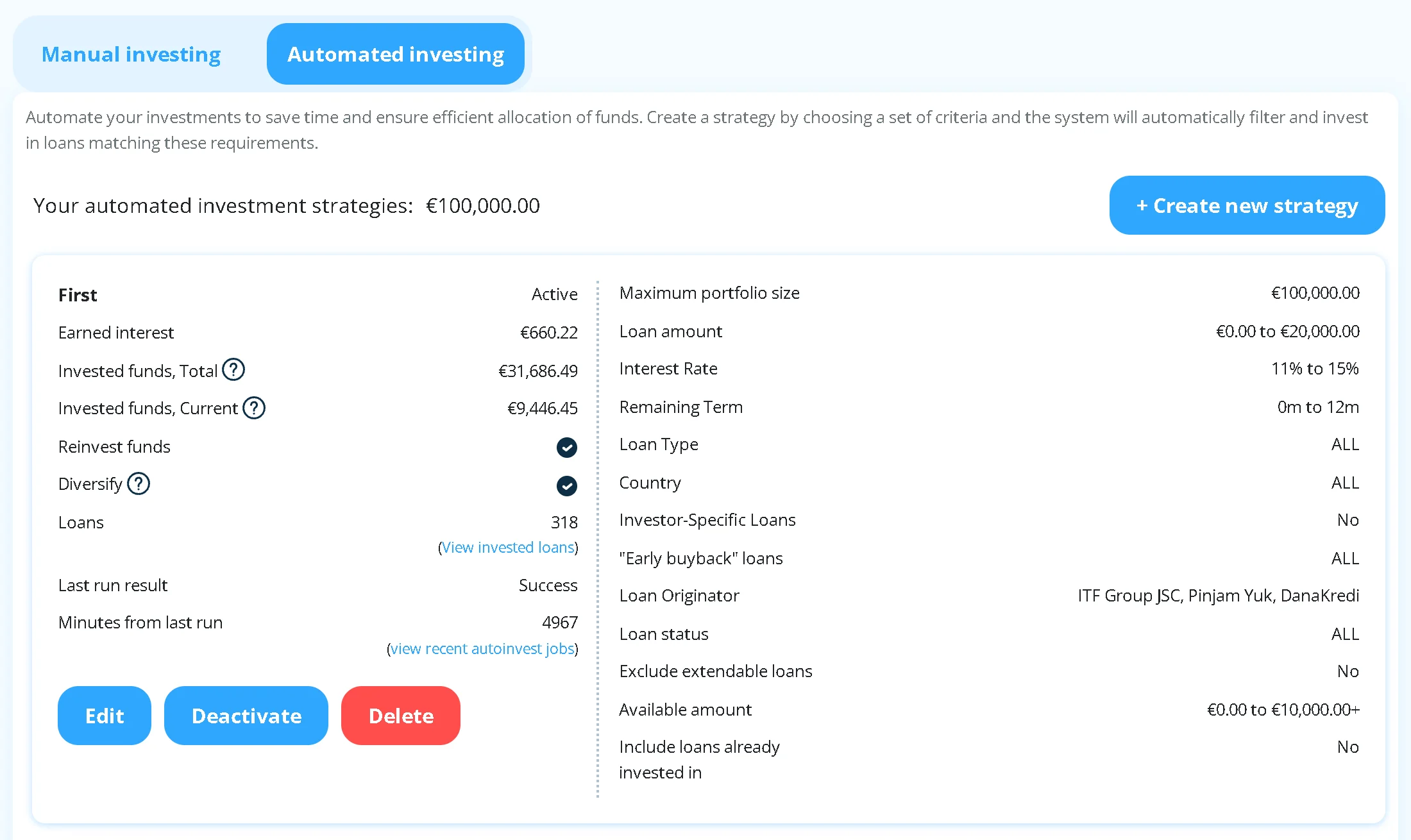
 My tips for setting up your robot properly
Cap each lender's share. The equal distribution option doesn't spread things perfectly: in the community, many have noticed that it favours the lenders that list the most loans, like Pinjam Yuk. Set a maximum amount per loan instead and check your breakdown every month in the dashboard.
Look at the early buyback date, not just the term. Many long loans (up to 7 years) have an early buyback date at one year. This buyback is not guaranteed on the planned date: since July 2024, the lender can postpone it if it is short of cash. If you want to be able to get your money back quickly, exclude loans that are too long.
Exclude the lenders you don't like, after reading their accounts. In my April 2026 video, for example, I had removed Virtus Lending from my robot after reading its financial statements, and I was focusing my investments on ITF Group and Pinjam Yuk.
Don't be surprised by slowness on Tuesdays: that is the day many settlements with lenders are processed, and manual investing can slow down. The robot keeps running.
Manual investing is possible from the list of loans, with the same filters. Loans at 13 or 15% go quickly, and the platform has had days when it was hard to buy manually. In practice, the robot is enough: my cash is almost always at zero, with no money sitting idle.
 Fees: free, unless your account is dormant
Income charges you nothing for deposits, withdrawals, investing or management. It earns its money from the lending companies. A single exception appeared with the terms and conditions in force from 1 November 2026: a fee of €10 a month on dormant accounts.
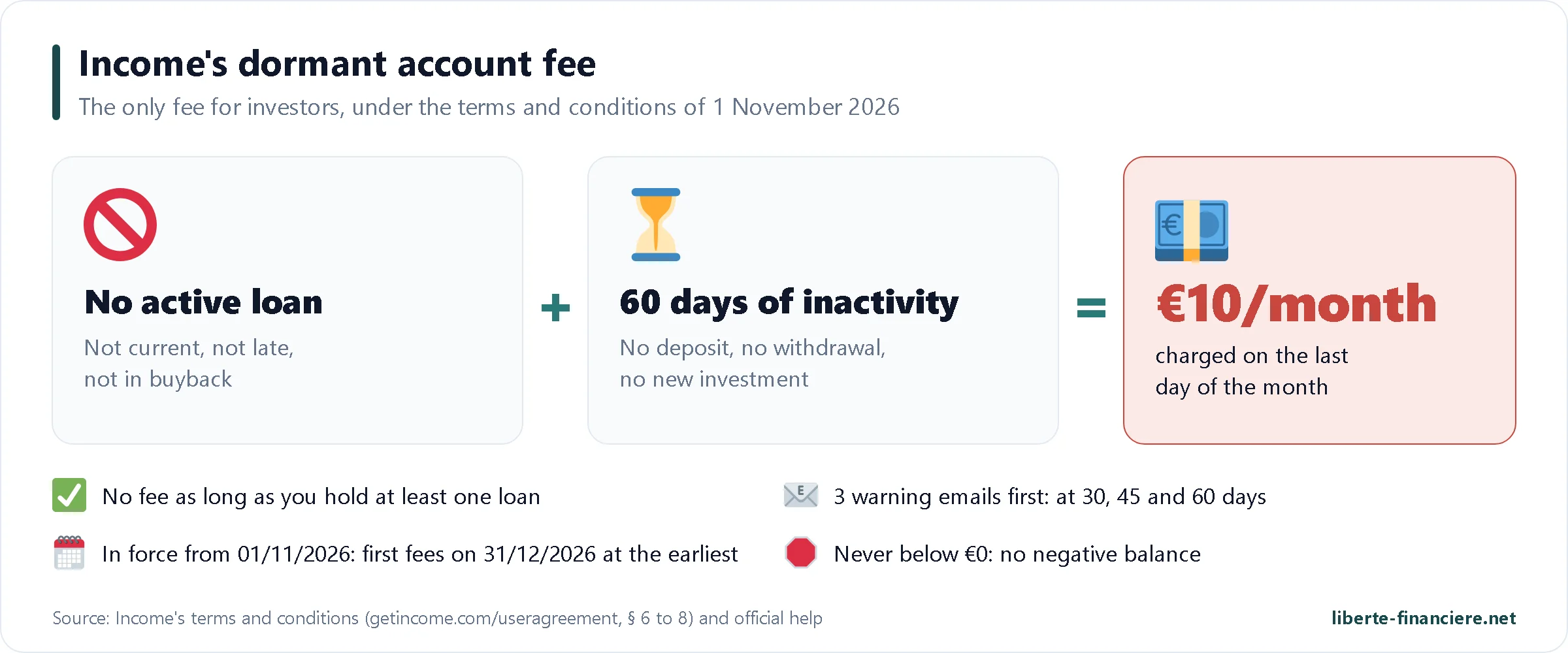
An account is dormant if it has no active loan and no deposit, withdrawal or investment for 60 days in a row. You receive three warning emails (at 30, 45 and 60 days), the fee is charged on the last day of the month, and it can never make your balance negative. As long as you have a single loan, even a late one, you pay nothing. Since the count started on 1 November 2026, no fee can be charged before the end of December 2026. In practice, it only affects forgotten accounts with a bit of cash: if you stop using Income, withdraw everything and ask for your account to be closed, which is free.
 Getting your money back: no secondary market
This is the weak point investors mention most: Income has no secondary market. You can't sell a loan before it matures; you get your money back as repayments, buybacks and early repayments come in. The secondary market was announced for 2024, then for the second quarter of 2026 at the latest. It was technically ready in summer 2026, but its launch was postponed with no date in September 2026. When I asked him in November, Lavrenti Tsudakov replied: "The secondary market remains on hold for now. We'll share more once we're confident about the scope and timing."
In practice, liquidity depends on your loans. On short loans like Pinjam Yuk's (1 to 3 months), your money comes back quickly. On car loans of 5 or 7 years, you depend on the early buyback, which is not guaranteed. My method: I favour short terms in my robot and I treat every euro placed on Income as locked up for at least a few months.
As for withdrawals, they are free and can only go to the bank account used for the deposit. According to the terms and conditions, the request is processed within three business days at most, then the transfer takes up to two business days. A withdrawal request cannot be cancelled.
 The risks you need to know

I'm not a financial advisor: any investment carries a risk of capital loss, and past performance is no guarantee of future performance. Here are the risks I see on Income, from the most general to the most specific.
Capital loss: if a lending company goes bankrupt and its protections are not enough, you can lose part of your money. The ClickCash case shows that the collateral can be weaker than expected.
Illiquidity: with no secondary market, your money is locked up until maturity or the buyback. Only put money on Income that you don't need in the short term.
Geopolitical and concentration risk: a large part of the outstanding portfolio is in Indonesia, Kosovo, Bulgaria or the Philippines, countries where a change in the law (the interest rate cap in Indonesia, for example) can weaken a lender. Five lenders carry 78.5% of the outstanding portfolio.
Unregulated, loss-making platform: no authority supervises Income, which still depends on its shareholders' support. A bankruptcy would slow down the collection of your loans.
Single payment provider: Verifo is subject to measures from the Bank of Lithuania, and Income does not yet have a second provider.
Uneven protections across lenders: Sandfield has no junior share and its insurance pays out to its SPV, not to you, even though that SPV is designed to keep the money flowing if Sandfield runs into trouble; some car loans have no pledge on the car; a private lender has no public page.
Delays and early buybacks: a third of the outstanding portfolio is permanently late, and the early buyback can be postponed. As long as buybacks are paid, it costs nothing, but it is a signal to watch.
Conflicts of interest: Income discloses them, but they exist (management's stake in ClickCash in the past, a shareholder shared with a lender).
These risks are not hidden: Income details them itself on its risks page, which is rather rare.
 Income Marketplace taxation in France

Income withholds no tax at source: your interest is paid to you gross, and it is up to you to declare it. If you are a French tax resident, it is subject to the French flat tax of 31.4% (12.8% income tax and 18.6% social contributions), or to the progressive income tax scale if that works out better for you.
Annual return: report your interest on the French tax forms 2047 and 2042, and declare your Income account as a foreign account on form 3916.
Document to use: in your dashboard, the account statement tab lets you export a statement for the calendar year as a PDF or Excel file, as well as a PDF tax export. There is no IFU (the annual tax summary issued by French institutions); it is a document specific to Income.
Monthly return (2778-SD): since nothing is withheld at source, you may have to declare the interest every month on this French form and pay the advance tax as you go, depending on your reference tax income. I do it for all my platforms; practice varies from one tax office to another.
Through a company: Income accepts legal entities. The interest then goes into the company's taxable profit, subject to corporate income tax.
To get a sense of the effect of tax, here is a simple simulation: €10,000 invested for three years at 12% gross, with interest reinvested. Before tax, you end up with €14,049. If you pay the flat tax every year on your interest, you end up with €12,678, i.e. a net return of about 8.2% a year. It is an order of magnitude, with no delays or defaults.
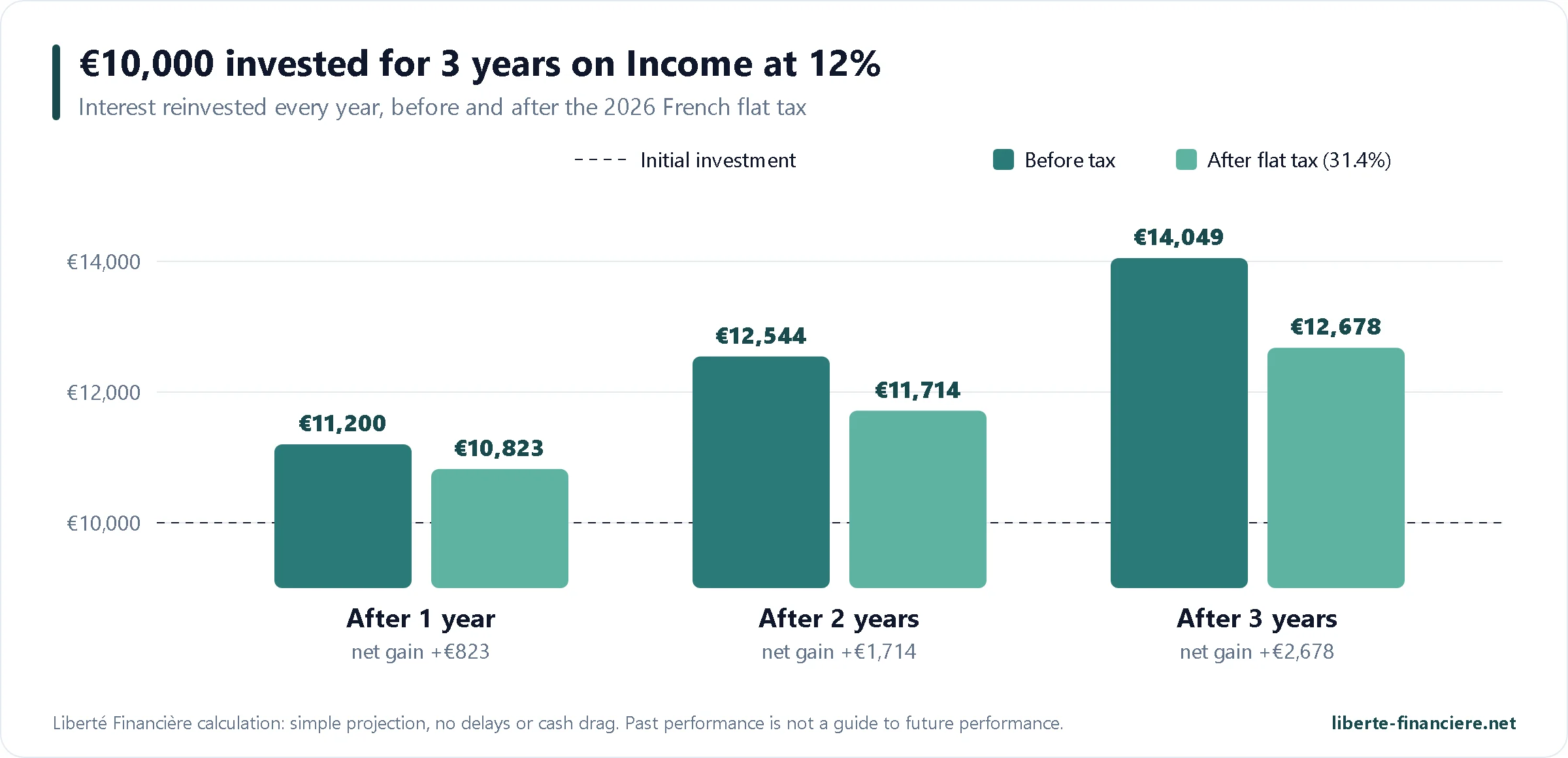
All the steps are detailed in my guide how to declare your P2P income for tax and in my article on withholding tax in P2P.
 Income Marketplace vs its competitors
I compare Income with other loan marketplaces where I also invest. The returns are my real XIRR excluding bonuses, calculated on all my cash flows on each platform.
Criterion |
|
|
|
|
|
|---|---|---|---|---|---|
Head office |
|
|
|
|
|
Regulation | None | None | ECSP | None | MiFID II |
My XIRR excluding bonuses | |||||
|



 Croatia
 Latvia
On returns, Income does clearly better than PeerBerry, the most cautious of the group, with a gap of more than two points in my case, and comes just behind Nectaro; Afranga and Swaper earn me more, over 14%. What it offers on top is diversification across many independent lenders and the junior share, whereas PeerBerry, Afranga and Swaper mainly rely on a single lending group; what it offers less of is regulation and liquidity. Afranga has the European ECSP status and Nectaro a MiFID II licence, while Income, PeerBerry and Swaper have none.
To widen the picture, here is Income compared with platforms that are regulated, more cautious or more liquid:
Criterion |
|
|
|
|
|
|---|---|---|---|---|---|
Head office |
|
|
|
|
|
Product | Loans from 14 lenders (13 for retail investors) | Loans from dozens of lenders | Loans from the Twino group | SmartSaver savings | Go & Grow savings |
Regulation | None | MiFID II | MiFID II | Lender's national licence | Lender's national licence |
My XIRR excluding bonuses | |||||
|

Compared with Mintos, Income earns one point more and offers stronger protection against a lender going bankrupt, but with no licence and no secondary market. Compared with savings products like Monefit SmartSaver or Bondora Go & Grow, it earns clearly more, at the cost of much lower liquidity. My Twino account is too recent for its XIRR to be meaningful.
 My experience: €11,400 invested, 11.95% a year
I made my first deposit on Income on 31 December 2024: €2,000, invested from 2 January 2025. In 2025, I tested the platform with a few thousand euros, withdrawing part of the money along the way, then I built up my position step by step from 2026, moving money from other platforms: €2,000 in January, €1,000 in May, €3,000 in June and €3,000 in July. In total, I have deposited €15,000 and withdrawn €4,603. Today, about €11,400 is invested, and my cash is at zero.
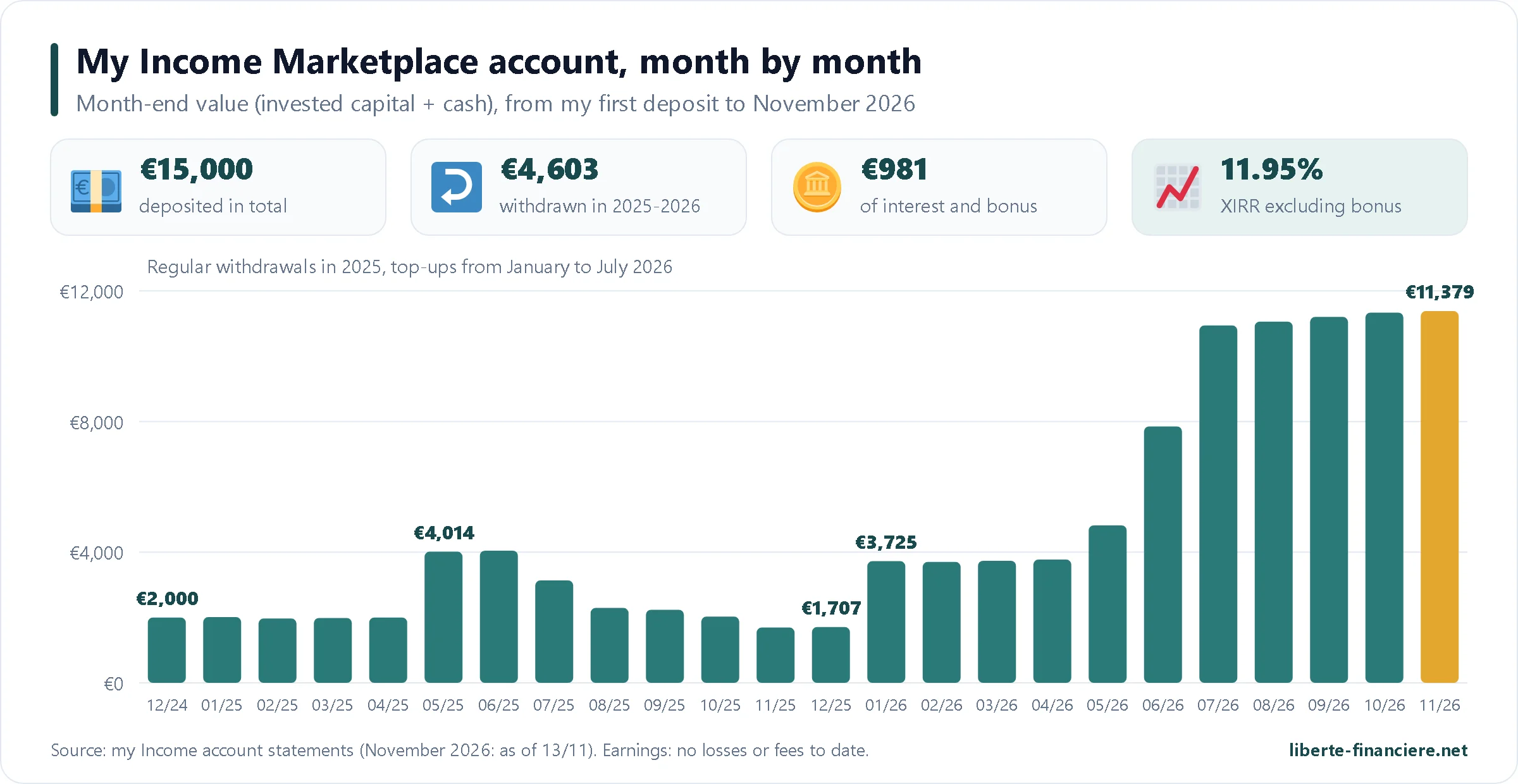
In almost two years, Income has paid me €965 of interest and €16 of bonus, with no losses and no fees. My real return, measured by XIRR, which takes the date of each cash flow into account, is 11.95% a year excluding the bonus, 12.19% with the bonus. Since September 2026, I have been earning between €130 and €145 of interest a month.
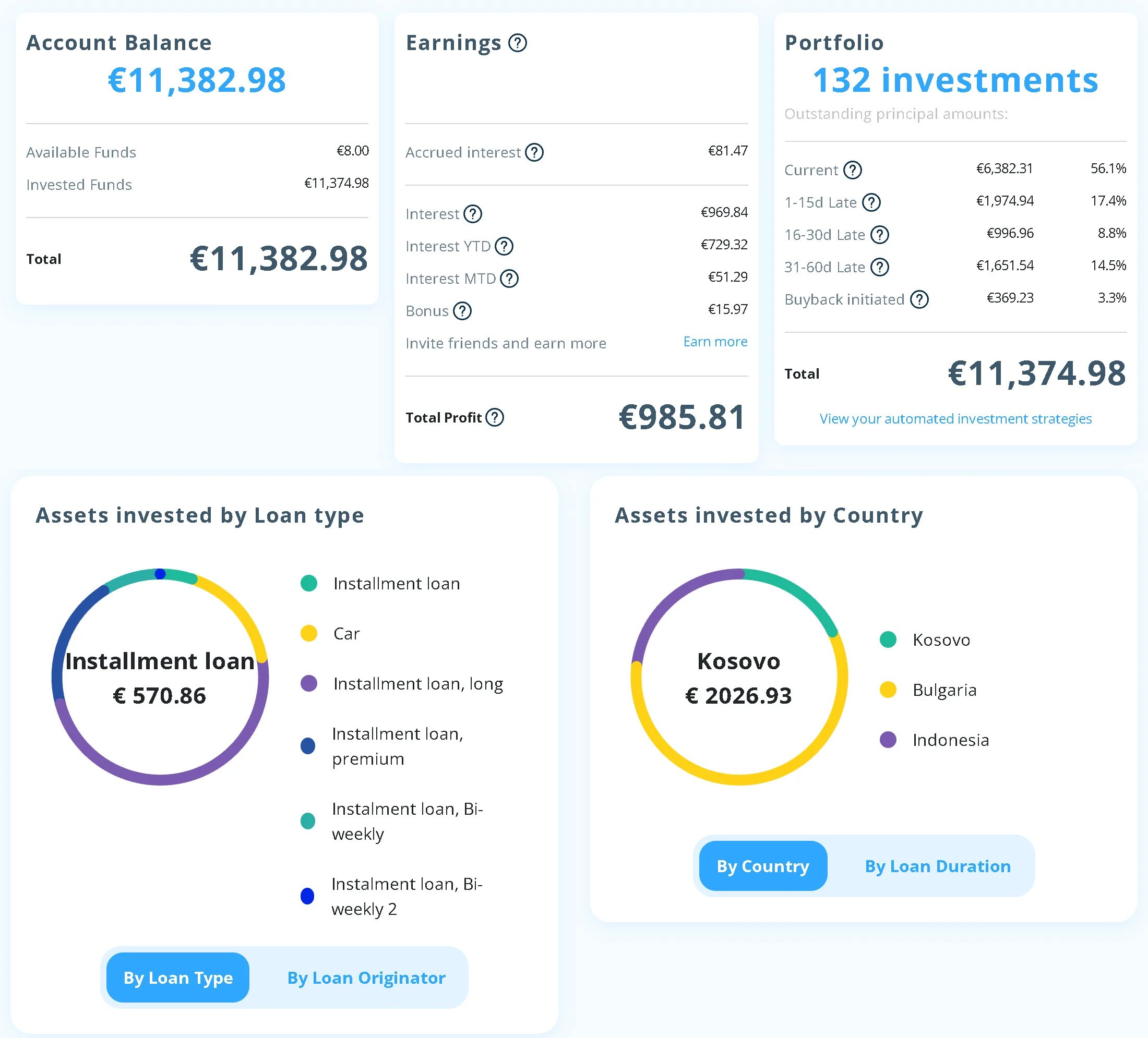
A technical detail for calculating your own return: with so many loans late or in buyback, part of the interest earned has not been paid out yet. If you calculate your return without taking this accrued interest into account, you underestimate it. Income's statement gives the total value of your account, accrued interest included: that is the figure to use as the final value.
Why don't I invest more, when returns are good and the lenders I follow publish good accounts? Because the platform is neither regulated nor profitable yet, it depends on a single payment provider and it has no secondary market. I prefer to keep Income as one yield position among others rather than make it my largest holding. If it gets a licence, becomes profitable and launches its secondary market, I will add to it.
Pros and cons
|
|
|---|---|
Three protections, including a junior share repaid after you (see the protections) | No regulation and a platform that is still loss-making (see regulation and accounts) |
Returns of 7 to 15%, 11.95% real for me | No secondary market, early buyback not guaranteed |
14 lending companies (13 open to retail investors) in 9 countries, all in euros | A single payment provider, subject to measures from the Bank of Lithuania |
Rare transparency: lenders' accounts, delays by lender, monthly reports | Interface in English only, sometimes slow; fees on dormant accounts |
No fees and no withholding tax, from €10 | |
Very complete Auto Invest, no money sitting idle |
 Cons
 Who is Income Marketplace for?
Profile | Is Income a good fit? |
|---|---|
You are looking for 11 to 14% and accept an unregulated platform for part of your portfolio | Yes |
You want to diversify across independent lenders, with protection against their bankruptcy | Yes |
You like analysing lenders and fine-tuning your robot | Yes |
You invest through a company | Yes, companies are accepted |
You may need your money in the coming months | Rather not |
You only want regulated platforms | Rather not |
You are a beginner and want a simple product with quick withdrawals | Rather not: take a look at Monefit or Bondora |
 What users say
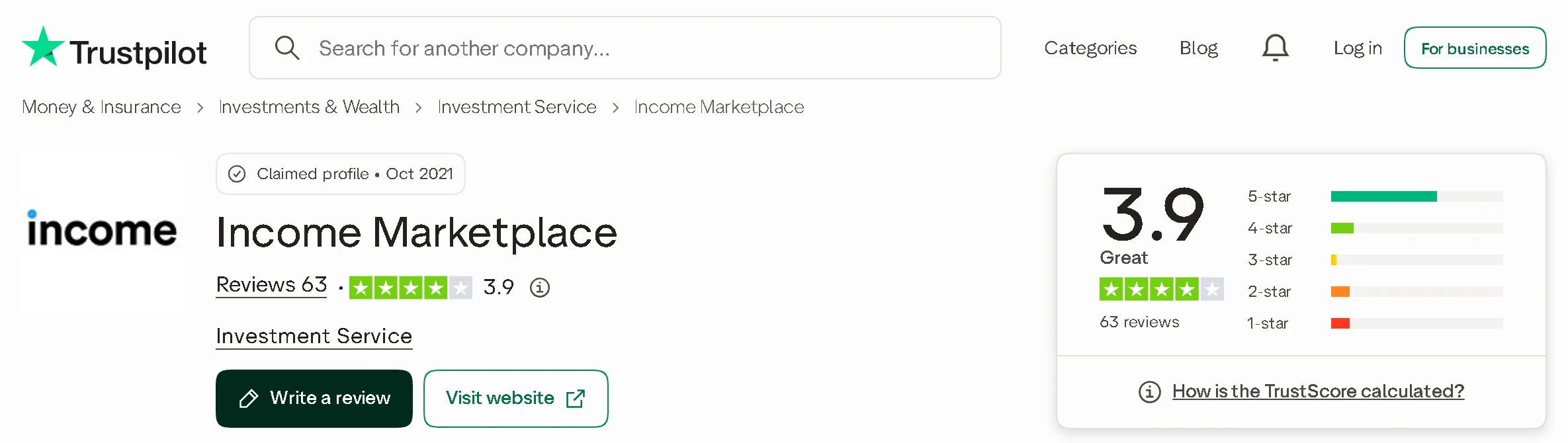
On Trustpilot, Income scores 3.9 / 5 from 63 reviews in mid-November 2026, including 39 five-star reviews and 14 one- or two-star reviews. Positive reviews praise the regular interest, the transparency and the quality of the official Telegram group, where the team and sometimes the CEO answer directly. Negative reviews are mainly about slowness and bugs on the website and the app, the lack of a secondary market, buybacks that drag on and the calculation of the referral bonus, which is poorly understood. The platform replies to most negative reviews.
In my community on Telegram, the questions that come up most are about the level of delays, especially at Pinjam Yuk, how the robot spreads money across lenders and how to calculate the return. Income's support is seen as responsive there: it usually answers in less than a day, by email or on Telegram.
 Income Marketplace bonus code

There is no code to enter: by signing up with my link, you get 3% of the average amount you invest during your first 30 days. The bonus is calculated on your average outstanding amount over the period, not on your highest amount: to get the full benefit, invest your deposit in the first few days.
Current offer- 3% of your average invested balance over your first 30 days, instead of 1%
- Example: €5,000 invested on average = €150 bonus
During the campaign, this offer replaces the usual offer.
Get the offer →Until 19 January 2027
Get the Income bonus 3% bonus on the average amount invested during your first 30 days, no code needed. |
 Frequently asked questions about Income Marketplace
Is Income Marketplace a scam?
No. It is an Estonian company registered since 2020, which publishes its own accounts and those of its lenders, and which repaid investors during the ClickCash and Vivus incidents. It is, however, not regulated, which is a real risk to be aware of.
Is Income Marketplace regulated?
No, it has no licence and no supervisory authority, and the Bank of Latvia lists it among unlicensed companies. Income says it is working on a licence, with no public timeline.
What happens if a lending company goes bankrupt?
Income takes over its portfolio and allocates all repayments to investors before the lender, thanks to the junior share and the Cashflow Buffer. This mechanism has never been fully tested; in the ClickCash case, Income is repaying investors out of its own funds.
What happens if Income goes bankrupt?
Your loan claims belong to you and your uninvested money is safeguarded at Verifo. The terms and conditions provide for collection by Income or a third party, but no successor is designated in advance: recovery would be slower.
Why are so many loans late?
The lenders grant short loans to borrowers who often pay late, and settlements take a few days. The buyback kicks in at 60 days and interest accrues during the delay.
How long does it take to get my money back?
There is no secondary market: you get your money back as repayments come in. Withdrawals of the available balance are free and arrive within a few business days.
Are there any fees on Income Marketplace?
None, except €10 a month on an account with no active loan and no activity for 60 days, since 1 November 2026.
Does Income withhold tax at source?
No. Your interest is paid gross; in France, you declare it (French tax forms 2047, 2042 and 3916) and pay the 31.4% French flat tax.
Can you invest on Income through a company?
Yes, companies registered in the European Economic Area, Switzerland or the United Kingdom are accepted.
Does Income offer two-factor authentication?
Yes, since 18 August 2026; turn it on in your settings.
Which bonus code should you use on Income Marketplace?
No code: go through my link to receive 3% of the average amount invested during your first 30 days. The current offer, if there is one, is shown at the top of this article.
 Conclusion: my review of Income Marketplace
Income Marketplace is, in my view, one of the best-built marketplaces in P2P on paper: real diversification across independent lenders, a junior share that aligns their interests with yours, a level of transparency you rarely find elsewhere, and a real return of almost 12% a year for me, with no losses in almost two years. In return, you accept a platform that is unregulated, still loss-making, without a secondary market and dependent on a single payment provider.
That is why Income holds a mid-sized place in my portfolio: about €11,400, which earns me €130 to €145 a month. I keep an eye on four things: the licence, the platform's profitability, the secondary market and the buybacks initiated at Pinjam Yuk. I will update this article as things change. If you want to get started, go through my link to get a 3% bonus on your first 30 days.
Investing carries a risk of capital loss. This article reflects my personal experience: I'm not a financial advisor.
Add a comment
A question or your own experience to share? Leave a comment: I reply personally.