For more than one year, I have been investing on IUVO (Iuvo Group), an Estonian crowdlending platform still relatively unknown among French investors. Yet it has existed since June 2016 and has already financed more than 930 million euros in claims. IUVO is part of a large Eastern European financial group (MFG). In this article, I explain everything you need to know: who the founders and CEO are, how the platform works, what the real returns are, the financial statements, the risks (regulatory, geopolitical, liquidity), and above all what I have learned after investing several thousand euros on this platform.
IUVO in brief
Criterion | IUVO Group |
|---|---|
Founded | June 2016 |
Registered office | 🇪🇪 Tallinn (Estonia), Narva mnt 7a |
Offices | Sofia (Bulgaria), within the MFG group |
Model | P2P marketplace: you buy assignments of claims |
Investors | Around 60,000 |
Financed volume | Around €932M (official statistics, mid-2026) |
Active originators | 12 listed lending companies |
Minimum ticket | €10 per position |
Displayed return | On average around 9 to 10%, and up to 15% on some loans |
Investor regulation | No ECSP or MiFID II authorisation (I talk about this further down) |
Interface language | English (you can translate with your browser) |
Bonus | 0.75% cashback during the first 60 days |
To give you an idea, IUVO is still far from the volumes raised by Mintos or PeerBerry. On the other hand, it is closer to intermediate platforms such as Robocash or Swaper. You can compare these volumes and criteria in my P2P comparison tool.
My video: full IUVO analysis
If you prefer video format, here is my detailed feedback on IUVO: MFG group, regulation, financial statements, primary market, Auto Assign, iuvoSAVE, secondary market and the Kviku crisis.
How does IUVO work?
IUVO is not a bank and does not lend directly to borrowers. Here, you are on a crowdlending marketplace:
Borrowers take out a loan from a lending company (loan originator) based in an Eastern or Southern European country.
This lending company resells part of the claim to the IUVO Group OU platform.
You, as an investor, buy a share of this claim and receive the interest according to the schedule set out in the contract.
In practice, you sign a claim assignment agreement. It is the same legal model as on PeerBerry, Swaper or Robocash. If you want to dig deeper into the subject, take a look at my article on P2P crowdlending regulation.
Most of the loans offered come from companies affiliated with the MFG group (Management Financial Group). IUVO remains a marketplace open to other originators, but the concentration around the group is real: 5 of the 12 active loan originators are MFG subsidiaries, and most of the loan volume comes from companies such as EasyCredit or VivaCredit.
The MFG group behind IUVO

To fully understand what IUVO is, you first need to take a look at MFG (Management Financial Group), a Bulgarian holding company active since 2005 through EasyCredit. MFG means more than 8,000 employees, a network of hundreds of offices in Eastern Europe and Spain, and more than 1 billion euros invested in total in consumer credit and alternative financial services.
IUVO Group OU is MFG’s Estonian subsidiary. The group owns around 97% of the platform’s capital. The group’s lending companies (EasyCredit, VivaCredit, iCredit, Access Finance via Biala Karta, etc.) feed a large part of the primary market.
This setup is reminiscent of what you can see at PeerBerry with the Aventus group: a “marketplace” platform where a large share of loans comes from the same ecosystem. Some call this a pseudo-marketplace. Personally, I do not necessarily see that as negative, provided the group is solid and the guarantees (buyback, group guarantee) hold up. Hence the importance of checking the P2P financial statements (platform and lending companies).
Governance and management team

At MFG, management is stable: Antoniya Sabeva has been the group CEO since 2017. Co-founders Stanimir Vassilev and Nedelcho Spasov have each owned around 50% of the capital since 2005.
For IUVO, Blagovest Karadjov has been CEO since 2022 (he comes from Vivacom). He took over from founder Ivaylo Ivanov. The platform employs few or no employees of its own (a light structure, with many operational functions shared with the group), which is clearly reflected in the Estonian annual reports.
What I take as positive: management stability at holding-company level. Still worth monitoring: the strong operational dependence on the MFG group if a systemic crisis were to break out.
Regulation and legal framework
Unfortunately, IUVO is not regulated at European level.
Originally, IUVO Group OU held a credit intermediary licence in Estonia. In 2022, the company asked the Finantsinspektsioon (Estonian public register) to withdraw this licence. Since then, the platform has operated under a claim assignment model, without an investor authorisation such as ECSP (European crowdfunding) or MiFID II.
The partner lending companies remain locally regulated in their respective countries (Bulgaria, Romania, Poland, Spain, etc.) for granting credit to borrowers. This regulation protects the borrower, but not your investment according to harmonised European standards.
In my P2P comparison tool (regulation view), IUVO is at the lowest level: no investor authorisation, like PeerBerry, Swaper or Robocash. It is not illegal: the head office is in Estonia, the model is based on a claims marketplace, and the activity is tolerated in this jurisdiction. However, you do not benefit from the protections provided by an ECSP (KIIS, reflection period) or from MiFID compensation of €20,000 in the event of platform bankruptcy.
I often say it: a regulated platform can still lead to losses (Mintos, EstateGuru…). Conversely, some platforms without authorisation sometimes show many years without incidents for investors. Regulation remains an important criterion, a plus, but it is not a shield against losses. Always cross-check this criterion with financial statements, the nature of the contract and diversification.
Financial statements: IUVO, MFG and lending companies
On IUVO, you need to look at financial statements on two levels: that of the platform (IUVO Group OU) and above all that of the MFG group, not forgetting the lending companies in which you place your money.
I analyse these documents both on the public page P2P Financial Statements and in the member area (app.liberte-financiere.net/bilans-financiers). I give them a score out of 10, based on five criteria: margin, ROE, debt, equity and cash relative to debt.
IUVO Group OU (platform)
The platform shows modest revenue (between around €1M and €2M), but it remains profitable after several years during which losses gradually decreased. The Estonian annual financial statements are public. There are no quarterly accounts for the platform (this is standard in this sector). I am waiting for the 2025 financial statements, which should be released in the coming months.
MFG (holding company)
This is the financial statement that interests me the most, especially because of the group guarantee that covers part of the loans. In 2024, MFG shows business volume of around €242M, a margin above 10%, solid equity and a comfortable debt-to-equity ratio. My internal score is around 9/10 for the latest available financial years.
Lending companies (EasyCredit, VivaCredit…)
EasyCredit remains the originator to which I am most exposed. VivaCredit and other MFG group subsidiaries have varied profiles: EasyCredit generally shows good financial statements; VivaCredit had a more difficult 2024 (score around 4.3/10 in my analysis). Even when an originator shows a fragile balance sheet, the combination of 60-day buyback + MFG group guarantee remains the safety net I monitor closely.
Ibancar, NordCard, Ocean Credit and other independent partners (outside MFG) also offer interesting financial statements, somewhat in the spirit of Afranga in terms of accounting quality.
What I would like to see on the platform: quarterly financial statements for lending companies, not just annual reports. I have asked IUVO the question; to be continued.
Key figures and statistics
You can find the official statistics (once logged in), which include in particular:
The total volume of financed claims (around €932M)
The breakdown by currency (mainly BGN and EUR; as Bulgaria switched to the euro at the beginning of 2026, the share in BGN will gradually disappear)
The breakdown by duration (most loans are between 3 and 12 months)
The number of investors (more than 60,000)
The displayed average return is around 9 to 10%, with occasional offers that go up to 15% depending on the score, country and originator. On the primary market, regular promotions on EasyCredit and VivaCredit sometimes reach 16%.
Lack of transparency (this is the main criticism): the statistics page does not clearly give details of outstanding amounts under recovery, or of claims linked to Kviku or suspended originators. This information exists on the IUVO blog, but it is not grouped together or visible at a glance. By comparison, Debitum or Mintos display this type of data much more clearly in their interface.
Opening an account, deposits and withdrawals
Here are the standard eligibility conditions:
Be at least 18 years old
Have a bank account in the European Union
Complete identity verification (KYC) with an identity document and proof of address/supporting document
Provide a declaration of source of funds if you exceed €15,000 in cumulative deposits (European AML regulation)
Deposit: only by bank transfer in euros. It is not possible to use a bank card. This is the standard setup on many P2P platforms in Estonia or Latvia.
Withdrawal: minimum €10. 2 free withdrawals per month, then around €1 in fees for each additional withdrawal. In general, allow 1 to 2 business days to receive the money. It is not as fast as on some platforms with a very responsive payment provider, but I find the compromise remains acceptable.
Support: you can contact them by email (info@iuvo-group.com) or by phone (in English). I have always received clear answers when I asked questions about transparency regarding blocked outstanding amounts.
Interface and usability
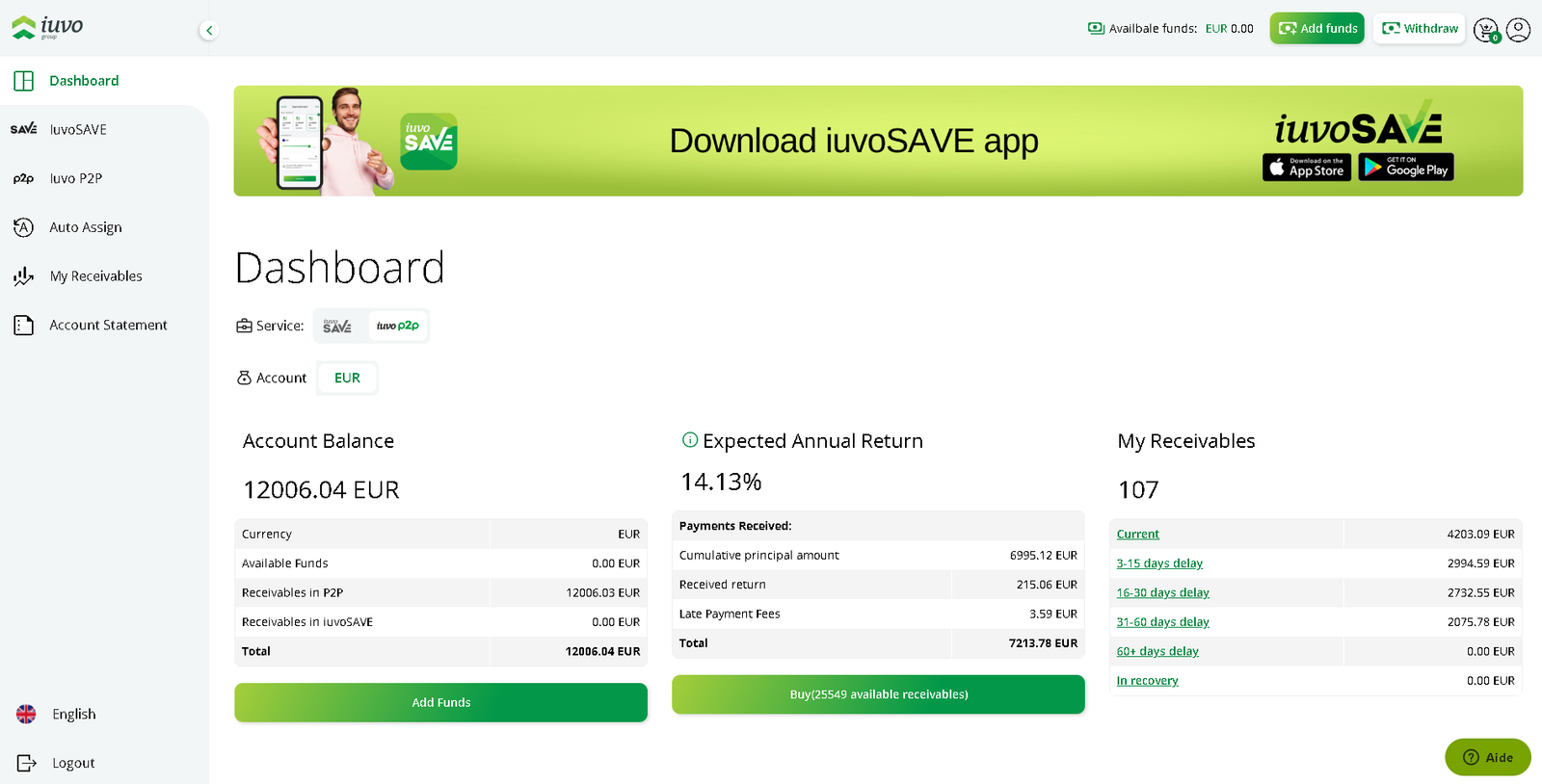
When I started, IUVO’s interface really looked outdated and was not very intuitive. Today, the platform has completely redesigned its dashboard: the side menus are clearer and you can easily navigate between the general overview, the primary market, the secondary market, Auto Assign, iuvoSAVE and your investments.
The interface remains in English (also with Spanish, German, Bulgarian and Estonian). There is no French version, but you can translate the page with your browser; it works very well day to day.
Primary market and types of loans
The core of IUVO’s offer is the primary market: here, you buy shares of claims that have just been listed.
Loan typology
Personal / consumer loans: this is by far the majority of the volume
Business loans: a smaller share
Car loans secured by the vehicle (notably at Ibancar)
First-rank mortgage loans in certain markets
Reading a loan line
Each loan line displays: country, identifier, listing date, loan originator, Score Class, buyback guarantee, annual rate, term, interest frequency, available amount, status (current, late, etc.).
Pay attention to IUVO’s vocabulary: a “period” can last 7, 14, 15 or 30 days. “6 periods” of 30 days correspond to around 6 months. The number in brackets sometimes tells you the remaining time if you buy a loan that has already started (example: a 6-month loan launched 2 months ago, with around 4 months remaining).
To buy, you choose a loan, enter the amount (minimum €10), add it to the basket (as on an e-commerce site), then confirm. Once you get the hang of it, it is very simple.
Advanced filters
IUVO offers ultra-complete filters: loan type, minimum or maximum rate, frequency, status, Score Class, country, buyback, currency, exclusion of loans already held, presence of collateral, remaining maturity… You can even save your favourite filters. A real asset if you are an active investor.
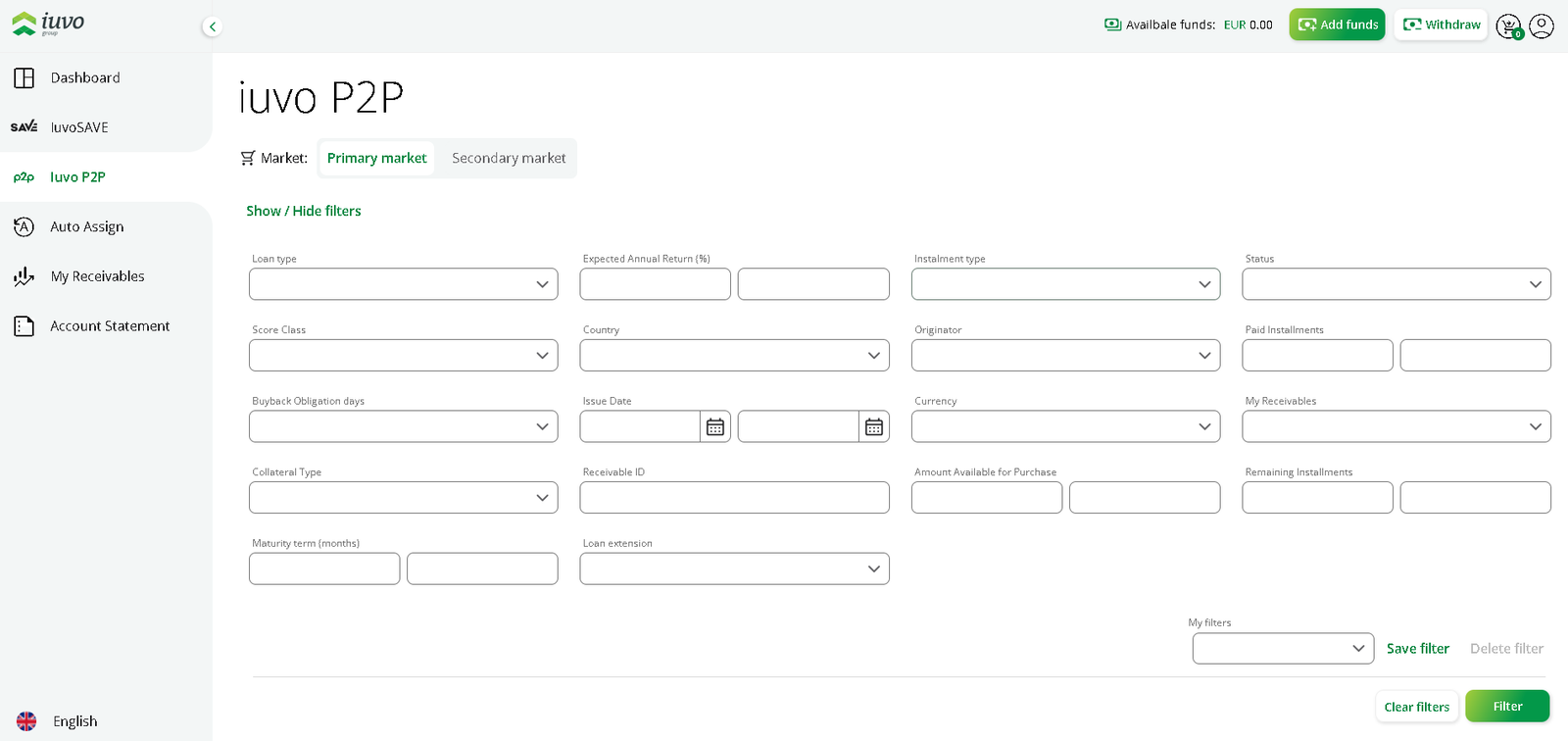
My advice: favour “current” loans rather than “late” ones, unless you have a very specific strategy.
Score Class: how to read the risk level
On IUVO, each loan receives a Score Class that reflects the estimated probability of delay:
Class | Probability of delay (indicative) |
|---|---|
A | 0 to 4% |
B | 4 to 10% |
C | 10 to 18% |
D | 18 to 25% |
E | 25 to 35% |
HR | More than 35% |
The closer the class is to A, the lower the risk of delay. Personally, I mainly favour classes D, E and HR at MFG originators, because the interest rates are higher (often between 12 and 16%) and you benefit from both the buyback and the group guarantee. This choice matches my own strategy and risk appetite; it is not investment advice.
Guarantees: buyback, group and skin in the game
60-day buyback
All loans offered on IUVO are covered by a buyback guarantee provided by the originator: if the borrower does not repay, the originator buys back your share at its nominal value after a certain period (generally 61 calendar days, sometimes a little less depending on the originator). This is a contractual commitment, not regulated insurance.
MFG group guarantee
For MFG group subsidiaries (EasyCredit, VivaCredit…), a group guarantee can take over if the originator is unable to honour the buyback. It is the same principle as on PeerBerry with Aventus for certain loans. Here too, everything depends on MFG’s financial strength, hence the importance of monitoring their financial statements.
Skin in the game
Lending companies keep a share of the principal in each loan, up to 30% depending on the case. This is a high level for the sector (the average elsewhere is often around 5 to 10%). The originator therefore has every reason to select borrowers carefully.
The 12 loan originators (June 2026)
Here is the list of active partners that you can find on the Originators page:
Originator | Country | Expected return | Portfolio (latest report) | MFG link |
|---|---|---|---|---|
EasyCredit | Bulgaria | 5 to 15% | ~€54M | Yes |
VivaCredit | Bulgaria | 4 to 15% | ~€7.7M | Yes |
Fast Finance | Romania | 10.5 to 12% | ~€2.16M | No |
Ibancar | Spain | 8.5 to 12.5% | ~€7.3M | No |
NordCard | Latvia | 8 to 12.5% | ~€4.94M | No |
Biala Karta (Access Finance) | Poland | 8 to 8.5% | ~€43M | Yes |
Ocean Credit | Romania | 8 to 11.5% | ~€19.3M | No |
Mint Credit | North Macedonia | 8.5 to 11% | ~€17M | No |
AXI Card Spain | Spain | 8 to 8.5% | ~€5.35M | Yes |
Mi Prestamo | Spain | 9 to 9.5% | ~€2.38M | No |
Kredis | Croatia | 9 to 9.5% | ~€7.5M | Yes |
Swiss Funds | Czech Republic | ~10% | ~€3.27M | No |
Of the 12 active partners, five are linked to the MFG group: EasyCredit, VivaCredit, Biala Karta (Access Finance), AXI Card (Access Finance portfolio) and Kredis (50% joint venture with MFG, group guarantee). IUVO also mentions iCredit in the MFG ecosystem, but this subsidiary no longer appears in the active originators list.
In general, loan terms range from 1 to 12 months for 80% of projects. The entry ticket is €10. Interest is paid every 7, 14, 15 or 30 days depending on the chosen contract.
Geographical diversification
IUVO lets you invest in eight main countries: Bulgaria (the main market), Romania, Poland, Spain, Latvia, North Macedonia, Czech Republic and Croatia. My portfolio remains heavily focused on Bulgaria, with rates ranging between 12 and 16%.
Originally, some loans were offered in BGN (Bulgarian lev). With Bulgaria’s switch to the euro (beginning of 2026), the exchange-rate risk has fallen significantly. Still keep an eye on the currency if you buy older BGN loans that are still active.
Auto Assign (auto-invest)
The Auto Assign function lets you reinvest automatically according to your own criteria (originator, country, Score Class, rate, term, buyback, etc.). It is the same principle as auto-invest on Mintos or PeerBerry.
Here are the advantages I see in it:
No cash drag: there are always loans available on IUVO, whereas on Swaper or PeerBerry, supply can sometimes become scarcer depending on the period
Much more passive investing
You can save the same filters as on the primary market
Be careful, there is an important limitation: Auto Assign only works on the primary market. You cannot buy claims on the secondary market with this function.
Personally, I combine auto-invest with a few manual purchases when I want to target a specific rate or originator.
iuvoSAVE: the “savings” product
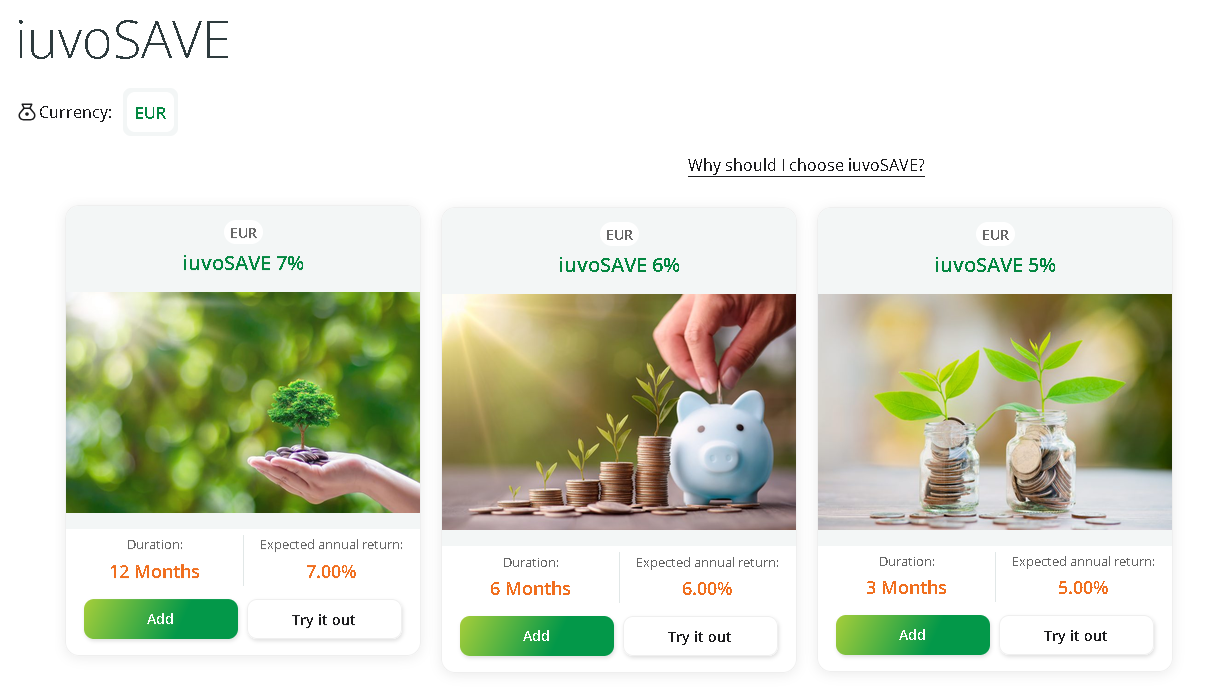
iuvoSAVE is a slightly separate product, in the same vein as Bondora Go & Grow, Mintos Smart Cash or Modena: you place your money in a fixed-term contract (6, 12 or 18 months) with a displayed rate (generally between 7 and 8.5% depending on the offers available at the time).
Deposit and withdrawal limited to €10,000/month
Early exit possible with a 1% fee
Rate slightly lower than classic P2P, but liquidity is simpler
Personally, I do not use iuvoSAVE: for this kind of investment, I currently prefer Monefit SmartSaver or Modena, for the rates and product transparency. A special “P2P savings” comparison is coming soon on the channel. iuvoSAVE is still interesting if you want to manage everything on IUVO.
Secondary market and liquidity
Few platforms offer you a primary market, secondary market, auto-invest and savings product all at once. IUVO is one of these rare exceptions.
On the secondary market, you can resell your claims to other investors. Selling fees are 1% of the transferred amount. You can also apply a discount to speed up the transaction (I have already seen discounts of 4% or more on attractive opportunities).
I tested resale a few months ago: fast execution, without a hitch. It is a real liquidity valve if needed, even if you lose a little because of the discount and fees. PeerBerry does not offer an equivalent secondary market; Mintos or Maclear do, but with different ways of working.
Past crises and blocked outstanding amounts
IUVO went through the Covid period (2020) without any visible impact on my portfolio: activity slowed for a few months, then everything restarted. However, the war in Ukraine (2022) really shook the platform because of the Russian originator Kviku.
Kviku / Russia: more than €55M blocked
Kviku managed more than 55 million euros on IUVO. With European and Russian sanctions, transfers became very limited (rouble caps, so-called “C” accounts, Russian Central Bank supervision). Monthly payments were suspended while a sustainable solution was found. IUVO refused the option of a type C account (funds blocked in Russia, risk of nationalisation).
In 2025, several updates mention Kviku bonds reaching maturity and ongoing legal proceedings. In mid-2026, part of the funds remains blocked: it is not a total loss for all investors, but recovery remains very uncertain over the long term.
You can follow developments on the official blog: Kviku weekly news.
Other suspended originators
IUVO confirmed to me by email that no active originator is currently in open default on new listings. But several former partners were suspended after unpaid amounts: Monify, BBG, CBC, Kviku. Recovery steps are detailed on the blog (Monify, BBG, CBC).
My criticism: this reality does not really appear on the statistics page. You have to dig through the blog to get the information. I reported this point to support: it needs improving.
Risks to know
Risk of capital loss: even if you benefit from a buyback or a group guarantee, nothing is certain if the originator and the holding company go bankrupt (example: Kviku).
Liquidity risk: when you invest, your money is locked up for the entire loan term. The secondary market can help you resell, but there are fees and often a discount.
Geopolitical risk: be careful with exposure to certain countries such as Russia or Ukraine, sanctions and exchange-rate fluctuations.
Regulatory risk: the absence of ECSP or MiFID licences, and possible regulatory changes in Estonia, can change the situation.
Concentration risk: a large share of loans may be linked to MFG, Bulgaria or EasyCredit. This increases the risk if one of these players has difficulties.
Currency risk: there remains a risk on old BGN claims or in other local currencies.
Operational risk: the platform has no employees of its own and depends entirely on the group. If the group has a problem, everything can stop.
Taxation in France
The interest you receive on IUVO is considered income from movable capital. There is no withholding tax in Estonia on these gains (unlike some Bulgarian or Latvian platforms).
You have a choice for taxation:
PFU (flat tax): 31.4% since 2026 (12.8% income tax + 18.6% social contributions)
Progressive scale + social contributions, if you choose the global option
Foreign account: yes, IUVO is indeed an account outside France. You must declare it every year with form 3916 (or 3916-bis depending on your situation). The first time, it takes a little while, but after that it is saved in your tax return.
Monthly declaration (2778-SD): if your reference tax income exceeds certain thresholds, you may be required to declare your P2P income every month. In practice, it depends on the tax offices: some agents ask for it, others do not. My advice: ask your individual tax office in writing. Personally, I make the monthly declaration because my tax office asked me to. Once you get the hang of it, it takes no more than 30 minutes per month.
My experience after 1 year (~€9,000)
A quick personal review in mid-2026:
I have invested around €9,000, with effective rates most often between 10 and 15%
Most of my investments are in Bulgaria, mainly via the EasyCredit originator
I favour D/E/HR classes, always with buyback and group guarantee
No payment incident on my MFG positions so far
I use Auto Assign and also make a few manual purchases from time to time
I tested the secondary market: positive experience even with a small discount on resale
The interface has been completely redesigned; it is much more pleasant than a year ago
I have no exposure to Kviku over the recent period (the originator was suspended before I started investing seriously), but I keep in mind the possible group risk and the fact that there is no real regulation for investors. You must always keep the risks in mind, regardless of the platform.
Advantages and disadvantages
Main advantages
Attractive rates (from 9 to 15%), varied terms (from 3 months to 5 years), real geographical diversification
Solid MFG group, buyback within 60 days, group guarantee, skin in the game up to 30%
No cash drag: lots of loans available
Four ways to invest: primary market, secondary market, Auto Assign, iuvoSAVE
Interesting financial statements accessible on my tool
Reasonable withdrawal fees (2 free per month)
Track record: IUVO shows ten years of activity and has gone through Covid and the Kviku crisis (partly)
Main disadvantages
Lack of transparency on amounts under recovery or in default in the statistics
No investor regulation under ECSP or MiFID II
Concentration on MFG / Bulgaria: limited diversification between groups
Interface only in English
Kviku history: geopolitical risk really exists
No quarterly financial statements from originators
Promotions and referral programme
IUVO regularly offers promotions on its official blog: for example, boosted rates on EasyCredit and VivaCredit (+1% or up to 16% announced on some campaigns planned for 2026), or iuvoSAVE offers at 8 or 8.5% over 12 to 18 months. These promotions change often, so remember to take a look at the banner on your dashboard after logging in.
The platform also runs a “Refer a friend” programme (conditions may vary). If you want to support Liberté Financière, use my affiliate code 9aef7ac1 via the link below.
Bonus and sign-up (referral code)
To open your IUVO account with my affiliate link:
👉 Referral code: 9aef7ac1
👉 Link: https://liberte-financiere.net/t.php?l=111
IUVO regularly launches cashback offers for new investors (generally 0.75% of the invested amount, capped at €150, provided you invest at least €100 over 60 days). Remember to check the current promotion on the sign-up page.
You can also find all P2P bonus codes on the Bonus page.
Frequently asked questions about IUVO
Is IUVO reliable?
IUVO has existed since 2016 and belongs to MFG, a solid and profitable group. My one-year experience with MFG loans is positive. However, there is no European regulation for investors and the Kviku case shows that geopolitical risk can block significant sums. “Reliable” does not mean “risk-free”.
Is IUVO regulated?
Not in the ECSP or MiFID II sense. The credit intermediary licence in Estonia was withdrawn in 2022. Lending companies are locally regulated for borrower credit.
What return can you expect on IUVO?
The displayed average is around 9 to 10%. If you target D/E/HR classes and MFG lending companies, you can expect between 12 and 15% gross.
What is the minimum investment?
€10 per loan. Deposits only by bank transfer in euros.
Is the 60-day buyback guaranteed?
It is a contractual obligation of the originator, but not a bank or regulatory guarantee. If the originator or MFG goes bankrupt, the buyback may not be honoured.
What happens to funds blocked at Kviku?
More than €55M remains in complex recovery due to Russia/EU sanctions. IUVO publishes updates on its blog. To date, the final outcome (partial recovery or loss) has not yet been publicly decided.
How do you declare IUVO for tax purposes in France?
Declare the interest as income from movable capital (PFU or progressive scale), account 3916, and possibly monthly 2778-SD depending on your RFR (Reference Tax Income).
Is Auto Assign worth it?
Yes, if you want to limit uninvested cash and automate. Set strict filters (originator, country, “current” status, buyback). It only works on the primary market.
iuvoSAVE or active P2P?
iuvoSAVE: lower rates, more simplicity. Active P2P: higher rates, more work and more credit risk. I prefer active P2P on IUVO; for liquid savings, compare with Modena or Monefit.
How long does it take to withdraw your money?
With bank processing times, allow 1 to 2 business days after the withdrawal is approved. If you are in a hurry, you can sell on the secondary market (watch out for fees and the discount).
Is the site in French?
No, the interface is in English. Automatic browser translation is enough for everyday use.
Where can you view the IUVO and MFG financial statements?
You can view them on the public page P2P Financial Statements and in the logged-in member area. There you will find IUVO Group OU, MFG, EasyCredit, VivaCredit and the other originators with my score out of 10.
Why is the head office in Estonia?
Estonia has long attracted European fintechs (e-residency, digital framework). MFG structured the marketplace through an Estonian subsidiary while keeping operations in Sofia. The withdrawal of the credit licence in 2022 confirms the shift to a pure marketplace model.
Conclusion
IUVO remains a crowdlending platform that is still little known in France, but it already has ten years of experience, relies on a solid financial group and offers quite a few advanced features. The rates (from 9 to 15%), the absence of cash drag, the buyback and the MFG guarantee explain why I now place around €9,000 there.
The two major weak points remain the lack of regulation for investors and the lack of transparency on outstanding amounts under recovery (Kviku and others). Always take the time to cross-check regulation, contract type, financial statements and diversification before investing. My P2P comparison tool and my article on regulation help you see things more clearly.
If you want to test the platform: IUVO sign-up with code 9aef7ac1.
And as always, never give up!
Last updated: June 2026.