
Since January 2026, I have invested around 10 000 € on Monefit through its flagship product SmartSaver, an Estonian P2P savings solution backed by the Creditstar group. Many French investors confuse it with a bank savings account or a money market fund. It is neither: you indirectly lend your money to the group through subordinated receivables, with an advertised return of around 7.5% on the main account (with liquidity) and up to 10.52% on locked Vaults. In this complete 2026 guide, I detail how it works, Creditstar’s financial statements, liquidity, taxation, risks, my experience with figures and alternatives such as Bondora Go & Grow, Modena or Twino Flexi.
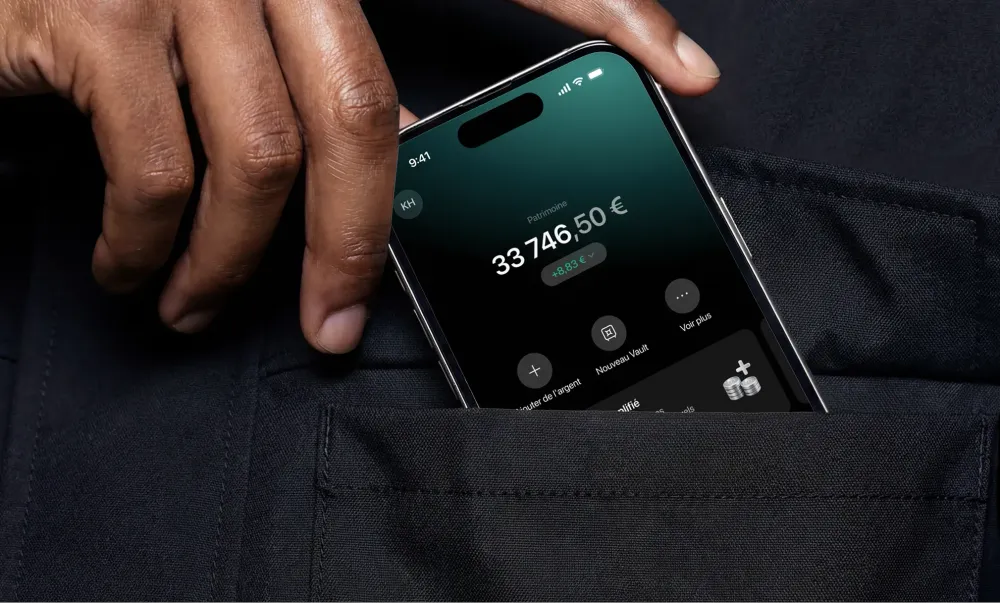
Monefit at a glance
Criterion | Monefit SmartSaver |
|---|---|
Platform launch | 2022 (Creditstar group active since 2006) |
Registered office | 🇪🇪 Tallinn (Estonia) |
Model | P2P savings: subordinated receivables on the Creditstar group |
Investors | More than 35 000 |
Invested volume (cumulative) | More than 300 M€ |
Main product | SmartSaver: 7.5% APY, partial liquidity |
Locked product | Vaults: 9.42% to 10.52% depending on term (12 to 24 months) |
SmartSaver withdrawals | 1 000 €/month instant; above that, up to 10 business days |
Minimum ticket | 1 € (deposit and investment) |
Investor regulation | No ECSP / MiFID II licence (Estonia, assignment of receivables) |
Withholding tax | No (Estonia) |
Mobile app | Android (Sept. 2026); iOS announced |
Trustpilot rating | Around 4.6 to 4.7 / 5 (see the full rating) |
Bonus | 0.25 % cashback during the first 90 days |
To put it in context: Monefit is similar to the “simplified savings” products in European P2P, alongside Bondora Go & Grow, Modena, or Twino Flexi. You can compare returns, liquidity and regulation in my P2P comparator.
My video: Monefit review after 10 000 €
If you prefer video format, here is my detailed feedback on SmartSaver: registration, returns, liquidity, comparison with other liquid P2P savings platforms and the first figures from my portfolio.
What is Monefit SmartSaver?
Monefit is not a bank. SmartSaver is not a regulated savings account in the French sense (Livret A, LDDS, etc.). It is an investment product offered by an Estonian company in the Creditstar group, designed to provide an experience close to savings: a single account, an advertised rate, daily compounded interest, and an exit route without a complex secondary market.
In practice, when you deposit euros into SmartSaver, your money finances subordinated receivables linked to the lending activity of the Creditstar group (mainly consumer loans in Northern and Eastern Europe). You are not buying shares in individual loans as on PeerBerry or Lendermarket. You are exposed to the overall risk of the structure issuing these receivables.
The rate advertised on the main SmartSaver account is 7.5% APY (annual percentage yield, compounded interest). The Vaults offer higher rates if you agree to lock your capital for 12, 18 or 24 months. It is the same principle as fixed terms on Modena or Vaults at other players, with returns between liquid savings and active P2P.
An important point regularly raised in my community: SmartSaver can be suitable for an emergency fund if you accept P2P risk, but it is not a guaranteed cash equivalent. Liquidity is conditional (monthly cap, delays above it). Do not place your entire safety cushion there without reading the risks section below.
Creditstar and the group’s history
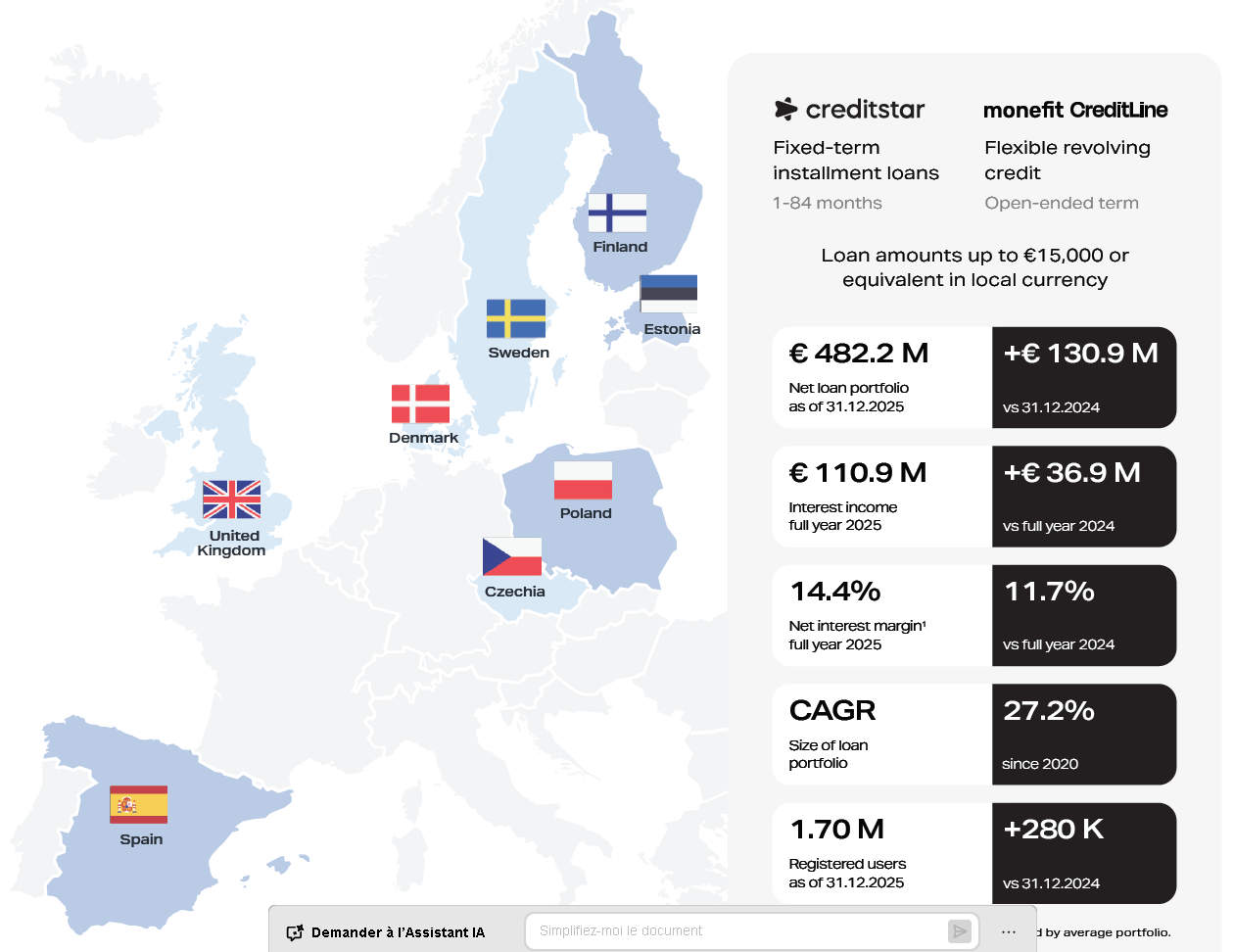
Understanding Monefit first means understanding Creditstar. The group has been active since 2006 in online consumer lending. It operates through several brands and subsidiaries in Sweden, Estonia, Finland, Poland, the Czech Republic, Denmark and beyond. Its historical activity: granting microloans and consumer loans, refinancing through bond markets and, since 2022, raising funds from retail investors through Monefit.
Creditstar is not a start-up that came out of nowhere. Before Monefit, the group was already funding itself by issuing debt on traditional P2P markets: Mintos, Lendermarket, and other marketplaces. This history cuts both ways: it proves the group’s longevity, but it also recalls episodes of payment delays (no losses) on certain issues in 2022 and 2023 (see risks section).
Monefit was launched in 2022 as a simple showcase for retail investors: simple interface, one advertised rate, less complexity than the Mintos primary market. Success came quickly: more than 35 000 investors and more than 300 million euros invested cumulatively according to official communications (mid-2026).
The group remains focused on consumer credit. It is not real estate crowdlending or venture. The quality of the underlying loan portfolio, the default rate and the financial leverage of the holding company are therefore the real drivers of your return, not the marketing hype around the advertised percentage.
Management team and Aaro Sosaar (CEO)

On the governance side, Aaro Sosaar is the public face of Monefit as CEO. He regularly appears in interviews (including my long video interview below), on social media and during investor webinars. His LinkedIn profile is available here: linkedin.com/in/aaro-sosaar.
A positive point for me: management that accepts debate (long interview, answers on liquidity, leverage and regulation). A point to watch: dependence on the Creditstar group as a whole. If the holding company goes through a liquidity or refinancing crisis, Monefit and SmartSaver are not ring-fenced behind a bank guarantee.
Creditstar employs several hundred people in Europe. The structure is heavier than an “empty shell” P2P marketplace, which can be reassuring operationally, but also increases margin and refinancing needs.
Regulation and legal framework

Like many historical Estonian platforms, Monefit operates through an assignment of receivables / investment in private debt instruments model. To my knowledge, it does not hold an ECSP (European crowdfunding) or MiFID II licence for the benefit of the investor.
Creditstar and its loan-issuing subsidiaries are regulated locally for their lending activity to borrowers (authorisations country by country). This regulation protects the borrower (caps, information, recourse), not your investor portfolio in the harmonised European sense.
In my P2P comparator (regulation view), Monefit is in the lower part: no investor licence, like PeerBerry, Bondora (Go & Grow) or Modena. It is not illegal: the registered office is in Estonia and the model is validated in that jurisdiction. However, you do not have the procedural protections of a PSFP (key investment information sheet, reflection period) or MiFID compensation up to 20 000 € in the event of platform failure.
I often repeat it: a regulated platform can still generate losses (Mintos, EstateGuru). Conversely, platforms without a licence can show many years without investor incidents. Regulation is an important criterion, not a guarantee of return. Cross-check it with financial statements, the nature of the contract and diversification. My article on P2P crowdlending regulation details MiFID II, ECSP/PSFP and assignments of receivables.
Creditstar financial statements

With Monefit, I do not stop at the advertised 7.5% rate. I read the Creditstar consolidated accounts, because this is the group carrying the risk behind SmartSaver. I analyse these documents on the public page P2P financial statements (filters Monefit platform and Creditstar company) and in the member area with a rating out of 10 based on five indicators: margin, ROE, debt, equity, cash on debt.

Here are the orders of magnitude from the Creditstar 2025 financial statements (closed financial year, consolidated figures):
Revenue: more than 100 M€
Net profit: around 13.5 M€ (profitable group)
Net margin: around 14.4%
Total assets: around 545 M€
Cash: around 46 M€
P2P debt / investor markets: increase from ~145 M€ to ~285 M€ over the year
Leverage (net debt / EBITDA): around 4.9x, close to the 5x bank covenant
Loan portfolio quality: around 87% of loans “OK”, defaults around 3.9%
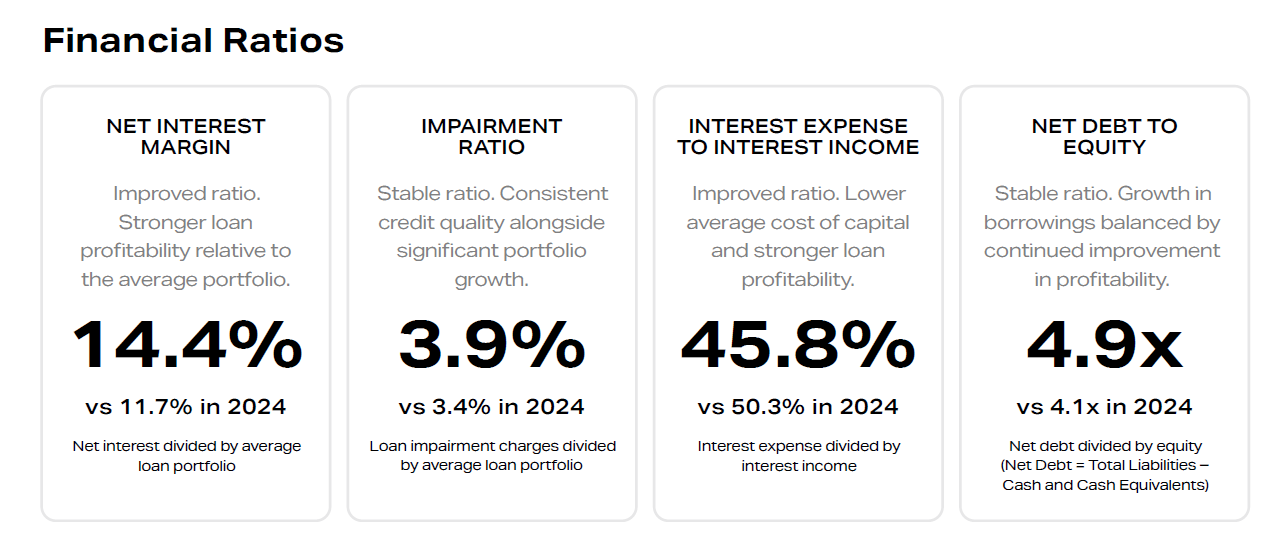
Investor reading: Creditstar remains profitable and generates cash, which is reassuring for funding SmartSaver interest. However, the high leverage (~4.9x) and the sharp rise in P2P debt show growing dependence on market refinancing (including Monefit, Mintos, Lendermarket, bonds). If markets close or defaults rise, room for manoeuvre shrinks.
In my dedicated video, I dig into the question “Is Creditstar safe?” with these figures and the context of past delays on other marketplaces.
Creditstar also publishes quarterly financial statements. This is an additional positive point that you should combine with annual reports, investor presentations and my P2P financial statements page to track developments.
Products: SmartSaver vs Vaults (rates and terms)
Monefit structures its offer into two families: the liquid account (SmartSaver) and fixed-term Vaults. Here is the table of rates advertised on 16 September 2026 (subject to change, check on the dashboard after logging in):
Product | Term | Advertised APY | Liquidity |
|---|---|---|---|
SmartSaver (main account) | No fixed term | 7.5% | 1 000 €/month instant; above that up to 10 business days |
12-month Vault | 12 months | 9.42% | Locked until maturity (except special conditions) |
18-month Vault | 18 months | 9.96% | Locked until maturity |
24-month Vault | 24 months | 10.52% | Locked until maturity |
Customisable Vault | Term and amount on request | (often > 10%) | Locked according to chosen term |
Interest is compounded daily on SmartSaver and Vaults. You can transfer funds from the main account to a Vault to boost the rate, and return to SmartSaver when the Vault matures.
A frequent question in my Telegram community: “Vault at 10.52% or Lendermarket at 14%?” They are not comparable on the same basis. Lendermarket exposes you to individual loans (risk specific to each borrower, term, variable buyback). A Monefit Vault is a group-level receivable, locked, with Creditstar refinancing risk. The 14% may compensate for the risk, but with more volatility and work (selection, auto-invest, monitoring delays). SmartSaver / Vaults aim for simplicity.
For liquid savings at a fixed rate without a long lock-up, I often compare SmartSaver 7.5% with Modena (~7 to 8% depending on promotional campaigns), Bondora Go & Grow (6% on the liquid segment in 2026), Twino Flexi or Spiko.
💧 Liquidity and withdrawals
This is the most misunderstood point about Monefit. SmartSaver is not a bank current account with unlimited instant withdrawals.
Advertised rules (September 2026):
Up to 1 000 € per month: withdrawal processed as instant (subject to the usual SWIFT/SEPA banking delays, often 1 to 2 business days in my experience)
Above 1 000 €/month: delay of up to 10 business days, giving the platform time to release liquidity on the asset side
Vaults: capital locked until the chosen maturity (12, 18 or 24 months). Liquidity is not guaranteed before the end date, except for an exceptional clause not contractually promised
In practice, if you place 20 000 € on SmartSaver and want to withdraw everything at once, you need to plan ahead: 1 000 € “fast” in the first month, then tranches with longer delays. For an emergency fund, many members of my community cap Monefit at a few thousand euros and keep the rest on more liquid vehicles (current account, regulated money market fund, etc.).
Quick comparison: Bondora Go & Grow allows a withdrawal without such a simple monthly cap, but with a lower rate and a possible queue in periods of stress (2020 history). Robocash offers “Robocash liquidity” with different rules. Modena advertises withdrawals within 24 to 48 h under normal conditions. None of these solutions is equivalent to a bank savings account.
My personal test: withdrawal below 1 000 € executed without notable friction. I have not yet tested a massive withdrawal above the monthly cap on my personal account. If you expect a large cash need, plan several months in advance or keep a reserve elsewhere.
Advanced features: auto-invest and passive income
Monefit goes beyond simple deposit/withdrawal. Several useful options for regular investors:

Auto-invest
You can activate auto-invest so that incoming deposits (or available cash) are automatically allocated according to your preferences (SmartSaver vs Vaults, allocation). This is practical if you make a recurring transfer every month and do not want to log in to invest manually.
Passive income (interest transfer)
“Passive income” option: instead of compounding all interest, you can request a monthly transfer of interest to your bank account. Useful if you want to supplement income or test the cash flow without withdrawing capital.
Calculator and PDF tax report
The dashboard includes a projection calculator (capital, term, rate) to simulate growth with or without Vaults. You also have an annual PDF tax report summarising the interest received: practical for tax filing in France (form 3916, investment income box). It is not a French tax certificate, but it is a better basic document than some platforms that only send a raw CSV.
Monefit mobile app
In September 2026, Monefit launched its Android app (Google Play). The iOS version has been announced for the following months. The app includes the essential functions: SmartSaver and Vaults balance, transaction history, deposit/withdrawal, auto-invest activation, access to the tax report.
In my test video, I show the mobile interface and my two accounts (personal and company) for a total exposure of around 10 000 €.
The app is still young with a few bugs. You should probably expect regular updates, but it is already fully functional.
🪪 Opening an account and KYC
You can open your Monefit account via this affiliate link (0.25% bonus for 90 days). Standard eligibility conditions:
Be 18 years old or over
Reside in an eligible country (European Union, including France)
EUR bank account for transfers
KYC: ID document, selfie, sometimes proof of address
Declaration of source of funds if you exceed AML thresholds (often 15 000 € in cumulative deposits, common European rule)
Registration: online form, email validation, then KYC process via a third-party provider (Onfido type or equivalent). My personal account was approved in less than 24 h in January 2026. Delays can reach 48-72 h during busy periods.
Deposit: SEPA bank transfer in EUR (free) or bank card / Apple Pay for a faster deposit. Card deposits are free for 7 days after your account is approved; after that, Monefit applies a 1% fee on card transactions (SEPA transfer and recurring card auto-invest remain free). IBAN details displayed in the investor area. Minimum 1 €.
Company account: investing through a company is possible (SASU, SARL, holding company). Enhanced KYC (Kbis, articles of association, beneficial owners). I detail my setup further down with the PeerBerry / company video (same multi-platform logic).
Support: chat in the investor area and email support@monefit.com. Good answers on liquidity and tax questions in my experience. Trustpilot around 4.6-4.7/5 with thousands of reviews (to be read critically, as always).
🖥️ Interface and usability
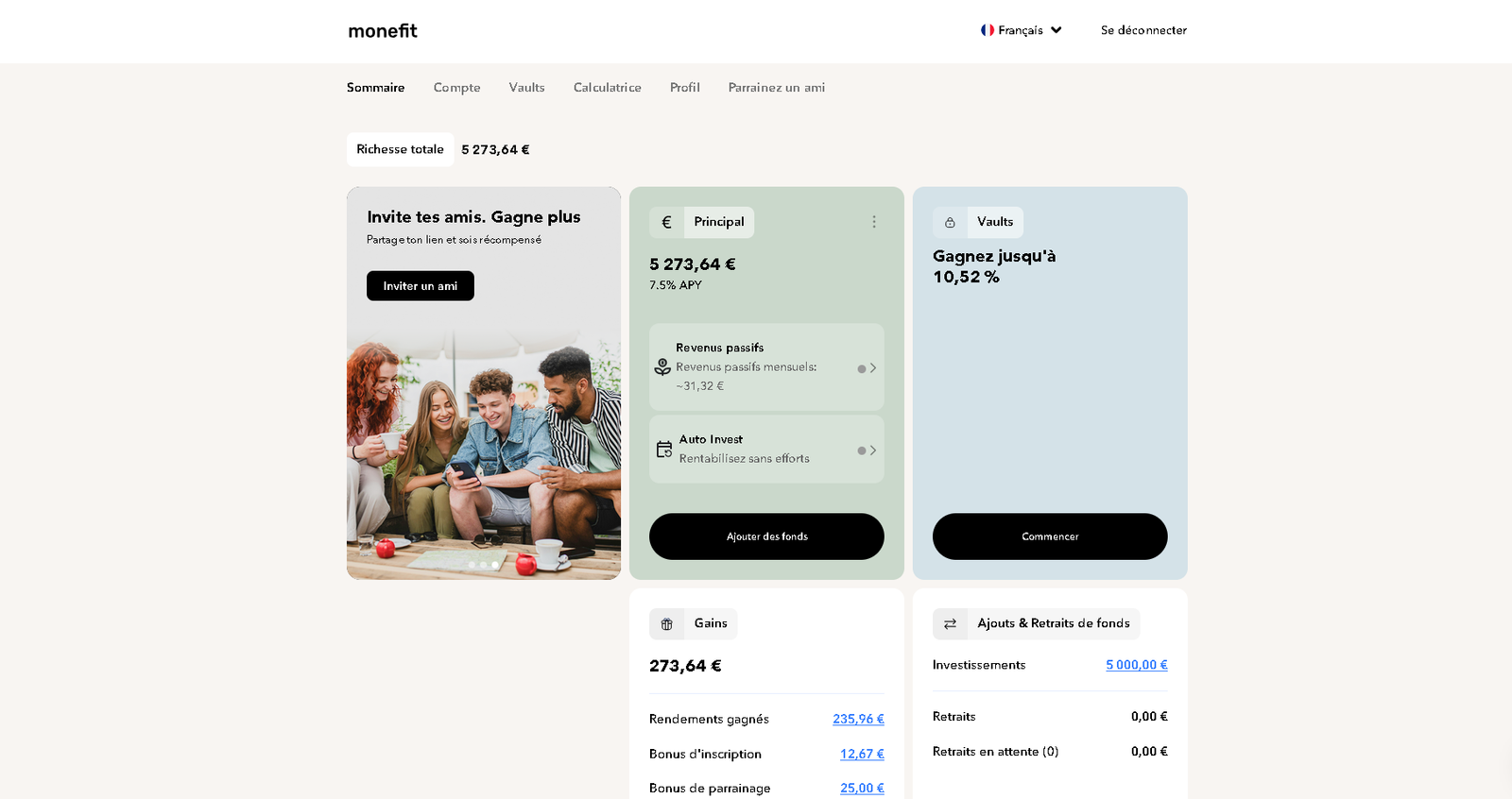
The Monefit interface is deliberately streamlined compared with Mintos or IUVO. On the home screen: total balance, SmartSaver / Vaults allocation, performance chart, deposit and withdrawal buttons, access to settings (auto-invest, passive income, documents).
Strengths:
Clear visibility of the APY rate and accumulated interest
Switching between SmartSaver ↔ Vaults in a few clicks
Detailed transaction history (deposits, interest, referral bonuses, withdrawals)
Downloadable PDF tax report
Weaknesses:
Limited transparency on the exact composition of the underlying assets (normal for a subordinated receivable, but frustrating for analysts)
Mobile app still limited to Android in September 2026
If you come from active P2P (Lendermarket, PeerBerry), the absence of a primary market can be confusing at first. Here, you accept the “savings” packaging in exchange for simplicity.
Investing through a company
You can open a Monefit account in the name of a company (SASU, SARL, family holding company). Benefits: separating personal and business assets, optimising corporate taxation depending on your structure (to be validated with an accountant), centralising business cash while awaiting reinvestment.
For me: a personal account (~5 000 € on SmartSaver) and a company account (~5 000 €), i.e. ~10 000 € of total Monefit exposure. Company KYC requires more documents, but the process remains manageable within a week.
I published a video on P2P investing through a company, with examples on Monefit and PeerBerry:
Comparison of liquid P2P savings platforms
SmartSaver belongs to the category of all-in-one P2P products with an advertised rate. Here is how I rank them at the end of 2026:
Criterion |
|
|
|
|
|---|---|---|---|---|
Indicative liquid rate | 7.5% | ~6% | ~7 to 8% | ~8% (variable) |
Max locked rate | 10.52% (24m Vault) | Up to ~7% (fixed segment) | Up to ~9% (long terms) | Term products depending on promos |
Liquidity | 1 000 €/month instant, then delays | Daily withdrawal, possible queue | 24-48 h under normal conditions | Variable depending on product |
Investor regulation | No (ECSP/MiFID) | No | No | Yes (ECSP licence) |
Discover |



I also compared Monefit with Lonvest (Latvia) in a dedicated video on liquid P2P savings with Bondora and Modena:
My current allocation choice: Monefit for the SmartSaver rate and Vaults >10%, Modena for slightly more predictable liquidity, Bondora Go & Grow for the group’s size and long track record (but lower rate). Spiko and Robocash liquidity enter the discussion if you favour other risk profiles. Use the P2P comparator to filter according to your criteria.
Interview with CEO Aaro Sosaar
I interviewed Aaro Sosaar (Monefit CEO with a written Q&A) about the product vision, the relationship with Creditstar, SmartSaver liquidity, Vaults growth and the mobile strategy.
My position after this interview: Monefit embraces the “digital P2P savings” positioning and wants to compete with neobanks on rate, not on deposit guarantee. The investor’s responsibility remains to read Creditstar’s financial statements and not over-allocate.
⚠️ The risks to know (no taboo)
No investment at 7.5% or 10% is risk-free. Here is what I monitor on Monefit / Creditstar:
Risk of capital loss: you hold subordinated receivables. In the event of Creditstar default or restructuring, the risk is there.
Liquidity risk: 1 000 €/month “instant” cap and the rest with a delay of up to 10 business days. Under market stress, these delays could lengthen (2020 sector precedents on Bondora).
Refinancing risk: Creditstar P2P debt has increased from around 145 M€ to 285 M€. The group depends on investor markets to roll over its debt. If Monefit, Mintos or Lendermarket close to new issues, pressure on cash.
High leverage: ~4.9x net debt/EBITDA, close to the 5x covenant. Reduced safety margin if defaults rise or bank rates remain high.
History of delays: in 2022-2023, some Creditstar issues on Mintos and Lendermarket experienced payment delays. The situations subsequently developed favourably without loss and that is a good thing. Cash has improved in recent years.
Regulatory risk: absence of ECSP/MiFID regulation. Possible future evolution of the Estonian or European framework. Lendermarket, very close to the Creditstar group, does have an ECSP licence.
Group concentration: SmartSaver = focus almost exclusively on Creditstar. No inter-originator diversification as on Mintos or Income Marketplace, etc...
I only invest in Monefit with a P2P diversification logic (an allocation I can lose without disrupting my budget) and as a placement for part of my emergency savings. I combine it with diversified active P2P (PeerBerry, Lendermarket, Nectaro, etc.) and less risky vehicles outside P2P.
Taxation in France

Interest received on Monefit is investment income. There is no Estonian withholding tax on this income (unlike some Bulgarian or Latvian platforms). See my dedicated article on P2P withholding tax.
Taxation options for an individual:
PFU (flat tax): 31.4% since 2026 (12.8% income tax + 18.6% social contributions)
Progressive tax scale + social contributions, with global option (if marginal tax rate is reliable)
Foreign account: yes, Monefit is an account outside France. Declare it every year with form 3916 (or 3916-bis depending on your situation). The first year takes a little time; after that it is memorised in your tax return so it becomes passive.
Monthly declaration (2778-SD): if your reference taxable income exceeds certain thresholds, you may be required to declare P2P income month by month. Practice varies depending on tax offices. My advice: ask your SIP in writing. Personally, I declare monthly because my office asked me to. If your reference taxable income is below the threshold, the declaration will be made in year N+1.
The Monefit PDF tax report summarises the gross interest received during the year. Referral bonuses (0.25% for 90 days via affiliate link) must also be declared as financial income according to the usual interpretation (to be confirmed with your adviser).
My experience in figures (XIRR, portfolio)
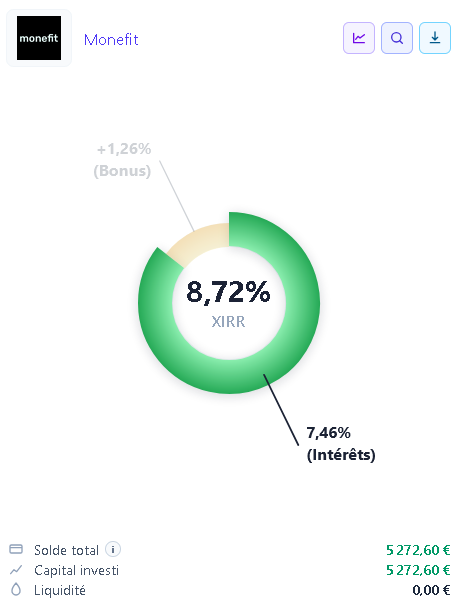
Example for my personal Monefit account (around 50% of my capital invested on the platform, the rest being on my company account — i.e. ~5 000 € + ~5 000 €, both in liquid SmartSaver). Balance sheet as of 16 September 2026 on this personal account:
Displayed capital: around 5 275 €
Net deposits: 5 000 € since January 2026
Accumulated interest + bonuses: around 273 €
XIRR: around 8.72% (referral bonus included); around 7.46% excluding referral bonus
Allocation: almost 100% liquid SmartSaver (no locked Vault on this personal account; my company account is also in liquid SmartSaver)
Reading: my XIRR is higher than the advertised 7.5% thanks to the 0.25% affiliate bonus for 90 days. Excluding the promotion, I am close to the catalogue rate (~7.46% measured), which confirms that Monefit has broadly kept its promise over the short period observed. This is only an 8-month track record: no point extrapolating over 10 years.
I have seen no payment incident, no refused withdrawal, no blocking bug on daily interest. I tested a withdrawal < 1 000 € without friction. My next personal step: test a 12-month Vault with a small amount to measure the net rate gap and the lock-up constraint.
⚖️ Pros and cons
✅ Pros
📈 Attractive SmartSaver rate (7.5% APY) and Vaults up to 10.52%
🎯 Extreme simplicity: no loan selection, no secondary market to manage
Profitable Creditstar group (2025 financial statements: ~13.5 M€ profit)
Financial statements that can be analysed on Liberté Financière
No withholding tax (Estonia): tax management only on the French side
Useful features: auto-invest, monthly passive income, calculator, PDF tax report
Minimum ticket 1 €, accessible for testing
Company account accepted
Android app (2026), iOS announced
Referral bonus 0.25% for 90 days via affiliate link
Trustpilot reviews generally positive (~4.6-4.7)
⚠️ Cons
No investor licence ECSP or MiFID II (Estonian assignment of receivables model)
Subordinated receivables: in the event of major difficulties for the group, repayment is not guaranteed as on a savings account
⏳ Conditional liquidity (1 000 €/month, delays beyond that up to 10 days. But much better than a loan locked for 1 year)
High Creditstar leverage (~4.9x) and sharply rising P2P debt
History of delays on Creditstar loans on Lendermarket (2022-2023). Cash better managed in 2025/2026.
Concentration on a single group (no inter-originator diversification)
Young platform (2022) despite a historical group since 2006
Bonus and registration
To open a Monefit account with my affiliate link:
👉 Bonus: +0.25% APY for 90 days on your SmartSaver balance (in addition to the catalogue rate)
The referral bonus is added to daily interest and appears in the transaction history. After 90 days, the rate returns to the standard level (7.5% on SmartSaver at the time of writing). Vaults have their own fixed rates depending on term.
You can also find all P2P bonus codes on the Bonus page, with links to Bondora, Modena, PeerBerry, Lendermarket and Twino.
Frequently asked questions about Monefit SmartSaver
Is Monefit reliable?
Monefit belongs to the Creditstar group, active since 2006 and profitable in 2025. My short experience (8 months) is positive on interest payments. However, there is no European investor regulation, the receivables are subordinated and the group’s leverage is high. “Reliable” in the sense of “solid group on paper” does not mean “risk-free” or “equivalent to a bank savings account”.
Is Monefit regulated?
Not in the ECSP or MiFID II sense for the retail investor. Creditstar is regulated locally for granting credit to borrowers in each country of activity. See P2P regulation.
What return can you expect on SmartSaver?
The advertised rate is 7.5% APY on the main account (Sept. 2026). My observed XIRR on the personal account rises to around 8.72% over the first months (referral bonus included). Vaults range from 9.42% (12 months) to 10.52% (24 months). All of this is gross, before French taxes and before risk of loss.
What is the minimum investment?
1 € to deposit and start receiving interest. Deposit by SEPA transfer (free) or by card / Apple Pay (free for 7 days after opening, then 1% fee).
Can I withdraw my money at any time?
On SmartSaver, yes within the limit of 1 000 € per month with “instant” processing, then delays of up to 10 business days for higher amounts. On Vaults, no: capital locked until maturity. It is not an unconstrained savings account.
Vault or SmartSaver: which should you choose?
SmartSaver if you want flexibility and accept 7.5%. Vault if you can lock funds for 12 to 24 months and target 9.42% to 10.52%.
What is the link between Monefit and Creditstar?
Monefit is the Creditstar group platform for raising funds through SmartSaver and Vaults. Creditstar consolidated financial statements are the main health indicator behind your investment. Check the Creditstar financial statements on Liberté Financière.
How do you declare Monefit to the tax authorities in France?
Interest as investment income (PFU or tax scale), form 3916 for the foreign account, possibly monthly 2778-SD depending on your RFR. No Estonian withholding tax. See withholding tax.
Can you invest through a company?
Yes, Monefit accepts company accounts (enhanced KYC). I have a company account with ~5 000 € alongside my personal account (~5 000 €), i.e. ~10 000 € in total.
Monefit or Bondora Go & Grow?
Monefit offers a higher SmartSaver rate (7.5% vs ~6%) and Vaults >10%. Bondora has a longer track record and a large group size, with different liquidity. Both are without an EU investor licence. Compare in the P2P comparator.
Monefit or Modena?
Similar liquid rates, Modena sometimes simpler on 24-48 h withdrawals, Monefit more aggressive on long Vaults. Both are liquid P2P savings platforms, without an investor ECSP licence. I allocate to both so I do not depend on a single group.
Does the mobile app exist?
Yes on Android since September 2026. iOS announced. The web version remains complete for all functions.
What is the main risk?
Creditstar default or restructuring, given the subordinated receivables and leverage of ~4.9x. In this extreme scenario, partial or total loss of invested capital is possible, despite the good 2025 financial statements.
SmartSaver for emergency savings?
A frequent debate in my Telegram community. My view: only on a limited fraction (a few thousand euros max) if you accept P2P risk and withdrawal constraints. The real safety cushion remains on guaranteed vehicles (regulated savings accounts, current account).
Where can you view Monefit and Creditstar financial statements?
On the P2P financial statements page: filter by Monefit platform or Creditstar company, with a rating out of 10 in the member area.
Conclusion
Monefit SmartSaver is one of the most interesting liquid P2P savings offers on the European market in 2026: 7.5% liquid, Vaults up to 10.52%, simple interface, Creditstar group profitable on paper. My observed XIRR (~8.72% with bonus, ~7.46% excluding promotion) matches the advertised rate over the first months, with around 10 000 € of total personal + company exposure.
Keep in mind: no ECSP/MiFID investor licence, subordinated receivables and still-high group leverage — with a history of occasional delays on other marketplaces, even if the situation has improved since. Cross-check regulation, financial statements (P2P financial statements page), real liquidity and diversification before investing. My P2P comparator and my regulation articles help you frame these choices versus Bondora Go & Grow, Modena or Twino Flexi.
If you want to test the platform: open a Monefit account.
And as always, never give up!
Last updated: September 2026.